How to Use ChatGPT to Reply to Text Messages (2025)
November 2025 update
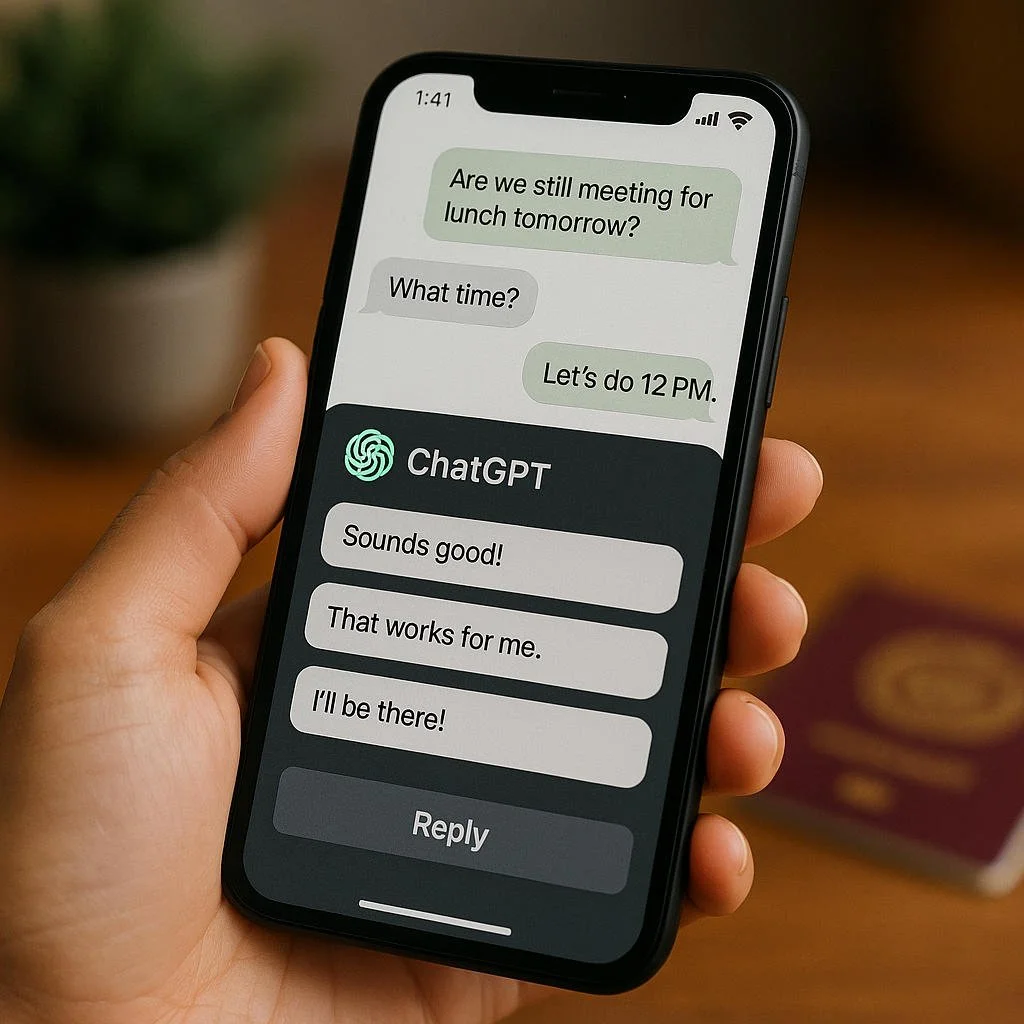
Don’t just paste a text and say “reply.” Give ChatGPT context + constraints so it returns a message that sounds like you, matches the situation, and protects your boundaries.
ChatGPT can help you:
Decode what the sender is really asking.
Choose a tone (warm, neutral, firm) and length (1-liner, short, detailed).
Draft a reply that mirrors their style but stays true to your voice.
Adapt for purpose: personal, dating, work, customer service, conflict.
Translate and sanitize (no oversharing, no promises you can’t keep).
Everything below is practical and ready to paste.
Step 1 — Lock in your voice and boundaries
Prompt: Voice & Boundary Card (once, then reuse)
“When helping me reply to texts, follow this Voice Card:
• Tone: [warm, concise, upbeat, dry wit, professional]
• Phrases I say: [‘hey hey’, ‘sounds good’, ‘appreciate it’]
• Things to avoid: [apologies when not needed, emojis at work, slang]
• Firm boundaries: [no last-minute commitments, no money lending, no meeting exes]
• Safety: never share personal data, address, or schedules unless I explicitly include them.
Acknowledge with 3 bullet rules you’ll follow every time.”
Step 2 — Feed the model enough context (but not your life story)
Before you ask for a reply, provide:
The incoming text (verbatim).
Relationship (friend, manager, customer, new date).
Goal (confirm, decline, reschedule, escalate, flirt lightly, apologize).
Constraints (length, tone, emoji yes/no, mention/avoid topics).
Options (ask for 3 variants).
Prompt: Reply Request Skeleton
“Incoming: ‘[paste]’
Relationship: [e.g., coworker (peer)]
Goal: [accept meeting but push to next week]
Constraints: 1–2 sentences, neutral-polite, no emojis
Return: 3 options that mirror their formality and include 1 follow-up question.”
Step 3 — Choose the right tone and length (fast)
Tone slider words
Ultra brief • Brief • Neutral-polite • Warm • Enthusiastic • Firm • Playful • Empathetic • Executive
Length slider1-liner (≤12 words) • Short (1–2 sentences) • Medium (3–5) • Detailed (6–8)
Prompt: Tone & Length Sliders
“Draft [number] replies at [tone] tone and [length] length. Keep my Voice Card. Include one emoji [allowed/not allowed].”
Step 4 — Mirror their style without losing yourself
If they write short, no punctuation, keep it short.
If they use complete sentences, do the same.
If they send voice notes, reply with a slightly longer text or offer a quick call.
If they overuse emojis, don’t feel obliged to match—mirror lightly.
Prompt: Style Mirror
“Mirror the sender’s style from this message: ‘[paste]’. Keep my voice and boundaries. Give 2 versions: one exact mirror, one 10% more formal.”
Step 5 — Logistics in one shot (stop the ping-pong)
Bundle the who/what/when/where in one concise block.
Prompt: Logistics Pack
“Reply to confirm [event/task] and include: date, time, timezone, location/URL, what I’ll bring, and one clear next step. Keep to 2–3 sentences, no emojis.”
Step 6 — Saying “no” without burning bridges
Use the Soft-No Formula: Thanks → Constraint → Alternative → Appreciation.
“Thanks for thinking of me.”
“I’m at capacity this week.”
“I can do next Wed after 3.”
“Appreciate your understanding.”
Prompt: Soft No
“Write 3 ‘soft no’ replies to this request ‘[paste]’. Format each as: Thanks → Constraint → Alternative → Appreciation. Max 2 sentences each.”
Step 7 — De-escalate conflict and correct misinformation
Use CALM: Clarify → Acknowledge → Limit (boundary) → Move forward.
Prompt: De-escalation
“Incoming: ‘[paste heated text]’. Goal: de-escalate, correct one fact, propose next step. Use CALM: Clarify the issue in one clause; Acknowledge their feeling; Limit with a boundary; Move forward with a specific option. Two options, no sarcasm.”
Step 8 — Apologies that actually land
Real apology bones: Name the impact → Own your part → Specific fix → Ask anything else?
Avoid “if” or “but.”
Prompt: Effective Apology
“Draft a 2-sentence apology for [what happened]. Sentence 1: name impact + own it. Sentence 2: concrete fix + offer to make it right. No ‘if’ or ‘but’.”
Step 9 — Dating & personal chats (flirty but respectful)
Green-flag flirty = playful, specific, consent-minded; avoid explicit content.
Use SEEN: Specific compliment → Engage their interest → Express availability → Name a next step.
Prompt: Light Flirt
“Reply with a SEEN message to ‘[paste]’: 1) specific, non-cringey compliment; 2) one engaging question; 3) light availability window; 4) suggest coffee/walk idea. Keep it breezy; max 2 sentences.”
Step 10 — Work & clients (professional polish in seconds)
Frameworks
Confirm/Clarify/Commit for tasks.
PACE for customer service: Problem, Acknowledge, Correct, Expectation-setting.
Prompt: Professional Confirm
“Incoming [work text]. Output a professional reply that (1) confirms understanding, (2) restates deliverable + due date, (3) flags any dependency. 2 sentences, no emojis.”
Prompt: PACE Service Reply
“Customer text: ‘[paste]’. Use PACE: state the problem in their words, acknowledge inconvenience, explain the correction, set exact next step with timing. Warm-polite tone, 2–3 sentences.”
Step 11 — Translation without losing tone
Ask for tone-aware translation and local phrasing.
Prompt: Tone-Aware Translation
“Translate my reply into [language] in a [tone: warm/neutral/professional] style that sounds native to [country/region]. Keep names and dates. Then provide the original English beneath for my records.”
Step 12 — Group chats & read-receipt etiquette
Summarize decisions after a long thread.
Avoid step-on replies: acknowledge previous speaker.
If you read but can’t reply: send a quick hold message.
Prompt: Group Summary
“Write a one-message summary after this group chat [paste key points] listing decisions, owners, and times. Friendly, bullet-style, one screen.”
Prompt: Hold Message
“Craft a polite ‘saw this—reply later’ text that sets a time to respond. 1 sentence.”
Step 13 — Safety & privacy defaults
Don’t share addresses, travel dates, or financials unless you explicitly choose to.
For unknown numbers: verify identity or move to safer channels.
For pressure or harassment: state a boundary once, then stop engaging.
Prompt: Verify Unknown
“Unknown number text: ‘[paste]’. Write a 1-liner to verify identity without sharing info.”
Prompt: Boundary then Exit
“Harassing text: ‘[paste]’. Write a firm boundary (‘Stop contacting me.’) and a non-engagement exit line.”
Ready-to-use quick-reply bank (copy/paste)
Logistics
“Locked for [day/time TZ]. See you at [place/link]. Anything you want me to bring?”
“Running [X] late—ETA [time]. Thanks for your patience.”
Soft No / Reschedule
“Appreciate the invite—this week’s full. [Alt day/time] work?”
“Can’t swing tonight. Rain check for next week?”
Work
“Got it—delivering [item] by [time/day]. Flag if priority changes.”
“Noted. Waiting on [dependency]; I’ll update once received.”
Conflict
“I hear you—it was frustrating. Let’s reset: here’s what I can do today [specific].”
“We see this differently. I’m open to talking [time window].”
Dating / Friendly
“This made me smile. Coffee [day/time]?”
“Spicy take. Tell me more about [topic].”
Verification / Safety
“Who’s this? Can you remind me how we know each other?”
“Not comfortable sharing that. Let’s keep it to [topic].”
Scenario playbooks (prompts you can paste)
1) Reschedule without sounding flaky
“Incoming: ‘[paste]’. Write 3 options that (a) own the reschedule, (b) offer 2 concrete time windows, (c) end with a polite close. 1–2 sentences each.”
2) Decline money requests
“Reply with a kind refusal to lend money, using empathy + boundary + non-financial support. 1–2 sentences.”
3) Nudge for overdue response
“Write a gentle nudge for [person] about [topic] that assumes good intent and offers a tiny next step. 1 sentence.”
4) Clarify vague asks
“Turn this vague text ‘[paste]’ into a clarifying reply with 3 bullet options the sender can pick from.”
5) Post-interview professionalism (text channel)
“Compose a brief, professional thank-you text that references [role/company], reaffirms interest, and offers one relevant asset [portfolio, reference, availability]. 1–2 sentences.”
6) Post-date follow-up
“Friendly follow-up after a good first date: specific callback to [thing you did], invite for [activity], light tone, no urgency. 1–2 sentences.”
Advanced: teach ChatGPT your “reply blocks”
Create a small library it can reuse.
Prompt: Save My Blocks
“Here are my repeat-use reply blocks with labels:
• ‘Confirm-Meet’: [text]
• ‘Soft-No’: [text]
• ‘ETA-Late’: [text]
• ‘Work-Handoff’: [text]
Always consider these first; adapt to context. Acknowledge with a summary.”
Prompt: Use My Blocks
“Incoming: ‘[paste]’. Start from [block name] and tailor to this context. 2 variants.”
Accessibility & neurodivergent-friendly options
Offer direct choices and predictable structure.
Lead with the main point.
Use short lines and clear time windows.
Avoid idioms if the other person prefers literal phrasing.
Prompt: Direct & Literal Mode
“Rewrite my reply in a direct, literal style: main point first, then 1 detail, then a clear next step. No idioms.”
Checklists (print these)
Before you hit send
Goal is clear (confirm / decline / ask / info).
Tone matches relationship + context.
One message covers logistics (who/what/when/where).
No over-sharing or personal data beyond intent.
Emojis and punctuation fit the channel (work vs personal).
Spelling of names, dates, and times correct (include timezone if needed).
When things get heated
Slow down (draft → pause → review).
Acknowledge feeling; correct one fact only.
Offer a next step or exit.
Don’t text what should be a call (or should be nothing).
Professional replies
Confirm understanding and ownership.
Dates/deadlines restated.
Dependencies flagged.
Polite close (“Thanks for the heads-up.”)
Troubleshooting (why replies go sideways)
Too long → Use the Length Slider and cap at 2 sentences.
Sounds unlike you → Update your Voice Card with 3 real texts you’ve sent.
Keeps escalating → Use CALM; stop after one boundary message.
Logistics ping-pong → Send a Logistics Pack with two options to choose from.
Ghosting → Send one gentle nudge, then stop. Your time matters.
One-minute mini-workflow (for busy days)
Paste the incoming text + relationship + goal.
Ask for 3 brief variants at the right tone.
Pick one, personalize one detail, send.
TL;DR (finally)
Give ChatGPT context + constraints (relationship, goal, tone, length).
Save a Voice & Boundary Card so every reply sounds like you.
Use specialized prompts: Logistics Pack, Soft No, De-escalation (CALM), PACE for service, SEEN for light flirt, Tone/Length sliders.
Bundle details to stop ping-pong; mirror style lightly; protect privacy.
Build a small reply-block library and reuse it.
Text smarter, not longer.