
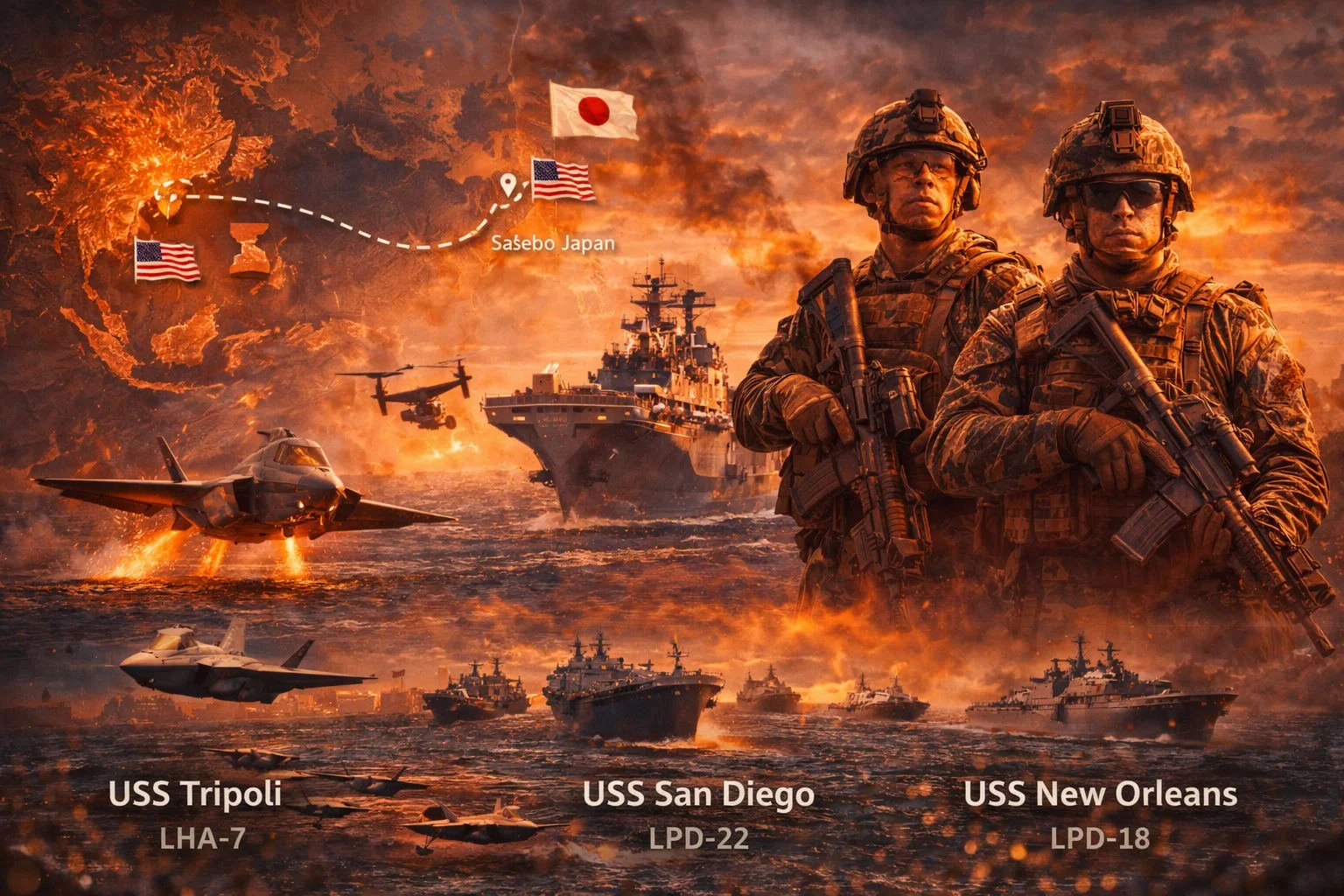
The Pentagon is now adding a Japan-based Marine amphibious force to the Middle East buildup, a step that makes the war look less like a short punitive campaign and more like a conflict Washington expects to keep widening. The Wall Street Journal reported that Defense Secretary Pete Hegseth approved Central Command’s request for an amphibious ready group and attached Marine expeditionary unit, with the USS Tripoli and its Marines headed toward the region as Iran’s attacks on shipping in the Strait of Hormuz continue to choke traffic and shake global markets. Current reporting around the move describes the package as the three-ship Tripoli group with more than 2,000 Marines aboard.
The force at the center of the move is not a token reinforcement. Official Navy and Marine Corps material shows the Tripoli formation operating recently as the Tripoli Amphibious Ready Group, built around the America-class amphibious assault ship USS Tripoli (LHA-7) and the San Antonio-class amphibious transport docks USS New Orleans (LPD-18) and USS San Diego (LPD-22), alongside the 31st Marine Expeditionary Unit. U.S. Indo-Pacific Command also said roughly 2,400 Marines from the 31st MEU had been training in Japan during Iron Fist 26, underscoring that this is a forward-deployed, combat-ready force already concentrated in the western Pacific before being redirected west.
That matters because an ARG/MEU is built for messy, fast-moving littoral war. Official 31st MEU material describes the unit as a persistent, combat-credible force with helicopter insert capability, boat-raiding capability, mechanized amphibious capability, and a Maritime Raid Force that acts as the commander’s “eyes, ears and trigger finger” in the battlespace. In plain English, this is the kind of formation sent when commanders want options that sit between airstrikes and a full invasion: raids, evacuations, seizures, boarding operations, show-of-force deployments, and rapid-response insertions from the sea.
The aviation piece is what makes the deployment feel even heavier. Official Navy photos show Marine F-35Bs from VMFA-121 flying from USS Tripoli as recently as February in the Philippine Sea. And the Marine Corps has already demonstrated that Tripoli can be used as a so-called “lightning carrier,” operating 20 F-35B Lightning II jets from the ship in a concentrated aviation configuration. That does not by itself prove the exact current jet count aboard for this deployment, but it does show the scale of strike and sensor power this ship can bring when loaded for air-heavy operations.
That is why this deployment looks escalatory even before the ships arrive. A force like this gives CENTCOM more than just extra deck space. It adds vertical assault capability, Marine infantry, short-takeoff stealth fighters, helicopters, small boats, and a self-contained command-and-control package that can operate close to contested shorelines. Given the current crisis in Hormuz, that points toward a wider menu of possible missions: helping reopen maritime corridors, supporting boarding and seizure operations, protecting or evacuating U.S. personnel, reinforcing bases under threat, or preparing for raids against coastal or island targets if Washington decides the naval fight has to become more aggressive. That is an inference, but it is a straightforward one based on the force’s documented capabilities and the wider U.S. discussion about eventually escorting traffic through Hormuz once military conditions allow.
The bigger picture makes the signal even louder. The United States already has major naval combat power in theater, including carrier forces that Reuters has reported moving into or operating in the Middle East earlier in the crisis, while France is also preparing a much larger maritime presence around the Mediterranean, Red Sea, and potentially Hormuz. Reuters also reported in February that the U.S. military was preparing for the possibility of sustained, weeks-long operations against Iran. Adding a Japan-based Marine amphibious force on top of that makes this look much less like a temporary surge and much more like Washington building depth for a conflict that could run longer, hit more coastlines, and require more than just bombers and destroyers.
There is also a strategic cost buried in the move: this force was not sitting idle in the continental United States. It was forward-deployed in Japan, operating in the Indo-Pacific, where the Marine Corps and Navy use it as one of their most flexible standing response formations. Pulling it toward the Middle East is a sign that Washington believes the Gulf fight now demands assets important enough to reassign from another top-priority theater. That is the kind of choice militaries make when they think a war is getting more dangerous, not less.
The cleanest way to read this deployment is simple: Washington is adding a force built for amphibious crisis response, coastal war, and aviation-heavy expeditionary operations to a region already buckling under carrier deployments, mine fears, and attacks on shipping. That does not automatically mean U.S. Marines are about to storm a beach in Iran. It does mean the Pentagon wants the option set that comes with a force designed for exactly that kind of unstable, coastal, escalation-prone fight. And that is what makes this move feel like another step up the ladder.