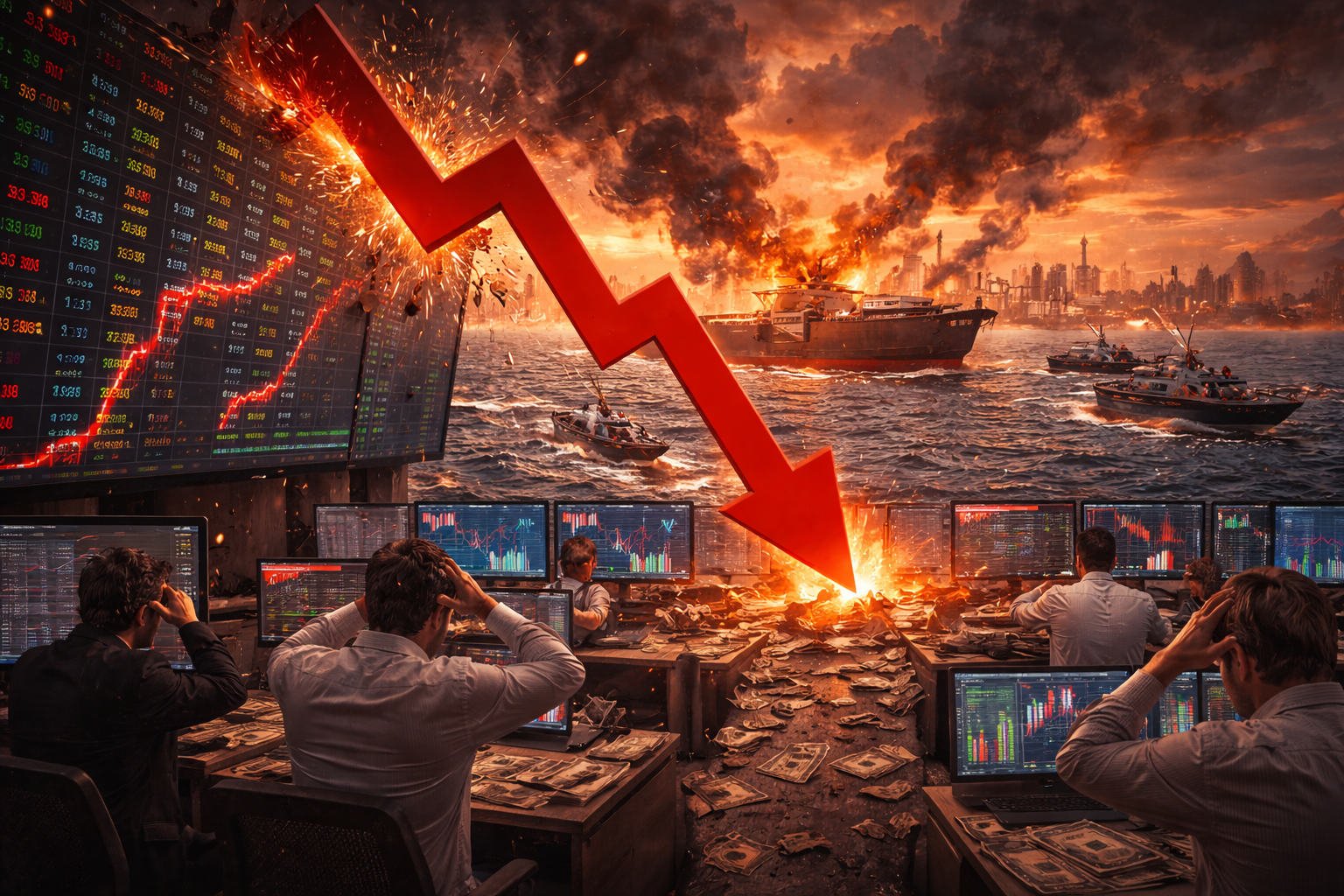
The stock market has fallen, but it still does not look like a market that has fully accepted what this war could mean.
That is the dangerous part.
The International Energy Agency said on March 12 that the Middle East war has created the largest oil-supply disruption in history, with global supply expected to fall by about 8 million barrels per day in March. Reuters also reported that Wall Street sold off sharply the same day as crude pushed back toward $100 a barrel, with the Dow down 581 points, the S&P 500 down 78.56 points, and the Nasdaq down 320.37 points as investors fled toward safety.
That sounds serious, and it is. But it still may not be serious enough.
What markets appear to be pricing now is a nasty shock that eventually fades. What they may still be underpricing is a much darker possibility: that the Strait of Hormuz stays badly impaired for longer than expected, that the war in Iran drags on because the regime does not collapse, and that the escalation ladder keeps getting steeper instead of flattening out. Reuters reported that Goldman Sachs has already extended its assumption for severely reduced Hormuz flows from 10 days to 21 days, followed by a 30-day recovery, and warned that if very low flows persist through March, daily oil prices could exceed the 2008 record highs. Reuters also reported that U.S. intelligence sees no immediate risk of Iran’s government collapsing, which undercuts the idea of a quick, clean end to the war.
That combination is exactly how a correction can turn into something much worse.
If oil remains high for days, markets wobble. If oil remains high for weeks, markets start repricing growth, inflation, corporate margins, and interest-rate expectations all at once. Reuters has already warned that higher oil is clouding Wall Street’s earnings outlook and reviving stagflation fears. That matters because stagflation is one of the ugliest setups for equities: slower growth hurts earnings, higher inflation keeps pressure on consumers, and central banks have less room to rescue markets.
The real problem is that the supply shock is not easy to patch. Reuters reported that the record emergency oil-stockpile release now being organized is only a partial band-aid. JPMorgan estimates such a coordinated release could flow at only about 1.2 million barrels per day, a tiny fraction of a disruption that Reuters has described as roughly 15 million to 20 million barrels per day. Worse, U.S. reserve barrels can take 40 to 60 days to reach Asian markets. That means governments can announce relief now while the physical market stays painfully short for weeks.
That lag is exactly the kind of thing stock investors hate. It means the market cannot simply tell itself that governments will ride to the rescue and make the problem disappear. The emergency release helps at the margin, but it does not fix the core issue: too many barrels are trapped, too much shipping remains disrupted, and too much of the world still depends on a chokepoint that is not functioning normally. Reuters’ March 12 reporting makes clear that this is not a theoretical concern; it is already weighing on equities while oil-sensitive parts of the market are being repriced in real time.
That is why the next leg down could be harsher than the first.
Right now, investors can still tell themselves a comforting story. They can say the war may end sooner than feared. They can say Hormuz will reopen faster than expected. They can say strategic reserves will smooth the damage. They can say the worst oil prices were just a panic spike. But every fresh piece of reporting chips away at that story. Goldman Sachs is extending its disruption timeline, not shortening it. U.S. intelligence does not see Tehran collapsing. The IEA is calling this the biggest supply disruption ever. The stock market is being hit even before those facts appear fully absorbed into longer-term earnings and valuation models.
That is the setup for a real crash scare: not one dramatic new event, but a slow, brutal shift in investor belief.
Once the market stops treating this as a temporary geopolitical spike and starts treating it as a prolonged economic shock, the logic changes fast. Airlines, industrials, retailers, transport, chemicals, and consumer names all start looking more vulnerable. Rate-cut hopes get pushed back. Treasury yields can rise on inflation fear even as growth expectations fall. That is how a selloff spreads from “war-sensitive” stocks into the broad market. Reuters has already reported a classic flight-to-safety move, with energy as the standout winner while much of the rest of Wall Street sank.
And then there is the worst-case layer above all of this: escalation fear.
There is no credible public reporting right now that the United States or Israel is preparing a limited nuclear strike on Iran. But markets do not need proof that such a move is coming in order to panic over the possibility. In a war with no clear off-ramp, a non-collapsing regime, a closed chokepoint, and rising pressure for a decisive end, even a small probability of extreme escalation becomes terrifying to price. That kind of fear would not just raise oil. It would hit confidence itself. It would push investors to dump risk assets, crowd into cash, Treasuries, gold, and the dollar, and assume that the global economy was entering a phase where standard valuation models no longer worked.
That is why a crash is a very real possibility from here.
Not because one bad day on Wall Street automatically becomes 2008. Not because every war shock ends in financial catastrophe. But because the market still seems to be pricing inconvenience when the underlying facts increasingly point toward something much more serious: a longer Hormuz disruption, a longer Iran war, slower relief from emergency stockpiles, and an escalation path that remains frighteningly open. Reuters’ reporting over the past two days shows exactly that pattern. The selloff has started. The oil shock is real. The easy rescue story is weak. And the war’s clean ending is nowhere in sight.
If investors finally decide to price that honestly, the current decline may end up looking like the warm-up.