
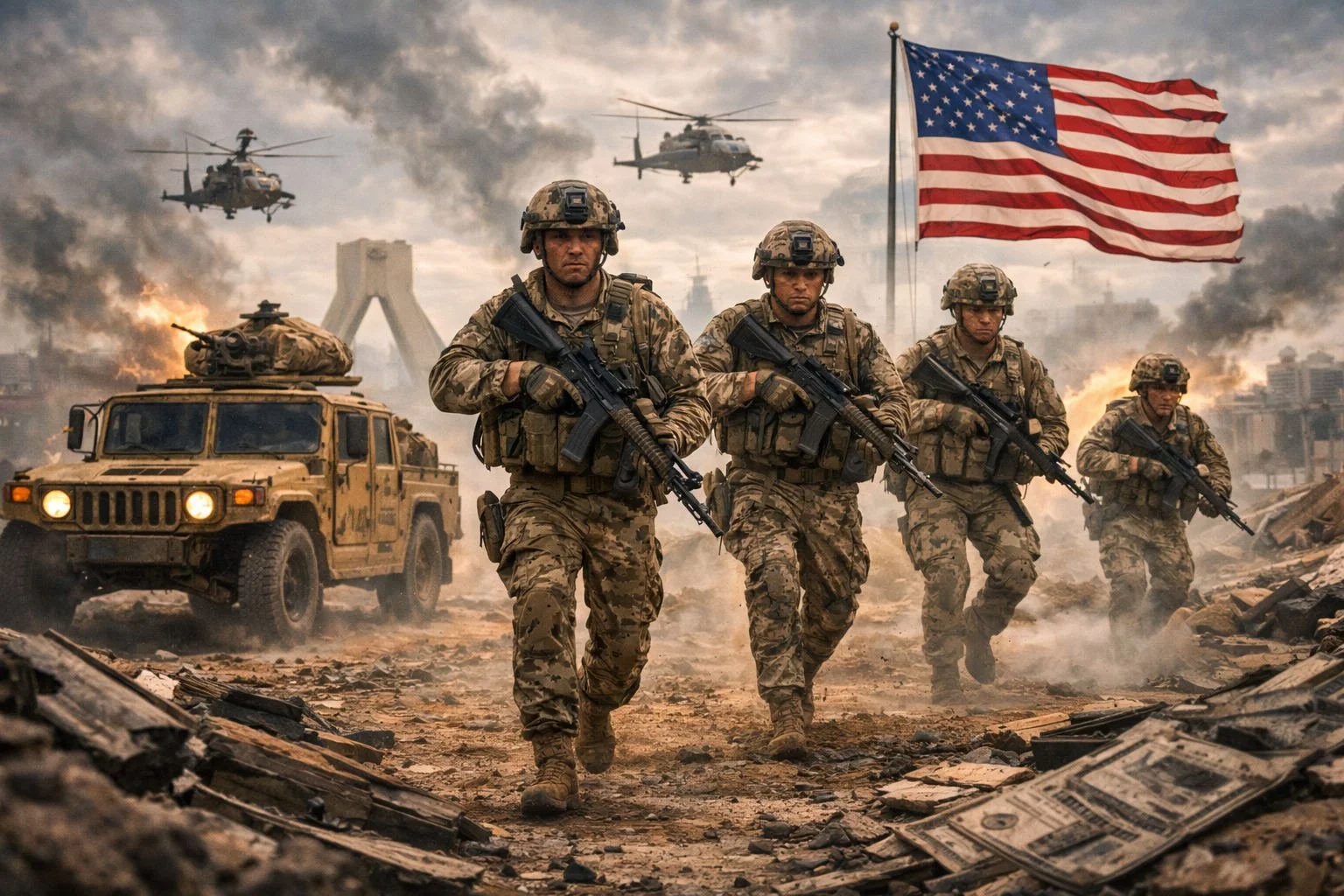
The easiest version of this war is the one Washington no longer seems able to achieve: bomb Iran from the air, break its capacity to fight back, reopen the Strait of Hormuz, and get out. Public reporting now points in the opposite direction. Reuters reported this week that the U.S. Navy still cannot escort commercial ships through Hormuz because the risks remain too high, while Treasury Secretary Scott Bessent said escorts can begin only once the United States has “complete control of the skies” and Iran’s missile-rebuilding capacity is “completely degraded.” That is not the language of a war nearing a clean finish. It is the language of a war whose core objective — reopening the world’s most important energy chokepoint — still has not been secured.
That is why pressure for some form of boots on the ground is building, even if the phrase still conjures images of a massive Iraq-style invasion that nobody in Washington wants to own. The more immediate scenario is narrower and more dangerous: raids, special operations, temporary footholds, coastal seizure missions, or Marines used to secure key launch areas, islands, or facilities close enough to affect Hormuz traffic. That logic follows directly from what military officials and outside experts are already saying. ABC reported that mine-clearing and escorted passage require local air superiority and methodical, slow-moving mine-countermeasure operations under heavy protection; Reuters reported that even now, with the war already underway, the Navy is refusing escort requests because the danger remains too high. If ships cannot move safely while Iranian coastal missile, drone, and small-boat threats remain active, then air power alone may not be enough to make the strait usable again.
The strategic trap for Trump is getting tighter by the day. Reuters reported Friday that Iran’s strategy is explicitly designed to create economic pain and pressure Washington to end the war by choking oil flows through Hormuz. Traffic is down 97% since the war began, according to Reuters, and analysts quoted by Reuters say Tehran’s goal is to take the global economy hostage until the United States blinks first. That means every extra day of disrupted shipping is not just a military embarrassment. It is also a political assault on Trump through gasoline prices, inflation, and market stress.
And that political pressure cuts both ways. Reuters also reported that Trump’s economic and political advisers are warning him that higher oil and gasoline prices could erode already weak domestic support for the war and hurt Republicans ahead of the midterms. But the same Reuters reporting shows hawks around Trump arguing the opposite — that Washington must sustain pressure, stop Iran from retaining meaningful capabilities, and respond forcefully to attacks on shipping and U.S. forces. That is what makes this so combustible: high gas prices can push a president toward de-escalation, but they can also push him toward a more decisive military move if he concludes that anything less will leave him looking weak, leave Hormuz half-closed, and leave the oil shock intact.
The military logic is becoming harder to dodge because the war is not producing the political outcome that would make a pullback easy. Reuters reported that U.S. intelligence believes Iran’s leadership is not at risk of collapse anytime soon. In other words, this is not turning into a quick decapitation campaign followed by surrender. It is turning into a harder grind against an entrenched regime that is still capable of economic warfare. Reuters also reported that Iran has effectively closed Hormuz without needing a conventional naval showdown, using missiles, drones, and dispersed asymmetric attacks to keep the artery under pressure. If Tehran can keep doing that while surviving the bombing, Washington faces a brutal choice: accept a prolonged oil shock, or escalate until the launch network and the coastline supporting it are physically suppressed.
Congress is already hearing that this may be where the war is headed. Reuters reported that senators came out of classified briefings warning that the United States seemed to be “on a path toward deploying American troops on the ground in Iran,” and noted that Trump has not ruled out sending ground forces. That does not mean a weekend announcement is imminent. It does mean officials on Capitol Hill are being briefed on a war whose duration, cost, and possible ground component remain unsettled enough to alarm lawmakers.
There is another concrete reason ground operations keep returning to the conversation: some of the war’s hardest objectives are, by definition, physical. Reuters reported that Trump has considered a special operation to seize Iran’s enriched uranium, and ABC reported that former defense officials believe such a mission would likely require a large U.S. special operations force on the ground, along with a wider protective perimeter and air cover. That matters because it shows how quickly “no boots on the ground” can erode once the mission shifts from bombing targets to securing them. The same logic applies, in a different way, to Hormuz. It is one thing to strike Iranian naval assets from the air. It is another to create a condition in which tankers can reliably pass, mines can be cleared, coastal launchers cannot reappear, and insurers believe the route is genuinely safe.
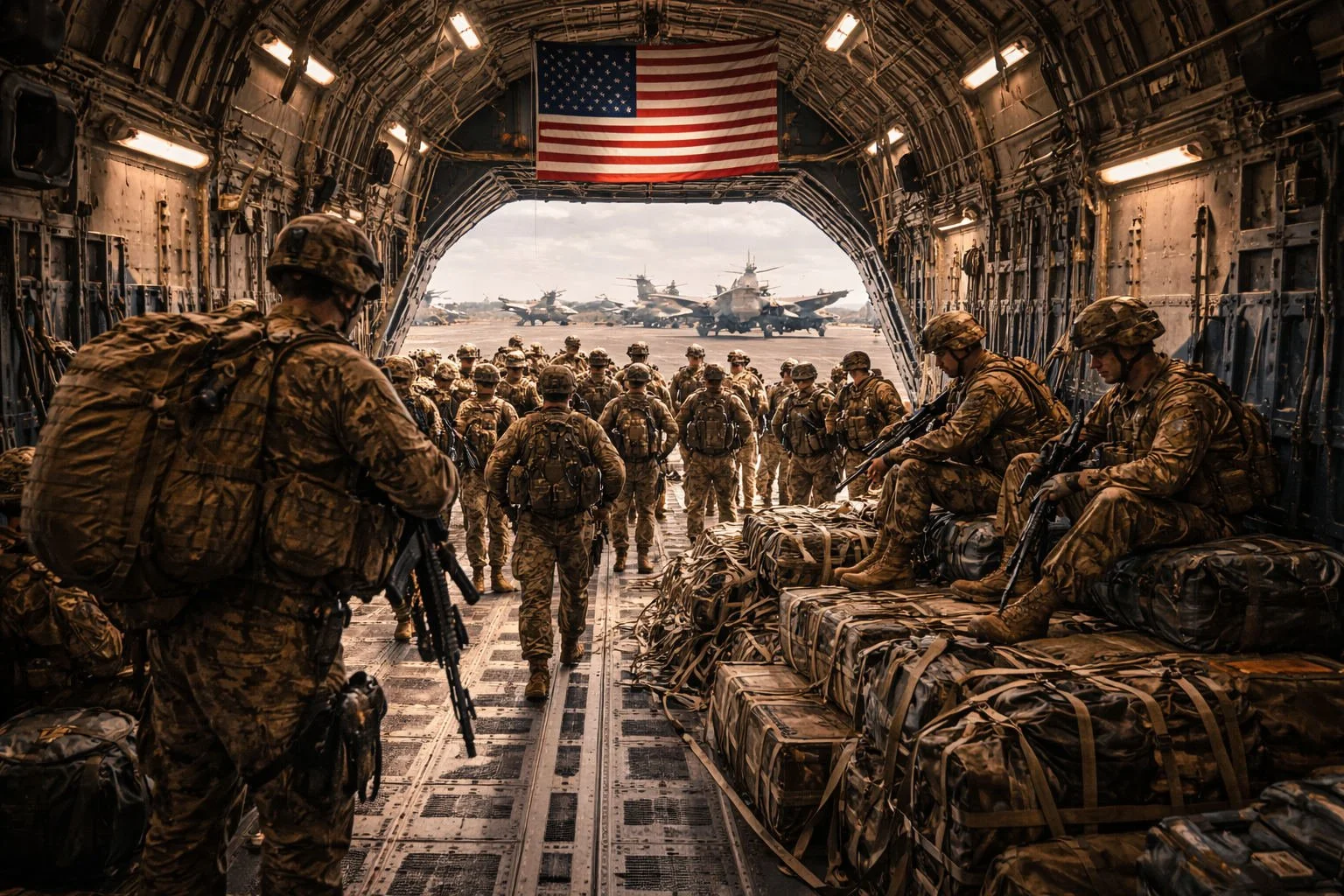
That is why the phrase “boots on the ground” may end up meaning something more limited, but still far more serious, than many Americans expect. A full conquest of Iran is still a wildly different proposition. Reuters quoted Ali Vaez of the International Crisis Group saying total defeat of Iran would require a land invasion involving up to a million troops, something Washington clearly has no appetite for. But limited ground action is a different matter. Special operators, Marines, engineers, and coastal-security missions all sit below the threshold of a classic occupation while still crossing the line into a much more dangerous war. And once that line is crossed, it becomes harder to reassure markets, allies, or the public that the conflict is still “short-term.”
So the most honest way to frame this is not that Trump is definitely announcing a ground invasion this weekend. It is that the logic pushing Washington toward some kind of ground role is getting stronger, not weaker. Naval escorts are not yet possible. Air power has not reopened Hormuz. Iran’s leadership is still standing. The oil shock is hammering the global economy. And every day the strait remains effectively closed increases the pressure on Trump to do something that looks decisive rather than absorb an open-ended humiliation. In that kind of war, “boots on the ground” stops sounding like a red line and starts sounding like the next escalation waiting for a justification.
What does this mean for stock prices?
If the United States gets dragged into another open-ended war in and around Iran, the market fallout could get much worse very quickly. Stocks are already wobbling with Brent back above $100, Wall Street selling off, and investors fleeing toward safer assets, but that is still happening before the market has fully priced a prolonged military commitment, a longer Hormuz closure, and the inflation shock that comes with it. Reuters reported that the S&P 500, Dow, and Nasdaq all fell sharply as crude surged, while the IEA called the current disruption the largest oil-supply shock in history. That is the kind of backdrop where a normal correction can start turning into a broader risk-off unwind.
The bigger danger is that a longer war would hit the market from several directions at once. Higher oil would keep squeezing consumers and corporate margins, while also making the Federal Reserve less able to rescue stocks with quick rate cuts. Barclays now expects the first Fed cut only in September because the Middle East war is worsening inflation risk, and Reuters reported that U.S. consumer sentiment fell in early March as gasoline prices jumped more than 21% to $3.63 a gallon. That is exactly the kind of mix equity investors hate: weaker confidence, stickier inflation, delayed rate relief, and a war bill that keeps getting larger instead of smaller.
That is why the “forever war” angle is so dangerous for indexes. If investors start believing this is not a short, containable operation but another drawn-out U.S. conflict with no clean exit, they will stop treating the selloff as a dip and start treating it as a repricing. Reuters reported that S&P Global warned the war could have long-lasting effects on the U.S. economy and credit conditions, while another Reuters analysis said Wall Street has looked remarkably calm relative to the scale of the oil shock. If that complacency breaks, richly valued and highly crowded parts of the market could get hit hard, because the story would no longer be “temporary geopolitical noise.” It would be “higher oil, tighter credit, weaker growth, and another open-ended American war.”
Will we see the US markets trip the circuit breakers on Monday? Only time will tell.