
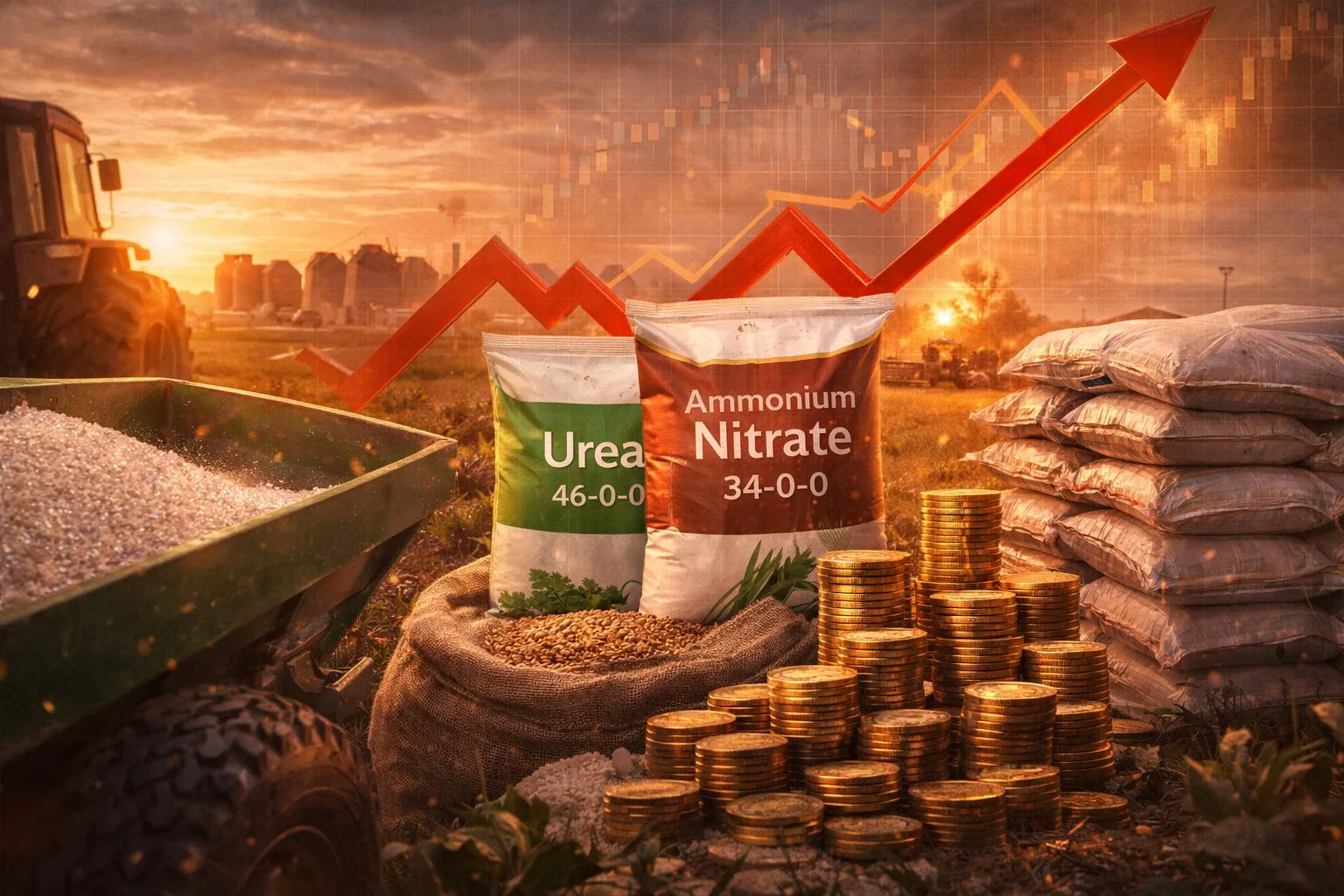
Most people hear “Middle East war” and think oil first. That makes sense. Oil is the obvious shock. It is on every ticker, every gas station sign, every inflation forecast.
But another price spike is building underneath it, and it could end up mattering almost as much for everyday life: fertilizer.
That matters because fertilizer is not some niche industrial input. It sits near the base of the modern food system. When fertilizer becomes scarcer or more expensive, farm margins get squeezed, planting decisions change, some growers use less of it than they otherwise would, and food inflation risk rises later on. That chain reaction does not always show up instantly at the grocery store, but once it starts, it can be hard to reverse. Reuters reported this week that the war has shut down fertilizer plants in the Middle East and severely disrupted shipping through the Strait of Hormuz, a conduit for about a third of global fertilizer trade.
The timing could hardly be worse. Reuters says farmers around the world are being hit just as the Northern Hemisphere planting season ramps up, with many needing to buy spring fertilizer right now rather than months from now. In the United States, fertilizer prices at the New Orleans import hub jumped from $516 per metric ton on February 27 to as high as $683 by March 5. Reuters also quoted StoneX analyst Josh Linville saying this “could not happen at a worse time of the year.”
The core reason is simple: the Gulf is not just an oil region. It is a fertilizer region too. Reuters reports that countries around the Persian Gulf account for about one-third of global fertilizer trade moving through Hormuz, while the American Farm Bureau Federation says countries exposed to disruption in the region account for nearly 49% of global urea exports and about 30% of global ammonia exports. Urea and ammonia are central to nitrogen fertilizer, one of the most important farm inputs in the world.
The shock is already visible in price data. IFPRI reported that Middle East urea prices closed above $590 per metric ton on March 5, up more than $90 in a week, a roughly 19% jump, while U.S. Gulf DAP prices rose more than $30 per metric ton to $655. Reuters separately reported that urea prices had already risen around $80 per ton from pre-war levels and that markets may not yet have fully priced a long conflict.
This is not just about ships being delayed. Production itself is being hit. Reuters reported that QatarEnergy had to stop production at the world’s largest single-site urea plant after attacks disrupted the natural gas feedstock it relies on. Reuters also said sulphur output has been cut elsewhere in the Middle East. That matters because sulphur is a key ingredient in phosphate fertilizer production, and Kpler estimates that about 33% of the world’s fertilizers, including sulphur and ammonia, pass through Hormuz.
So this is already more than a “war premium” story. It is becoming a physical supply story.
And there is a second problem: the world does not have an easy replacement. Reuters reported that Russia, the world’s largest fertilizer exporter, cannot quickly make up for a Middle East-related shortfall because of limited spare capacity, domestic supply obligations, export caps, and other constraints. One Reuters source said it might be possible to cover unmet demand “over a short horizon,” but in the long term the missing volume is too large to replace.
That is why this can get worse from here.
The first way it gets worse is if Hormuz stays dysfunctional for weeks rather than days. Reuters reports shipping through the strait has largely halted, insurers have sharply raised premiums, and the conflict has already turned the route into a high-risk corridor. If that persists, the issue stops being “higher prices for available product” and becomes “product not arriving in time for planting.” Reuters quoted analysts saying a weeks-long shutdown would prevent supplies from reaching farmers for spring application windows.
The second way it gets worse is if more producers are knocked offline. Reuters says the war has already shut fertilizer plants in the region, and the Middle East exports an estimated 22 million tons of urea, or about 40% of global trade, according to StoneX comments cited by Reuters. If more gas plants, export terminals, or chemical facilities go down, the market would have to absorb not just logistics pain but a deeper structural shortage.
The third way it gets worse is if other countries clamp down on exports to protect domestic supply. Reuters reported that China had already been restricting fertilizer exports before the war and that analysts expected those controls could tighten further because of the conflict. When one big supplier goes down and another big supplier hoards more product, the squeeze spreads globally very quickly.
The fourth way it gets worse is through energy, especially natural gas and diesel. Fertilizer is heavily tied to energy markets: natural gas is the main feedstock for nitrogen fertilizer, and diesel is critical for mining, manufacturing, shipping, and farm operations. Reuters reported that sustained oil-price shocks can push food inflation higher later in the year by raising fertilizer and transportation costs. Reuters also reported that diesel markets have been severely disrupted by the war, with potential retail diesel prices high enough to threaten broader economic slowdown.
The fifth way it gets worse is timing. A fertilizer shock in the middle of planting season is more dangerous than the same shock in an off-season. The American Farm Bureau Federation warned that if farmers cannot obtain remaining fertilizer supplies in time, they may reduce acreage, shift to crops with lower fertilizer needs, or face lower yields. Reuters echoed that risk, citing former USDA chief economist Seth Meyer saying farmers may alter crop choices and fertilizer application rates because of the spike. Reuters specifically noted farmers could cut back on corn, which is especially nitrogen-intensive.
That is how fertilizer costs start turning into food costs.
The transmission is not always immediate, and it is not one-to-one. Fertilizer is only one part of food pricing, alongside labor, weather, freight, packaging, and retail margins. But it is a major part of crop economics. Reuters quoted a South African agricultural economist saying fertilizer can make up as much as 50% of production costs for farmers there. IFPRI warned that higher fertilizer prices could push some growers to plant less input-intensive crops or apply less fertilizer, which can reduce yields and tighten supply later.
That means the most likely path is not “food prices explode tomorrow morning.” It is more gradual and more insidious. First fertilizer rises. Then some farmers delay purchases, trim application rates, or change acreage. Then fuel and freight costs climb too. Then yields and delivered supply come under pressure. Then, months later, consumers see the effect in bread, cereals, meat, dairy, vegetable oils, and other staples whose production costs depend heavily on grains and fertilizer-intensive crops. That sequence is consistent with warnings from Reuters, IFPRI, and the World Food Programme.
The early warning signs are already there. FAO reported on March 6 that its Food Price Index rose 0.9% in February, ending a five-month decline, led by higher wheat, vegetable oil, and meat prices. That increase mostly predates the full fertilizer fallout from the war, which is why the bigger risk may lie ahead rather than behind. Reuters also quoted BNP Paribas economist Andy Schneider saying a sustained oil shock would raise fertilizer and transportation costs that could push food inflation higher later in the year.
The risk is especially acute for poorer import-dependent countries. The World Food Programme warned on March 8 that the conflict is already creating a “dual chokepoint” shock across shipping, energy, and fertilizer markets, with clear knock-on effects for food prices worldwide. WFP said disrupted fertilizer availability risks lower crop yields and higher global food prices, and warned that vulnerable populations in the Middle East and beyond could be pushed further toward severe food insecurity.
Some countries are particularly exposed. Reuters reported that Brazil covered 100% of its urea needs with imports in 2025 and that an estimated 41% of those imports passed through Hormuz. Reuters also reported that India buys more than 40% of its urea and phosphatic fertilizers from the Middle East and that three Indian plants had already been forced to reduce urea output because Qatari LNG supplies dropped sharply. Those are not isolated examples; they show how a Gulf shock can hit both importing countries and domestic producers that rely on Gulf feedstocks.
So where does this go next?
If the war de-escalates and shipping normalizes fairly soon, fertilizer prices may remain elevated but avoid the worst-case spiral. But if the Strait of Hormuz stays constrained, more plants go offline, export controls tighten, and diesel remains expensive, the price shock could deepen. Reuters quoted Morningstar analyst Seth Goldstein saying nitrogen prices could roughly double and phosphate prices could rise 50% from current levels if the supply shock lasts more than a few weeks, potentially returning to the highs seen after Russia’s invasion of Ukraine in 2022.
That is the real warning here. Oil may be the headline, but fertilizer could be the stickier inflation story. Oil shocks hit quickly and visibly. Fertilizer shocks move more quietly through the system, but they can leave a longer tail—especially when they arrive just as farmers are deciding what to plant, how much to spend, and where to cut back. If this war drags on, the food-price consequences may not stay hidden for long.