France Is Drawing a Line on Hormuz: End This Crisis in Weeks, or the Economic Damage Gets Much Worse
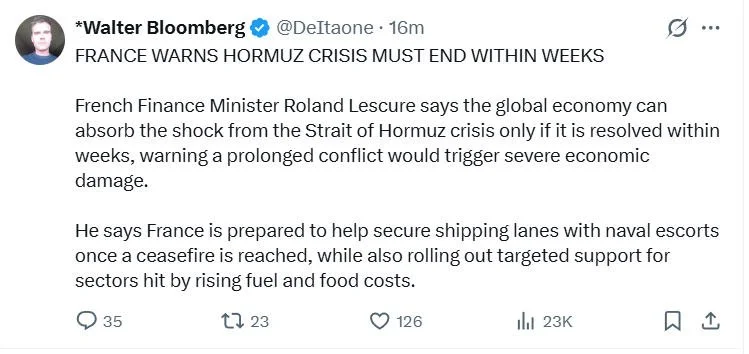
The tweet is not just dramatic framing. It captures a real warning now coming out of France: Paris is effectively saying the global economy can stomach a Hormuz shock for a short period, but not for long. The key message from French Finance Minister Roland Lescure is that this crisis needs to be resolved in weeks, not months. France is also signaling that it would support a defensive effort to help restore shipping only after a ceasefire, while continuing to prepare targeted relief for parts of the economy squeezed by higher energy-related costs.
That matters because France is not talking like a country that sees this as a temporary market wobble. It is talking like a government that sees a countdown clock already running. When a major European finance minister starts putting a rough time limit on how long the world can absorb the shock, that is another way of saying policymakers are worried the damage is moving beyond oil traders and into inflation, industry, household budgets, and central-bank decisions. The IMF has already cut its global growth outlook because of the war-driven energy shock and warned that a longer conflict could push the world close to recession.
This is really a warning about time
Short disruptions can sometimes be absorbed. Governments can release emergency stocks. Companies can reroute shipments. Traders can assume diplomacy will arrive before the pain spreads too far. But those buffers get weaker the longer the Strait stays constrained. The IEA said Tuesday that the war has created what it calls the largest oil supply shock in history, with global supply set to shrink by 1.5 million barrels per day this year. It also said flows through Hormuz had collapsed to about 3.8 million barrels per day in early April, down from more than 20 million before the conflict. That is not a normal disruption. That is a severe constriction in one of the world’s most important energy arteries.
The IEA’s warning also helps explain why France is suddenly talking in terms of weeks. The agency said resuming flows through Hormuz remains the single most important variable for easing pressure on energy supplies, prices, and the broader economy. It also warned that demand destruction will spread if scarcity and high prices persist. In plain English, that means the longer this drags on, the less this looks like a temporary price spike and the more it starts looking like a real economic slowdown caused by energy scarcity.
Europe has more to lose than many investors seem to realize
France’s tone also reflects Europe’s particular vulnerability. The euro zone imports most of its energy needs, and the IMF now expects euro-area growth to slow to 1.1% in 2026 from 1.4% in 2025 even under a baseline where the war’s disruptions fade by mid-year. Inflation is projected to rise to 2.6%, and the IMF says the ECB is then likely to raise rates by 50 basis points over the course of the year. That is a nasty combination: weaker growth, hotter inflation, and tighter monetary policy, all from a conflict that has not even reached its worst-case scenario.
That is why this French warning should be read as more than a comment on shipping. It is really a warning about stagflation risk. If energy stays expensive for long enough, it hits factories, logistics, food production, and consumer confidence at the same time. Reuters also reported that the IMF’s more adverse scenarios envision global growth dropping to 2.5% or even 2.0%, with oil prices averaging $110 in 2026 and $125 in 2027 in the severe case. At that point, this stops being an energy story and becomes a full-blown macro story.
France’s naval escort idea is not a sign the crisis is solved
One of the more important parts of the tweet is the line about France helping secure shipping lanes. That sounds reassuring at first glance, but the details are actually more sobering. Britain and France are co-hosting talks on a strictly defensive multinational mission meant to restore freedom of navigation, but Reuters reports that such a mission would only be deployed once the situation allows and only after the conflict is effectively over. European diplomats also said any mission would require some form of accord from both Iran and the United States. In other words, this is a post-crisis plan, not a solution to the crisis right now.
The talks themselves show how serious the blockage still is. Reuters reported that the planned meetings will involve around 40 countries and focus on maritime security, possible economic measures against Iran if the strait stays closed, releasing trapped ships and seafarers, and working with industry to prepare for the resumption of transit. That is not the kind of diplomatic machinery you build for a problem you think will disappear on its own. It is the kind of machinery you build when you know the economic consequences of delay are becoming unacceptable.
The economic support measures tell you Paris expects pain to spread
France’s approach to domestic relief is also revealing. Lescure has already argued that broad fuel tax cuts or subsidies would only worsen inflation when supply is constrained. Instead, France has leaned toward targeted, temporary support. Reuters reported in March that Paris was considering or offering measures such as loans, payroll contribution relief, and more flexible tax deadlines for transport, fishing, and farming, while later reporting targeted relief for sectors hit hardest by the energy spike, including trucking and fisheries. That is a government trying to prevent pressure points from turning into broader economic damage without pouring fuel on inflation.
That approach also lines up with what international institutions are now saying. The IMF, World Bank, and IEA warned this week against hoarding energy supplies or imposing export controls, and they cautioned governments against broad untargeted subsidies. They argued that the war has already driven gas and fertilizer prices higher, raising concerns about food security and job losses. The World Bank separately said the conflict has disrupted oil, gas, fertilizer, helium, tourism, and air travel, while warning that even a ceasefire would not erase the cascading economic impact. France’s emphasis on targeted help is a sign that policymakers are trying to contain second-round effects before they become politically explosive.
The real message behind France’s warning
The deeper point is that France is saying out loud what many governments probably believe privately: the world economy can survive a short Hormuz shock, but it is not built to shrug off a long one. Strategic reserves can buy time, but even France has said reserves are only a signal to the market and cannot replace the actual flow of oil through the strait. That is why Lescure said back in March that reopening Hormuz was the only lasting way to ease the market. The message now is essentially the same, just more urgent.
So this is the right way to read the tweet: France is not merely calling for calm. It is issuing a deadline-shaped warning. Resolve this crisis within weeks, and the world might still escape with a painful but manageable shock. Let it drag on, and the damage starts to spread outward—from oil to inflation, from inflation to growth, from growth to politics, and from politics to financial instability. Once that chain reaction really gets going, reopening the Strait of Hormuz will still matter, but it will not be enough to undo everything that happened while the world waited.