Trump’s Hormuz Blockade Threat Could Send Oil Soaring More Than 50%
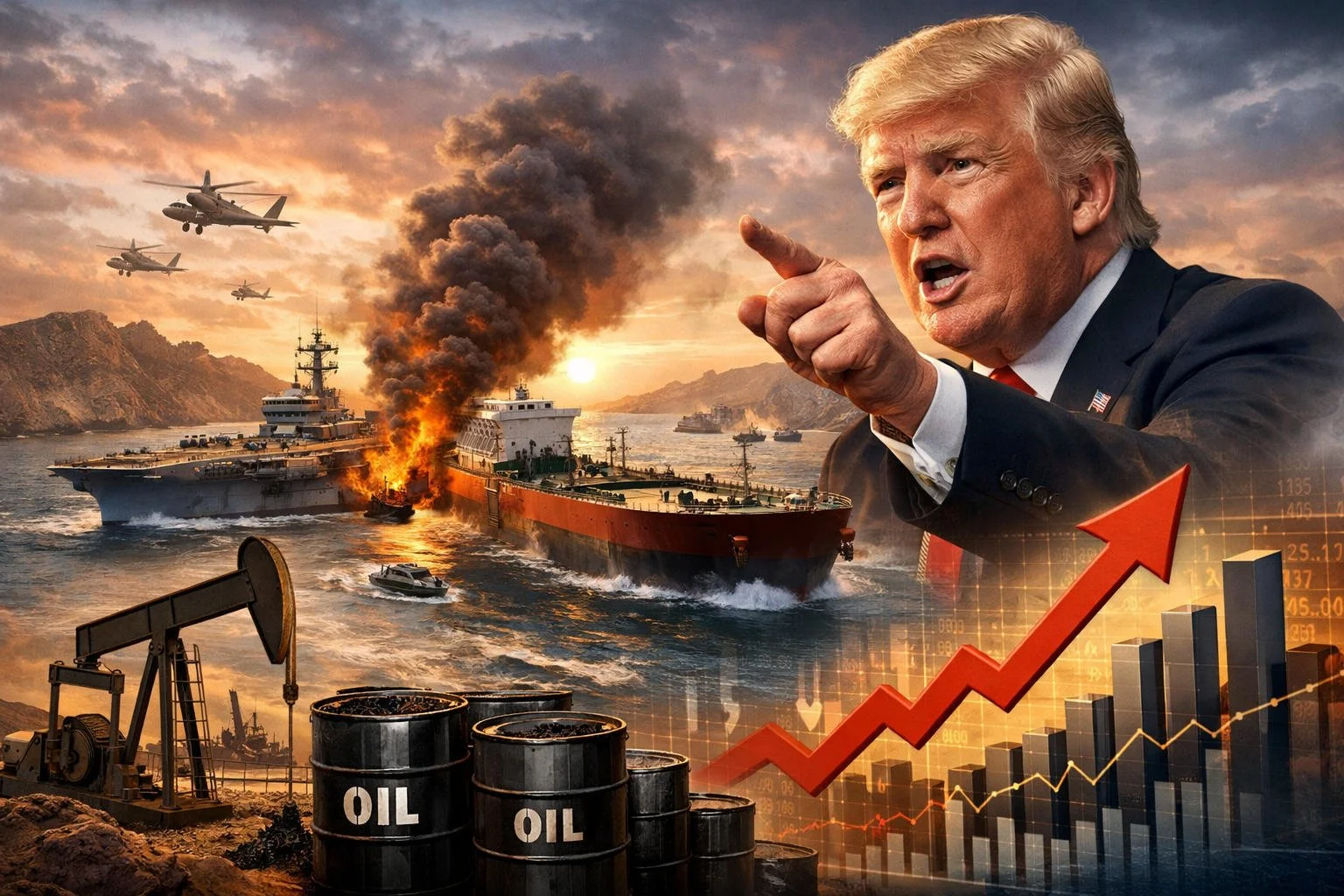
As of April 12, 2026, this is no longer a hypothetical market scare built on vague cable-news chatter. Reuters and AP both reported that President Donald Trump said the U.S. would begin blockading the Strait of Hormuz after U.S.-Iran talks in Islamabad collapsed. Reuters also reported that Trump later said the blockade would “take a little while” to implement, which matters because it suggests the threat is real enough to be operationally planned, not just casually floated.
That matters because the Strait of Hormuz is not just another shipping lane. It is the single most dangerous energy chokepoint on the planet. The IEA says roughly 20 million barrels per day of oil normally move through it, equal to about 25% of global seaborne oil trade, while around 19% of global LNG trade also depends on it. The EIA likewise describes Hormuz as the world’s most important oil transit chokepoint and says there are very few practical alternatives if flows are interrupted.
That is why a U.S. blockade threat is so explosive. It does not calm the market simply because it is the United States making the move instead of Iran. A blockade means more military friction, more legal uncertainty, more insurance chaos, more hesitation from shippers, and a much higher chance that commercial traffic freezes up even before a single tanker is physically stopped. Oil markets do not wait for the final mine to be laid or the first boarded vessel to appear on live TV. They reprice on fear, perceived duration, and the risk that missing barrels stay missing longer than expected. That is an inference, but it is strongly supported by how sharply crude has already swung on ceasefire and reopening headlines.
And the scale of the disruption is already enormous. The IEA said in March that the war created the largest supply disruption in the history of the global oil market, with flows through Hormuz falling from around 20 million barrels per day to a trickle. It also warned that limited bypass capacity and rising storage pressure meant supply losses could increase without a rapid resumption of shipping.
That is the first reason oil could jump much more than most casual observers think: the world does not have a clean substitute route for Hormuz. The IEA says alternative export routes out of the Gulf amount to roughly 3.5 to 5.5 million barrels per day, while the EIA has estimated only about 2.6 million barrels per day of realistically available bypass capacity from Saudi and UAE pipelines in a disruption. In other words, even under relatively generous assumptions, alternative routes cannot fully replace what Hormuz carries. They can soften the blow. They cannot erase it.
The second reason is that the backup systems are not as safe as people assume. Reuters reported that Saudi Arabia’s East-West pipeline, the kingdom’s main workaround to avoid Hormuz, had just been restored to full 7 million barrels per day capacity after attacks linked to the Iran conflict. Reuters also reported analysts describing those attacks as a dual shock that hit both production and the very infrastructure meant to bypass Hormuz. That means the supposed safety valve is itself under fire.
This is where the 50% upside scenario starts to stop sounding crazy. A few days ago, Reuters reported that Brent fell 13.29% to $94.75 after Trump announced a two-week ceasefire, because the market suddenly believed blocked Gulf supply might come back. AP similarly reported that U.S. crude fell to $96.83 and Brent to $94.74 on reopening hopes after having traded above $117 during the crisis. That is an enormous swing based largely on the market’s confidence, or lack of confidence, that Hormuz might normalize. If hope of reopening can knock oil down by double digits in a flash, renewed conviction that the chokepoint will stay contested can send it violently the other way.
A move of more than 50% from roughly $95–$100 oil gets you into the $145–$150+ range. That is not today’s consensus base case. It is a severe escalation scenario. But it is not fantasy math either. If the market concludes that a U.S. blockade, Iranian retaliation, and tanker hesitation will keep a large share of Gulf barrels stranded for weeks rather than days, then prices stop trading like a normal cyclical commodity and start trading like a wartime scarcity asset. In that environment, refiners bid aggressively for prompt barrels, governments start discussing emergency measures, freight and war-risk premiums spike, and physical buyers scramble to secure supply first and ask questions later. The article of faith that “someone will fill the gap” stops holding the market together.
There is also a third layer of danger here: oil is not the only market that breaks. The IEA says almost a fifth of global LNG trade moves through Hormuz too, especially from Qatar and the UAE. That means a Hormuz crisis is not just a crude story. It is also a gas story, a power-price story, a fertilizer story, a shipping story, and eventually an inflation story. JPMorgan CEO Jamie Dimon warned in his annual letter that the Iran war could produce persistent oil and commodity shocks and keep inflation and interest rates higher than expected. That kind of cross-market spillover is how an oil shock becomes a macro shock.
And here is the part markets may still be underpricing: a blockade is not a neat administrative move. It is a military escalation layered on top of an already militarized waterway. Reuters reported that Trump said the U.S. would target vessels that paid tolls to Iran and destroy Iranian mines, while Iran’s side has warned against hostile moves and continues to insist on leverage over the strait. Once both sides are publicly drawing red lines around commercial traffic, it becomes much easier for shipping firms, insurers, and charterers to decide the safest trade is not sailing at all. That alone can tighten prompt physical supply before formal interdictions are even visible.
The UAE’s ADNOC chief put the stakes bluntly, saying any disruption in the strait would endanger global energy, food, and healthcare security. Reuters also reported that around 230 loaded ships were stalled during the broader closure. Even when some supertankers managed to transit during the ceasefire window, the broader picture remained one of severe restriction, fragile access, and chronic uncertainty. Markets can tolerate bad news more easily than they can tolerate unreliable access to the artery that feeds a fifth of the world’s oil consumption.
So could this really push oil up more than 50% from here? Yes, under the right chain reaction.
Not because every single Hormuz barrel has to disappear permanently. Not because analysts have universally penciled in $150 tomorrow morning. But because the combination of factors is exactly what creates outsized oil spikes: a vital chokepoint, limited rerouting capacity, attacks on backup infrastructure, a military standoff involving the U.S. and Iran, elevated LNG stress, and a market that has already shown it will swing violently on any sign that Hormuz is opening or staying shut.
The calm interpretation is that this is brinkmanship and the market will eventually settle. The alarmist interpretation is that Washington has just threatened to turn the most important oil chokepoint in the world into an active U.S.-Iran enforcement zone. If traders start believing that second version is the real one, oil does not have to creep higher. It can gap higher, squeeze higher, and overshoot far beyond what “fundamentals” alone would seem to justify in calmer times.
That is why this story matters so much. A blockade threat at Hormuz is not just another geopolitical headline. It is the kind of headline that can turn a tense oil market into a full-blown supply panic.