
Forget Kharg: Why Larak Island Could Decide the Strait of Hormuz Crisis
For all the attention on Kharg Island, the more urgent piece of terrain in the current crisis may be Larak. Kharg matters because it is Iran’s main oil-export hub. Larak matters because it sits inside the Strait of Hormuz fight itself. That distinction is everything. If the immediate goal is to restore shipping through the world’s most important energy chokepoint, the island tied most directly to traffic control inside the strait starts to look more important than the island tied primarily to export revenue. Reuters has reported that around a fifth of the world’s oil and LNG normally passes through Hormuz, and that Iran has effectively turned the passage into a selective, controlled corridor rather than a normal international transit lane.
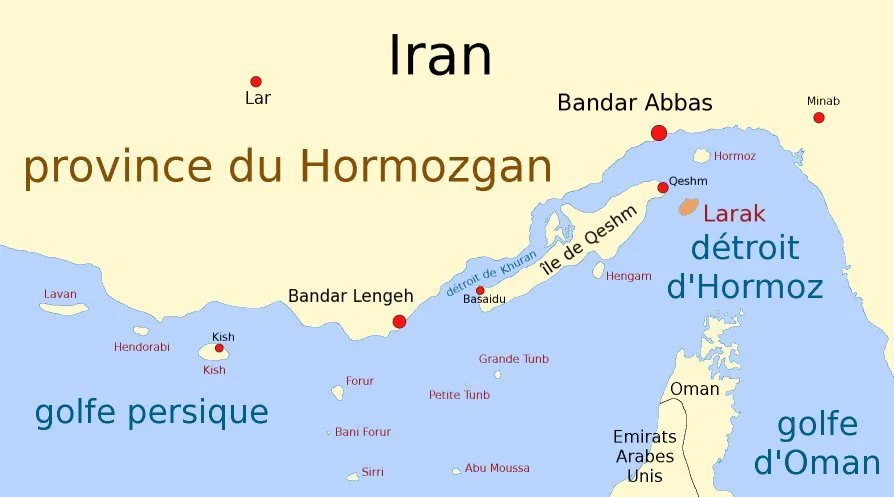
Larak’s importance is first and foremost geographic. Encyclopaedia Iranica identifies it as a small Iranian island in the Strait of Hormuz, south of Hormuz Island and near the eastern end of Qeshm. Public maps of the strait also place Larak right along the narrow throat between the Persian Gulf and the Gulf of Oman. In a crisis built around bottleneck control, geography is strategy, and Larak sits in exactly the kind of location that can matter far more than its size suggests.
That geography has become more than academic. Reuters reported on March 24 that Iran told the United Nations and the International Maritime Organization that “non-hostile” ships may still pass through Hormuz if they coordinate with Iranian authorities and avoid involvement in hostile actions. That is not normal freedom of navigation. That is Tehran asserting a gatekeeper role over a global trade artery. And once Iran starts deciding who can pass, where they pass, and under what conditions, islands and waters close to the transit corridor become the center of gravity of the crisis.
Larak keeps appearing in that conversation because it seems to be tied to the corridor Iran is using to manage or screen traffic. Lloyd’s List reported that approved vessels have been rerouting around Larak Island and into Iranian territorial waters when transiting the strait, while Newsweek, citing Lloyd’s List, said vetted vessels were moving through a corridor near Larak where Iranian authorities and the IRGC reportedly carry out visual verification. That makes Larak look less like an obscure island and more like one of the places where the current Hormuz regime is being enforced in practice.
This is why Larak can look more immediately relevant than Kharg, even though Kharg is more famous. Reuters reported that Kharg handles about 90% of Iran’s crude exports and has been discussed in Washington as a possible pressure point. But Kharg is primarily an economic lever. It is about choking Tehran’s export income or seizing bargaining power over Iranian oil flows. Larak is different. Larak is about the mechanics of who controls passage through Hormuz right now. If the central problem is that the strait is not functioning as a normal waterway, then the terrain tied to the strait’s control system becomes more urgent than the terrain tied to export finance.
That difference matters enormously for oil markets. The global panic is not being driven mainly by fears that Iran will lose export revenue. It is being driven by fears that too much of the world’s oil cannot move freely through Hormuz at all. Reuters reported today that Iraq’s oil output has plunged further as storage fills and exports stay blocked, a sign that the crisis is no longer just about price but about physical flow. When a chokepoint stops operating normally, the market cares most about the points from which that chokepoint is being controlled.
There is another reason Larak matters: this is a maritime-control war before it is anything else. Reuters reported that Western powers struggled to secure shipping in the Red Sea and that Hormuz is expected to be harder because Iran is closer, stronger, and operating in much narrower waters with drones, missiles, floating mines, and coastal support. In that kind of fight, whoever dominates the islands, inlets, and near-shore approaches linked to the navigation corridor gains disproportionate leverage. That is exactly why analysts keep circling back to places like Larak.
Kharg still matters enormously, but in a different phase of the conflict. Kharg is the island to watch if the priority becomes punishing Iran economically or bargaining over its oil-export future. Larak is the island to watch if the priority is who can actually regulate, disrupt, or restore movement through Hormuz itself. One is about revenue. The other is about access. Right now, access is the bigger emergency.
That is the clearest way to understand why Larak suddenly looks so important. It is not a household name. It is not Iran’s main export terminal. But it sits at the intersection of geography, shipping control, and the selective transit regime Tehran now appears to be building inside Hormuz. In a war increasingly defined by who can move oil rather than who can merely bomb it, that may make Larak one of the most important islands in the world.
What could this do to the price of oil?
Quite a lot, because Larak is tied much more directly to control of passage through Hormuz than to Iran’s export revenue alone. If traders start viewing Larak as one of the places from which Tehran is effectively regulating, screening, or constricting traffic, oil stays expensive for a simple reason: the market has to assume the strait is not really “reopening” in any normal sense. Reuters reported this week that Iraq’s output has plunged further as storage fills and Hormuz exports remain blocked, while Reuters also said the strait normally carries about 20% of the world’s oil and gas and remains the center of the current supply shock.
That means Larak matters less as a symbol and more as a signal. If the island is seen as part of the corridor through which Iran is selectively allowing “non-hostile” ships, traders will read that as a form of Iranian control premium on global oil. Even if some ships move, the market is still pricing a chokepoint that is politically constrained, militarily vulnerable, and far from normal. Reuters reported that Brent recently moved around the $100 area amid these disruptions, while BlackRock CEO Larry Fink warned that oil could hit $150 if the threat from Iran persists and Hormuz remains a serious danger to trade.
The bigger danger is that once the market believes access through Hormuz depends on Tehran’s approval near places like Larak, oil stops trading like a temporary war spike and starts trading like a longer-duration supply problem. That is when price pressure can get much nastier, because the question is no longer “Are tankers moving?” but “Who is still willing to depend on this route?” Reuters reported that Gulf producers and energy executives are already warning that current stopgap measures are nowhere near enough to replace the lost flow, which is why any sign that Iran is entrenching control near the strait can keep crude elevated and make another violent move higher easier to imagine.