If Hormuz Stays Broken for Six More Months, the Real Economic Pain Hasn’t Even Started
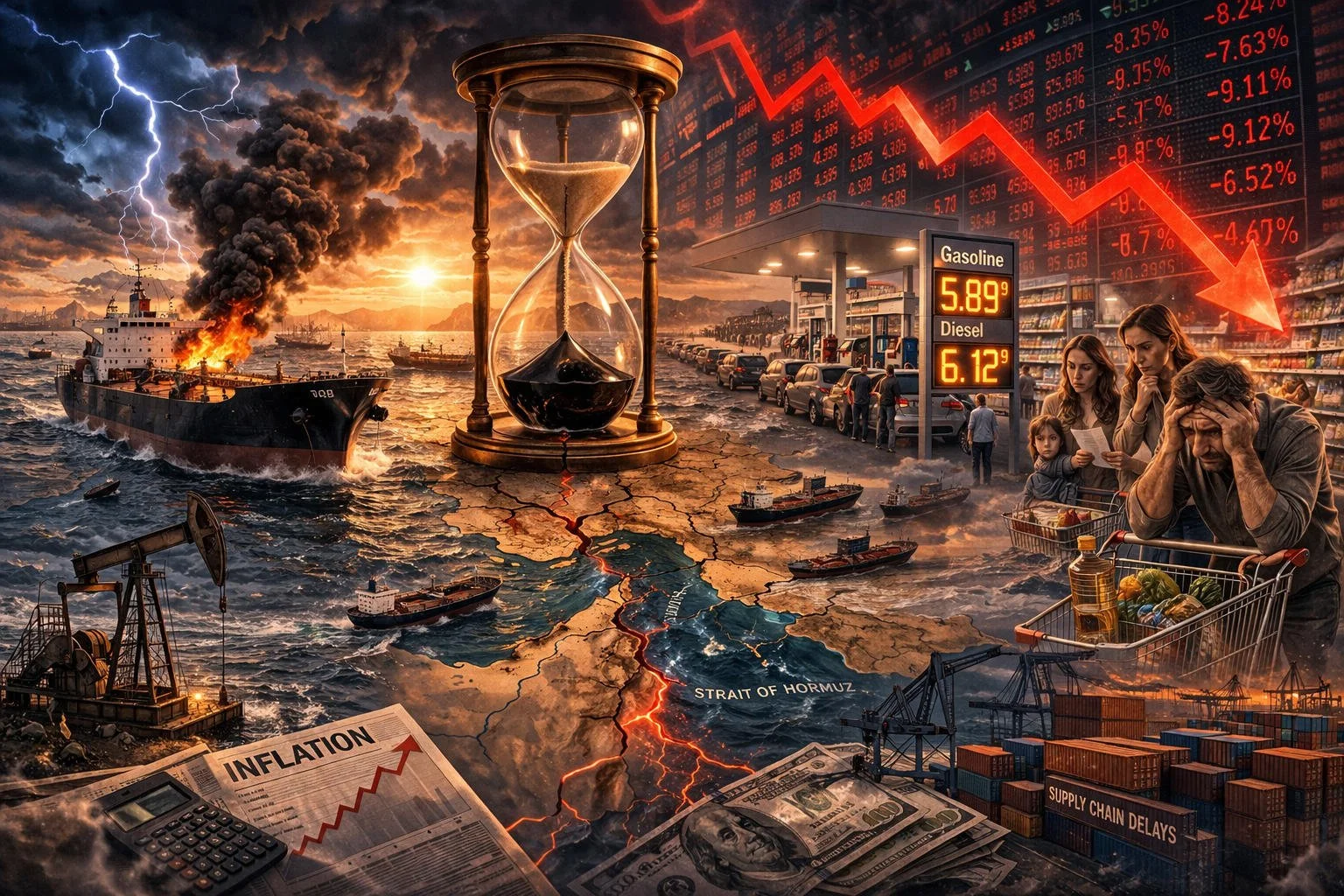
For the first phase of a Hormuz disruption, the world can tell itself a comforting story. Inventories still exist. Some tankers are already on the water. Alternative routes and emergency stock releases buy time. Financial markets can rally on every rumor of talks. But if the Strait of Hormuz stays functionally impaired for another six months, this likely turns from a price shock into something worse: a shortage-and-allocation crisis where the system still works, but badly, unevenly, and with mounting collateral damage. That is not a Mad Max scenario. It is more dangerous than that in a way, because it would spread quietly through fuel, freight, food, inflation, and credit.
The first few weeks are the deceptive part
What makes long energy shocks so dangerous is that the worst pain usually does not arrive on day one. It arrives after the buffers start running out. Right now, some of those buffers are still visible. Saudi Arabia has restored the capacity of its East-West pipeline to 7 million barrels per day, the U.S. has pushed crude exports up to 5.2 million barrels per day and is brushing against its roughly 6 million barrel-per-day export capacity, and the IEA has already coordinated a massive 400 million barrel emergency release from member reserves. Those are meaningful shock absorbers. They are also temporary and incomplete.
That is why the six-month scenario is so much darker than the six-week scenario. The emergency measures can soften the blow, but they cannot fully replace normal Hormuz flows for half a year. Reuters reports that nearly a fifth of global oil flows have been blocked and Gulf producers have already shut in about 9 million barrels per day. Even with rerouting and reserves, that is too large a disruption to absorb cleanly for long.
Aviation is probably where the damage becomes impossible to ignore
The clearest warning sign is jet fuel. The AP reported today that IEA chief Fatih Birol believes Europe may have only about six weeks of jet fuel left at current disruption levels. Reuters separately reported that Europe is now pulling record jet-fuel inflows from the U.S. and Nigeria because roughly 75% of its jet-fuel imports normally come from the Middle East. Even with those emergency inflows, Reuters says the IEA believes European stockpiles could fall to just 23 days by June if replacement supplies fail to recover more than half the lost Gulf volumes.
That is the kind of fact that makes the whole crisis feel different. This stops being an abstract oil chart and starts looking like flight cancellations, airport disruptions, higher fares, grounded aircraft, and governments openly drafting emergency fuel plans. Reuters says the EU is already working on exactly that. If the Strait is still badly impaired six months from now, summer travel chaos would probably be only the beginning, not the peak.
Asia could get squeezed even harder than Europe
Asia’s vulnerability is even more unnerving because of the scale. Reuters reported today that the IMF sees Asia as particularly exposed to a Middle East energy shock: oil and gas consumption amount to about 4% of Asia’s GDP, nearly double Europe’s share, while net fuel imports account for about 2.5% of GDP. Under more adverse scenarios, the IMF says conflict-related supply disruptions could trim 1 to 2 percentage points from Asian growth through 2027.
China does have a buffer. Reuters reports it may now be sitting on crude stockpiles above 1.2 billion barrels, enough to help sustain refinery output for a while. But that same Reuters piece warns that China’s fuel exports are likely to decline, which would tighten refined-product markets across Asia, especially for diesel and jet fuel. In other words, China’s stockpile can cushion China better than it can cushion the rest of Asia. If Hormuz stays impaired for six months, neighboring import-dependent economies would likely feel the shortage first and the hardest.
The oil market is already flashing something uglier than the stock market
One reason this crisis can still look deceptively manageable is that headline futures prices are probably understating how bad the physical market already is. Reuters reported today that physical crude benchmarks like Dated Brent have surged as high as $120 to $150 a barrel even while futures hover closer to $100. That gap matters. It means the barrels people need in the real world are much tighter than the screen price implies. Reuters described it as oil’s “price compass” being shattered.
That is the kind of dislocation you see when markets are still betting on a short crisis even as the physical system is straining much harder underneath. If that mismatch persists for months, it becomes a serious economic problem in its own right. Companies hedge off futures. Investors price risk off futures. Politicians calm the public with futures. But if the real physical market is tighter than the visible market, the eventual adjustment can be violent. That is an inference, but it is directly supported by Reuters’ reporting on the widening gap between physical and paper oil pricing.
Then the crisis spreads from energy into growth, inflation, and finance
This is the part people tend to underestimate. A six-month Hormuz disruption would not just mean expensive gasoline. It would likely mean slower growth, stickier inflation, and central banks trapped in an ugly middle ground.
Reuters reported that the IMF now expects more than a dozen countries may seek loans to cope with the energy shock and supply-chain disruption, with potential financing needs of $20 billion to $50 billion. The Fund also warned that global growth could fall to 2.5% in 2026, or even 2% in a worse scenario. Reuters also reported today that Germany has slashed its 2026 growth forecast to 0.5% and raised its inflation forecasts, while the IMF says the euro zone would still take a major hit even if the conflict were resolved quickly, with 2026 growth at just 1.1% and inflation at 2.6%.
In the U.S., New York Fed President John Williams said today that the war is already feeding inflation pressure into airfare, groceries, fertilizer, and other categories. The IMF has also warned that the war is increasing broader financial-stability risks, including the possibility of tighter funding conditions and forced asset sales if the shock drags on. So if Hormuz remains badly impaired for six months, the likely outcome is not just “higher prices.” It is a nastier mix of weaker growth, persistent inflation, and higher financial fragility.
Food is where this could get politically explosive
The energy story is bad enough. The food angle is where it starts turning vicious.
Reuters reported that the UN Food and Agriculture Organization warned a prolonged Hormuz crisis could trigger an “agrifood catastrophe.” The reason is simple: the Strait is critical not just for oil, but for fertilizers and related inputs that have to arrive on time for planting cycles. Delays there can reduce yields later, which means the price shock does not stay confined to fuel pumps. It eventually lands in grocery bills and food security. The IMF also said delays in fertilizer shipments are already worsening food insecurity in vulnerable countries.
You can already see the early edge of this in corporate reporting. Reuters reported today that Lactalis, the world’s largest dairy company, said the Iran war is causing shipment delays and higher costs for energy, transport, and packaging, and that it expects to raise consumer prices in 2026. If a giant multinational dairy company is already warning about spoilage risks and passing through higher costs, that is a glimpse of how a long Hormuz crisis stops being a commodities story and becomes a supermarket story.
So how bad does six more months get?
Bad enough that the comforting phase ends.
Not “everything collapses tomorrow” bad. Not “the world runs out of oil completely” bad. But very likely worse than a normal oil shock, because the damage would spread layer by layer. First prices spike. Then fuel gets prioritized. Then flights get cut. Then industrial users pay more or get less. Then food inflation worsens. Then governments start triaging who gets help, central banks lose room to maneuver, and weaker countries go looking for IMF money. The reporting from the IEA, IMF, FAO, Reuters, and AP all points in the same direction: a prolonged Hormuz disruption is not just inflationary. It is recessionary, destabilizing, and hardest on importers and poorer countries.
That is why the six-month scenario matters so much. The first stretch can be masked by stockpiles, emergency releases, and wishful market pricing. The later stretch is where reality starts forcing itself into airline schedules, factory margins, household budgets, and sovereign balance sheets. If the Strait is still badly constrained six months from now, the real headline probably will not be that oil is expensive. It will be that the global economy kept pretending this was temporary until the shortages became impossible to hide.