
82nd Airborne on Deck: Why the Iran War May Be About to Get Much Bigger
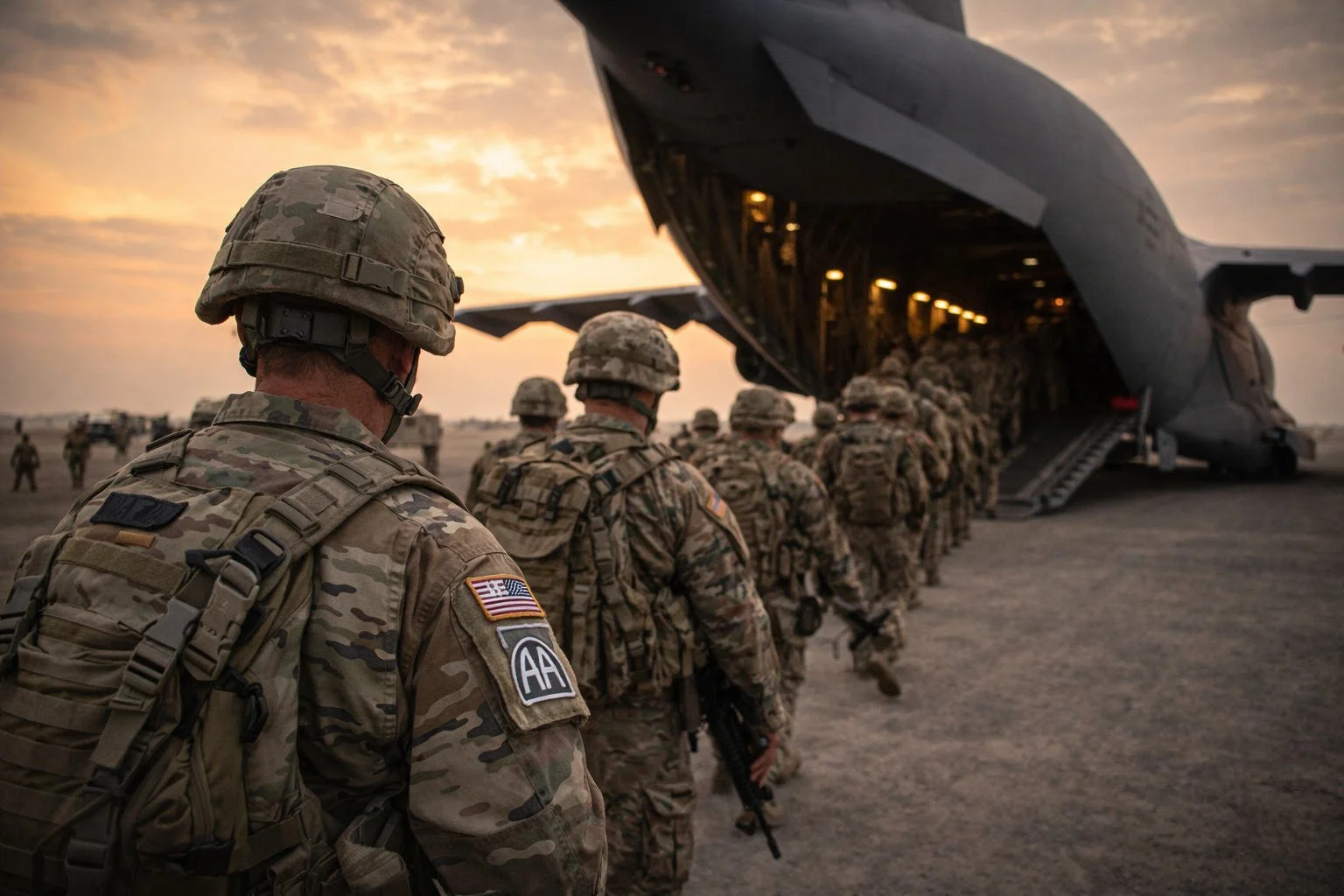
Reports that senior military officials are weighing the deployment of a combat brigade from the 82nd Airborne Division’s Immediate Response Force, along with elements of the division’s headquarters staff, are about as clear a sign as there is that Washington wants a real ground-war option on the table. The New York Times reported Monday, via syndicated coverage, that the Pentagon is considering sending roughly 3,000 paratroopers from the 82nd’s rapid-response brigade, a force built to deploy anywhere in the world within 18 hours, and that one possible mission discussed is seizing Kharg Island, Iran’s main oil export hub.
That does not mean a drop into Iran is guaranteed tomorrow. But it does mean the planning has moved past generic contingency talk. Reuters has already reported that the Trump administration is weighing military reinforcements for a “possible new phase” of the war, that Trump’s stated goals include securing safe passage through the Strait of Hormuz, and that no decision has yet been made to send troops into Iran itself even as the U.S. builds capacity for possible future operations in the region. Reuters also reported that the U.S. now has more than 50,000 troops in the Middle East and is adding thousands more Marines and sailors, including two Marine Expeditionary Units that can conduct aviation strikes or be deployed on land.
That is why this looks like escalation, not theater. Headquarters elements are not moved casually. Command staffs are what make a larger operation possible: they coordinate intelligence, logistics, airspace management, communications, follow-on forces, casualty planning, and deconfliction with naval and air assets already in theater. If reporting that the 82nd’s command element is being sent forward is accurate, that suggests the Pentagon is not merely asking, “Should we send troops?” It is starting to ask, “How would we run it if we do?” That is a much more serious question. The Washington Post reported earlier this month that the Army abruptly canceled a major exercise involving the 82nd’s headquarters element, fueling speculation about a Middle East deployment, while Reuters has reported that lawmakers emerged from classified briefings worried the United States was moving toward putting troops on the ground in Iran.
The larger context makes the move even more ominous. The air and naval campaign has been intense, but it has not solved the central strategic problem. Reuters reported that Trump’s goals go beyond degrading Iran’s military and include securing navigation through Hormuz, while a Reuters report today noted that Bahrain, backed by Gulf states and the United States, has pushed a draft U.N. resolution authorizing “all necessary means” to protect commercial shipping. That is a sign that the chokepoint problem remains unresolved enough that Washington and its partners are still searching for a more decisive answer.
That matters because if the United States concludes that airpower and naval strikes alone cannot reopen Hormuz reliably, then some kind of land or near-shore operation becomes easier to imagine. Reuters has reported that Trump has oscillated between promising to secure the strait, pushing allies to help do it, and hinting he may leave others to manage the fallout. At the same time, Reuters reported on March 21 that Marines and heavy landing craft were already heading to the region, while Kharg Island remained in focus as a potential target if Washington chose to use ground troops. That is the operational bridge between “no boots on the ground” rhetoric and real expeditionary planning.
So what targets would the United States most likely focus on if it crossed that line?
The first and most obvious target set is Kharg Island. Kharg is not just another Iranian island. It is the hub for nearly all of Iran’s oil exports, and Reuters reported that U.S. forces already struck more than 90 Iranian military targets there while deliberately preserving the oil infrastructure. That is the tell. If Washington only wanted to destroy Kharg, it could try to wreck the export facilities themselves. Preserving them while hitting mine storage, missile bunkers, and other military sites suggests Kharg is being treated as something more valuable intact than ruined. In plain English, that looks much more like preparation for coercive control than for simple demolition.
The second likely target set is Iran’s southern coast and the islands tied directly to the Strait of Hormuz fight. Reuters has reported that Trump’s stated war aims include safe passage through the strait, and the war’s center of gravity remains the shipping corridor and the military network that can threaten it. If the Pentagon decides it needs paratroopers and planners in theater, the most plausible use would be to support operations against the military architecture making Hormuz unusable: coastal missile positions, mine-related infrastructure, drone-launch areas, IRGC naval facilities, and island strongpoints supporting attacks on shipping. That is an inference, but it is a straightforward one drawn from the publicly stated objective of reopening the strait and from the fact that U.S. strikes have already focused heavily on Iran’s navy, mine storage, and missile capabilities.
The third possible target set is Iran’s nuclear material and associated sites, though this would likely be a special-operations-heavy mission rather than a large conventional airborne assault. Reuters reported earlier this month that Trump was weighing the option of deploying special forces on the ground to seize Iran’s near-bomb-grade uranium, even though he later said he was “nowhere near” a decision on that issue. The significance is not that a uranium raid is imminent. It is that the White House has already entertained a mission that could not be accomplished cleanly from the air alone. Once that kind of mission enters the planning conversation, it becomes much easier to imagine supporting deployments whose job would be to secure entry points, protect extraction corridors, or provide command-and-control for a wider ground package.
What makes all this feel like a possible inflection point is that it lines up with how officials are talking behind closed doors. Reuters reported that Senator Richard Blumenthal came out of a classified briefing warning that the U.S. seemed to be “on a path toward deploying American troops on the ground in Iran to accomplish any of the potential objectives here.” That is not a pundit’s guess. It is how at least one senator described what he heard after being briefed by the administration.
The military logic is harsh, but not hard to see. If Washington wants to do more than punish Iran from the air—if it wants to physically change conditions on the ground or at the shoreline—then it needs forces built for seizure, rapid entry, and holding terrain long enough for follow-on operations. That is precisely the kind of role the 82nd Airborne exists to fill. It is not a force you lean on when you are preparing to wind a war down. It is a force you ready when you want the ability to suddenly make the war much bigger.
The final point is the simplest. A possible 82nd Airborne deployment does not prove Washington has decided on an invasion of Iran. But it strongly suggests the administration wants to be ready for operations that are qualitatively different from what it has been doing so far. Airstrikes, naval skirmishing, and sanctions can hurt Iran. Seizing islands, securing coastal launch zones, or moving against nuclear material would be something else entirely. If the reporting is right, the Pentagon is now planning for that “something else.” And that is why this development looks less like routine reinforcement and more like the clearest sign yet that a much larger escalation could be coming.
What could this do to the price of oil?
A move toward using the 82nd Airborne would likely be read by oil markets as a sign that Washington thinks the war is entering a more dangerous and longer-lasting phase, not moving toward a quick exit. That matters because crude is already reacting violently to every sign the conflict could widen: Reuters reported today that Brent jumped above $104 and WTI above $92 as the Hormuz disruption persisted and hopes for near-term diplomacy faded.
If investors start believing U.S. ground or near-shore operations are being prepared to seize or secure key targets, oil could rise for two reasons at once. First, it would signal that the Strait of Hormuz crisis is not close to being solved peacefully. Second, it would raise the risk of Iranian retaliation against more energy infrastructure, shipping, or Gulf producers. Reuters reported this week that Goldman Sachs has already raised its outlook because it expects a longer Hormuz disruption, and Reuters separately reported that Wood Mackenzie sees oil potentially reaching $150 if the Gulf shutdown persists.
The bigger point is psychological as much as physical. A possible 82nd Airborne deployment would tell traders this is no longer just an air-and-sea campaign with limited objectives. It would suggest Washington may be preparing for a phase of the war that is harder to reverse and far more unpredictable. In oil markets, that is exactly the kind of signal that can keep a war premium high, or drive it even higher, because traders stop asking when the spike ends and start asking how much worse the disruption could get.