
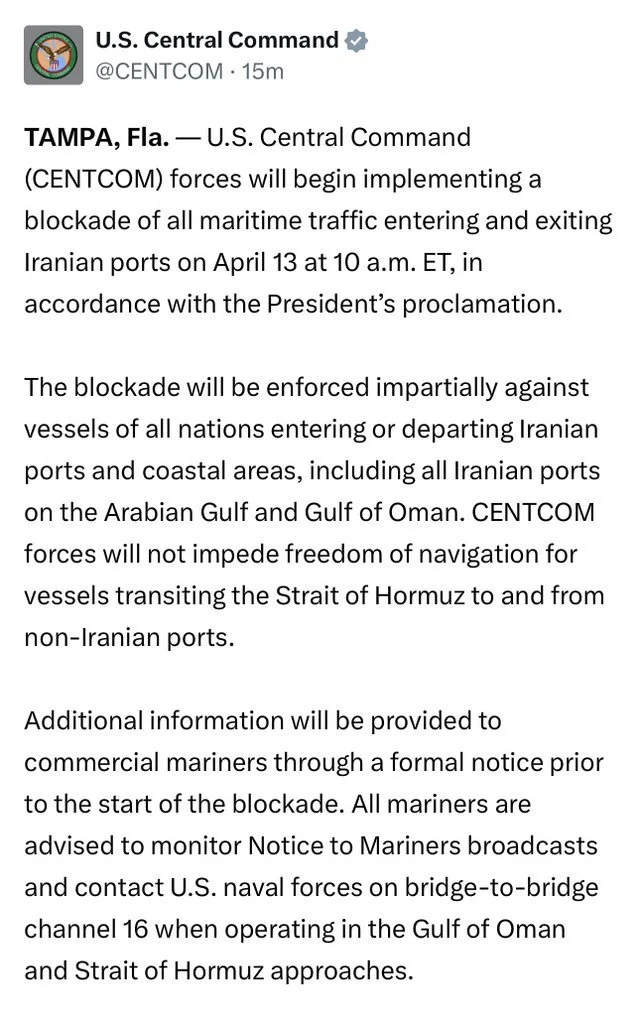
U.S. Central Command (CENTCOM) forces will begin implementing a blockade of all maritime traffic entering and exiting Iranian ports
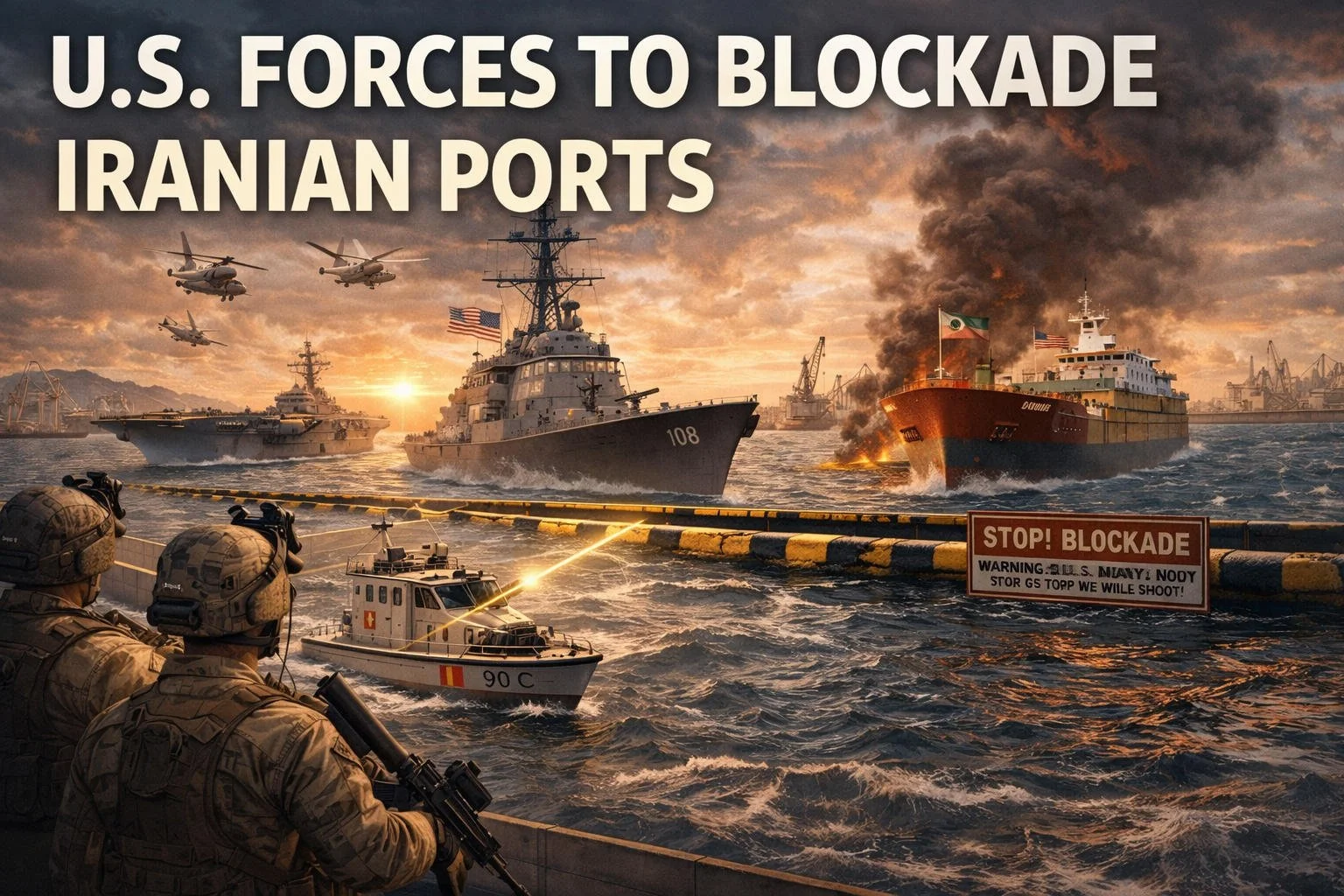
At first glance, investors may try to tell themselves this is manageable. After all, the U.S. is not formally closing the entire Strait of Hormuz to all traffic. The announced blockade is narrower: ships bound for Iranian ports or leaving Iranian ports are the target, while non-Iranian transit is supposedly allowed. But markets do not crash because a legal memo sounds broad or narrow. Markets crash when traders suddenly realize a “limited” step can still blow up into a full-scale energy and macro shock. That is the danger here.
The first reason this could hammer stocks is simple: this is an escalation, not a de-escalation. It follows the collapse of U.S.-Iran talks in Islamabad, and it comes in a region where shipping, insurance, energy infrastructure, and military signaling are already badly stressed. Reuters reported that after the talks failed, the dollar immediately caught a fresh safe-haven bid, risk-sensitive currencies fell, and investors started bracing again for higher inflation and fewer rate cuts. That is exactly how a market begins to reprice from “fragile truce” back to “hard escalation.”
And the market has already shown how violently it swings on Hormuz headlines. When the two-week ceasefire was announced earlier this week, oil collapsed and stock futures surged. AP reported that U.S. crude fell 14.3% to $96.83, Brent fell 13.3% to $94.74, Japan’s Nikkei jumped 4.8%, South Korea’s Kospi rose 5.6%, and S&P 500 futures gained 2.3%. Reuters likewise reported Brent settling at $94.75 and U.S. crude at $94.41 after the truce. In other words, the relief rally was built on one core belief: that the worst of the Gulf energy shock might be fading. If that belief dies, the reversal could be savage.
That matters because the Strait of Hormuz is not just another geopolitical hotspot. The IEA says about 20 million barrels per day of crude oil and oil products moved through Hormuz in 2025, about 25% of the world’s seaborne oil trade, and it stresses that alternatives are limited. The EIA likewise describes Hormuz as one of the world’s most critical oil chokepoints. So even a blockade that is technically focused on Iranian ports can still terrify markets if it raises the odds of broader interference, retaliation, confusion at sea, or renewed insurer refusal to cover transits.
The second reason this could hit stocks hard is that the oil market has already shown signs of outright panic under similar stress. Reuters reported that Brent crude rose 60% in March during the Hormuz disruption, and that physical oil prices for some grades surged near $150 a barrel as refiners scrambled for immediate supply. That is not a neat, orderly repricing. That is the kind of stress that starts breaking models, squeezing margins, and making traders pay almost anything for prompt barrels. Once the oil market behaves like that, equity investors stop thinking about earnings growth next quarter and start thinking about systemic damage.
The third reason is that traffic through Hormuz was never truly back to normal in the first place. Even after the ceasefire, reports indicated that shipping remained far below normal levels. The Wall Street Journal’s live coverage cited the UK Maritime Trade Operations center saying there had been no meaningful increase in traffic since the truce and that only four vessels had transited in the previous day, versus a pre-war daily average of about 138. Reuters separately reported that only a few supertankers had begun moving again and that Gulf equities remained subdued because investors still doubted the ceasefire’s durability. In other words, this new blockade is landing on top of a market that was already unstable, not a market that had fully healed.
There is also a more dangerous point here: even if Washington insists it is only blockading Iranian ports, Tehran does not have to respond in a proportionate, lawyerly way. Iran can retaliate asymmetrically. It can harass tankers, lean harder on naval mines, threaten military vessels, pressure Gulf shipping, or encourage more strikes on regional energy infrastructure. Iran has already warned of a “strong and forceful response” to military vessels approaching the strait, and Reuters has reported recent attacks that cut Saudi output and reduced flows on the East-West pipeline before Saudi restored it. That is the real market nightmare: not the blockade order by itself, but the next move it provokes.
If that retaliation comes, the stock market problem becomes much bigger than energy. It becomes inflation. The Bureau of Labor Statistics reported that in March 2026, the U.S. CPI rose 0.9% month over month and 3.3% year over year, with the energy index up 10.9% and gasoline up 21.2% in a single month — the biggest monthly gasoline increase since the series began in 1967. Reuters reported gasoline accounted for nearly three-quarters of the inflation jump. That means the U.S. economy is already digesting one oil shock. A fresh escalation risks pouring gasoline on gasoline.
And once inflation is re-ignited, equities get hit from both sides at once. Consumers get squeezed by higher fuel and transport costs, while the Fed gets less room to cut rates. Reuters reported on Sunday that after talks collapsed and the blockade threat emerged, investors began bracing for possible central-bank tightening rather than easing. That is poison for richly valued growth stocks, rate-sensitive sectors, and any company that depends on strong consumer spending and cheap capital at the same time.
Federal Reserve research helps explain why. In a 2024 note, Fed staff found that foreign oil supply shocks push U.S. inflation higher and output lower. In their model, a shock large enough to produce the kind of oil surge seen in early 2022 added almost one percentage point to headline inflation on impact, while dampening U.S. output growth. That was not even a Hormuz-scale war shock. It was a reminder that oil spikes do not just hit drivers at the pump; they filter through production costs, import prices, real incomes, and growth expectations.
This is why a blockade of Iranian ports could crash markets even if it is not technically a total shutdown of Hormuz. Stocks do not need every single tanker in the Gulf to stop moving. They just need enough fear that the next step is worse: more retaliation, fewer sailings, higher insurance costs, fresh attacks on bypass infrastructure, stickier inflation, delayed rate cuts, and the return of recession talk. That chain reaction is what turns a “regional maritime action” into a global equity event.
The most exposed parts of the market are not hard to imagine. If oil spikes again, the sectors that benefited most from the ceasefire could reverse hardest. Reuters reported that when the truce punctured the war premium in oil, energy shares fell sharply while airlines rallied. Flip that dynamic around and you can see the map of the pain: travel, transport, fuel-sensitive industries, consumer names exposed to household budgets, and rate-sensitive growth stocks could all come under pressure at once, even if oil producers initially benefit.
So could this really trigger a serious market drop? Yes. Not because the blockade automatically guarantees a crash at Monday’s open, and not because every scenario ends in a 1987-style wipeout. But because the setup is exactly the kind markets hate most: war risk rising again, oil already elevated, inflation already hot, shipping still impaired, and a policy shock that can spiral into retaliation before traders have time to convince themselves it is “contained.” If investors start believing this blockade is the first step toward a broader maritime war in the Gulf, the selloff could get ugly fast.