Why Dorsia From American Psycho Is Still the Ultimate Restaurant Status Joke
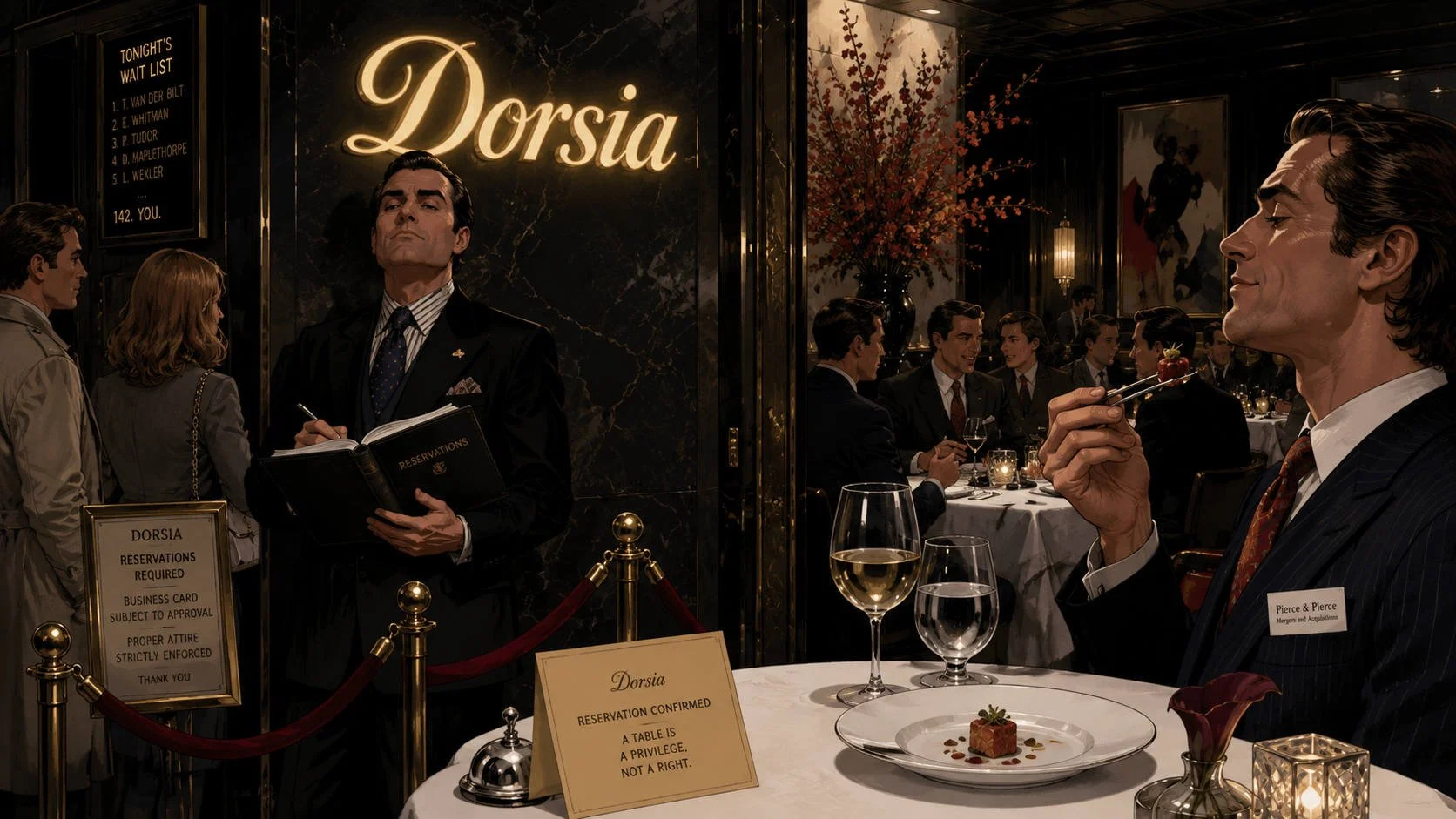
Dorsia is the perfect restaurant because it does not exist. No menu to disappoint you. No server to ignore you. No $28 endive salad arriving with the confidence of a mortgage payment. No actual food to ruin the fantasy. Just a name, a reservation, and the crushing knowledge that Patrick Bateman cannot get in.
That is why Dorsia still works. It is not a restaurant joke. It is a status joke wearing a dinner jacket.
In American Psycho, Dorsia is the impossible table. The trophy reservation. The social checkpoint. The place everyone pretends to know, nobody can casually access, and Patrick Bateman desperately wants because his entire personality is a luxury goods receipt with abs. Eater’s guide to the restaurants of American Psycho notes that the film and novel name-check plenty of real New York hotspots, but Dorsia itself is fictional. Perfect. The most powerful restaurant in the story is the one that cannot serve a single appetizer.
And that is the joke: Dorsia does not need to be good. It only needs to be unavailable.
Dorsia Is Not About Food. Obviously. Please Try to Keep Up.
The funniest thing about Dorsia is that nobody ever talks about wanting to eat there in any normal human way. Nobody says, “I hear the roast chicken is wonderful.” Nobody says, “They have a lovely seasonal pasta.” Nobody says, “The service is warm, and the room has good acoustics.” That would be restaurant talk. Dorsia is not restaurant talk. Dorsia is caste talk.
Patrick Bateman wants Dorsia because other people want Dorsia. That is the whole disease, neatly plated.
The restaurant becomes a social asset, like a business card, an apartment, a suit, a reservationist who knows your voice, or the ability to say “we’re doing Dorsia” without immediately being laughed into a municipal trash can. It is not dinner. It is proof of rank.
This is why the joke has outlived the 1980s yuppie world it was skewering. Because status did not go away. It just downloaded an app.
American Psycho Made the Reservation the Real Monster
American Psycho is a 2000 film directed by Mary Harron and based on Bret Easton Ellis’s 1991 novel; Rotten Tomatoes describes it as a biting comedy about Patrick Bateman, a young New York professional with a double life as a serial killer. The film’s horror is obvious, yes, but the comedy is in how much of Bateman’s world runs on shallow signals: suits, cards, restaurants, apartment décor, bodies, brand names, and the correct level of expensive boredom.
The Dorsia joke works because it is smaller than the murders and somehow more humiliating. Bateman can perform wealth. He can perform taste. He can perform confidence. He can perform skincare with the emotional depth of a laminated instruction manual. But he cannot perform access.
Access is the one thing money alone cannot always buy, and this makes him furious. Poor little murder banker. Somebody denied him sea urchin ceviche and now civilization must answer for it.
Dorsia Is the Restaurant Version of the Business Card Scene
The famous business card scene and the Dorsia obsession are basically the same joke with different stationery.
The business card scene says: these men are so empty that microscopic differences in paper stock can trigger spiritual collapse. Dorsia says: these men are so empty that a dinner reservation can become a personality crisis. The stakes are absurd because the people are absurd. The whole ecosystem is men with expensive haircuts trying to rank each other by details invisible to anyone with a functioning soul.
Dorsia is not a place. It is a scoreboard.
That is why “getting into Dorsia” became shorthand for a specific kind of social hunger: the need to be seen not merely as rich, but as selected. Rich is money. Selected is status. Money buys dinner. Status gets the table at 8:30.
And of course Patrick Bateman wants the 8:30 table. He is not going to eat at 5:45 like a divorced orthodontist near a train station.
The Joke Aged Horribly Well Because Reservations Became Worse
The most annoying thing about American Psycho is that its restaurant satire became less exaggerated over time. We were supposed to laugh at Bateman’s status panic, not build an entire reservation economy around it like a society having a nervous breakdown in loafers.
The New Yorker reported in 2024 that hard-to-get restaurant reservations in New York had become their own market, shaped by reservation platforms, concierges, membership clubs, secondary marketplaces, and bots that can monitor apps many times per second. It also described resellers making tens of thousands of dollars selling coveted tables.
Beautiful. The future arrived, and it brought scalped pasta.
Now everyone gets to experience a mild Dorsia moment. You want a table at a hot restaurant? Set an alarm. Refresh the app. Watch every decent time vanish instantly. Wonder if a bot beat you to rigatoni. Consider eating at 9:45 p.m. on a Wednesday like a raccoon with a Chase Sapphire card. This is progress, allegedly.
The Real Dorsia App Is Almost Too On the Nose
Because irony is dead and wearing a blazer, there is now an actual Dorsia: a members-only platform promising access to desirable restaurants, events, and experiences around the world. Its own site describes it as offering “the most desirable tables” and cultural experiences in cities including New York, Miami, London, Dubai, and others.
The platform’s FAQ says members prepay a locked-in minimum spend to confirm a reservation, with that spend calculated through a supply-and-demand pricing model based on timing, urgency, availability, and demand. In other words, Dorsia the fictional joke about status dining became Dorsia the real mechanism for monetizing status dining. Satire looked at capitalism and said, “Please don’t,” and capitalism said, “Great brand name.”
This is why the original joke still lands. Because the premise did not become outdated. It became a business model.
Imagine explaining this to Patrick Bateman. He would not be horrified. He would ask whether the membership tier comes embossed.
Dorsia Works Because It Is Pure Exclusion
A normal restaurant has three basic functions: feed people, host people, and make enough money not to collapse into a pile of unpaid invoices. Dorsia has one function: exclude people.
That is what makes it funny. The fantasy is not “Dorsia serves great food.” The fantasy is “Dorsia turns away people who are almost good enough.” That “almost” is where the comedy lives. Bateman is not poor. He is not unfashionable by his own deranged standards. He is not outside the world of wealth. He is inside it, but not securely enough to relax.
Status anxiety is most violent near the top. Nobody panics about Dorsia from a diner booth at 2 a.m. eating pancakes in peace. The person panicking is the one who thinks he should be above the line and discovers there is another line above him. Then another. Then another. Congratulations, you have found the VIP escalator to hell.
The Best Restaurant Status Symbols Are Invisible to Outsiders
Dorsia is brilliant because the status signal only works inside a specific social circle. To a normal person, “I got us into Dorsia” means nothing because Dorsia is fictional and also you sound unbearable. To Bateman’s world, it means access, taste, power, and social proof.
That is how elite restaurant culture often works. The signal is not always the food; it is knowing which door matters, which table matters, which night matters, which host matters, which room matters, and which reservation time says “chosen” instead of “technically seated.”
A 6 p.m. table says you have a reservation. An 8 p.m. table says you have a relationship. A corner booth says the restaurant knows you. A last-minute prime-time table says either you are important, your concierge is terrifying, or your credit card has entered a new tax bracket and brought a tiny flag.
Dorsia compresses all of that nonsense into one word. That is efficient satire. Terrible dinner planning, excellent cultural diagnosis.
The Modern Reservation Black Market Proves the Joke Had Legs
New York State eventually treated reservation scalping seriously enough to pass the Restaurant Reservation Anti-Piracy Act. Governor Kathy Hochul’s office said in December 2024 that the law prohibits third-party reservation services from arranging unauthorized reservations and was meant to crack down on a black market that put extra costs on consumers before they even entered the restaurant.
That is where we are now: laws against unauthorized table flipping. Human civilization invented agriculture, restaurants, online booking, bots, reservation scalpers, and then legislation to stop the bots from taking the cacio e pepe slots. Magnificent work, everyone. The dolphins must be exhausted watching us.
The Dorsia joke predicted the emotional logic perfectly. The reservation itself becomes valuable before the meal exists. The table is not a place to eat; it is a scarce digital token representing access to social oxygen. Dinner has become ticketing. The maître d’ has become a market maker. Your anniversary is now competing with a bot named something like ResyDestroyer9000.
Dorsia Is Funny Because It Is Empty at the Center
The ultimate restaurant status joke requires one thing: emptiness.
If Dorsia had a real menu, people could argue about the food. If it had a real chef, people could debate technique. If it had a real dining room, people could discuss lighting, service, and whether the chairs were designed by a sadist with a Scandinavian furniture grant.
But Dorsia has none of that. It is pure aura. Pure rumor. Pure social hunger. It is a restaurant reduced to the only thing status diners sometimes care about: the ability to say they got in.
That is the dead-eyed genius of it. Dorsia is not even pretending food is the point. Food would only complicate the brand.
Mary Harron Understood the Men Were the Joke
Part of why Dorsia still works is that the film understands Bateman is ridiculous. Not aspirational. Not cool. Not a sigma icon. Ridiculous. Director Mary Harron said in a 2025 interview that she and co-writer Guinevere Turner did not expect the film to be embraced by “Wall Street bros,” adding that Christian Bale was clearly making fun of that type of man and playing Bateman as “dorky and ridiculous.”
This matters because Dorsia gets misread the same way Bateman gets misread. Some people hear “Dorsia” and think, “Elite.” The joke says, “Pathetic.” Some people see the obsession with reservations and think, “Power.” The joke says, “Insecurity with a phone line.”
Bateman is not impressive because he wants Dorsia. He is pathetic because he needs Dorsia to confirm he exists.
Tiny distinction. Very important. Apparently still too advanced for certain men with podcast microphones.
Dorsia Is the Original “I Know a Place” Flex
Every era has its own access phrase.
“I know the owner.”
“Text me, I can get us in.”
“They hold tables for regulars.”
“My friend is friends with the chef.”
“We’re doing the private room.”
“It’s members-only.”
“You can’t book it online.”
“I have a guy.”
Dorsia is the distilled version of all of these. It is the fantasy of being the person who can make the impossible happen. Not because the food is needed. Because the social magic is needed.
And that is why the joke is so durable. Everyone recognizes the type. The person who does not invite you to dinner, but announces the reservation like a military victory. The person who treats a host stand like passport control. The person who says “they squeezed us in” in the tone other people reserve for surviving avalanches.
Pop-Ups Prove Dorsia Is Now Cultural Currency
In 2025, Time Out reported that Dorsia was brought to life as a one-night New York pop-up tied to Ketel One and the real Dorsia hospitality-tech platform, described as an immersive cocktail experience built around 1980s excess, secrecy, and status.
That is not just fan service. That is proof of how powerful the joke became. Dorsia is now recognizable enough to sell an experience based on not being able to access an experience. This is very stupid. It is also completely logical. The joke was always about exclusivity as performance. A Dorsia pop-up is just the performance becoming honest about itself.
The food is optional. The velvet rope is the entrée.
What Diners Can Learn From the Dorsia Joke
Here comes the useful part, because even satire should occasionally pay rent.
First, do not confuse hard to book with good. A restaurant can be impossible to enter because it is excellent, tiny, hyped, poorly managed, botted into oblivion, or full of people trying to impress other people who are also pretending not to be impressed.
Second, eat where you actually want to eat. Not where your group chat thinks you should want to eat. Not where TikTok pointed its ring light. Not where the reservation time feels like a personality upgrade.
Third, stop treating dinner like social proof. A great meal at a neighborhood place beats an anxious, overpriced performance where everyone is secretly calculating whether the table was worth the effort.
Fourth, if you do get the impossible reservation, enjoy the food. Radical concept. Chew. Talk. Look at the person across from you. Do not spend the whole meal broadcasting access like a human press release.
Otherwise, congratulations. You are not dining at Dorsia. You are being eaten by it.
Why Dorsia Is Still the Ultimate Restaurant Status Joke
Dorsia endures because it captures the dumbest, sharpest truth about status dining: sometimes the meal matters least to the people most desperate to get the table.
It is the perfect fictional restaurant because it is all access and no substance. It exposes the vanity of a world where being seen in the right room matters more than what is on the plate. It turns reservation anxiety into character study. It makes a wealthy man look small because he cannot secure dinner. Beautiful. Petty. Accurate.
The joke has only gotten stronger because modern dining culture has moved closer to the satire. We have bots grabbing tables, resellers auctioning reservations, members-only platforms, minimum spends, VIP tags, concierge networks, and restaurants that function as social currency with appetizers. The world looked at Patrick Bateman’s humiliation and decided what it needed was better software.
Dorsia is still funny because nobody is laughing from a safe distance anymore. We are all somewhere in the reservation queue, refreshing at 9:59, pretending we are above the nonsense while quietly wondering if 5:30 p.m. counts as dinner.
And that is the final humiliation. The fictional restaurant won.
It never opened. It never served a plate. It never had to comp a bad entrée or answer a one-star review from someone named Brad.
Dorsia simply stayed impossible, and let everyone else do the embarrassing work.