
Can You Lose Weight Eating Chipotle Bowls? What Bobby Flay Would Fix First
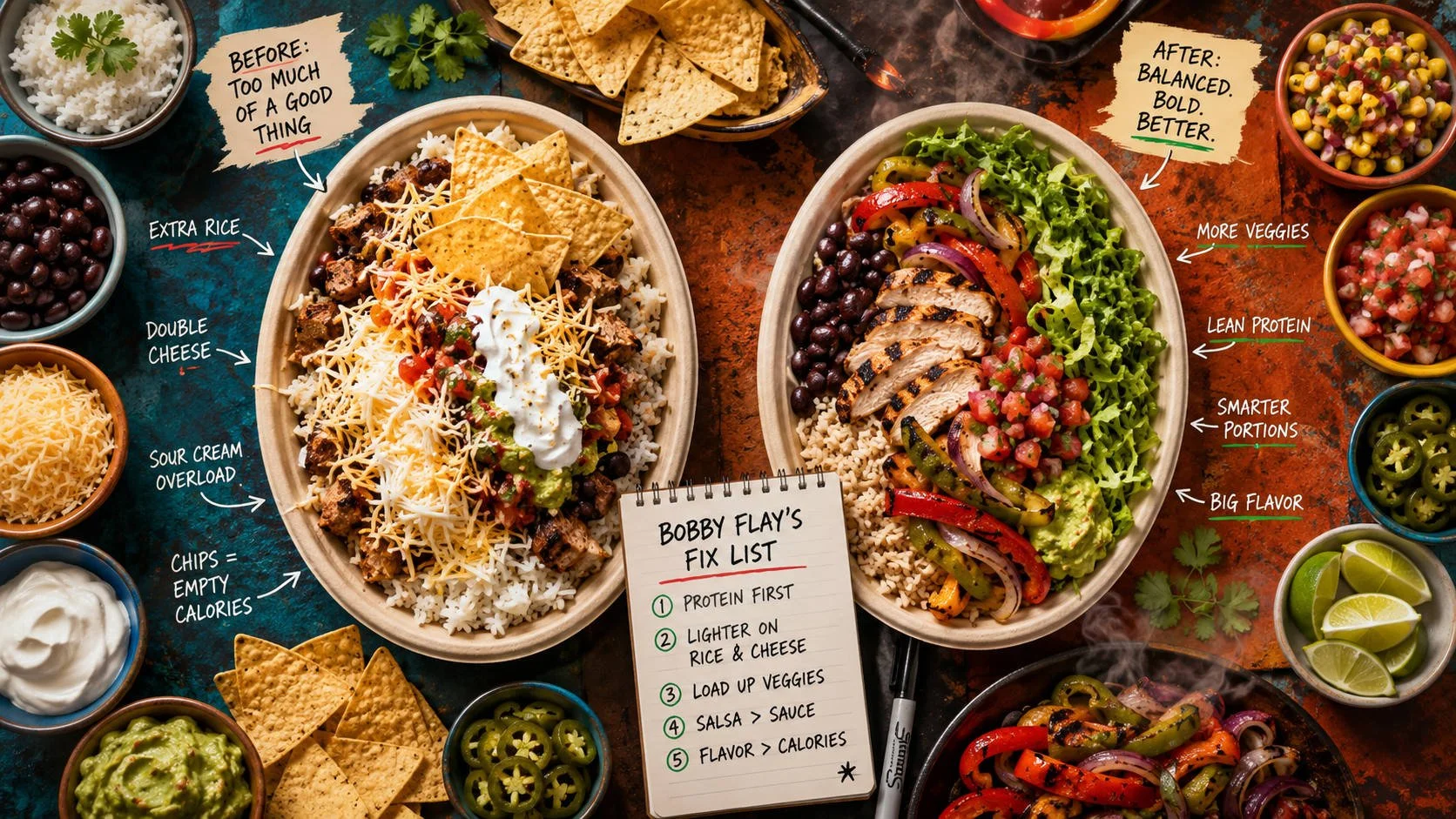
Chipotle is the rare fast-casual restaurant where people can order the same “healthy bowl” and end up with either a reasonable lunch or a tortilla-adjacent landslide that needs its own ZIP code. One person gets chicken, beans, fajita veggies, salsa, and lettuce. Another person gets rice, beans, double meat, queso, cheese, sour cream, guac, corn salsa, vinaigrette, chips, and a lemonade, then says, “But it’s a bowl,” as if the cardboard container has mystical fat-loss powers.
So can you lose weight eating Chipotle bowls? Yes. Obviously. You can lose weight eating almost any food if your overall calorie intake stays below what you burn. The CDC puts the boring truth plainly: weight loss comes from using more calories than you take in, and most weight loss comes from reducing calories, with physical activity helping weight maintenance. NIH says a deficit of about 500 calories per day is commonly suggested for roughly one pound per week of weight loss, though individual needs vary because bodies remain rude, complicated, and uninterested in your spreadsheet.
The real question is not “Can Chipotle work?” The question is “Can you order Chipotle like a functioning adult instead of a raccoon who found Apple Pay?”
That is where Bobby Flay comes in. Not because Bobby Flay has personally certified your burrito bowl, calm down. But because a Bobby Flay-style approach would fix the actual problem first: flavor. Bon Appétit’s profile of Flay highlights his practical cooking instincts: hot pans, bold seasoning, lemon zest, vinaigrettes used as sauces, condiments, chiles, and texture. In other words, he would not solve a boring diet bowl by making it sadder. He would make it sharper, hotter, brighter, crunchier, and less dependent on sour cream doing all the emotional labor.
The Chipotle Weight-Loss Problem Is Not Chipotle. It Is Bowl Math.
Chipotle is customizable, which is great until customization becomes self-sabotage with cilantro. The company’s nutrition sheet lists a burrito bowl range of 420 to 910 calories, while a burrito ranges from 740 to 1,210 calories. That range exists because one bowl can be lean and protein-heavy, while another can become an edible beanbag chair stuffed with fats, starches, and sauces.
The ingredient math is where the halo dies. A standard serving of chicken is 180 calories with 32 grams of protein. Steak is 150 calories with 21 grams of protein. Black beans are 130 calories, with 8 grams of protein and 7 grams of fiber. White rice is 210 calories. Cheese is 110 calories. Sour cream is 110 calories. Queso is 120 calories. Guacamole is 230 calories. Chips are 540 calories before you even drag queso or guac into the crime scene.
This is why people get confused. Chipotle can be a high-protein, high-fiber, satisfying meal. It can also be a 1,200-calorie bowl wearing lettuce like a fake mustache.
What Bobby Flay Would Fix First: The Bowl Is Bland Because You Made It Bland
Most diet orders fail because they taste like punishment. People remove cheese, sour cream, guac, rice, joy, color, and dignity, then wonder why they are face-first in chips by 9 p.m.
The Bobby Flay move would not be “make it dry.” It would be “make it taste like something.” Flay’s advice in Bon Appétit emphasizes seasoning, high heat, vinaigrette-as-sauce thinking, chiles, condiments, and contrast. Applied to Chipotle, that means using the low-calorie flavor tools aggressively before reaching for calorie-heavy comfort toppings.
Chipotle gives you plenty of flavor options that do not cost much calorie-wise: fresh tomato salsa is 25 calories, tomatillo-green chili salsa is 15 calories, tomatillo-red chili salsa is 30 calories, fajita veggies are 20 calories, and romaine lettuce is 5 calories. Even corn salsa, at 80 calories, can add sweetness, texture, and volume without behaving like a dairy-based wallet ambush.
The first fix is simple: stop using sour cream as your only sauce because you are afraid of salsa. Salsa is not there for decoration. It is the sauce. It is the acid. It is the heat. It is the thing keeping your “weight-loss bowl” from tasting like a spreadsheet in a compostable container.
Choose the Bowl, Not the Burrito, Unless You Budget for the Tortilla
The easiest weight-loss move at Chipotle is ordering a bowl instead of a burrito. This is not because bowls are virtuous and burritos are sinners. It is because the burrito tortilla alone is 320 calories, with 50 grams of carbs. That is not evil. That is just a lot of wrapper for people who claim they “barely ate anything.”
A tortilla can absolutely fit into a weight-loss plan. But if you want rice, beans, meat, salsa, cheese, and maybe guac, the tortilla is often the first thing to go. Not because carbs are demons. Because 320 calories of flour blanket is a large price to pay before the meal has even started speaking.
The bowl gives you flexibility. You can keep rice. Or beans. Or guac. Or cheese. Or double protein. But if you keep everything plus the tortilla, congratulations, you have created a delicious weighted blanket for your digestive system.
Protein Is the Anchor, Not the Decoration
For weight loss, protein matters because it helps satiety and helps preserve lean mass during calorie restriction, especially for active people. A review on elite athletes notes that protein recommendations during weight loss are often set around 1.6 to 2.4 grams per kilogram per day, depending on deficit severity and training. That does not mean every office worker needs to start eating chicken like a Victorian strongman, but it does mean protein is not optional garnish when trying to lose fat without losing usefulness.
At Chipotle, the strongest protein-per-calorie choice is usually chicken: 180 calories and 32 grams of protein. Steak is lower calorie at 150 calories, but it has 21 grams of protein. Barbacoa gives 170 calories and 24 grams of protein. Carnitas gives 210 calories and 23 grams of protein. Sofritas are 150 calories but only 8 grams of protein, which is fine for plant-based eaters but not exactly a protein thunderclap.
So the fix is obvious: anchor the bowl with protein. Then build around it. Do not build a rice-and-queso jacuzzi and toss in chicken as a decorative raft.
Beans Are Doing More Work Than People Give Them Credit For
Beans are the adult in the Chipotle line. Quiet, useful, affordable, filling, and constantly overshadowed by guacamole because guacamole has better public relations.
Black beans are 130 calories, with 8 grams of protein and 7 grams of fiber. Pinto beans are also 130 calories, with 8 grams of protein and 8 grams of fiber. That is exactly the kind of satiety structure a weight-loss bowl needs. Fiber intake is associated with lower body weight in epidemiologic studies, and satiety is one possible explanation, though fiber is not magic fairy dust and different fibers behave differently.
A chicken-and-bean bowl is already more satisfying than a chicken-and-lettuce bowl that leaves you hungry enough to negotiate with a vending machine. The point is not to make the lowest-calorie bowl possible. The point is to make the lowest-calorie bowl you can actually live with without becoming a snack goblin at 4:30 p.m.
Rice Is Not the Enemy. Unconscious Rice Is the Enemy.
Rice is where diet culture gets theatrical. People act like one scoop of rice has personally betrayed them. Relax. A 4-ounce serving of Chipotle cilantro-lime rice is 210 calories. That is not nothing, but it is also not the devil in grain form.
The Bobby Flay-style question is not “rice or no rice?” It is “what does the rice do for the dish?” If you trained hard, need carbs, or want a more filling meal, rice can make sense. If lunch is mostly sedentary and you want room for beans and guac, skip it or ask for light rice. Just understand that “light rice” is not an official lab-measured nutrition unit; portions vary, and Chipotle itself notes nutrition can vary due to portion size, recipes, seasonality, and ingredient sourcing.
Rice is a tool. Use it. Do not let a bored employee with a spoon decide your calorie deficit while you stare at the sneeze guard like a stunned deer.
The Fat Triangle: Cheese, Sour Cream, Guac. Pick Your Favorite Child.
Here is where many Chipotle bowls stop being weight-loss-friendly and start becoming dairy-and-avocado infrastructure.
Cheese is 110 calories. Sour cream is 110 calories. Guacamole is 230 calories. Queso is 120 calories. All of these can fit. Not all of them need to attend the same meeting.
Guacamole has fiber and unsaturated fat, so it is not the same as sour cream or queso. But calories still count, because sadly avocado did not receive a divine exemption from arithmetic. A chicken bowl with beans, fajita veggies, salsa, and lettuce might sit around the 400-calorie neighborhood. Add guac and suddenly you are in the 600s. Add rice, cheese, sour cream, and queso, and now the bowl has become a gated community.
The best rule: choose one rich topping. Guac if you want fat, fiber, and creaminess. Cheese if you want salty dairy. Sour cream if you want tang. Queso if you want molten confidence. But stacking them all and calling the result “healthy” because salsa is present is nutritional theater.
The Salad Trap: The Vinaigrette Is Not a Little Innocent Sauce Baby
Some people order a salad and assume they have outsmarted lunch. Very cute. The salad base itself can be light, but the Chipotle-Honey Vinaigrette is 220 calories, with 16 grams of fat, 18 grams of carbohydrate, 12 grams of sugar, and 850 milligrams of sodium. That dressing is not a finishing touch. That is a side quest.
This is the exact sort of thing Bobby Flay would probably fix by using salsa like sauce. Fresh tomato salsa plus tomatillo-green salsa gives acid, moisture, heat, and freshness for 40 calories total. Add corn salsa if you want sweetness and texture. The vinaigrette can still fit, but use half, get it on the side, or accept that it is a 220-calorie decision and not a drizzle from heaven.
Salads are not automatically lighter. Bowls are not automatically heavier. The toppings are the plot. The lettuce is just the stage.
Chips Are Not a Side. Chips Are Another Meal Wearing Salt.
Chipotle chips are delicious because salt, lime, oil, and crunch were invented by whatever demon runs the snack division of the human brain. But regular chips are 540 calories, with 73 grams of carbohydrates and 25 grams of fat. Add guac or queso and the “side” can match or exceed the bowl.
That does not mean you can never eat chips. It means chips need to be planned, split, or treated as the meal’s big indulgence. Do not add them automatically because the cashier asked and you panicked. A bag of chips is not a garnish. It is a second lunch with corners.
Drinks can do the same ambush. Chipotle’s nutrition sheet lists regular sodas and iced teas from 0 to 300 calories for 22 ounces and 0 to 440 calories for 32 ounces; organic lemonades and aguas frescas range from 170 to 230 calories for regular and 250 to 330 calories for large. Water is boring, yes. So is keeping the deficit you spent all day creating.
Sodium Is the Sneaky Little Gremlin in the Bowl
Even a smart Chipotle bowl can be high in sodium. Chicken has 310 milligrams, steak 330, barbacoa 530, sofritas 560, fresh tomato salsa 550, tomatillo-red salsa 500, and the vinaigrette 850. You can build a bowl that is calorie-smart and still sodium-loud enough to require a tiny brass band.
The FDA says the Dietary Guidelines recommend adults limit sodium to less than 2,300 milligrams per day, while average U.S. intake is about 3,400 milligrams per day. That does not mean one salty bowl ruins your life; it means regular restaurant meals need awareness, especially if your clinician has told you to watch sodium.
Weight loss and health are related, but they are not identical twins. A bowl can fit your calories and still be something you balance with lower-sodium meals the rest of the day. Astonishingly, dinner does not occur in a vacuum, unless you eat in a Dyson showroom, in which case please explain.
Three Chipotle Bowls That Actually Make Sense
A lean, high-flavor bowl: chicken, black beans, fajita veggies, fresh tomato salsa, tomatillo-green salsa, and lettuce or supergreens. Using Chipotle’s standard portions, that lands around 385 to 395 calories depending on lettuce choice, with roughly 40+ grams of protein from chicken and beans. Add guac if you want richness, but know it adds 230 calories.
A training-day bowl: chicken, white or brown rice, black beans, fajita veggies, fresh tomato salsa, tomatillo-green salsa, and lettuce. This lands around 585 calories with standard portions and gives carbs, protein, fiber, and actual meal satisfaction. Add cheese if you want, but now it is closer to 695 calories. Still workable. Just not “light” because you whispered “bowl.”
A vegetarian bowl that does not collapse emotionally: sofritas, black beans, fajita veggies, fresh tomato salsa, corn salsa, tomatillo-green salsa, and supergreens. That is about 420 calories, but only around 21 grams of protein, so plant-based eaters may want extra beans or another protein source later in the day. Add guac and you gain creaminess and fiber, but the bowl climbs to about 650 calories.
The Bobby Flay Fix: Replace Heavy Creaminess With Heat, Acid, and Crunch
The fastest way to make a lower-calorie Chipotle bowl taste expensive is not more cheese. It is contrast.
Heat: tomatillo-red chili salsa or green chili salsa.
Acid: fresh tomato salsa, lime-heavy flavors, and salsa moisture.
Crunch: fajita veggies, lettuce, maybe a small planned amount of chips crumbled on top if you have the self-control of a monk with a food scale.
Sweetness: corn salsa.
Richness: one of guac, cheese, sour cream, or queso.
That is the difference between a good bowl and a sad bowl. A sad bowl removes everything. A good bowl edits. Bobby Flay’s public cooking advice is basically a monument to editing with confidence: season well, use heat, use sauces, use condiments, use chiles, and make food taste alive.
Diet food fails when it tastes like beige obedience. A Chipotle bowl can avoid that if you stop using fat as the only flavor strategy.
Can You Eat Chipotle Every Day and Lose Weight?
Technically, yes. Emotionally, maybe seek variety before your personality becomes adobo. If your Chipotle bowl fits your calorie target, supports your protein and fiber needs, and does not trigger nightly chips-and-queso negotiations, it can be part of a weight-loss plan.
But eating the same restaurant meal every day can make sodium, budget, portion variability, and boredom harder to manage. Chipotle itself notes that serving sizes are approximations and nutrition can vary from order to order. That matters when your “light rice” scoop one day looks like a tablespoon and the next day looks like a landscaping project.
The practical move is to have a default bowl, not a prison sentence. Use Chipotle when it helps. Cook other meals when you can. Rotate proteins. Get vegetables elsewhere. Drink water. Sleep. Move. Try not to turn lunch into a personality cult.
The Final Answer: Yes, But the Bowl Has to Do Its Job
You can lose weight eating Chipotle bowls. The bowl is not magic. It is math plus behavior plus flavor. The same restaurant can serve a 400-calorie protein-and-bean bowl or a 1,200-calorie pile of “technically fresh ingredients” that arrives with chips and a sugary drink like backup dancers.
What Bobby Flay would fix first is not the rice. Not the beans. Not even the cheese. He would fix the flavor problem that makes people over-order rich toppings because their “healthy” bowl tastes like a damp salad bar apology.
Build the bowl around protein. Use beans for fiber. Choose rice intentionally. Use salsa like sauce. Pick one rich topping. Be careful with vinaigrette. Treat chips like a planned indulgence, not a constitutional right. Watch sugary drinks. Respect sodium. And for the love of guacamole, stop believing that putting food in a bowl automatically makes it a weight-loss food.
A good Chipotle weight-loss bowl should taste bold, not punished. It should be filling, not enormous. It should have heat, acid, crunch, protein, and enough satisfaction that you do not spend the afternoon stalking the office snack drawer like a disappointed wolf.
That is the fix: not less food, smarter food. Not bland restraint, edited abundance. Not “diet Chipotle,” which sounds like a cry for help, but Chipotle ordered by someone who understands that calories count and flavor is allowed to live.