What Subway Reveals About the Illusion of Healthy Fast Food
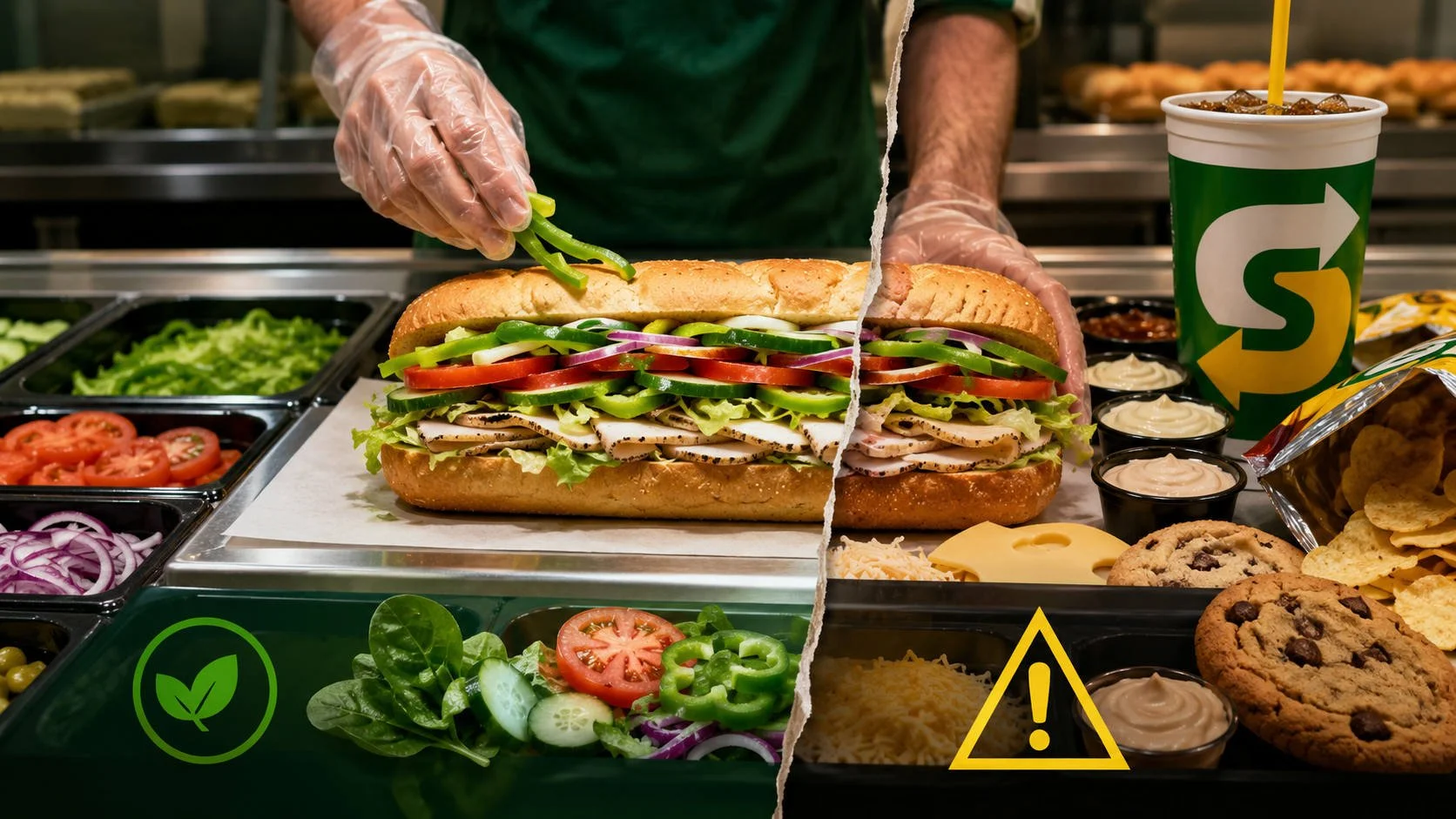
Subway is the fast-food chain that convinced America a sandwich becomes healthy the moment someone assembles it in front of you while wearing plastic gloves. A burger place hands you a wrapped object and everyone knows what happened: beef, bun, salt, possibly regret. Subway gives you a tray of spinach, cucumbers, tomatoes, and banana peppers, and suddenly lunch feels like it earned a minor certification in wellness.
This is the magic trick: Subway does not always sell healthier fast food. It sells fast food that lets you feel like you supervised it.
That is not nothing. Customization matters. Vegetables matter. Portion size matters. Protein matters. Subway can absolutely be a better choice than a fried combo meal large enough to qualify as a furniture delivery. But it can also become a footlong meat-and-sauce tube with chips, soda, and a cookie riding alongside it like the Four Horsemen of “But I Had Veggies.”
Subway itself leans hard into this better-for-you identity. The company says it has more than 35,000 restaurants worldwide and describes its meals as freshly made and customizable, built with crisp vegetables, freshly baked bread, and simple ingredients. That is the brand in one sentence: fresh, customizable, local enough to feel friendly, global enough to appear in every strip mall like edible wallpaper.
And that is why Subway is the perfect case study in the illusion of healthy fast food. It can be healthy-ish. It can be a sodium cannon in a bread sleeping bag. The difference is not the logo. The difference is the order.
Subway’s Health Halo Is Not Imaginary. It Has Receipts.
The “health halo” around Subway has been studied for years, because apparently scientists looked at America ordering footlongs with cookies and thought, “Yes, this nonsense deserves a journal article.”
A classic Journal of Consumer Research paper found that people were more likely to underestimate calories and choose higher-calorie sides, drinks, or desserts when a fast-food restaurant claimed to be healthy, using Subway as the example of the “healthy” fast-food brand and McDonald’s as the comparison. The paper’s abstract says these health halos made people underestimate main dishes and choose more indulgent extras.
That is the Subway problem in laboratory form: the sandwich gets a halo, then the cookie sneaks in under the glow.
Cornell’s summary of the same research reported that people underestimated calories at “healthy” restaurants and chose side items with up to 131% more calories when the main dish was positioned as healthy. It also quoted Brian Wansink saying people estimating a 1,000-calorie meal underestimated by 159 more calories if the meal was from Subway rather than McDonald’s.
Isn’t that beautiful? Subway does not just feed you. It gives your brain store credit.
The Sandwich Line Feels Like Control, and Control Feels Like Health
Subway’s biggest psychological advantage is that you watch the sandwich happen.
The bread is sliced. The meat is folded. The cheese lands. The lettuce falls like green confetti. You are asked questions. You say “more spinach,” and for one brief shining moment, you are not a person buying fast food. You are a wellness director. A sandwich auteur. A microgreen-adjacent adult.
This is very powerful and very silly.
Customizing food can help you make better choices. But the feeling of choice can also make the whole meal seem healthier than it is. A pile of vegetables does not erase mayonnaise. Spinach does not nullify bacon. Pickles do not legally absolve a footlong Italian B.M.T. The sandwich is not a court case where lettuce provides reasonable doubt.
Subway makes fast food feel active rather than passive. You did not just order. You participated. That participation becomes moral camouflage.
Fresh Fit Is Real, But It Is Not the Whole Menu
To be fair, Subway does offer genuinely lighter builds. In 2025, Subway reintroduced its Fresh Fit menu, saying each six-inch sandwich had at least 20 grams of protein, a full serving of vegetables, and fewer than 500 calories. The lineup included options like Grilled Chicken & Avocado, Ham & Turkey Stacker, Seasoned Steak & Avocado, and Turkey & Ranch Delite.
That is useful. A six-inch sandwich under 500 calories with protein and vegetables can be a perfectly reasonable lunch. Nobody needs to perform a Greek tragedy over a turkey sandwich.
But the Fresh Fit menu also reveals the bigger trick: Subway’s healthier identity comes from the existence of these options, while the customer may order something completely different and still bask in the brand’s glow. This is like going to a gym, sitting in the lobby, and saying you “did fitness.”
The healthy option being available does not mean you ordered it. Very rude, but true.
The Footlong Is Where Math Goes to Become a Problem
Subway’s nutrition guide says six-inch sandwiches can be doubled for footlong nutrition information. This is not advanced science. It is literally “multiply by two,” a process humanity developed before sandwich marketing and yet continues to ignore at lunch.
A six-inch sandwich can look modest. A footlong changes the entire meal. A 470-calorie Fresh Fit sandwich becomes 940 calories if doubled. A 580-calorie Chicken & Bacon Ranch six-inch becomes 1,160 calories as a footlong before chips, cookie, drink, or the emotional decision to add extra ranch.
This is the part people hate because it ruins the spell. A footlong is not a six-inch sandwich with ambition. It is two sandwiches connected by branding.
The old Subway health aura was built around “I’m not eating a burger.” Fine. You are eating a footlong, chips, and a cookie. The burger is not the only route to nutritional clownery.
Bread Is Not Evil. Bread Is Also Not Air.
Diet culture has made people weird about bread, so let us be adults for almost three paragraphs.
Bread is not evil. Bread is food. Bread is useful. Bread is also not invisible just because it holds turkey. Subway’s January 2026 nutrition guide lists a six-inch Artisan Italian bread at 210 calories, 39 grams of carbohydrates, and 380 mg of sodium; six-inch Hearty Multigrain bread at 200 calories, 36 grams of carbohydrates, 3 grams of fiber, and 350 mg of sodium; and a 12-inch wrap at 300 calories before the fillings arrive wearing their little meat costumes.
So yes, the bread contributes meaningfully to the meal. Not in a scary way. In a math way. The worst kind, because math does not care how fresh the bread smelled.
The “healthy fast food” illusion often depends on ignoring the base. Bowl places do this with rice. Smoothie places do this with juice. Subway does it with bread. The foundation counts. The building does not float because cucumbers are present.
Sauces Are Tiny, Sneaky Little Calorie Lawyers
Subway sauces are where many “healthy” orders quietly take a wrong turn and ask nobody to notice.
According to Subway’s 2026 nutrition guide, mayonnaise adds 100 calories per 14-gram serving, Peppercorn Ranch adds 80, Roasted Garlic Aioli adds 80, Baja Chipotle adds 70, Honey Mustard adds 60, and MVP Parmesan Vinaigrette adds 60. Sweet Onion Teriyaki adds 30 calories and 6 grams of added sugar. Hot Honey Sauce adds 30 calories and 8 grams of added sugar.
A sauce is not automatically bad. Sauce is joy. Sauce is moisture. Sauce is the difference between lunch and chewing a napkin with turkey in it. But sauces are also concentrated little calorie bombs. One sauce is flavor. Three sauces are a condiment trust fall.
The Subway line makes sauce feel casual because the employee asks it so quickly. “Any sauce?” they say, as if they are not handing you the keys to ranch-based chaos.
Sodium: “Fresh” Does Not Mean “Low Salt”
Subway’s biggest health illusion may be that “fresh” gets mentally translated into “light,” “clean,” or “low sodium.” That is adorable. Wrong, but adorable.
The FDA’s Daily Value for sodium is 2,300 mg, and it says 20% DV or more of a nutrient per serving is considered high. The same FDA guidance recommends using labels to choose lower amounts of nutrients like saturated fat, sodium, and added sugars.
Subway can climb toward that sodium number with alarming enthusiasm. Its 2026 guide lists several six-inch sandwiches above 1,000 mg of sodium, including the Chicken & Bacon Ranch at 1,230 mg, Spicy Italian at 1,690 mg, Meatball Marinara at 1,370 mg, and Big Hot Pastrami at 2,070 mg. And remember, footlongs double the six-inch values, because apparently the sandwich becomes twice as committed to seasoning your circulatory system.
Again, this does not mean Subway is poison. It means “fresh” and “lower sodium” are not synonyms. One describes the vibe. The other describes the number.
The Cookie Is Not a Side. It Is Dessert Wearing a Napkin.
Subway cookies are famous because they are good. There is no need to lie. The chocolate chip cookie has done more for Subway’s emotional brand than many sandwiches. But Subway cookies are still cookies, despite being sold next to lettuce, which apparently gives them witness protection.
Subway’s nutrition guide lists a chocolate chip cookie at 210 calories with 18 grams of added sugar; a double chocolate cookie at 210 calories with 19 grams of added sugar; and the footlong chocolate chip cookie at 1,330 calories with 100 grams of added sugar. The FDA says the Daily Value for added sugars is 50 grams per day based on a 2,000-calorie diet, so the footlong cookie is basically a dessert parade that ate the rulebook.
A regular cookie can fit into a normal eating pattern. A footlong cookie is not a side. It is a prank on adulthood.
This is the health halo in action. A customer gets a turkey sandwich with vegetables and thinks, “I’ve been good.” Then comes the cookie. Then the chips. Then the soda. Suddenly the healthy lunch is a sandwich-themed permission slip.
Protein Bowls Fix One Problem and Create Others
Subway’s protein bowls are useful because they remove the bread and keep the meat and vegetables. Great. Sometimes that is exactly what someone wants. But removing bread does not automatically make the meal light, especially if the bowl uses a footlong meat portion and then adds cheese, sauces, and dressing.
Subway’s nutrition guide notes that protein bowls include a footlong meat portion plus vegetables, and do not include dressing or cheese unless noted. Some protein bowls are modest, while others are not exactly dieting in a bowl: the Chicken & Bacon Ranch protein bowl is listed at 760 calories and 1,750 mg of sodium, while the Spicy Italian protein bowl is 960 calories and 2,610 mg of sodium.
So yes, bowls can help if you are cutting bread or carbs. But they do not cancel meat, cheese, sauce, or sodium. The bowl is not a magic cauldron. It is a container. Please stop giving containers spiritual powers.
Subway Can Be Better Than Other Fast Food, But That Is a Low Bar Wearing Lettuce
A UCLA study of adolescents found that participants bought meals averaging 955 calories at Subway and 1,038 calories at McDonald’s, with no statistically significant difference. The study also found Subway meals averaged 2,149 mg of sodium versus 1,829 mg at McDonald’s, while the sandwiches purchased at Subway averaged 784 calories compared with 572 calories at McDonald’s.
That study is not the final word on every Subway order ever assembled by mankind. It was one study with adolescents in one setting, and the researchers themselves noted limitations. But it points at the same big truth: Subway can look healthier while still producing a very large meal.
That is the illusion of healthy fast food. It is not that Subway is secretly worse than everything else. It is that Subway’s branding makes people less suspicious. And fast food deserves suspicion. Not panic. Suspicion. A modest little eyebrow raise before you add bacon, pepper jack, ranch, chips, and a cookie to a “light lunch.”
The Real Healthy Subway Order Is Boringly Specific
The best Subway strategy is not “Subway is healthy” or “Subway is bad.” Both are lazy. The useful strategy is to order like the details matter, because they do.
Start with a six-inch sandwich unless you actually need a footlong. Choose grilled chicken, turkey, ham, roast beef, or another leaner protein. Use Hearty Multigrain if you want a bit more fiber than Artisan Italian. Load up vegetables until the sandwich looks like it has been attacked by a garden. Use mustard, vinegar, red wine vinegar, or one moderate sauce. Be careful with cheese if the rest of the sandwich is already rich. Skip chips or split them. Treat the cookie as dessert, not a constitutional right.
A smart Subway order can be very normal: six-inch turkey or grilled chicken, multigrain bread, lots of vegetables, mustard or vinegar, maybe avocado if you want fat and creaminess, water or unsweetened drink, and no automatic cookie just because the display case winked at you.
This is not glamorous. It is lunch. Lunch does not need to change your life. It needs to not quietly become 1,400 calories while calling itself “fresh.”
The Subway Test: Ask What Would Still Be Healthy Without the Logo
Here is the mental trick that breaks the halo: imagine the exact same meal sold somewhere without the Subway branding.
Footlong Italian with cheese, mayo, chips, soda, cookie. Does that sound like a healthy meal? No. It sounds like a delicious lunch that may need a walk and a nap.
Six-inch chicken sandwich on multigrain with vegetables, mustard, applesauce, and water. Does that sound balanced? Yes. Annoyingly reasonable. Like something a person might eat before continuing to function.
The brand is not the meal. The order is the meal.
The classic health halo research found that simply prompting people to consider whether health claims might not apply reduced the halo effect. That is wonderfully petty and useful: just ask, “Is this particular thing actually lighter, or am I giving it credit because of the place?”
Congratulations. You have just defeated marketing with one question. Do not expect a parade.
What Subway Reveals About Healthy Fast Food
Subway reveals that “healthy fast food” often means healthier possibilities, not healthier outcomes.
It shows how customization can empower people and confuse them at the same time. It shows how vegetables create a halo that cheese, sauces, sodium, and portion size can hide under. It shows how a six-inch sandwich can be a reasonable meal and a footlong can be two meals pretending to be one. It shows how a brand can be “better-for-you” while still selling cookies large enough to qualify as a zoning dispute.
Most importantly, Subway shows that healthy eating is not a restaurant category. It is a set of choices inside a category. Fast food does not become healthy because the walls are green, the tomatoes are visible, or the bread smells like a mall-based hug.
The illusion is thinking the place did the thinking for you.
Subway Is Not the Villain. The Halo Is.
Subway can be useful. Subway can be convenient. Subway can be a decent fast-food option when you order carefully. It can also be a calorie-and-sodium landslide wrapped in paper and congratulated by lettuce.
That is what makes it interesting. Subway is not the opposite of McDonald’s. It is fast food with better lighting for your conscience.
The real lesson is simple: do not outsource your judgment to a brand. Read the nutrition. Watch the portion. Choose sauce like it counts. Treat sides like they exist. Remember that “fresh” does not mean “low calorie,” “vegetables” do not erase everything else, and “customizable” only helps if you customize in a direction other than “ranch festival.”
Subway’s great revelation is that healthy fast food is often less about the food and more about the story we tell ourselves while ordering it.
And if that story ends with a footlong, chips, soda, and a cookie, please do not blame the spinach. It did what it could.