What Paris Cafés Reveal About Eating Slowly as a Status Symbol
Paris cafés are not really about coffee. Please, let us not insult the empire of wicker chairs by pretending this is about caffeine. If the only goal were coffee, everyone would be standing in line, ordering something aggressively large in a paper cup, and power-walking into traffic while answering email like a haunted intern. That is not Paris café culture. That is office survival with foam.
A Paris café is about time. Specifically, the appearance of having some.
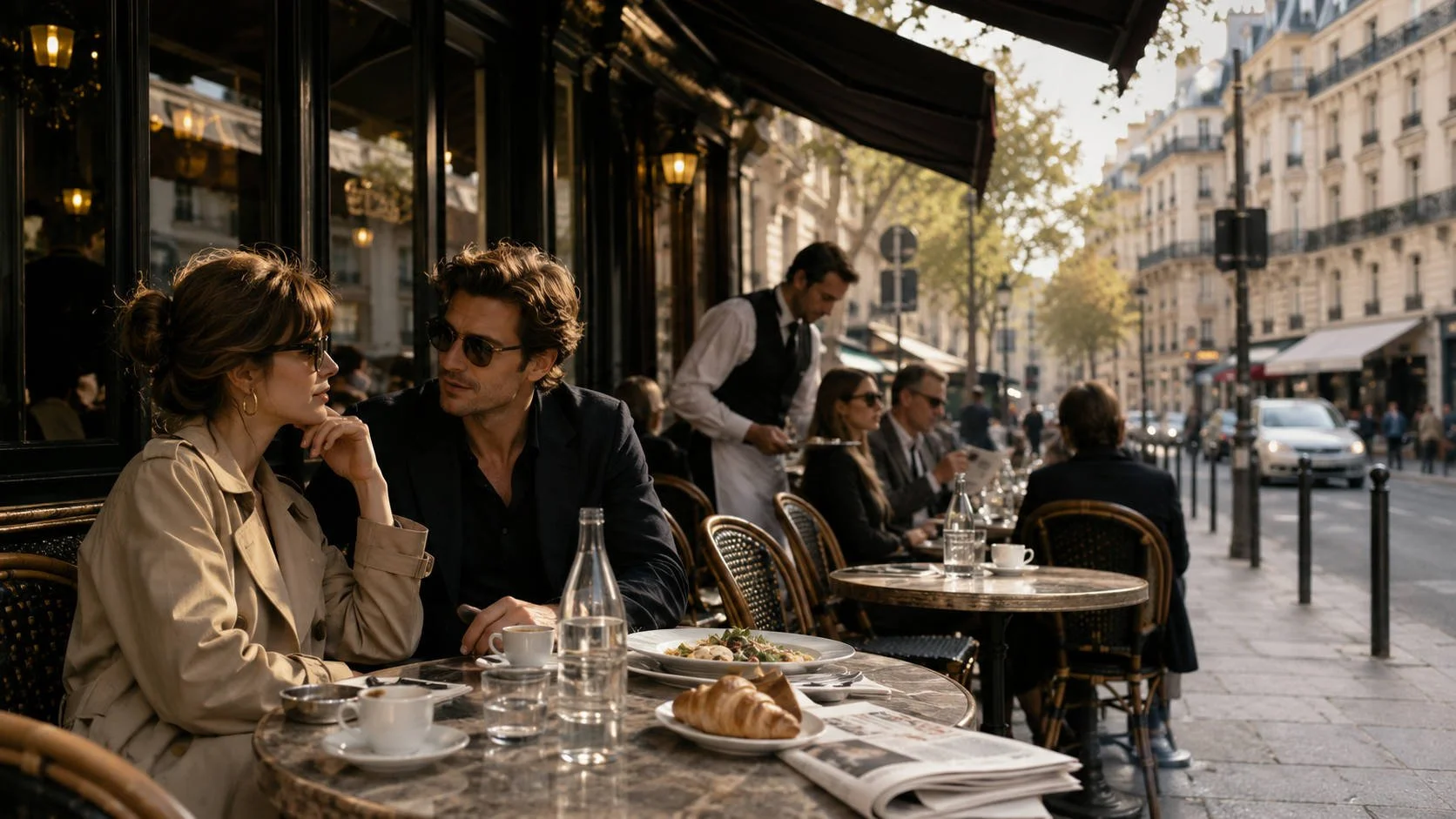
This is why the terrace matters. France’s official tourism site describes everyday Parisian rhythm as unfolding on café terraces, with passersby, clinking cups, fresh coffee, croissants, Haussmann buildings, and each terrace becoming “a small stage.” Beautiful. Sickeningly beautiful. The kind of sentence that makes a granola bar eaten over a keyboard feel like a cry for help.
And that is the point. Paris cafés reveal that eating slowly is not just a habit. It is a signal. It says: I am not being chased by my calendar. I am not chewing lunch between spreadsheets. I am not drinking coffee from a cup designed to fit a car holder because my civilization gave up on chairs. I am seated. I am composed. I have chosen a table facing the street, because apparently the world has agreed to perform for me.
Paris Cafés Turn Time Into the Main Course
At a normal fast lunch, the food is the product. At a Paris café, time is the product, and the coffee is basically rent.
The French really do devote more time to eating than many other countries. INSEE reported that eating took up an average of two hours and twenty-two minutes of French people’s daily schedules in 2010, and that eating remained heavily concentrated around the three traditional meals, with half the French population having lunch at 1 p.m.
Compare that with the United States, where the Bureau of Labor Statistics listed average eating and drinking time at 1.24 hours per day in 2024. That is not a meal culture. That is a pit stop with napkins.
This is why slow eating reads as status. Time is now one of the hardest luxuries to fake. Anyone can buy a sandwich. Not everyone can sit with it. Not everyone can linger without checking Slack, apologizing to a deadline, or eating from a container that says “protein bowl” because apparently lunch needed a performance review.
In Paris, sitting still can look like social confidence. Elsewhere, it looks like you missed a meeting.
The Café Terrace Is a Theater, and You Are Both Actor and Audience
The genius of the Paris café terrace is that it solves humanity’s oldest problem: wanting to be seen while pretending not to care.
The Guardian described Parisian terrace chairs as often arranged on either side of small bistro tables facing the street, allowing diners to watch the world pass by. It also quoted a writer on bistro culture calling the terrace a place with “one foot inside and one foot outside,” immersed in the spectacle of city life.
This is not accidental furniture placement. This is surveillance with wine.
At a Paris café, you do not just eat. You occupy a visible position in the city. You sit where strangers can see your scarf, your posture, your tiny cup, your theatrical lack of urgency. You become part of the streetscape, one more elegant obstacle between tourists and the crosswalk.
Eating slowly becomes a status symbol because it turns the body into a public display of ease. You are not shoveling food into your face like an exhausted raccoon outside a conference center. You are pacing yourself. You are pausing. You are letting the meal breathe, because apparently your salad has lungs now.
The Slow Meal Has Cultural Backup, Which Is Very French of It
France did not accidentally make eating slowly look important. The culture has receipts, footnotes, and probably a committee.
The French gastronomic meal was added to UNESCO’s intangible cultural heritage list in 2010. IEHCA, the European Institute for the History and Cultures of Food, describes it as a social practice built around togetherness, attention to others, shared pleasure of taste, beautiful table settings, sequences of courses, wine pairings, conversation, identity, and belonging.
Now, obviously, a weekday café lunch is not the same as a full ceremonial gastronomic meal. Nobody is sitting at a corner table with a starter, fish course, cheese, dessert, liqueur, and three generations of family unless they are either French royalty or trapped in a tourism brochure. But the cultural value carries over: eating is not merely refueling. Eating is social structure. Eating is conversation. Eating is identity. Eating is not supposed to look like a protein bar being murdered in an elevator.
That makes slowness feel respectable. Even when the actual order is just an espresso and a tartine, it borrows prestige from a broader culture where meals are treated as occasions instead of interruptions.
Historic Paris Cafés Made Lingering Look Intellectual
The status of slow café eating also comes from history, because Paris never misses a chance to make sitting down sound philosophical.
Le Procope, often described as the oldest café in Paris, dates to 1686 and is associated with Saint-Germain-des-Prés literary and intellectual life. Paris’s official tourism office notes that figures such as Rousseau, Diderot, Voltaire, and Robespierre met there.
That legacy matters. In Paris, lingering at a café does not merely look lazy. It can look literary. You are not wasting time; you are participating in a long tradition of people ordering something small and developing large opinions. Wonderful news for anyone who has ever wanted to call procrastination “continental thought.”
This is the alchemy of café culture. Sitting for an hour over one drink in a random chain restaurant looks like loitering. Sitting for an hour over one drink in Saint-Germain-des-Prés looks like you might be revising a novel, even if you are actually checking whether your phone has enough battery to find the Métro.
Slow Eating Says: I Have Control Over My Day
The real status symbol is not the croissant. It is control.
Fast eating usually signals pressure. The meeting starts soon. The kid needs pickup. The shift ends in ten minutes. The inbox is a dumpster fire with attachments. The sandwich must be consumed like evidence.
Slow eating signals the opposite. I have time. I have choices. I have arranged my day so that lunch is not a hostage situation. Even if this is not entirely true, the performance is convincing, and that is half of city life anyway.
This is why Paris cafés are so seductive to visitors. They offer a fantasy of self-possession. You sit down and briefly become the kind of person who does not eat lunch while walking. The kind of person who knows when to order wine. The kind of person who does not call every outing “grabbing something.” Grabbing. What a hideous little verb. Food is not a squirrel.
In the café fantasy, you do not grab. You order. You wait. You receive. You sip. You look at the street as if the street was hired for your benefit. Then you sit a little longer because leaving too quickly would suggest you still belong to the economy of panic.
But Let’s Not Pretend Every Café Is a Temple of Grace
Paris terrace culture is lovely, but it is also commercial real estate with ashtrays.
The café terrace can be poetic and annoying at the same time, which is basically Paris’s full operating system. The Times reported that Paris has more than 20,000 year-round restaurant and café terraces plus thousands of seasonal terraces, and that residents filed more than 45,000 complaints about terrace noise between January 2022 and June 2023.
So yes, the terrace is a symbol of art de vivre. It is also a thing under someone’s bedroom window at midnight where six people named Hugo are laughing near a metal chair.
That is important because status symbols always have a shadow. Slow café eating looks effortless from the chair. From the apartment above, it may sound like a sociology experiment with wine glasses. From the server’s side, it may be table management. From the business owner’s side, it is revenue. From the tourist’s side, it is “Paris magic.” From the neighbor’s side, it is “please shut up, I have work.”
The café is not pure romance. It is romance with operating costs.
The Coffee Is Not the Point, Which Is Deeply Offensive to Coffee People
Modern specialty coffee has changed Paris, too. Vogue notes that Paris now has both classic cafés and modern coffee shops, with specialty coffee spots emerging over the past two decades alongside the old Left Bank institutions.
This creates two versions of slow café status. The classic café says: I belong to old Paris. I know terraces, zinc bars, newspapers, waiters, and the correct way to look bored near a famous awning. The specialty coffee shop says: I know extraction, origin, design, and why this flat white costs enough to qualify as a minor cultural grant.
Both are status games. One uses history. The other uses taste expertise. One says “I am timeless.” The other says “I know where the good beans are.” Both involve sitting down and performing discernment, because apparently even caffeine must now pass through identity customs.
The Paris café reveals that eating slowly is rarely just about appetite. It is about knowing how to inhabit a place. The food may be simple. The performance is not.
Eating Slowly Is Class-Coded, Because Of Course It Is
Let us remove the beret and speak plainly: lingering is easier when time does not cost you too much.
If you have a flexible schedule, paid lunch, disposable income, no second job, no care crisis, and no boss counting your bathroom breaks, eating slowly is charming. If you are working hourly, sprinting between obligations, or choosing the cheapest filling thing before the next shift, slow eating becomes less “lifestyle” and more “must be nice.”
That is why eating slowly can read as status. It says not just “I value pleasure,” but “I can afford to value pleasure right now.” Time is not evenly distributed. Neither are tables with views.
Paris cafés make this visible because the terrace turns leisure into public display. The person lingering over lunch may simply be enjoying life. They may also be announcing, intentionally or not, that they have temporarily escaped the machinery that tells everyone else to hurry up and swallow.
Very elegant. Very unfair. Very photogenic.
The Tourist Wants the Slow Café Moment, and Naturally Ruins It
Tourists arrive in Paris determined to eat slowly, which is adorable because many of them schedule the slow meal between nine monuments, two museums, a boat ride, and an urgent need to photograph a pastry from three angles.
They sit at a café and immediately ask, “How long will this take?” There it is. The American national anthem, performed in one sentence.
The Paris café moment cannot be speed-run. That is the whole point. You do not achieve slowness by sitting down while internally sprinting. You do not become elegant by ordering espresso and checking Google Maps every eleven seconds. You are not “living like a local” if your backpack is attacking the neighboring table and your itinerary has sub-bullets.
To eat slowly, you need to surrender one block of time to the meal. Not the whole day. Calm down, no one is asking you to dissolve into existentialism over a croque monsieur. But for an hour, the meal has to be the event, not an obstacle.
Useful Slow Eating Lessons From Paris Cafés
The first lesson: sit down. Revolutionary, apparently. Eating while standing over a sink is not a lifestyle; it is a domestic accident.
The second lesson: choose one meal a day to not multitask. No laptop. No meeting. No scrolling as the main course. Vogue even notes that at some Paris cafés, the point may be chatting with friends or lingering rather than using the place as a mobile office with better chairs.
The third lesson: order enough to justify the table. The fantasy of sitting for three hours over one espresso is charming until every table is full and the business is trying to survive. The Guardian notes that France’s lack of tipping culture may create less pressure to turn tables quickly, but that does not mean a café chair is your ancestral property.
The fourth lesson: use pauses. Put the fork down. Taste the food. Talk. Look around. Let the meal have beats. This sounds embarrassingly basic, but modern lunch culture has reduced many adults to chewing like they are clearing a loading dock.
The fifth lesson: do not confuse slow with expensive. A sandwich eaten calmly in a park can do more for your life than a rushed tasting menu where everyone is photographing foam like it might escape.
Slow Eating Is Not a Wellness Hack. It Is a Rebellion Against Rush.
Please do not turn this into another self-improvement system. The world does not need “The Paris Café Method: 7 Steps to Monetize Mindful Tartines.” We have suffered enough.
The value of Paris café culture is not that it will optimize your digestion, improve your aura, or make you 12% more employable. The value is that it treats eating as something worthy of attention. That is already radical in a culture where lunch is often wedged between obligations like a damp napkin.
Eating slowly says the meal matters. The person across from you matters. The street matters. The city matters. Your own body, inconvenient little rented apartment for consciousness that it is, matters.
That is why it feels luxurious. Not because the food is always extraordinary. Sometimes the food is merely fine. Sometimes the coffee is not worth the mythology. Sometimes the waiter looks at you like you personally caused the decline of civilization. Still, the structure of the experience says: stay.
The Final Answer: Paris Cafés Sell the Luxury of Not Looking Rushed
Paris cafés reveal that eating slowly has become a status symbol because modern life has made unhurriedness rare. The terrace is not just a place to eat. It is a public display of time ownership, taste, urban belonging, and calm self-presentation. It lets people perform a tiny aristocracy of leisure, even if only for the price of coffee and a pastry.
That performance has roots in French meal culture, Paris café history, terrace architecture, intellectual mythology, and the simple fact that a chair facing the street can turn lunch into theater. It is beautiful. It is pretentious. It is useful. It is occasionally unbearable. In other words, it is perfect.
The lesson is not that everyone must eat like a Parisian, because nothing ruins pleasure faster than trying to do it correctly under foreign lighting. The lesson is that slowing down changes what food means. A meal becomes more than fuel. A table becomes more than furniture. A café becomes more than a business selling coffee to people pretending not to check their phones.
Eating slowly in Paris looks like status because it says the one thing many people cannot honestly say anymore: I have time.
And in the modern world, that may be the fanciest thing on the menu.