What WeightWatchers Reveals About Diet Culture Rebranding Itself
Diet culture does not die. It gets a new logo, removes the word “diet” from the lobby, adds a calming blue app icon, hires a wellness copywriter, and starts saying things like “weight health” with the polished sincerity of a yoga mat that has seen a quarterly earnings call.
Nobody demonstrates this better than WeightWatchers.
For decades, Weight Watchers was the polite, church-basement version of dieting. Not the grapefruit diet, not the cabbage soup diet, not the “drink cayenne pepper lemonade until you hallucinate a bagel” diet. Weight Watchers had structure, community, weigh-ins, recipes, Points, sensible shoes, and a reputation for being the adult in a room full of diet-industry lunatics. It was dieting with a name tag and a folding chair.
Then “dieting” became embarrassing.
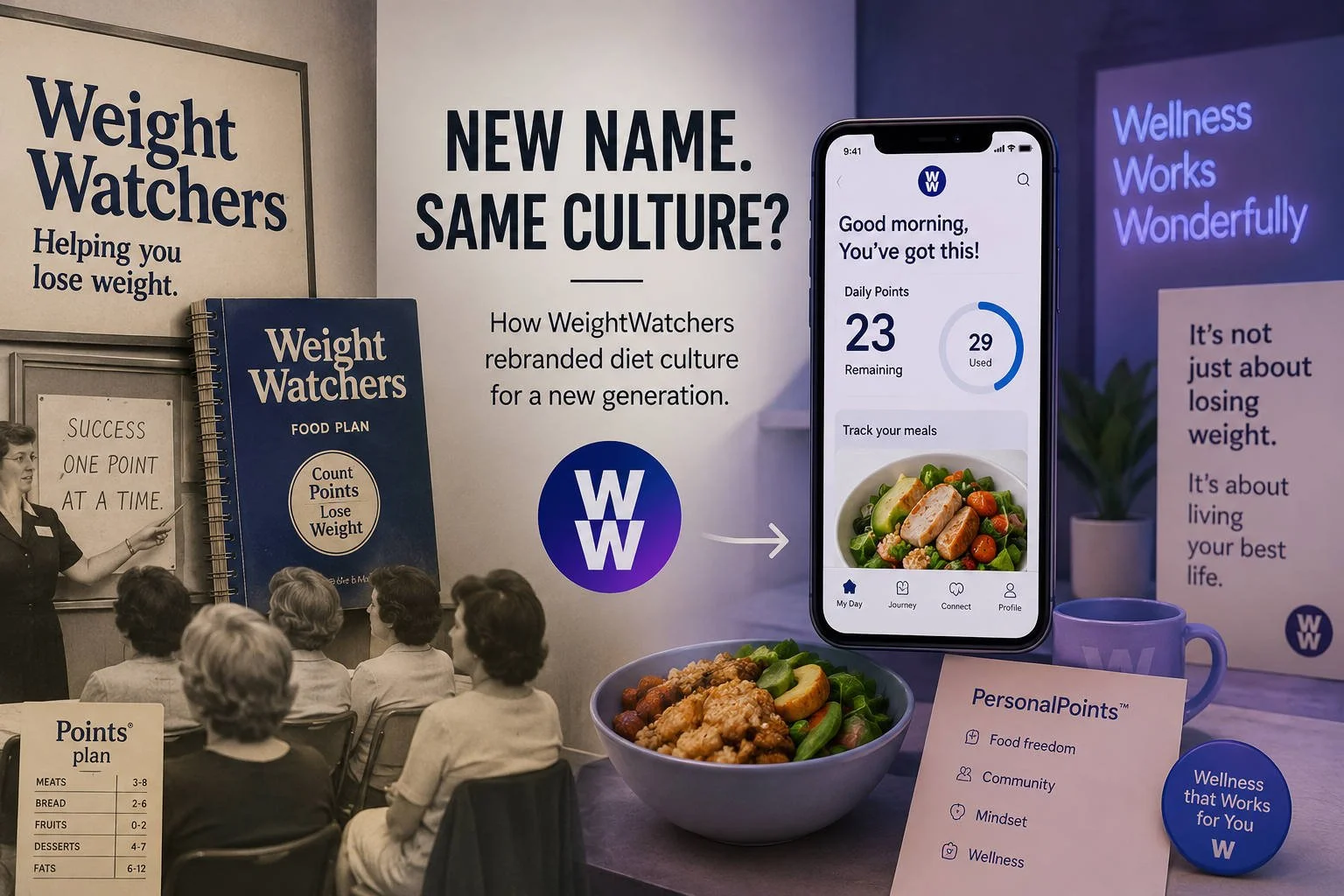
So Weight Watchers became WW. Meetings became Workshops. Weight loss became wellness. Tracking became behavior change. Food rules became Points. Hunger became “your journey.” Then GLP-1 drugs arrived and body-size discourse shifted again, so the brand pivoted from willpower to “biology,” telehealth, prescriptions, medication tracking, and clinical support. Amazing. The same cultural machine that once sold you discipline is now selling you compassion with a prescription portal.
This is not just a story about one company. It is a case study in how diet culture survives by changing the words on the package.
WeightWatchers Didn’t Leave Diet Culture. It Put Diet Culture in Athleisure.
In 2018, Weight Watchers rebranded as WW, with the tagline “Wellness that works.” The company later changed its legal name from Weight Watchers International, Inc. to WW International, Inc., saying the rebrand reflected its broader role in helping people lead healthier lives by losing weight, eating healthier, moving more, shifting mindset, or all of the above. That is corporate language for: “Please stop calling us a diet company; the kombucha generation is listening.”
The timing was not random. Vox described the rebrand as happening when “dieting” had become more taboo and wellness and self-care were culturally ascendant. The Guardian also framed the move as a tech-and-wellness rebrand meant to compete with fitness trackers and apps while moving beyond a short-term diet fix. In other words, Weight Watchers saw the word “diet” starting to smell like low-fat cookies and public shame, so it backed slowly into the wellness aisle.
This is diet culture’s favorite survival trick. It does not say, “You should shrink yourself to be acceptable.” That would be gauche now, like smoking indoors or saying “beach body” near a person with media literacy. It says, “Become your healthiest self.” Beautiful. Who could oppose health? Health is great. Health has no enemies except maybe insurance billing departments.
But when “health” always points back to weight, and “wellness” still requires tracking, budgeting, measuring, and optimizing food, the old machinery is still there. Someone just replaced the fluorescent lights with a mindfulness playlist.
Points Are Calorie Counting Wearing a Better Suit
WeightWatchers’ core genius has always been translation. Calories are boring. Macros are gym-bro accounting. Grams of saturated fat sound like a lab report. But Points? Points feel like a game. A tiny food economy. A personal budget where cake becomes a financial decision and chicken breast becomes a responsible adult with no student loans.
The current Weight Watchers explanation says Points are numbers assigned to foods to make decisions simpler; the formula lowers Points for nutrients the program wants more of, such as fiber, protein, and unsaturated fat, and raises Points for saturated fat and added sugars. The company says each member gets a personalized Daily Points Budget based on factors like age, height, weight, sex assigned at birth, metabolic rate, and whether the person is trying to lose or maintain weight.
That is not automatically evil. Some people like structure. Some people benefit from a simplified system. Some people need help seeing that a giant restaurant dessert and a bowl of lentil soup are not nutritionally interchangeable, a truth apparently still fighting for public office.
But the cultural trick is obvious: Points make restriction feel less like restriction. You are not “dieting.” You are “spending.” You are not “avoiding food.” You are “budgeting.” You are not “being controlled.” You are “empowered.” Very good. Very modern. Very much the same hamster wheel with a touchscreen.
ZeroPoint Foods Are the Company’s Best Idea and Its Best Disguise
ZeroPoint foods are the part of WeightWatchers that most convincingly says, “Look, we are not starving anyone.” The company says ZeroPoint foods do not have to be weighed, measured, or tracked, and its list includes beans, peas, lentils, chicken breast, turkey, fish, shellfish, fruits, vegetables, tofu, oats, Greek yogurt, cottage cheese, popcorn, and more.
This is genuinely better than old-school diet nonsense where a banana could be treated like contraband because it had too much natural sugar, while a chemical snack bar named Skinny Blizzard Crunch somehow got blessed by the diet gods. Encouraging people to build meals around beans, fruit, vegetables, lean proteins, yogurt, tofu, and oats is not the problem. The problem is the scoring system still trains the brain to see food as numbers, permissions, penalties, and loopholes.
ZeroPoint is psychologically clever because it softens the system. It gives members a safety valve. It says, “Eat these freely,” which sounds generous until you remember that the whole reason “freely” feels exciting is because everything else is still being counted.
It is like a prison yard with a garden. Nice garden. Still a prison yard if the rest of your day is spent negotiating with a food budget.
Meetings Became Workshops Because Shame Needed Better Upholstery
One thing WeightWatchers has always understood better than many diet companies is that people do not just want meal plans. They want witnesses. They want community, accountability, encouragement, other people who understand the weekly drama of snacks, family dinners, restaurant menus, holidays, stress, shame, plateaus, and the suspicious gravitational pull of leftover birthday cake.
Weight Watchers now describes its community and Workshops as a “superpower,” with coaches and members creating spaces where people feel seen, heard, and supported. That part is not silly. Social support can matter. In fact, for many members, the community has probably been more valuable than the math.
But let us not pretend the rebrand erased the emotional weirdness of a weight-focused group program. A “Workshop” sounds like people making pottery or learning how to write better emails. Historically, Weight Watchers meetings involved weigh-ins and food accountability. Call it community, call it coaching, call it support, call it a moon-circle for metabolic optimism — the central project was still weight loss.
Diet culture rebrands shame by making it softer. It stops yelling “discipline” and starts whispering “support.” Better? Often, yes. Still built around shrinking? Also yes. Two things can be true, because reality refuses to fit into a branded tote bag.
The Rebrand Revealed That “Wellness” Can Be Dieting With Better PR
The great cultural move from dieting to wellness was supposed to liberate people from old-school body obsession. And sometimes it did. People started talking more about energy, strength, mental health, sleep, stress, blood sugar, mobility, and actual health markers. Great. About time. Please send diet culture a sympathy fruit basket and escort it out.
But wellness also became the perfect hiding place for diet culture. Because wellness sounds morally clean. Nobody says, “I am trying to be smaller so the world approves of me.” They say, “I am focusing on my health.” Maybe they are. Maybe they are also weighing almonds like a jeweler while pretending this is freedom.
Vogue’s critique of the WW rebrand put the issue bluntly: how can a brand built on the idea that losing weight is the answer to living well simultaneously distance itself from that mission? The piece argued that even with friendlier messaging, the Points system still functioned as a dieting framework involving counting, budgeting, and sometimes restriction.
That is the heart of it. Diet culture rebranding does not always change the underlying behavior. It changes the explanation. Same tracking, new vocabulary. Same weight goal, new emotional lighting. Same before-and-after logic, now with fewer explicit “before” photos and more words like “journey.”
Then GLP-1s Arrived and Burned Down the Willpower Temple
For decades, commercial diet culture sold a story about control. Track the food. Attend the meetings. Manage the cravings. Be accountable. Change habits. Learn discipline. If you failed, try again. If you kept failing, buy another plan. A beautiful little treadmill, financially speaking.
Then GLP-1 medications entered the mainstream weight-loss market and made the old moral story look suddenly antique. Appetite was no longer just a character issue. “Food noise” became a phrase. Biology moved to center stage. Hunger, satiety, metabolism, hormones, and chronic disease entered the conversation like adults arriving at a children’s birthday party and finding everyone covered in frosting and shame.
WeightWatchers responded by buying its way into the new era. In 2023, the company agreed to acquire Sequence, a subscription telehealth platform offering access to providers specializing in chronic weight management, medication management, and insurance support. WeightWatchers said the goal was to pair its nutrition and behavior-change program with a clinical platform, while emphasizing that obesity is complex and chronic and that medications can help some people address biological components of weight management.
This is the most revealing pivot of all. The company that built its empire on behavior change now says biology matters. Correct. Welcome. We saved you a seat. It only took sixty years and a pharmaceutical market large enough to be seen from space.
WeightWatchers Clinic Is Diet Culture With a Lab Coat and a Subscription Page
WeightWatchers has since gone all-in on the GLP-1 era. In late 2025, it announced a “fully integrated” platform pairing GLP-1 prescribing, personalized nutrition, behavioral support, coaching, community, and technology. Its Med+ program provides access to board-certified physicians and coordinated care teams specializing in obesity and metabolic health, with clinicians able to write prescriptions for eligible members. The company also offers a GLP-1 Success program for people who get prescriptions elsewhere.
By 2026, Weight Watchers was also announcing preferred subscription pricing for Wegovy through an expanded collaboration with Novo Nordisk, saying eligible Med+ members could save up to $1,200 per year on the medication. This is not your grandmother’s weekly weigh-in. This is the old diet club walking into the pharmacy wearing a Bluetooth headset.
This is not necessarily bad. Medical treatment for obesity can be appropriate, and many people have long been harmed by the idea that weight is simply willpower in pants. But from a cultural standpoint, the rebrand is dazzling. The same industry that once sold “eat less” now sells “your biology needs support.” The shame did not vanish; it got redistributed. Before, the failure was personal discipline. Now, the failure may become lack of access, lack of coverage, lack of the right medication, or lack of money. Much more advanced. Very 2026. Still miserable if you are the person priced out.
Oprah’s Exit Was the Symbolic End of the Old Spell
WeightWatchers’ old modern comeback was inseparable from Oprah Winfrey. She joined the board in 2015, became a major ambassador, and gave the brand the one thing diet companies crave more than low-calorie snacks: emotional authority. Oprah could make bread sound like liberation and points tracking sound like self-love. That is not marketing. That is cultural weather.
Then in 2024, Oprah stepped down from the WeightWatchers board after nine years and said she would donate her stock, with Reuters reporting that the company said the donation would help eliminate any perceived conflict of interest around her use of weight-loss medications. WeightWatchers shares fell sharply after the announcement.
Symbolically, this was enormous. The face of “I’m doing the program” became associated with the new medication era. The old message was: I can eat bread and still succeed with WeightWatchers. The new message was: weight is complicated, medication is part of my care, and I am leaving the board so this does not look like a giant branded conflict. That is not just a celebrity business move. That is diet culture’s operating system updating in public.
Bankruptcy Was the Market Saying the Rebrand Wasn’t Enough
Then came the corporate reality check. In May 2025, WW International filed for Chapter 11 bankruptcy protection to cut debt after obesity drugs disrupted its business model. Reuters reported the plan was intended to eliminate $1.15 billion in debt, with the company carrying substantial debt of about $1.6 billion.
WeightWatchers’ own announcements framed the move as a financial reorganization that would eliminate $1.15 billion in debt while operations continued for more than three million members worldwide. The company later said the reorganization plan was confirmed and would reduce debt by more than 70%, and its 2026 financial release noted it emerged from its financial reorganization process on June 24, 2025.
This is what happens when a brand rebrands faster than its business model evolves. “Wellness” bought time. Apps bought time. Oprah bought time. GLP-1s changed the clock. The company had to admit, financially and structurally, that the old subscription diet model was no longer enough.
Diet culture can rebrand itself, yes. But the market is a brutal little mirror. Sometimes it says, “Cute tagline. Where is the growth?”
Diet Culture Rebranding Always Keeps the Customer’s Body as the Product
Here is the uncomfortable through-line: whether it is Points, wellness, coaching, workshops, telehealth, GLP-1 support, or medication subscription pricing, the customer’s body remains the business opportunity.
That does not mean every member is being exploited. Some people find support, lose weight in ways that improve their health, gain better habits, make friends, reduce shame, and feel more in control. Good. We can acknowledge that without pretending the business model is a charity picnic.
But diet culture rebranding works because it keeps moving the moral frame. First the good body was the thinner body. Then the good body was the healthy body. Then the good body was the optimized body. Now the good body is the biologically managed body, supported by data, telehealth, coaching, and a subscription plan that auto-renews with the emotional subtlety of a gym contract.
The consumer is no longer just asked to eat less. They are asked to track, scan, log, attend, optimize, medicate if eligible, manage side effects, monitor protein, preserve muscle, join communities, and maintain results indefinitely. This is not freedom from diet culture. This is diet culture becoming a full-service platform.
The Points System Is the Perfect Metaphor for Modern Food Anxiety
Points turn food into a budget, and budgets are never neutral. Budgets train people to think in tradeoffs. If I eat this, I must compensate there. If dinner is high, lunch must be low. If dessert happens, breakfast becomes penance wearing yogurt.
WeightWatchers says no food is “bad” or off-limits, and that high-Point foods are just information. That is the official, reasonable version. The human version is messier. People are very good at turning information into judgment. We do it with bank balances, step counts, sleep scores, grades, likes, unread emails, and now sandwiches.
This is where diet culture rebranding gets slippery. A company can say, “No shame.” The app can say, “No bad foods.” The coach can say, “It’s all about balance.” And still, the system can train a person to feel like a brownie is a budget crisis and a salad is moral repair.
The problem is not only the message. It is the structure. When every food gets a number, the numbers start talking.
The Rebrand Also Shows Why People Still Want Diet Culture
Let’s not pretend WeightWatchers survived for decades because everyone was duped by evil salad accountants. People keep returning to programs like this because they meet real needs.
People want structure. People want community. People want a plan. People want someone to say, “Here is what to do on Monday.” People want help after years of shame, confusion, chaotic eating, medical advice that amounts to “lose weight somehow,” and an American food environment designed by snack engineers and then blamed on individual weakness.
WeightWatchers understood this before everyone had a wellness app. Jean Nidetch’s original idea grew out of supportive weekly gatherings, and WeightWatchers’ own history emphasizes that the meeting concept came from friends gathering in her Queens living room before the company was officially founded in 1963.
That social insight still matters. Diet culture is not powerful only because it shames people. It is powerful because it offers relief. It offers rules when everything feels confusing. It offers belonging when people feel alone. It offers progress when health feels stuck. It offers a story where effort might become control.
That is why rebranding works. It does not sell only thinness. It sells hope with a tracker.
The Dark Side: Some People Should Be Very Careful Around Any Tracking Program
Not everyone experiences tracking as helpful structure. For some people, it becomes obsession, restriction, binge-restrict cycles, body surveillance, or a return ticket to disordered eating. The National Eating Disorders Association lists a history of dieting and weight-control methods among risk factors associated with eating disorders, and it identifies weight stigma and the message that thinner is better as damaging sociocultural factors linked to body dissatisfaction and disordered eating behaviors.
That does not mean no one should ever track food or pursue medically supervised weight loss. It means “science-backed” and “supportive” do not magically make a program safe for every brain and every body. A person with a history of eating disorder symptoms, compulsive tracking, severe body dissatisfaction, bingeing, purging, or obsessive weighing should be cautious and should involve qualified medical or mental health support rather than trusting an app to know when “healthy habits” have become a prison with push notifications.
Here is the practical test diet culture hates: does the program make your life bigger or smaller? Are you eating more nourishing meals, feeling more stable, and participating in your life? Or are you spending more mental energy negotiating with food numbers, avoiding social meals, fearing normal hunger, and treating your body like a failing employee?
The answer matters more than the branding.
What WeightWatchers Reveals About the Future of Diet Culture
WeightWatchers reveals that diet culture’s future is not the old magazine-cover command to “drop 10 pounds by Friday.” That version is too obvious. Too tacky. Too 1998 checkout aisle.
The future is softer, cleaner, and more medically literate. It uses words like “metabolic health,” “habit formation,” “community,” “weight health,” “biology,” “evidence-based,” “personalized nutrition,” “muscle preservation,” and “food noise.” Some of those words are useful. Some are overdue. Some help reduce stigma. Some are also fantastic marketing vehicles for selling the same core promise: your body can be improved if you subscribe to the right system.
The company’s 2025 integrated platform announcement basically says the quiet part with a PowerPoint deck: WeightWatchers is combining GLP-1 prescribing, nutrition, behavioral support, coaching, community, and technology in one platform. That is the new diet culture stack. Not a book. Not a meeting. An ecosystem.
Diet culture rebranding itself means the product is no longer just weight loss. The product is ongoing management. Of appetite. Of identity. Of metrics. Of risk. Of food. Of the fear that without the system, the body will misbehave.
How to Tell the Difference Between Support and Rebranded Diet Culture
A program is more likely to be supportive if it helps you eat enough, improves health markers that matter to you and your clinician, reduces shame, respects your medical history, includes mental health awareness, allows flexibility, and does not make your entire self-worth hinge on a number.
A program is more likely to be rebranded diet culture if it calls itself wellness but still makes weight the main trophy, turns normal eating into constant accounting, frames higher weight as personal failure, treats hunger as a character flaw, encourages secrecy or compensation, or makes you feel virtuous only when you are shrinking.
That is the useful takeaway. Do not judge by the logo. Judge by the lived experience. “Wellness that works” is only wellness if it helps you live, not just weigh less under friendlier lighting.
WeightWatchers Is Diet Culture’s Evolutionary Chart
WeightWatchers reveals that diet culture is extremely adaptable. It can be a meeting. It can be a magazine. It can be a Points calculator. It can be a wellness brand. It can be an app. It can be a telehealth clinic. It can be a GLP-1 companion program. It can file Chapter 11, shed debt, and come back talking about integrated care like a phoenix with a meal tracker.
This does not make WeightWatchers uniquely evil. It makes WeightWatchers uniquely useful as a mirror.
The brand shows how diet culture learned to survive criticism by absorbing the language of its critics. Shame became support. Diet became wellness. Restriction became budgeting. Weight loss became health. Willpower became biology. Medication became empowerment. Subscription became care.
Some of that evolution is real. Some of it helps people. Some of it reduces stigma and acknowledges that bodies are complicated. Good. About time.
But the old message still flickers underneath: your body is a project, your food needs management, your weight needs a platform, and freedom is available starting at the monthly plan price.
That is the rebrand. Not diet culture disappearing. Diet culture becoming fluent in wellness.