Why SpongeBob SquarePants Made the Krabby Patty a Perfect Fast-Food Myth
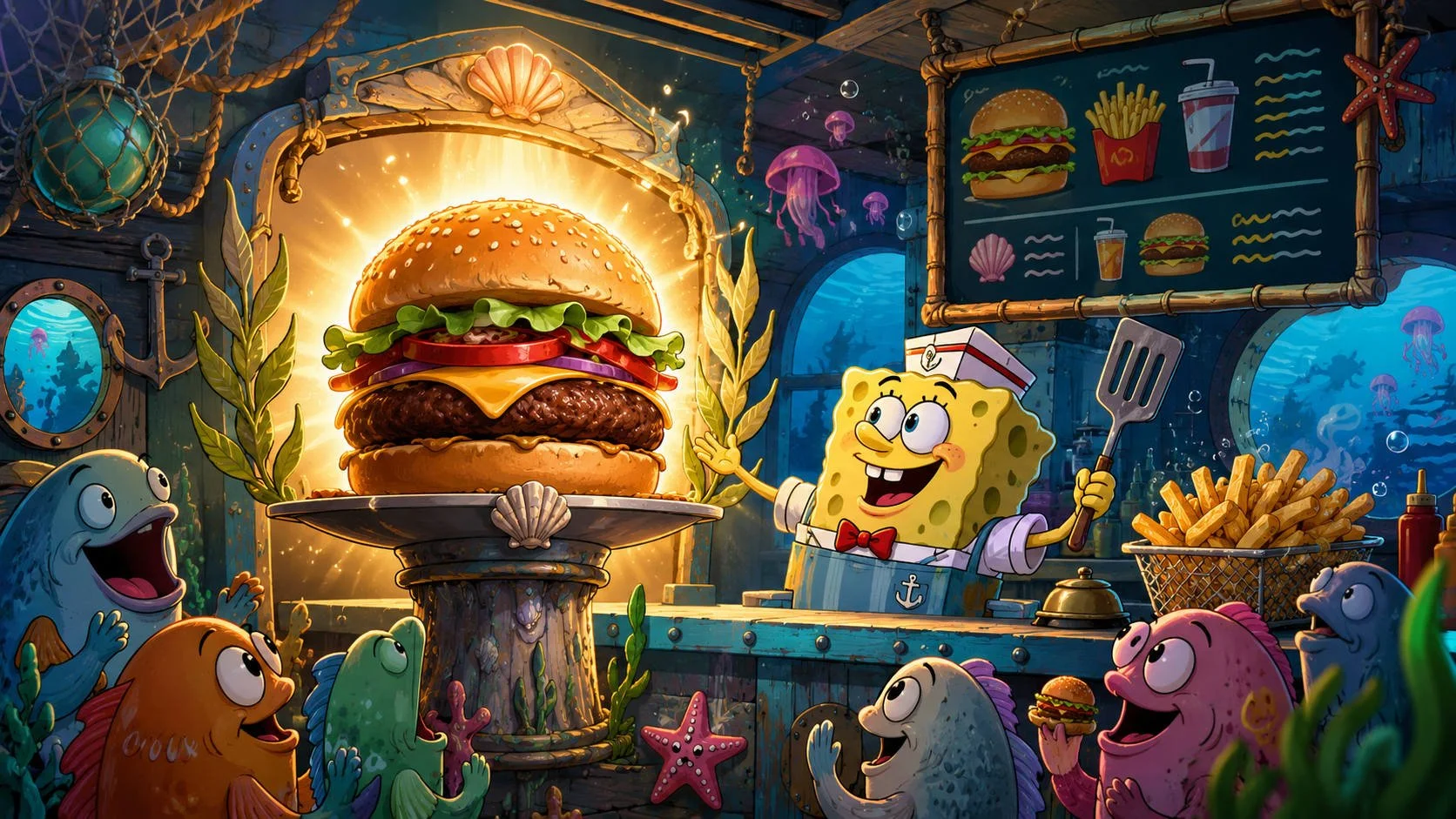
The Krabby Patty is the greatest fast-food item in television history because nobody has ever eaten one. This is important. Reality ruins food myths. The second a real burger exists, people can complain that the bun is dry, the sauce tastes like Thousand Island with delusions, and the lettuce has the crispness of a wet receipt. But a fictional burger? Untouchable. The Krabby Patty lives forever in the golden imagination zone where every patty is hot, every bun is perfect, and the secret formula is always one failed Plankton scheme away from being revealed.
SpongeBob SquarePants premiered on Nickelodeon on July 17, 1999, and grew into one of the most widely distributed properties in Paramount/Nickelodeon history, with the franchise seen in more than 180 markets and translated into 30-plus languages by its 25th anniversary. The show was created by Stephen Hillenburg, who studied marine biology and art before turning a fry cook sponge into a global pop-culture barnacle that will apparently outlive all of us.
And at the center of this ridiculous undersea empire sits a burger.
Not SpongeBob’s pineapple. Not Patrick’s rock. Not Squidward’s clarinet, which should be tried at The Hague. The Krabby Patty. A fast-food object so powerful that it has fueled decades of plots, memes, merchandise, brand collaborations, and adult nostalgia from people who now pay rent but still know the difference between the Krusty Krab and the Chum Bucket. Horrifying. Beautiful. Deeply American, despite occurring under the ocean.
The Krabby Patty Is Perfect Because the Secret Formula Never Pays Rent in Reality
The Krabby Patty’s greatest ingredient is secrecy. Not beef. Not pickles. Not love. Please, love is what brands say when they forgot to season. The myth works because the formula is hidden.
Nickelodeon’s official Plankton profile describes his mighty plans to steal the Krabby Patty Secret Formula and run the Krusty Krab out of Bikini Bottom. It also identifies him as the owner and founder of the Chum Bucket, “the least popular restaurant under the sea,” which is devastating because even in a town full of fish, this man cannot sell chum.
That secret formula is fast-food branding distilled into cartoon form. Every real chain wants some version of it: the special sauce, the seasoning blend, the guarded recipe, the thing customers cannot make at home even though the ingredients are probably sitting in a walk-in cooler next to a mop bucket. The Krabby Patty takes that marketing fantasy and makes it literal. The secret is not a cute slogan. It is the engine of the universe.
The brilliant part is that the show never needs to reveal it. Revealing the secret formula would be like telling children Santa uses invoice software. Technically informative, spiritually disastrous.
The Krusty Krab Is Fast-Food Satire With a Cash Register
The Krusty Krab is not a cozy neighborhood café. It is a fast-food restaurant owned by a greedy crab, staffed by a hyper-devoted sponge and a cashier who would rather be anywhere else, including possibly prison. This is not subtle workplace satire. This is a minimum-wage aquarium with punchlines.
Nickelodeon’s official Mr. Krabs page says Eugene H. Krabs owns the Krusty Krab, is SpongeBob and Squidward’s boss, and has one main goal in life: make as much money as possible while spending as little as possible. So yes, the Krusty Krab is basically a children’s cartoon explaining restaurant capitalism with a crustacean who treats pennies like newborns.
That is why the Krabby Patty myth works so well. It is not just a burger. It is the product of a whole ecosystem: cheap owner, miserable cashier, eager cook, desperate competitor, addicted customers. The Krabby Patty is the thing holding Bikini Bottom’s dumb little economy together.
Fast food in the real world often sells convenience. The Krabby Patty sells obsession. Customers do not merely purchase it. They crave it. Plankton does not merely compete with it. He devotes his entire sad little cyclops life to stealing it. SpongeBob does not merely cook it. He worships the process like a spatula monk.
That is not a menu item. That is a religion with sesame seeds.
SpongeBob Made Fry-Cook Labor Look Heroic, Which Is Absurd and Somehow Sweet
SpongeBob is officially introduced by Nickelodeon as everyone’s favorite “Krabby Patty flipping” sponge, and his first appearance was in the first episode of the series. Paramount’s anniversary release also emphasizes that SpongeBob began his journey as a fry cook flipping Krabby Patties in the pilot episode.
This matters because the show treats the fry cook job with insane emotional sincerity. SpongeBob does not act like fast food is beneath him. He acts like flipping burgers is a sacred calling. He approaches the grill with more reverence than most adults bring to weddings, voting, or assembling IKEA furniture without crying.
That is part of the Krabby Patty myth: the product feels special because SpongeBob believes it is special. His enthusiasm does half the branding work. The burger is not built by a cynical employee dragging himself through a shift. It is built by a sponge whose entire soul has been laminated into the employee handbook.
In the real world, fast-food work is often dismissed as low-skill, disposable, or temporary. SpongeBob flips that nonsense like a patty. The joke is that he takes the job too seriously. The sweetness is that maybe taking pride in work, even absurd work, is not actually the worst idea ever. Annoying lesson from a sea sponge. Very rude.
The Krabby Patty Looks Generic, Which Makes It More Powerful
The Krabby Patty is not visually complicated. It is a cartoon burger. Bun, patty, lettuce, cheese, tomato, pickles, condiments, tiny aura of destiny. It does not look like some overwrought chef burger with onion jam, brioche, smoked aioli, and a steak knife stabbed through it because apparently sandwiches now need orthopedic support.
Its normalness is the trick.
The Krabby Patty looks like the Platonic ideal of a fast-food burger. Not a specific real burger. Not a Whopper. Not a Big Mac. Not a Wendy’s single. It is burger as childhood symbol: round, bright, stacked, happy, impossible. It looks like every burger ad promised food would look before reality handed you a smashed bun and a pickle sliding out like it was fleeing a crime scene.
Because it is generic, everyone can project onto it. Kids imagine the best burger ever. Adults remember the imaginary taste from childhood. Food brands see a licensing opportunity and begin sweating money.
A more detailed fictional food would have aged worse. The Krabby Patty survives because it is simple enough to mean anything and secret enough to mean everything.
Plankton Is the Perfect Fast-Food Rival Because He Has All Strategy and No Product
Plankton is the funniest kind of competitor: obsessed with stealing the winning formula because he cannot accept that his own restaurant is garbage. Inspirational, really. A tiny green LinkedIn post with antennae.
Nickelodeon says Plankton’s whole thing is trying to steal the Krabby Patty Secret Formula and outdo Mr. Krabs, usually with help from Karen, his computer-wife. It also says his plans do not always go the way he plans them, which is generous wording for a man who has spent decades losing to a sponge with a spatula.
This is excellent fast-food satire. Plankton does not want to become good. He wants access. He does not want to build a better restaurant, improve service, develop a beloved product, or stop serving something called chum to sentient sea creatures, which seems like a branding challenge even before the health department gets involved. He wants the formula.
Every industry has Planktons. People who think success is one stolen deck, one viral sauce, one copied concept, one “secret” away. They want the result without the culture. The Krabby Patty myth says: no, idiot. The formula matters, but so does SpongeBob, the Krusty Krab, customer habit, mythology, and the fact that your restaurant appears to be a bucket of despair.
The Krabby Patty Is Scarcity Without Actual Scarcity
The Krusty Krab sells Krabby Patties all the time. They are not rare in Bikini Bottom. Yet the secret formula makes them feel rare. This is advanced nonsense, and fast-food brands should be taking notes on a napkin.
The product is accessible, but the mystery is not. That is the perfect commercial setup. Everyone can buy the burger. Nobody can know the burger. This creates a weird dual status: ordinary customers feel included, while the myth remains protected.
Real brands constantly try to create this feeling. Limited-time sauces. Secret menus. “Vault” recipes. Seasonal drops. Celebrity meals. Nostalgia collaborations. The product must be easy enough to buy and special enough to talk about. The Krabby Patty mastered this before every brand started acting like a sandwich needed an event rollout and a social media calendar.
It is fast food with sacred secrecy. A drive-thru item wearing a temple robe.
The Krabby Patty Became Real, Which Was Always Dangerous
In 2024, Nickelodeon and Paramount celebrated SpongeBob’s 25th anniversary with “The Krabby Patty Kollab,” bringing more than 100 Krabby Patty-inspired interpretations to over 250 local restaurants in cities including New York, Los Angeles, Chicago, Toronto, London, and Mexico City. The official release said the formula remained secret but fans could enjoy imaginative interpretations of the legendary burger.
Wendy’s also partnered with Paramount for a national Krabby Patty Kollab Burger and Pineapple Under the Sea Frosty in the U.S., Canada, and Guam, describing the burger as a quarter-pound beef patty with American cheese, lettuce, tomato, pickle, onion, and a top-secret Krabby Kollab sauce on a toasted bun.
This was inevitable. A fictional burger can only haunt the culture for so long before a real fast-food chain says, “What if we monetized everyone’s childhood?” Very innovative. No notes. Just 25 years of emotional buildup converted into a limited-time sauce.
But the real-world Krabby Patty had an impossible job. It had to taste like nostalgia, secrecy, cartoon physics, the pilot episode, SpongeBob’s joy, Mr. Krabs’ greed, Plankton’s failure, and every childhood Saturday morning that now exists only as back pain and streaming subscriptions. No actual burger can do that. A real burger can be tasty. It cannot be a metaphysical sponge memory.
That is why the Krabby Patty was more perfect before anyone tried to serve it. Myths do not need kitchen execution. They need distance.
The Krabby Patty Is Really a Joke About Branding
The Krabby Patty reveals the mechanics of fast-food branding with embarrassing clarity.
A great fast-food myth needs a signature product. Check.
A secret ingredient or formula. Check.
A lovable worker whose identity fuses with the product. Check.
A greedy owner who knows the product is money. Check.
A failed rival who proves the product’s superiority by constantly trying to steal it. Check.
Customers who behave like the product is more than food. Check.
Catchphrases, locations, rituals, visual consistency, and endless repeatability. Check, check, check, and please stop making Squidward work doubles.
The Krabby Patty is not just a burger in a show. It is a complete brand system. The Krusty Krab has a founder, a hero employee, a signature menu item, a competitor, trade secrets, consumer loyalty, scarcity theater, and brand extensions. It is more coherent than half the real restaurant concepts opened by men who describe sliders as “elevated.”
The Burger Works Because Children Understand Desire Better Than Marketers
Children do not need a tasting note. They understand desire instantly. The Krabby Patty is wanted by everyone, guarded by Mr. Krabs, lovingly made by SpongeBob, hunted by Plankton, and served in a goofy restaurant shaped like a crab trap. That is all the child brain needs. Frankly, it is all the adult brain needs too, which is why adults keep buying limited-time nostalgia meals while pretending it is “for fun” and not because time is eating them alive.
The show never had to explain why the Krabby Patty was good. It only had to show everyone acting like it was good. That is how food desire often works. The line outside the bakery makes the pastry better before you taste it. The packed diner makes the burger feel validated. The secret sauce makes you wonder. The unavailable table makes you want it more.
The Krabby Patty is social proof with pickles.
The Secret Formula Is Better as a Mystery Than a Recipe
There have been jokes, fan theories, fake recipes, promotional burgers, candies, toys, and endless speculation. None of it matters. The real secret formula is that there is no recipe that could satisfy the fantasy.
If the formula were revealed as salt, flour, turmeric, seaweed, paprika, and “love,” everyone would groan and open Twitter to complain like democracy had failed. If it were crab meat, the internet would have a morality aneurysm. If it were just a normal burger sauce, people would accuse Nickelodeon of betrayal. There is no winning. Mystery is the only recipe strong enough to survive.
The Krabby Patty teaches one of the oldest branding lessons: never explain the magic if the magic is doing fine.
The Final Answer: SpongeBob Made the Krabby Patty a Perfect Fast-Food Myth Because It Can Never Disappoint Us
The Krabby Patty is the perfect fast-food myth because it is everything real fast food wants to be and cannot be for more than about six minutes under a heat lamp. It is iconic, consistent, mysterious, craved, protected, memetic, and emotionally loaded. It has a secret formula, a sacred cook, a villainous rival, a greedy owner, and a customer base that treats lunch like destiny.
It is also fictional, which is its greatest competitive advantage.
Real fast food has to deal with supply chains, labor costs, drive-thru times, online reviews, soggy fries, sauce shortages, and customers who think “extra pickles” means “construct me a brined cathedral.” The Krabby Patty has none of that. It exists in a cartoon economy where the patty can remain perfect forever because nobody has to actually taste it.
That is why SpongeBob made it legendary. The show understood fast food as work, ritual, greed, joy, competition, and obsession. It turned a basic burger into a cultural object without ever needing to give us a bite.
And maybe that is the secret formula: don’t sell the burger. Sell the hunger for the burger.
Plankton should have figured that out decades ago, but unfortunately he was busy operating the least popular restaurant under the sea, which is what happens when your entire business plan is “steal sauce from crab.”