What James Bond Martinis Reveal About Luxury Food Branding
James Bond’s martini is ridiculous, which is exactly why it works. A martini is already a tiny glass of cold alcohol wearing formalwear, and Bond somehow made it more theatrical by giving it a catchphrase, a preparation method, a silhouette, a romantic origin story, and the emotional energy of a man who files expense reports with a silenced pistol.
The drink itself is not the whole point. It never was. The point is branding. Bond does not order a martini because he is thirsty. Thirst is what happens to joggers and people trapped at airport gates. Bond orders a martini because the martini tells the room who he is before he has to bother speaking. Cold. Precise. Expensive. Dangerous. Fussy in a way we have all agreed to call “sophisticated,” because apparently if a handsome man in a tuxedo is difficult, that is elegance, but if your uncle does it at Applebee’s, it is “a scene.”
The official 007 cocktail book notes that Bond christens the Vesper in Casino Royale and that “shaken, not stirred” first appears in print in Diamonds Are Forever. The official 007 site also notes that in the 2006 Casino Royale, Bond reveals the recipe for his favorite martini, “The Vesper.”
And that is the first lesson of luxury food branding: the product matters, but the story sells the product a little monocle and a superiority complex.
James Bond Martini Branding Starts With Ritual
A normal person orders a drink. James Bond performs a ritual.
The phrase “shaken, not stirred” is a marketing miracle because it is short, repeatable, distinctive, and completely unnecessary. It does not explain the drink. It brands the drink. It turns preparation into personality.
Official 007 coverage says Bond first requested a martini “shaken not stirred” aboard Auric Goldfinger’s private jet in Goldfinger in 1964, and Smirnoff No. 21 was the original vodka used to make 007’s martini in Dr. No.
The instruction does what every luxury food brand dreams of doing: it makes the customer feel like a connoisseur for repeating a phrase. That is the whole scam, and frankly, respect. “Shaken, not stirred” is not just a preference. It is an identity button. Press it and suddenly you are not ordering booze; you are borrowing danger, tailoring, and cheekbones.
Luxury brands love ritual because ritual slows consumption down and makes it feel intentional. Champagne gets opened with ceremony. Espresso has crema. Caviar has mother-of-pearl spoons because apparently fish eggs are too fragile for regular cutlery, poor little oligarch pellets. A martini gets chilled glassware, measured spirits, garnish choreography, and a sentence that makes the bartender silently judge you.
Ritual turns a commodity into an event. Bond’s martini proves that if you can make the customer say the product correctly, you have already won half the brand war.
The Vesper Is Luxury Branding With a Love Interest
The Vesper is not famous because it is the world’s most practical cocktail. It is famous because Bond gives it a myth.
In Casino Royale, the drink is tied to Vesper Lynd, which means it carries romance, betrayal, memory, and tragedy. Ian Fleming Publications describes the Vesper martini as being christened in honor of Bond’s great love, Vesper Lynd, and says Fleming’s precision about Bond’s drinks, clothes, cars, food, and weapons helped make the fantasy feel reachable.
That is luxury branding at its most shamelessly effective. The drink is not just gin, vodka, and aromatized wine. It is desire in a glass. It is heartbreak with a lemon peel. It is a cocktail that comes with emotional lore, because apparently plain alcohol was not carrying enough narrative luggage.
This is how luxury food branding works everywhere. A chocolate brand does not sell cocoa; it sells origin, harvest, craft, farmers, single estates, and the fantasy that eating 72% dark chocolate makes you morally and intellectually superior to people with peanut butter cups. A coffee brand does not sell caffeine; it sells altitude, varietal, processing method, tasting notes, and the idea that your morning beverage has a more interesting passport than you do.
The Vesper teaches that the most powerful luxury food products are not just consumed. They are remembered.
Precision Makes the Customer Feel Important
Bond’s Vesper recipe is famously specific: three measures of Gordon’s, one of vodka, half a measure of Kina Lillet, shaken until ice-cold, with a large thin slice of lemon peel. At home you can reproduce the order from Casino Royale, and official Bond sources continue to treat the Vesper as part of the 007 drinking mythology.
This is precision as theater. Does the average person need exact ratios to enjoy a drink? No. The average person needs a chair and fewer emails. But exact ratios create authority. They say: this is not random. This is not “pour until vibes.” This is a formula.
Luxury food brands use this constantly. “Aged 36 months.” “Harvested at dawn.” “Single-origin.” “Hand-selected.” “Small batch.” “Estate grown.” “Cold-pressed.” “Barrel-aged.” “Line-caught.” “Stone-milled.” All of these phrases do the same thing Bond’s martini order does: they make the product feel controlled, deliberate, and too refined to be compared with whatever dusty bottle is lurking in your cabinet like a bad decision from 2019.
Precision lets luxury brands charge for confidence. It reassures the buyer that someone cared intensely about a detail the buyer may not understand but would like credit for appreciating.
The Martini Is Not About Taste. It Is About Character Transfer.
Let us be honest: most people do not want Bond’s martini because they are deeply invested in the mouthfeel implications of shaking gin and vodka. They want the drink because they want the Bond aura to rub off on them without requiring espionage, cardio, or emotional damage.
This is character transfer. Bond drinks the martini. Bond is cool. Therefore the martini becomes cool. Then the consumer drinks the martini and receives, allegedly, 4% of the coolness. This is how product placement works when it is not just a logo slapped onto a lunchbox like a corporate hostage note.
Research on brand placement has found that product placements can affect brand recall, and another business review notes that product placement can generate higher brand recall, more favorable perceptions, attitudes, and purchase intentions.
This is why Bond’s drink branding is stronger than a normal ad. A vodka commercial says, “Buy this.” Bond’s martini says, “Be this.” Much more dangerous. Much more profitable. Much more likely to make a man in a rental tuxedo say “shaken, not stirred” at a wedding bar serving well vodka in plastic cups.
Luxury Food Branding Needs a Uniform
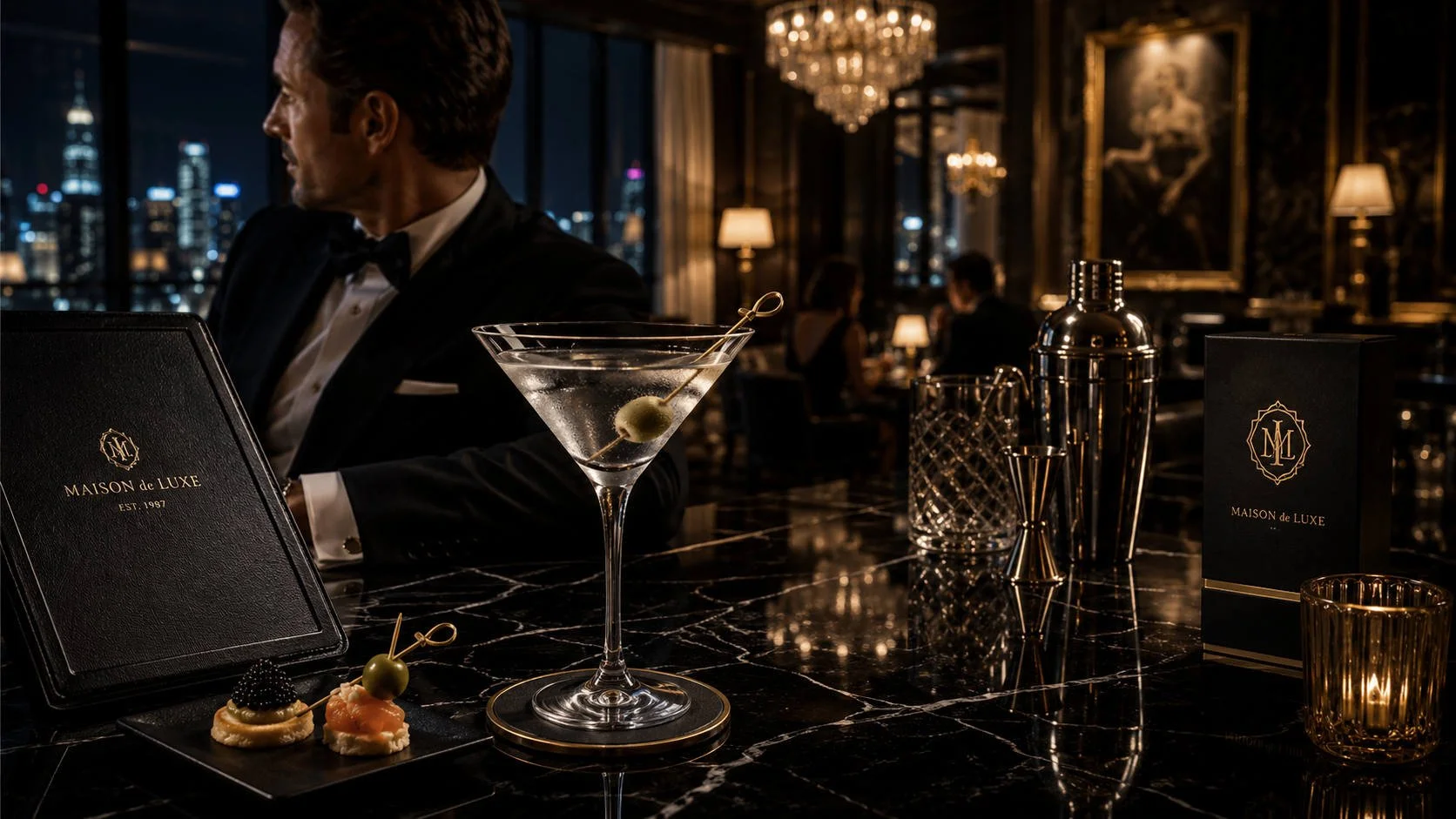
Bond’s martini has a visual uniform: clear drink, elegant glass, lemon twist or olive, cold surface, hard angles, controlled minimalism. It looks expensive even before you know what is in it. That matters, because luxury food branding is often visible before it is edible.
A martini glass is basically a billboard on a stem. It says, “This person has chosen inconvenience in the name of style.” It spills easily. It warms quickly. It is terrible for walking. It is a glass designed by someone who thought beverages should punish poor posture. Perfect luxury object.
Luxury food brands understand this. Packaging is never just packaging. The bottle shape, label stock, foil, cork, capsule, box, menu typography, serving spoon, tin, glassware, and garnish all conspire to say: this is not regular food for regular goblins.
Bond’s martini succeeds because it has instantly recognizable stagecraft. Even people who cannot make one know what it should look like. That is branding victory. The product has become a silhouette.
Shaking the Martini Is Technically Questionable, Which Makes It Better Branding
Many bartenders prefer stirring spirit-forward cocktails because it keeps the drink clear and silky; GQ quoted bartender Jeff Bell saying spirit cocktails are generally stirred, not shaken.
Bond, naturally, shakes it anyway. Wonderful. Of course he does. The man announces his own name to enemies and somehow remains employed in intelligence.
But the technical wrongness helps the brand. “Shaken, not stirred” is not famous because it is the perfect method. It is famous because it is a signature. Luxury does not always require being correct. It requires being recognizable.
This is a crucial branding lesson. A luxury food habit can be irrational and still powerful if it becomes distinctive. The tiny espresso cup. The oversized wine glass. The elaborate pour-over kettle. The server shaving truffles over pasta with the seriousness of a surgeon defusing a bomb. Half of luxury food culture is just preference turned into commandment.
Bond’s martini reveals that the market does not always reward the best technique. It rewards the technique people can quote.
The Brand Partnership Machine Under the Tuxedo
The Bond martini is not just fictional taste. It is also commerce with better lighting.
Smirnoff’s official 007 campaign for No Time To Die leaned directly into Bond history, calling Smirnoff No. 21 the original vodka used to make 007’s martini in Dr. No. Belvedere announced a major partnership with SPECTRE in 2014, including limited-edition bottles celebrating Bond’s vodka martini and a global marketing campaign.
Bollinger has done the champagne version beautifully. The house says its Special Cuvée 007 limited edition celebrates more than 45 years as the official Champagne of James Bond, with packaging that uses the Bond gun-barrel motif, 007 logo, and black-and-gold collector-box drama, because apparently champagne was not already fancy enough and needed to borrow a spy.
This is luxury food branding’s favorite trick: association laundering. The drink borrows Bond’s glamour. Bond borrows the drink’s sophistication. The audience receives an image so polished that everyone forgets they are watching an ad with cufflinks.
And unlike a regular commercial, product placement arrives inside the fantasy. Bond is not standing in front of a white background saying, “I enjoy premium vodka.” He is saving the world, seducing danger, and pausing for a branded drink because even fictional espionage needs partnership revenue.
Bond Shows That Luxury Can Survive Contradiction
One of the funniest things about Bond’s drinking image is that it is much cleaner as branding than as behavior.
A Medical Journal of Australia analysis of 24 Bond films found 109 drinking events across six decades, averaging 4.5 drinking events per movie, and classified Bond as having severe alcohol use disorder based on DSM-5 criteria. The same study noted that alcohol product placement in Bond’s environment increased significantly over time.
So yes, the luxury fantasy is doing some heavy lifting. In real life, a man drinking before fights, chases, gambling, machinery, and enemy-adjacent bedrooms is not suave. He is an HR incident wearing Omega.
But luxury branding is not realism. It is edited reality. It takes the appealing part — poise, glassware, glamour, control — and throws the consequences into a volcano. Bond’s martini is not marketed as “alcohol before dangerous occupational tasks.” It is marketed as confidence. The hangover has been removed in post-production.
That is how luxury food branding often works. It isolates pleasure from consequence. The butter is artisanal, not saturated fat. The steak is heritage breed, not a 22-ounce nap requirement. The cocktail is iconic, not three spirits in a glass daring your liver to write a resignation letter.
Luxury does not eliminate contradiction. It makes contradiction photogenic.
The Martini Turns Simplicity Into Scarcity
A martini is simple. Annoyingly simple. Spirit, vermouth or aromatized wine, ice, garnish. Yet Bond makes it feel rare.
This is perhaps the most useful lesson for food brands: luxury does not always mean complexity. It means control. A simple product becomes luxurious when the brand controls the frame around it.
Coffee is simple until it becomes single-origin, washed-process, altitude-specific, brewed through a glass device that looks like lab equipment for people who say “mouthfeel.” Salt is simple until it becomes hand-harvested flakes from a coast nobody can pronounce. Olive oil is simple until it arrives in a matte black bottle with a tasting wheel and a price that suggests the olives had private tutors.
Bond’s martini teaches that luxury can be built from minimalism if the ritual, character, and context are strong enough. The drink is not cluttered. It is edited. And edited looks expensive.
“Bond Drinks This” Beats “This Tastes Good”
Taste is important, obviously. But in luxury food branding, taste is often only part of the sale. The rest is identity.
A Bond martini allows the consumer to participate in a story. That is much more powerful than saying “this vodka is smooth.” Every vodka says it is smooth. Vodka marketing has used the word “smooth” so hard it now means nothing. A floor can be smooth. A jazz saxophone can be smooth. A bald eagle’s head is probably smooth. Please develop another adjective.
Bond gives the drink a world. Casinos. Trains. tuxedos. danger. secret files. impossible women. villains with architecture budgets. A luxury brand wants exactly that: not a claim, but an atmosphere.
That is why Bond lifestyle products keep appearing. Ian Fleming Publications says the 007 lifestyle remains in demand, including endless takes on the Vesper martini, and the official 007 site recently promoted a barware collection to help fans “make the perfect martini at home.”
This is the dream: the customer does not just buy the product. The customer buys equipment to imitate the product’s fictional context. That is not a cocktail anymore. That is a fandom with ice.
Luxury Food Brands Need Heritage, Even If They Have to Borrow It
Luxury loves age. Heritage is one of its favorite costumes. A Journal of Consumer Research article describes brand heritage as a dimension of identity tied to track record, longevity, core values, symbols, and the belief that history matters; it also notes that heritage can help luxury brands signal elevated status.
Bond offers instant borrowed heritage. Partner with Bond and suddenly your vodka, champagne, barware, or cocktail kit does not merely exist in the present. It plugs into 60-plus years of cultural memory. It gets Sean Connery’s eyebrows, Daniel Craig’s jawline, casino tables, Aston Martins, and theme music it did not pay to compose.
This is why a Bond-branded bottle can feel more collectible than the same liquid in regular packaging. The liquid may be identical. The story is not. And luxury branding knows the story can carry a shocking amount of margin before anyone gets embarrassed.
Useful Lessons for Luxury Food Branding From Bond’s Martini
First, give the product a ritual. Do not just sell the thing. Sell the way to order it, pour it, cut it, plate it, shake it, garnish it, open it, or share it. If customers can repeat the ritual, they can spread the brand for free. Horrifying, but effective.
Second, make the product visually legible. Bond’s martini looks like Bond’s martini. A luxury product needs a shape, color, serve, package, or gesture people recognize across a room.
Third, attach the product to character. Not demographics. Character. Bond is not “male 25–54 with discretionary income.” He is a fantasy of control under pressure. That fantasy sells better than a spreadsheet.
Fourth, edit the product. Luxury often feels expensive because it removes clutter. One perfect glass. One lemon twist. One precise phrase. Stop throwing twelve toppings, seven fonts, and a handwritten origin story onto the same product like a deli counter having an identity crisis.
Fifth, use heritage carefully. History helps, but fake heritage smells like a candle called “Old Money.” If the brand has history, use it. If it does not, build consistency now so some future marketer can pretend it was destiny.
Sixth, understand that luxury is often performative. People want taste, yes, but they also want the feeling of knowing what to ask for. Bond’s martini gives them a script. Scripts are powerful because most people panic when asked what they want.
Bond’s Martini Is a Branding Weapon
James Bond martinis reveal that luxury food branding is not about making something expensive and hoping rich people clap. It is about turning consumption into identity. The Bond martini has ritual, phrase, glassware, precision, history, romance, contradiction, product placement, and a character so strong that the drink barely has to defend itself.
It is not merely “a martini.” It is proof that a beverage can become a costume. A script. A status signal. A lifestyle fragment. A little glass of borrowed masculinity and international incident.
The genius is that the product is simple. The branding is not. The liquid is cold. The mythology is warm. The order is brief. The implications are endless.
That is what luxury food brands should learn from Bond: people are rarely buying only taste. They are buying the story that taste lets them tell about themselves.
And if that story happens to come in a chilled glass with a lemon twist and a catchphrase everyone knows, congratulations. Your cocktail has become better at marketing than most agencies.