Why Bob’s Burgers Is the Best Show About Trying to Make Rent With Food
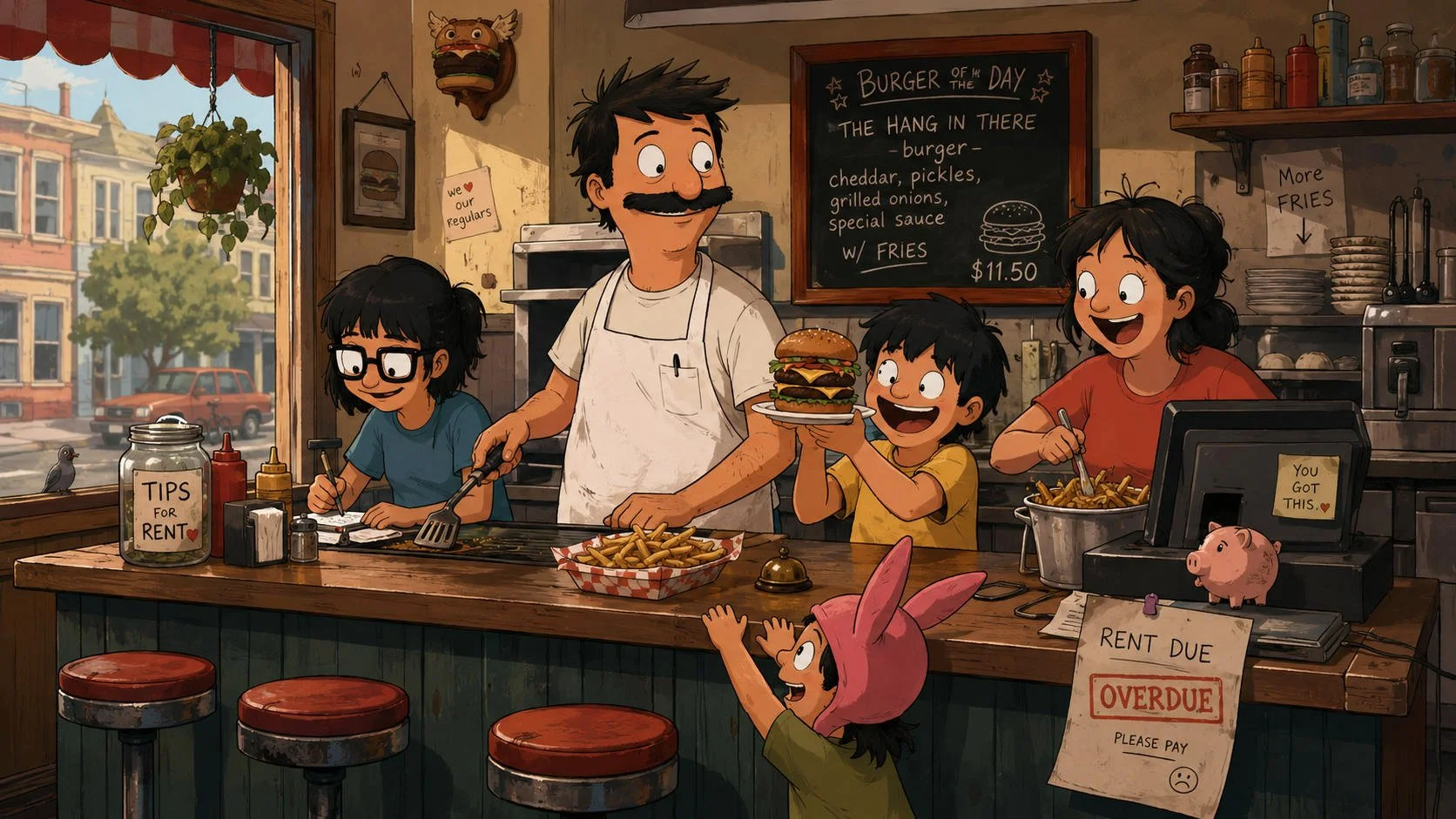
Bob’s Burgers is not really a show about burgers. That is the trick. The burgers are there, obviously, sitting on the grill with pun names like edible dad jokes wearing cheese. But the show is actually about something far more American and spiritually exhausting: trying to keep a tiny restaurant alive long enough to pay rent.
Bob Belcher is not chasing a culinary empire. He is not opening twelve locations, disrupting fast casual, launching a ghost kitchen, or describing ketchup as “a legacy condiment vertical.” He is trying to sell enough burgers to keep the lights on, keep the landlord calm, keep the kids vaguely employed, and keep Linda from turning every minor crisis into dinner theater with jazz hands.
That is why Bob’s Burgers is the best show about trying to make rent with food. It understands that the restaurant business is not sexy. It is beautiful, stupid, exhausting, repetitive, humiliating, and held together by family labor, unpaid children, customer regulars, broken equipment, stubborn hope, and one man’s doomed belief that a great burger should be enough.
Bob’s Burgers Is a Restaurant Show Wearing a Family Sitcom Costume
Disney’s official description of Bob’s Burgers gets the setup exactly right: Bob runs the restaurant with Linda and their three kids, business is slow, and the family “never give up hope.” The longer description is even more brutal: Linda supports Bob’s dream but is sick of the slow times, and the restaurant is “constantly in danger of going out of business.” Lovely. A cartoon sitcom premise or a small-business loan officer’s bedtime story? Hard to tell.
That is the genius. The show never lets the restaurant become a cute backdrop. It is not Central Perk with beef. It is not a magical hangout where nobody seems to work and rent is paid by vibes. Bob’s Burgers is a business, and a not especially successful one. Every episode has the faint smell of unpaid invoices.
The restaurant is where the family works, eats, argues, hides, schemes, sings, fails, and tries again. The dining room is their stage. The kitchen is their factory. The apartment upstairs is not a charming sitcom convenience; it is the small-business owner’s final form: live above the thing that is financially killing you so you can be close when it needs to kill you again.
Bob Belcher Is Not a Celebrity Chef. Thank God.
Most food television is about victory. Awards. Michelin stars. Redemption arcs. Perfect plating. A chef staring into a walk-in cooler like the salmon has explained mortality.
Bob is different. Bob just wants the burger to be good.
That sounds simple until you realize it is practically heroic in a food culture where everyone is trying to build a brand, open a concept, post a reel, sell merch, and say “community” while charging $19 for fries with a meeting agenda. Bob does not want fame. He wants the person eating the burger to understand that he cared. Horribly inconvenient quality in a capitalist system, caring.
Series creator Loren Bouchard has described Bob as a working-class creative person: someone making a different burger every day, not primarily because he is good at making money, but because he has a need to create. That is the whole show, right there: the man is an artist, but unfortunately his chosen medium is ground beef in a rental property.
Bob’s tragedy is that he is good at the food and bad at everything the food business rewards. Marketing? No. Customer service? Emotionally inconsistent. Ambition? Present, but mostly in burger form. Business strategy? A loose napkin with panic on it.
He is every excellent small restaurant owner who believes the product should speak for itself, only to discover the product has a tiny voice and rent speaks through a megaphone.
The Real Villain Is Not Jimmy Pesto. It’s Overhead.
Jimmy Pesto is annoying, sure. He is loud, smug, and has the energy of a man who would describe mozzarella sticks as “Italian innovation.” But he is not the true villain of Bob’s Burgers.
The true villain is overhead.
Rent. Utilities. Equipment loans. Food cost. Repairs. Slow customer traffic. Insurance. Random disasters. Health inspections. Marketing failures. The crushing little math problem behind every restaurant meal.
The National Restaurant Association has reported that, before the recent cost surge, a typical independent restaurant had food and labor each taking about 33 cents of every sales dollar, while expenses like occupancy, utilities, supplies, repairs, administration, and credit card fees took another 29 cents. That left roughly a 5% pre-tax profit margin. Five percent. That is not a margin. That is a napkin between you and the abyss.
Suddenly Bob’s constant low-grade panic stops being a cartoon joke and starts looking like documentary realism with bunny ears.
The National Restaurant Association’s 2026 report also says 42% of operators reported their restaurants were not profitable in 2025, with elevated costs and softer traffic continuing to pressure margins. So when Bob loses one lunch rush, or a sinkhole blocks the entrance, or the fryer acts up, the show is not exaggerating restaurant fragility. It is animating it with better songs.
The Restaurant Is Always One Disaster Away From Collapse
The clearest proof that Bob’s Burgers understands restaurant life is The Bob’s Burgers Movie, which does not raise the stakes by giving Bob a villain with lasers or sending the family to space. No, the movie threatens them with the most terrifying thing imaginable for a small restaurant: blocked foot traffic and a loan payment.
The official 20th Century Studios synopsis says a ruptured water main creates a giant sinkhole in front of Bob’s Burgers, blocking the entrance and ruining the family’s plans for a successful summer while Bob and Linda struggle to keep the business afloat. That is not just a movie plot. That is every restaurant owner’s stress dream, plus choreography.
The movie works because the stakes are small and enormous at the same time. Nobody has to save the world. They have to save the restaurant. Which, for the Belchers, is the world.
That is what the show gets better than almost any sitcom: when you are broke, small things become huge. A broken window is not a broken window. It is rent money leaving through glass. A slow Tuesday is not a slow Tuesday. It is payroll coughing politely in the corner. A blocked entrance is not an inconvenience. It is the universe pressing its thumb on your throat and asking whether the lunch special was really a good idea.
Family Labor Is the Business Plan, Tragically
The Belchers’ business model is basically: “What if we had no money, but we did have children?”
Tina, Gene, and Louise are not employees in any professional sense. They are tiny workplace hazards with backpacks. Tina can technically take an order if nobody asks follow-up questions. Gene treats the restaurant like a performance venue with burger grease. Louise is a liability in rabbit ears who would unionize the ketchup bottles if it helped her avoid wiping tables.
And yet, the show understands something real about small family restaurants: everyone works. The kids work. The spouse works. The cousin works. The friend fixes something. The regular becomes emotional furniture. The business is not separate from the family; it eats the family’s time and gives them identity in return. Very fair trade, if you are a haunted cash register.
Bob’s Burgers survives because the family is cheap labor, moral support, chaos engine, and marketing department all at once. Is this healthy? Absolutely not. Is it common? Please visit literally any family-run restaurant and ask the 12-year-old doing homework behind the counter.
Teddy Is the Regular Every Restaurant Needs
Teddy is not just a customer. Teddy is recurring revenue with feelings.
Every struggling restaurant needs a Teddy: someone who shows up, orders, talks too much, over-identifies with the staff, fixes things badly or wonderfully, and treats the restaurant like a second living room because his first living room has too much emotional asbestos in it.
Teddy matters because small restaurants are not built only on foot traffic. They are built on regulars. People who come back. People who forgive weird days. People who bring other people. People who know the owner’s name and maybe too much about the owner’s marriage. Restaurants need tourists, sure, but regulars are the heartbeat. Weird, chatty, sauce-consuming heartbeat.
Teddy is also proof that Bob’s food is good. The man returns constantly. Either the burgers work, or Teddy has developed Stockholm syndrome with fries. Possibly both.
The Burger of the Day Is Bob’s Art and Marketing Department
The Burger of the Day is one of the show’s best jokes because it is both stupid and deeply sincere.
Bob writes a new pun burger on the chalkboard constantly. Most are groan-inducing. Some are genius. Many sound like the result of a man losing a quiet battle with language and cheese.
But the Burger of the Day is also the whole point of Bob. It is his creative practice. It is his marketing. It is his identity. He cannot afford a rebrand, so he writes a joke on a board. He cannot hire a social media agency, so he makes a pun with chard. He cannot compete with Jimmy Pesto’s louder, dumber, more successful operation across the street, so he does the thing he can do: make a better burger and name it something ridiculous.
This is what small restaurants do. They make personality out of scarcity. They turn a chalkboard into advertising. They turn limitations into charm. They turn “we cannot afford a campaign” into “please enjoy today’s special, the Brieyoncé.”
Linda Is the Restaurant’s Emotional Infrastructure
Bob may be the burger guy, but Linda is the atmosphere. Without Linda, Bob’s Burgers would be a grim little beef cave run by a man muttering at patties until foreclosure arrived wearing a little hat.
Linda keeps the room alive. She sings. She greets. She overcommits. She turns disaster into pageantry. She believes in Bob with the intensity of someone who has chosen love and will now make that everyone’s problem.
That matters because food alone rarely saves a restaurant. Vibe matters. Hospitality matters. Someone has to make the place feel human. Someone has to decide that this financially unstable burger box is still worth decorating, singing inside, and defending from the world’s steady attempts to crush it.
Linda is the reason the restaurant feels like a place instead of a sad grill with chairs.
The Show Understands That Poverty Is Not Always Noble
A worse show would make the Belchers’ struggle cute. It would turn being broke into quirky wallpaper. It would say, “They may not have money, but they have love,” then cue a ukulele and call it a day.
Bob’s Burgers is smarter than that. The Belchers do have love. They also have stress, bad credit energy, equipment panic, unpaid bills, and the constant need to improvise. Their financial situation is funny because the writing is funny, not because being broke is adorable.
The show never pretends that rent pressure builds character like some inspirational poster in a landlord’s bathroom. It shows that money problems make people weird, tired, short-tempered, inventive, loyal, desperate, and occasionally musical.
That is why the show’s optimism lands. It is not fake cheer. It is survival optimism. Bouchard told Salon the show thinks about the “hope and grit and optimism” that keeps the family going in tough times, which is a painfully polite way of saying: these people are financially cooked but still making jokes.
Why Bob’s Burgers Feels More Honest Than Prestige Food TV
Prestige food shows love transformation. The chef overcomes trauma. The dish means memory. The sauce represents grief. Someone plates a scallop like it is testifying before Congress.
Bob’s Burgers says: what if the food is good and the restaurant is still struggling?
That is the truth many food shows avoid. Good food does not guarantee success. Good food does not pay rent by itself. Good food does not fix bad location, weak marketing, thin margins, landlord pressure, customer inconsistency, or the fact that half the public thinks a $7 burger should arrive instantly, taste homemade, support local business, and cost less than a gas station taquito.
Bob can make a great burger. That is not enough. Horrifying lesson. Very rude of reality.
What Real Restaurants Can Learn From Bob’s Burgers
The show is comedy, not a hospitality MBA, which is good because most MBAs would immediately replace Gene with a kiosk. But Bob’s Burgers accidentally gives useful lessons.
Have a signature item. Bob has burgers. Not twelve cuisines, not a menu the size of municipal code, not sushi-taco-pizza-brunch fusion. Burgers. Know what you are.
Make the place feel personal. The Burger of the Day gives the restaurant character. Small restaurants need memory hooks. People remember personality.
Respect regulars. Teddy is annoying, but Teddy pays. Regulars are not background characters. They are rent with elbows.
Do not ignore business basics. Bob’s food is better than his business instincts, and the show punishes him for it constantly. Passion is lovely. Cash flow is less romantic but annoyingly necessary.
Let people care. The Belchers survive because the restaurant is not just a business. It is a shared project. Staff, family, regulars, neighbors — people return to places that feel like they matter.
The Real Reason Bob’s Burgers Is the Best Rent-and-Food Show
Bob’s Burgers is the best show about trying to make rent with food because it understands the central absurdity of restaurants: people pour their entire lives into a business where success can depend on weather, foot traffic, landlord mood, fryer health, Yelp goblins, ingredient costs, and whether strangers feel like eating a burger today.
The show loves restaurants without romanticizing them into nonsense. It knows cooking is craft. It knows hospitality is labor. It knows family businesses are beautiful little pressure cookers. It knows a restaurant can be someone’s dream and also the thing slowly eating their nervous system with a side of fries.
Bob Belcher is not winning. Not in the conventional sense. He is not rich. He is not famous. He is not scaling. He is not disrupting. He is not building a burger empire with a TED Talk called Meat the Future.
He is making food. He is raising kids. He is trying to pay rent. He is writing a pun on a chalkboard and hoping enough people walk in.
That is not failure.
That is the restaurant business, stripped of its influencer lighting and exposed under fluorescent truth.
A man. A grill. A family. A landlord. A dream.
And one more Burger of the Day standing between dinner service and doom.