Why Waffle House Is America’s Best Lesson in Affordable Comfort Food
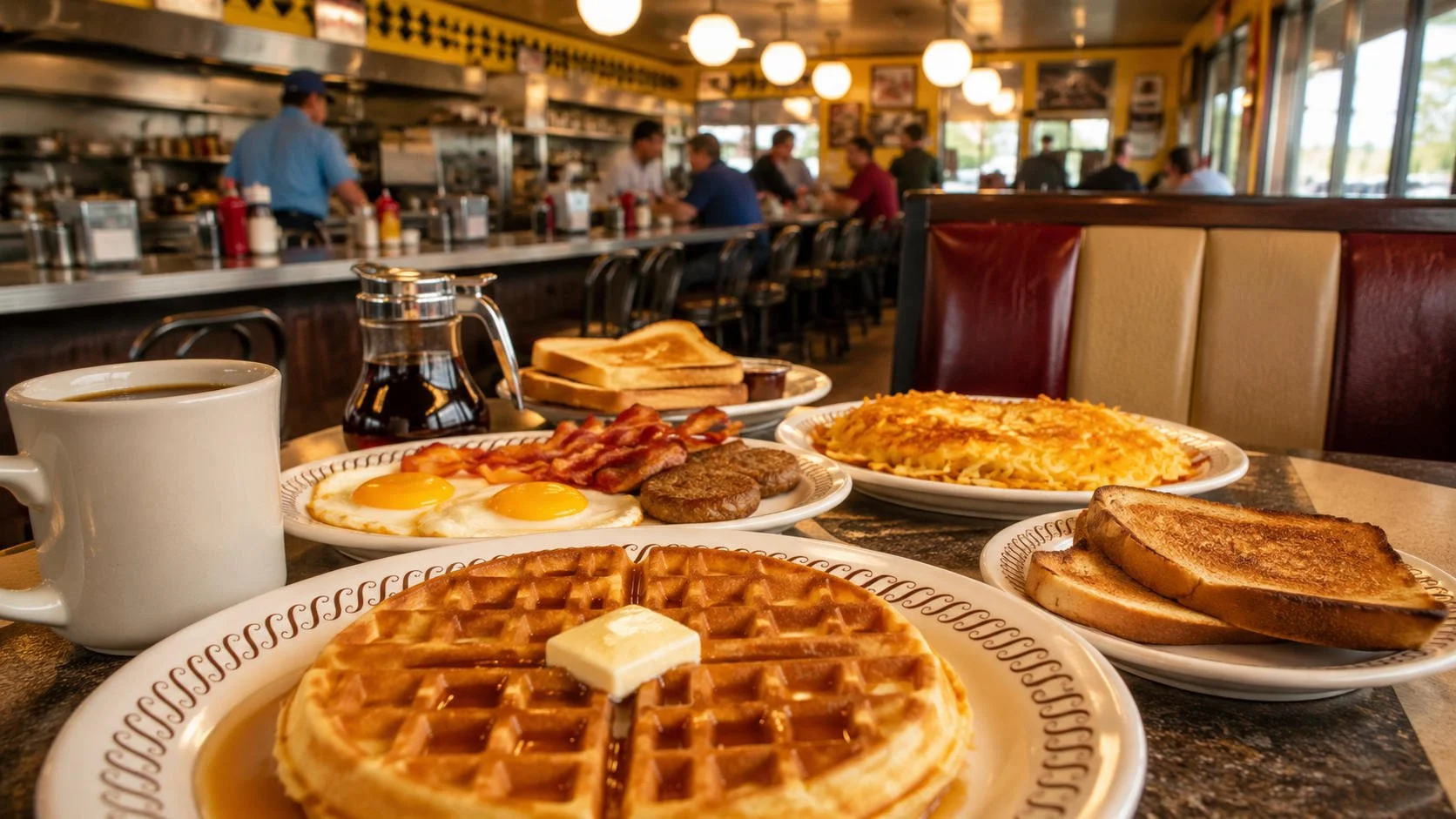
Waffle House is not fancy. That is the point. It does not serve eggs on slate. It does not ask whether you would like your coffee “bright” or “jammy,” because coffee is not a jazz solo and everyone involved needs to calm down. It is a yellow-signed, fluorescent-lit monument to the idea that a person should be able to sit down, order eggs, waffles, hash browns, bacon, coffee, and dignity at 2:17 a.m. without being financially assaulted by a “farm egg experience.”
That is why Waffle House remains America’s best lesson in affordable comfort food. Not because it is always the cheapest meal in town, and not because every location is some mystical diner utopia where the bacon sings hymns. It is because Waffle House understands value the way normal people understand value: hot food, fair portions, predictable choices, fast service, endless customization, and no decorative shrubbery pretending to be hospitality.
Waffle House Affordable Comfort Food Starts With Being Open
The first rule of comfort food is that it has to exist when you need it. A closed restaurant is not comforting. It is architecture with opinions.
Waffle House says its system includes more than 1,900 locations in 25 states, all open 24 hours a day, seven days a week. The company traces that always-open DNA back to 1955, when Joe Rogers Sr. and Tom Forkner opened a 24-hour sit-down restaurant in Avondale Estates, Georgia.
That matters because affordability is not just price. It is access. A $7 breakfast that disappears at 10:30 a.m. is not affordable to the night-shift nurse, the trucker, the college student, the stranded traveler, or the person whose life has briefly become a Waffle House parking lot at midnight. Waffle House’s own site promotes breakfast favorites “all day, every day,” which is exactly the kind of plainspoken miracle brunch restaurants have spent 20 years trying to ruin with waitlists and edible flowers.
In a World of Rising Restaurant Prices, Waffle House Still Feels Like a Deal
Restaurant prices are still climbing. The Bureau of Labor Statistics reported that food away from home rose 3.6% over the 12 months ending in April 2026, with full-service meals up 3.8% and limited-service meals up 3.2%.
This is the economic backdrop that makes Waffle House feel less like a diner and more like a public utility with syrup. When a sample official Waffle House online ordering page lists a Two Egg Breakfast at $7.25 and an All-Star Special at $12.60, with prices varying by location, the value proposition is not hard to understand.
You are not paying for “a concept.” You are paying for eggs, toast, jelly, grits or hash browns, maybe a waffle, maybe meat, maybe enough coffee to restart a small tractor. The whole thing is deeply unglamorous, which is another way of saying honest.
Waffle House Comfort Food Does Not Need a TED Talk
Waffle House serves the kind of food that understands human weakness and does not judge it. Waffles. Eggs. Bacon. Hash browns. Coffee. Toast. Grits. Melts. Chili. The menu is not trying to “challenge” you, because dinner should not require emotional resilience.
The scale is almost absurd. Waffle House says it serves 85 million strips of bacon, 153 million hash brown orders, 124 million waffles, 58 million cups of coffee, and 272 million eggs each year.
That is not a restaurant chain. That is a national carbohydrate weather system.
And the comfort comes from repetition. The waffle tastes like the waffle. The hash browns behave like hash browns. The coffee is coffee, not a lifestyle accessory brewed by a man named Mason who wants you to taste “stone fruit.” Waffle House gives America the rarest luxury of all: knowing exactly what you are getting.
The Hash Browns Are a College Course in Affordable Customization
Waffle House hash browns are the best argument that affordable food does not have to be boring. One pile of potatoes becomes a full personality exam.
The classic language is famous: scattered, smothered, covered, chunked, diced, peppered, capped, topped, and country. Waffle House’s own hash brown guide explains the terms: smothered means onions, covered means American cheese, chunked means ham, diced means tomatoes, peppered means jalapeños, capped means mushrooms, and topped means chili. It also notes that there are 768 possible hash brown combinations, because apparently potatoes needed their own multiverse.
This is the genius. Waffle House does not need a 14-page menu with “chef-driven seasonal bowls.” It has a griddle, potatoes, toppings, and a language. You can order simple hash browns like a responsible citizen, or you can order them all the way like someone building a tiny edible landfill with confidence.
Either way, you get choice without pretension. That is value.
Waffle House Is Cheap Because It Is Efficient, Not Soulless
The modern restaurant industry loves to pretend efficiency means misery. Touchscreens. App-only deals. Kiosks that ask for a tip after making you do the work yourself. Waffle House is efficient in an older, better, louder way: a small kitchen, open grill, short menu, staff who know the rhythm, and food that does not require tweezers.
The counter is part of the experience. You can watch your meal happen. Eggs hit the flat top. Hash browns crisp. Bacon behaves badly in public. Someone calls an order. Someone else pours coffee. It is dinner and theater, except the theater has better prices and fewer people named “Sebastian” explaining the tasting menu.
Waffle House’s company story even quotes co-founder Joe Rogers Sr.: “We aren’t in the food business. We’re in the people business.” That sounds like corporate wallpaper until you sit at the counter and realize, annoyingly, that it is true.
The Waffle House Index Proves Comfort Is Reliability
Waffle House’s reputation for staying open is so serious it became disaster folklore. The “Waffle House Index” uses green, yellow, and red to describe whether a location is serving a full menu, a limited menu, or is closed after a storm. A Waffle House page recounts former FEMA Administrator Craig Fugate’s famous line that if a Waffle House is closed, “that’s really bad.”
That sounds like a joke until you think about what it really means. Comfort food is not just melted cheese and coffee. Comfort food is normalcy. It is a hot meal after chaos. It is a place with lights on when other places have surrendered to weather, staffing, or vibes.
Waffle House teaches a very simple lesson: people do not always need luxury. Sometimes they need a booth, hash browns, and proof that the world has not fully come apart like a gas station sandwich in July.
What Other Restaurants Should Learn From Waffle House
The lesson is not “serve waffles.” Please, America has enough concept waffles. The lesson is to stop confusing comfort with decoration.
Waffle House wins because it keeps the menu understandable, the service direct, the portions satisfying, and the hours useful. It lets people customize without forcing them through a questionnaire longer than a mortgage application. It gives regulars a ritual and newcomers a map. It sells food people actually want at times they actually need it.
That sounds obvious, which is why half the restaurant industry has ignored it while trying to sell $19 toast under a pendant lamp.
How to Eat Cheaply and Well at Waffle House
The best affordable Waffle House move is to order around the basics: eggs, hash browns, toast, waffles, coffee, and simple breakfast plates. Combo meals usually give you more structure for the money than building a random plate like a raccoon choosing dinner during a power outage.
Hash browns are the budget hero. Start with scattered, then add one or two toppings instead of turning them into a geological event. Smothered and covered is classic. Peppered adds heat. Topped with chili becomes a meal that looks like it knows your secrets.
Coffee is also part of the value. Not because it is rare, not because it was harvested by monks from a cliffside bean sanctuary, but because it is hot, refillable in spirit, and exactly what diner coffee should be: fuel with manners.
The Real Reason Waffle House Works
Waffle House works because it respects the actual human condition. People are hungry at weird times. People are broke. People want options but not a dissertation. People want food that tastes familiar. People want to sit somewhere unpretentious and feel, for 30 minutes, like life is manageable.
Affordable comfort food is not about being cute. It is not about nostalgia wallpaper or $16 “elevated” pancakes wearing powdered sugar like stage makeup. It is about trust.
Waffle House is America’s best lesson in affordable comfort food because it gives people what they came for: breakfast all day, potatoes in 768 emotional configurations, coffee, waffles, speed, warmth, and the quiet mercy of a menu that does not require translation.
It is not fancy.
Thank God.