What Las Vegas Casino Buffets Reveal About “Free” Food That Isn’t Free
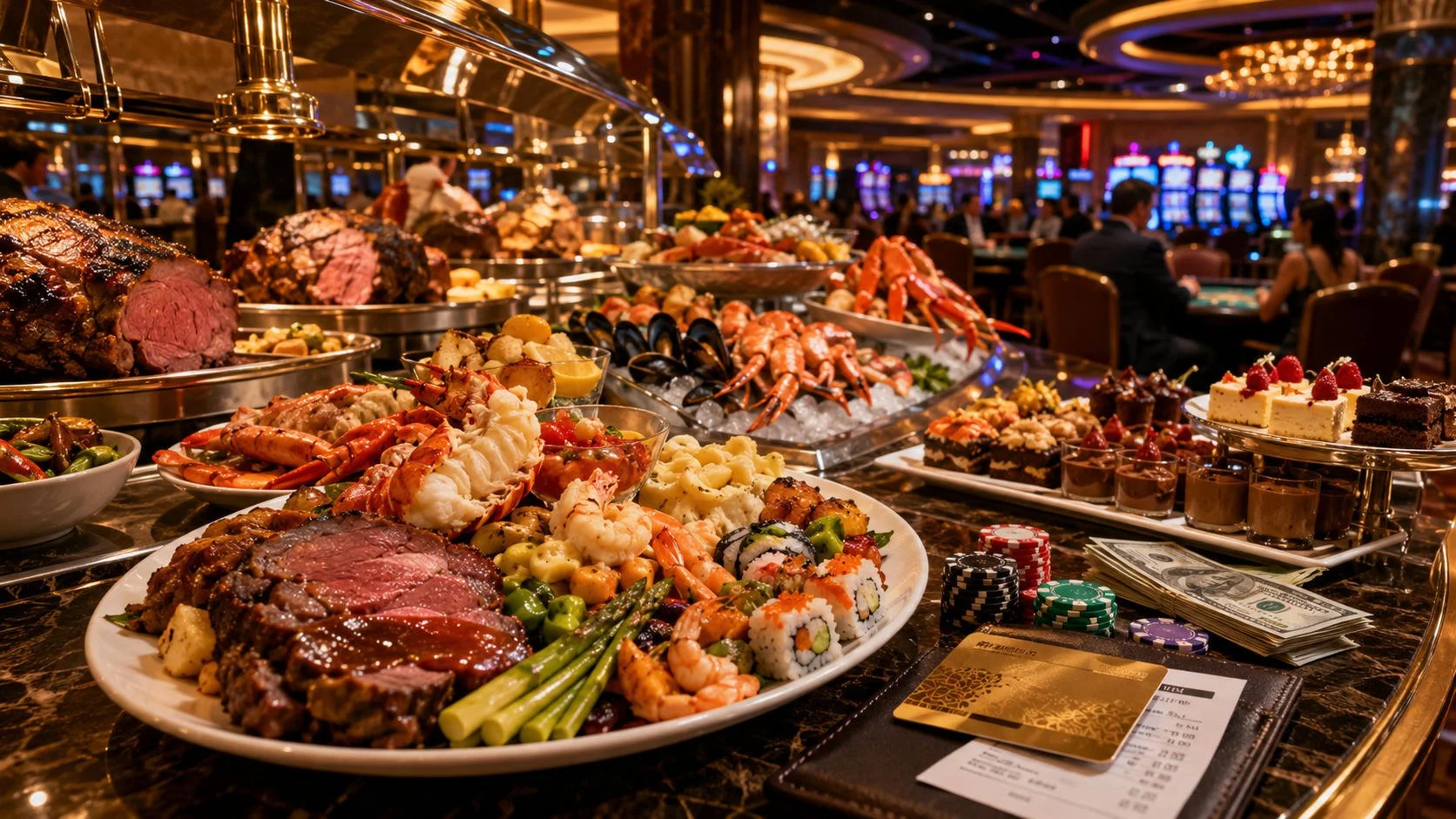
Las Vegas did not invent the lie of “free” food, but it did put it under 40,000 watts of casino lighting, surround it with crab legs, and make a man in cargo shorts believe he had beaten capitalism because he ate $83 worth of shrimp after losing $600 at blackjack.
The Las Vegas casino buffet is America’s most glamorous reminder that free food is rarely free. It is paid for with gambling losses, resort fees, inflated room rates, loyalty data, bad math, and the ancient tourist belief that “I’m getting my money’s worth” is a financial strategy rather than a cry for help from a person holding a third plate of prime rib.
Buffets are not generous because casinos love you. Casinos do not love you. Casinos love your tracked play, your average bet, your time on device, your tier credits, and the adorable way you think a comped brunch means you won something.
Las Vegas Buffets Were Built to Keep Gamblers Inside
The original Vegas buffet was not a culinary love letter. It was bait with potato salad.
The buffet tradition dates back to the 1940s, when El Rancho Vegas created the Chuck Wagon/Buckaroo Buffet to keep guests fed and, more importantly, still inside the casino. Food & Wine describes the early buffet as a practical profit tool: cheap midnight snacks helped keep gamblers “in action,” which is casino language for “still available to donate money to the building.”
Eater Vegas makes the same point with less mayonnaise nostalgia: for decades, Vegas buffets were loss leaders designed to get people into resorts and keep them close to the casino floor. Before 2020, Las Vegas had more than 70 casino buffets; today, the options are far more limited, and the surviving ones are often attractions in their own right.
So when someone says, “The casino gave me a free buffet,” the correct translation is usually: “The casino identified me as a customer worth feeding so I would continue behaving in a casino-adjacent manner.”
Romantic, really. Like a love letter, except the letter has a player-card number and smells faintly of drawn butter.
The “Free Buffet” Is Usually a Comp, Not a Gift
A comped buffet feels free because no cash leaves your hand at the restaurant. This is the same logic toddlers use when they hide behind curtains and declare themselves invisible.
Casino comps are earned through tracked behavior. MGM Rewards says members can earn rewards through hotel stays, dining, gaming, entertainment, spa spending, and retail, then redeem points for things including dining and other experiences. MGM also says gaming earning is based on things like wager, game type, denomination, time played, and average bet. Caesars Rewards similarly says Reward Credits are comps that can be used toward rooms, food, and entertainment, while Tier Credits can be earned through slots, table games, dining, hotel stays, and other activity.
In other words, the buffet is not falling from heaven like a divine casserole. It is a calculated reinvestment in you, the customer, who has demonstrated a promising willingness to keep touching buttons, pulling handles, and explaining why “the machine is due.”
The casino is not rewarding your charm. It is rewarding your expected value.
“Free” Food Works Because It Separates Price From Pain
The genius of the casino buffet comp is that it removes the immediate sting of paying. You do not stand at Bacchanal or Bellagio thinking, “I just spent X dollars.” You think, “This was comped.” And then your brain lights a tiny victory candle, even if the comp came after hours of gambling losses.
This is how “free” becomes expensive. The cost is moved upstream. You paid before the meal, after the meal, through your play, through your room spend, through your loyalty profile, or through some spectacular internal accounting swamp only casino systems and possibly swamp demons understand.
The comped buffet is the culinary version of a casino saying, “Here, have a plate of crab legs. Please forget the part where we know exactly how long you played video poker.”
Modern Vegas Buffets Are Not Cheap Little Bribes Anymore
Old Vegas had cheap buffets that functioned like edible glue: keep people in the building, keep them happy, keep them gambling. New Vegas looked at that model and said, “What if the buffet itself became expensive enough to need financing?”
The Wynn Buffet currently lists daily brunch at $59.99 plus tax and seafood dinner at $79.99 plus tax, with a two-hour dining window and more than 120 dishes. The Endless Pour package is another $32.99, because unlimited food apparently needed a beverage accomplice.
Bellagio’s buffet lists weekday brunch at $44.99, weekend brunch at $49.99, Saturday seafood dinner at $69.99, and Sunday dinner at $59.99, with prices subject to change during peak days.
This is not the era of the $4.99 gut-bomb buffet hiding near the keno lounge. This is brunch with a price tag, a dress code of “resort casual,” and the emotional energy of a seafood market that hired a lighting designer.
The House Learned the Buffet Could Be the Product
A funny thing happened on the way to the comp line: the buffet became an attraction.
UNLV’s Center for Gaming Research notes that the Las Vegas Strip has changed dramatically over the past 40 years, with gaming’s share of total revenue falling from 59% in 1984 to 35% in 2024. Food, beverage, rooms, entertainment, retail, and other non-gaming categories now matter far more than they used to.
That changes the buffet’s job. It is not just bait anymore. At the high end, it is a ticketed spectacle. You are not merely being fed so you gamble. You are paying to enter a controlled fantasy of abundance where the crab legs are cold, the desserts are tiny, and everyone walks around with the haunted urgency of someone trying to amortize dinner by plate count.
Old buffet logic: “Eat cheap, then gamble.”
New buffet logic: “Pay $80, then convince yourself you defeated the restaurant by eating four lobster-adjacent substances and a macaron.”
Progress. Very stupid progress.
The “All You Can Eat” Trap Is Just Gambling With Mashed Potatoes
The buffet is psychologically perfect for casinos because it turns eating into a game.
You pay one price. Now you must win. But winning is impossible because the house has already set the price, the food cost, the time limit, the portion strategy, the layout, and the location of the prime rib station, which is somehow always 900 tourist-steps away from your table.
Food & Wine quotes Las Vegas Advisor publisher Anthony Curtis saying buffet customers often try to “beat the house by out-eating the price,” but usually the house wins.
Of course it does. The house has accountants. You have a stretchy waistband and confidence built on shrimp.
This is the central buffet delusion: people think value equals volume. It does not. Value is not “I ate until my organs held a meeting.” Value is quality, enjoyment, convenience, and whether you still respect yourself after dessert.
The Casino Floor Is Always Nearby, Because Architecture Has Motives
Casino buffet placement is not random. Nothing in a casino is random, except maybe the man yelling at a slot machine named Buffalo Something.
Buffets historically worked because they kept people inside the resort. Food breaks became gambling intermissions, not exits. The casino solved a simple problem: hungry people leave. Fed people linger. Overfed people waddle past blackjack tables with lowered defenses and a bloodstream full of cheesecake.
The buffet is not just food. It is retention. It says: do not go outside. Outside has sunlight, cheaper tacos, and the possibility of remembering your budget.
Inside has prime rib.
Loyalty Programs Make “Free” Feel Personal
The modern comp system is even more seductive because it feels personalized. You get an offer. A dining credit. A buffet comp. A tier benefit. A “just for you” discount that makes you feel selected, valued, maybe even loved by a corporation whose main emotional language is database segmentation.
MGM Rewards says members can earn points on eligible dining and food-and-beverage charges, and those points are redeemable for dining, hotel stays, entertainment, and more. Caesars Rewards uses Reward Credits and Tier Credits to track and reward spend and play.
This is not inherently evil. Loyalty programs can be useful. But they are also extremely good at turning spending into a game. You are no longer buying dinner. You are earning. Advancing. Unlocking. Progressing. Your lunch has become a side quest.
Congratulations, your omelet has tier status.
The Buffet Is Paid For With Data, Too
Even when you are not gambling, the “free” or discounted buffet can cost something else: information.
A players card tells the casino what you play, where you spend, what restaurants you visit, how often you return, what offers move you, whether dining credits pull you back, and how much theoretical future money can be extracted from your charming little vacation personality.
That does not mean you should panic and wrap your crab legs in tinfoil. It means you should understand the exchange. A comp is not just hospitality. It is a business tool connected to tracking, segmentation, incentives, and behavior prediction.
The buffet line is not just a buffet line. It is a data hallway with sneeze guards.
The Decline of Cheap Buffets Reveals the Lie
The old bargain buffet died because casinos no longer needed to underprice food the same way. The Strip became a destination for luxury dining, celebrity chefs, nightclubs, entertainment, shopping, and $28 cocktails that arrive in glassware shaped like regret.
Eater Vegas reported that off-Strip casinos may still use buffets as loss leaders, sometimes subsidized by player discounts tied to slot play, but Strip casinos have shifted strategy. A UNLV economics professor quoted by Eater said Strip buffets used to be marketing tools that “really didn’t make money” unless you counted the gambling they encouraged.
That is the entire free-food economy in one sentence wearing buffet pants.
The food was never free. It was subsidized by the behavior around it.
“Free” Drinks Work the Same Way
Buffets are the meal version of the classic casino “free drink.” Sure, the cocktail arrives without a menu price if you are playing. How generous. How magical. How completely unrelated to the fact that alcohol can reduce inhibition and keep people seated at machines that are specifically designed to extract money over time.
The free drink is not charity. It is lubrication for the gaming ecosystem.
The buffet does the same thing with carbohydrates. Nobody makes crisp financial decisions after a third plate of carved meat and a dessert sampler arranged like a tiny edible subdivision.
The Tourist Math Is Usually Terrible
Here is the tourist calculation:
“I got a free buffet.”
Here is the actual calculation:
You gambled for three hours, lost $280, earned enough points or got rated well enough to receive a buffet worth maybe $50 to $80, and now feel like you beat the system because your dinner receipt says zero.
This is not beating the system. This is buying dinner through a very complicated slot-machine layaway plan.
The buffet becomes a trophy. It lets you leave with a story other than “the casino won.” Instead, you say, “Yeah, but they gave me dinner.” Beautiful. Like getting punched in the face and bragging that the hospital had free mints.
How to Enjoy a Vegas Buffet Without Being a Buffet Idiot
The casino buffet can still be fun. It is Vegas. Fun and bad decisions have a timeshare there.
But treat the buffet like a paid experience, not a rescue mission. Check the actual price before you go. Wynn and Bellagio publish buffet pricing and hours, and those prices can change during holidays and peak periods.
Do not gamble to “earn” a buffet. That is like setting your wallet on fire to warm up a dinner roll.
Use comps only if you earned them from gambling or spending you were already going to do. A comp is a discount on existing behavior, not a reason to manufacture new losses.
Eat the expensive or unique things first if value matters to you. Seafood, carving stations, made-to-order items, specialty desserts. Do not walk into an $80 buffet and begin with dinner rolls like a confused medieval peasant.
Do not try to “win” by overeating. You will not defeat the casino with mashed potatoes. You will only defeat your afternoon.
The Smart Buffet Strategy
A good Vegas buffet strategy is boring, which is why it works.
Look up the price. Read recent hours. Go during a meal period that matches your appetite. Do not arrive starving enough to make decisions like a cartoon wolf. Take a scouting lap before filling your plate, because beginners load up on pizza and pasta before discovering crab, prime rib, and desserts that look like jewelry.
Use small portions. Sample widely. Skip filler unless you genuinely want it. Drink water. Pace yourself. Leave when satisfied, not when you are calculating whether emergency pants exist.
The best buffet guest is not the person who eats the most. It is the person who enjoys the meal without turning the table into a personal endurance sport.
What Vegas Buffets Teach About “Free” Food Everywhere
The Vegas buffet is just the loudest version of a much bigger lesson: free food is usually a business model.
Free office snacks are not just snacks; they keep workers on-site and mildly loyal to fluorescent captivity. Free hotel breakfast is baked into the room rate. Free samples are sales funnels with toothpicks. Free loyalty-app food is paid for with purchase history and future nudging. Free shipping is baked into the product margin. Free casino buffets are funded by gamblers who think luck is a plan.
Nothing is free. Sometimes it is prepaid. Sometimes it is cross-subsidized. Sometimes it is paid for with data. Sometimes it is paid for by the guy at the next slot machine muttering, “Come on, baby,” to a screen full of digital buffalo.
The Real Meaning of the Las Vegas Casino Buffet
Las Vegas casino buffets reveal that “free” food works because people love abundance and hate accounting. A comped buffet feels like victory because it is tangible. You can see the crab legs. You can photograph the dessert station. You can point at a plate and say, “This is what I got.”
Losses are more abstract. They happened earlier. They happened in chips, credits, room charges, time, tier math, and tiny decisions. The buffet gives you something visible to balance the invisible leak.
That is why the buffet is perfect Vegas theater. It looks generous. It feels indulgent. It flatters your appetite and distracts your spreadsheet.
And, like almost everything in a casino, it is designed so the house remains very comfortable.
So enjoy the buffet. Eat the prime rib. Use the comp. Get the dessert. Marvel at the shrimp. Wander through the glowing cathedral of excess and make your peace with the fact that the “free” meal was never really free.
It was just folded into the bet.
And somehow, after three plates and a tiny cheesecake, you still paid extra for parking.