
Why Bryan Johnson Made Breakfast Sound Like a Software Update
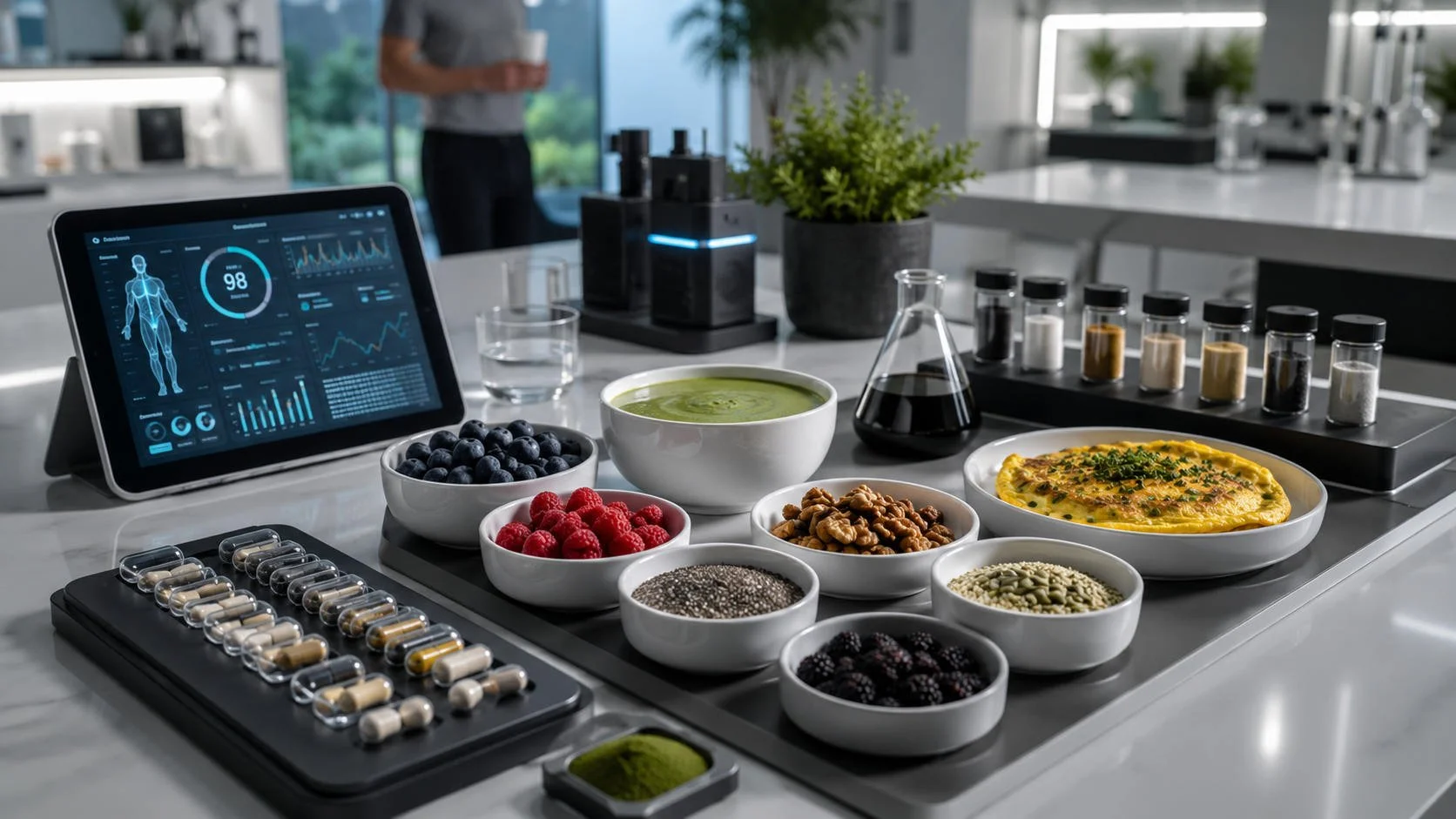
Breakfast used to be a meal. You woke up, toasted something, burned your tongue on coffee, and made a small private promise to become a better person by lunch. Simple. Human. Mildly pathetic, but in a warm way.
Then Bryan Johnson arrived and turned the first meal of the day into a firmware patch for the human organism. Suddenly breakfast was no longer “eggs or oatmeal?” It was “Have you installed Protocol 6.3.2 with optimized lentil throughput, polyphenol compliance, and a deprecated Evening Bryan permission structure?” Beautiful. Horrifying. Exactly what Silicon Valley would do to a banana.
Johnson, the entrepreneur who sold Braintree Venmo to PayPal for $800 million, has become famous for Blueprint, his anti-aging routine built around diet, exercise, sleep, biomarker testing, supplements, and a general refusal to let the body behave like a normal haunted meat clock. His food routine is not presented like a recipe so much as a product roadmap. Breakfast does not nourish him. It ships.
Bryan Johnson’s Breakfast Became a Protocol, Because “Meal” Was Apparently Too Cozy
The first reason Bryan Johnson made breakfast sound like a software update is that he stopped speaking in food language and started speaking in system language. He does not merely “eat healthy.” Please. That is for peasants with cutting boards.
He has a protocol. A Blueprint. A stack. A set of repeatable inputs designed to produce measurable biological outputs. Somewhere, a bowl of oatmeal is trembling in a pantry, realizing it has not been optimized for mitochondrial destiny.
Johnson has described using blood, saliva, urine, micronutrient, microbiome, and other tests to generate food decisions customized to his biology. He also wrote that he “fired” his conscious mind from food decisions, which is a very Silicon Valley way of saying, “The part of me that wants pizza has been removed from the board.”
Normal breakfast asks: “What sounds good?”
Bryan Johnson breakfast asks: “What would a spreadsheet eat if it feared death?”
Super Veggie: The Breakfast That Sounds Like a Mandatory Corporate Training Module
One of Johnson’s best-known Blueprint staples is Super Veggie, a dish involving black lentils, broccoli, cauliflower, mushrooms, garlic, ginger, lime, cumin, apple cider vinegar, hemp seeds, and olive oil. The official Blueprint recipe gives measurements in grams, because nothing says “morning joy” like weighing cauliflower while your will to live negotiates with a kitchen scale.
Super Veggie is not a name. It is a command. It sounds like the vegetable department got promoted to middle management and now wants you to complete onboarding by Friday.
And this is where Johnson’s breakfast language becomes funny, useful, and deeply unwell in equal measure. A regular person says, “I had vegetables.” Johnson says, “I consumed Super Veggie,” as though he unlocked a nutrient achievement and the body will now restart to apply changes.
The meal itself is not ridiculous. Lentils, cruciferous vegetables, mushrooms, seeds, spices, and olive oil are all perfectly defensible foods. The absurdity is the branding. This is not a bowl. This is a patch note with broccoli.
Nutty Pudding: Dessert Wearing a Lab Coat and Refusing to Blink
Then there is Nutty Pudding, which sounds like either a longevity dessert or the nickname of a Victorian aristocrat who died mysteriously near a gazebo.
Blueprint’s official Nutty Pudding recipe includes cinnamon, ground flaxseeds, sunflower lecithin, walnuts, berries, cherries, macadamia nuts, a Brazil nut fraction, nut milk, pomegranate juice, chia seeds, and protein powder. In normal food culture, this would be a berry-nut smoothie bowl. In Bryan Johnson culture, it becomes a precision-engineered longevity dessert, because apparently “I blended berries” lacked sufficient venture capital tension.
Again, the ingredients are not the problem. The ingredients are fine. Berries? Great. Nuts? Solid. Flax and chia? The tiny seeds of people who own reusable water bottles and opinions about inflammation.
The problem is that Nutty Pudding has been spiritually promoted from “breakfast bowl” to “biological maintenance event.” It is not food. It is a support ticket for your bloodstream.
He Made Breakfast Updateable
The real software-update energy comes from the fact that Johnson treats his diet as something constantly revised. In an older food post, he said the routine represented “today’s routine” and that he changed something every day to incorporate new evidence, test results, hypotheses, or personal experience.
That is not breakfast. That is breakfast with release notes.
Most people change breakfast when they run out of bananas. Bryan Johnson changes breakfast because the data has spoken, and apparently the data was very concerned about sunflower lecithin.
This is why the whole thing feels less like cooking and more like downloading an operating system for a man. Today’s patch improves sleep latency, removes refined sugar vulnerabilities, enhances broccoli compatibility, and resolves a bug where the user experienced joy after 7 p.m.
The Body Becomes a Dashboard, Which Is Both Smart and Insane
Johnson’s whole pitch is that the body can be measured, adjusted, and improved through systems. TIME described him as devoting hours to working out, following a strict vegan diet, prioritizing sleep, using therapies, and monitoring a large number of health metrics, from organ-related biological-age claims to sleep and other personal data.
This is the deeper reason breakfast starts sounding like software. Once the body becomes a dashboard, food becomes input. Sleep becomes output. Mood becomes a metric. Digestion becomes analytics. The human being becomes a subscription service with bones.
There is something useful here, annoyingly. Most people would benefit from making breakfast less chaotic. Protein, fiber, whole foods, repeatable habits, and fewer sugar-powered disasters are not bad ideas. The average breakfast in America often looks like a dessert got legally adopted by coffee.
But Johnson takes the reasonable idea — “eat a consistent, nutrient-dense breakfast” — and drives it through a data center until it emerges wearing a lanyard that says Longevity Systems Architect.
Blueprint Turned Breakfast Into a Product Line
The next obvious software-update move: productization.
Blueprint now sells nutrition products, supplements, and meal-related items, and the Blueprint meal delivery site advertises Nutty Pudding, Super Veggie, and other protocol-friendly meals ready in under two minutes. It also promotes meals as avoiding gluten, dairy, and refined sugar.
This is how breakfast becomes tech. First, it is a routine. Then it is a protocol. Then it is a product. Then it is shipped to your door like your intestines joined a startup accelerator.
There is a very specific modern magic trick here: take ordinary healthy eating principles, give them names that sound like health-tech features, add biomarker language, wrap everything in blue packaging, and suddenly lentils have a valuation.
Your grandmother ate vegetables and went for walks. Bryan Johnson does it with dashboards, biomarkers, and a documentary. Same species, different marketing department.
“Evening Bryan” Was Fired, Which Is the Funniest Human Resources Decision in Food History
One of the strangest and most revealing parts of Johnson’s food philosophy is his idea of naming the version of himself that made self-destructive eating choices. He has written about “Evening Bryan” losing authority to eat between 5 p.m. and 10 p.m. because that version of him would overeat and ruin things for Sleep Bryan, Morning Bryan, Work Bryan, and Dad Bryan.
This is ridiculous. It is also kind of brilliant.
Everyone has an Evening Bryan. Yours may be called Midnight Brenda, Snack Goblin Marcus, or “Me After One Email From My Boss.” That version of you does not care about longevity. That version of you believes shredded cheese eaten over the sink is a legitimate dinner format.
Johnson’s solution is to revoke decision-making power from the chaos gremlin and let the better-planned version of himself run the system. Is it funny to treat your appetite like a badly governed internal company? Yes. Is it useful? Also yes, unfortunately.
The problem is that Johnson makes breakfast sound like a software update because he treats the self like a workplace with access controls. Pancakes tried to log in. Permission denied.
Why People Mock It, and Why They Still Pay Attention
People mock Bryan Johnson because he has made breakfast sound like something that requires a compliance officer. They also pay attention because the man has turned everyday health habits into spectacle, and spectacle is what modern culture eats when it is out of cereal.
There is also legitimate skepticism around the broader longevity industry. TIME noted that many longevity scientists criticize Johnson’s approach as overhyped or insufficiently scientific, even as he argues he is publishing and testing his methods. Blueprint itself includes disclaimers that its products are not intended to diagnose, treat, cure, or prevent disease and that its website should not replace personal medical advice.
That matters. Eating berries and lentils is one thing. Treating one rich man’s self-experiment as a universal operating manual for human survival is another. Your body is not Bryan Johnson’s body. Your budget is probably not Bryan Johnson’s budget. Your breakfast does not need a board meeting.
What Normal People Can Actually Steal From Bryan Johnson’s Breakfast Machine
The useful lesson is not “become a smoothie monk with a blood panel subscription.” The useful lesson is that mornings get easier when breakfast is not a daily philosophical crisis.
Pick one or two nutrient-dense breakfasts you can repeat without drama. Greek yogurt with berries and nuts. Eggs with vegetables. Oatmeal with protein and fruit. A smoothie that does not contain nine powders and the emotional temperature of a medical trial.
Build breakfast around protein, fiber, and foods that keep you full. Prep ingredients ahead. Stop letting the sleep-deprived goblin version of you make decisions while standing in the kitchen holding a pastry like it contains answers.
And perhaps most importantly, make the healthy choice boring enough to survive. A breakfast that requires 47 steps, three powders, a scale, a prayer, and a ceramic bowl photographed like a hostage is not a habit. It is a part-time job with chia seeds.
Breakfast Does Not Need to Become a Cult
Johnson’s breakfast philosophy is fascinating because it exposes a very modern sickness: we no longer know how to improve our lives without turning them into systems, dashboards, brands, protocols, or apps. We cannot simply eat vegetables. We must optimize vegetable exposure. We cannot sleep. We must architect recovery. We cannot have pudding. We must deploy Nutty Pudding.
And yet, under all the techno-monastic pageantry, there is a boring little truth hiding in the bowl: consistency works. Whole foods help. Sleep matters. Late-night chaos eating can wreck you. Breakfast should probably not be a frosted dessert wearing a cartoon mascot.
So yes, Bryan Johnson made breakfast sound like a software update. He took the most ordinary human ritual — feeding yourself after waking — and transformed it into a quantified longevity protocol with product names, biomarker feedback, version changes, and enough branding to make a lentil ask for equity.
It is absurd.
It is also, in pieces, useful.
Just remember: you do not need to become Breakfast 2.0. You do not need to install Super Veggie Enterprise Edition. You do not need to fire every emotional version of yourself and replace them with a nutrient governance committee.
Eat real food. Repeat the good habits. Get some sleep. Touch grass.
Then, by all means, enjoy your breakfast before someone in Silicon Valley renames it Morning Intake Architecture and charges $49 a month.