
Donald Trump’s latest warning about the Strait of Hormuz matters for one reason above all: it suggests Washington is trying to stop the next escalation before it becomes undeniable.
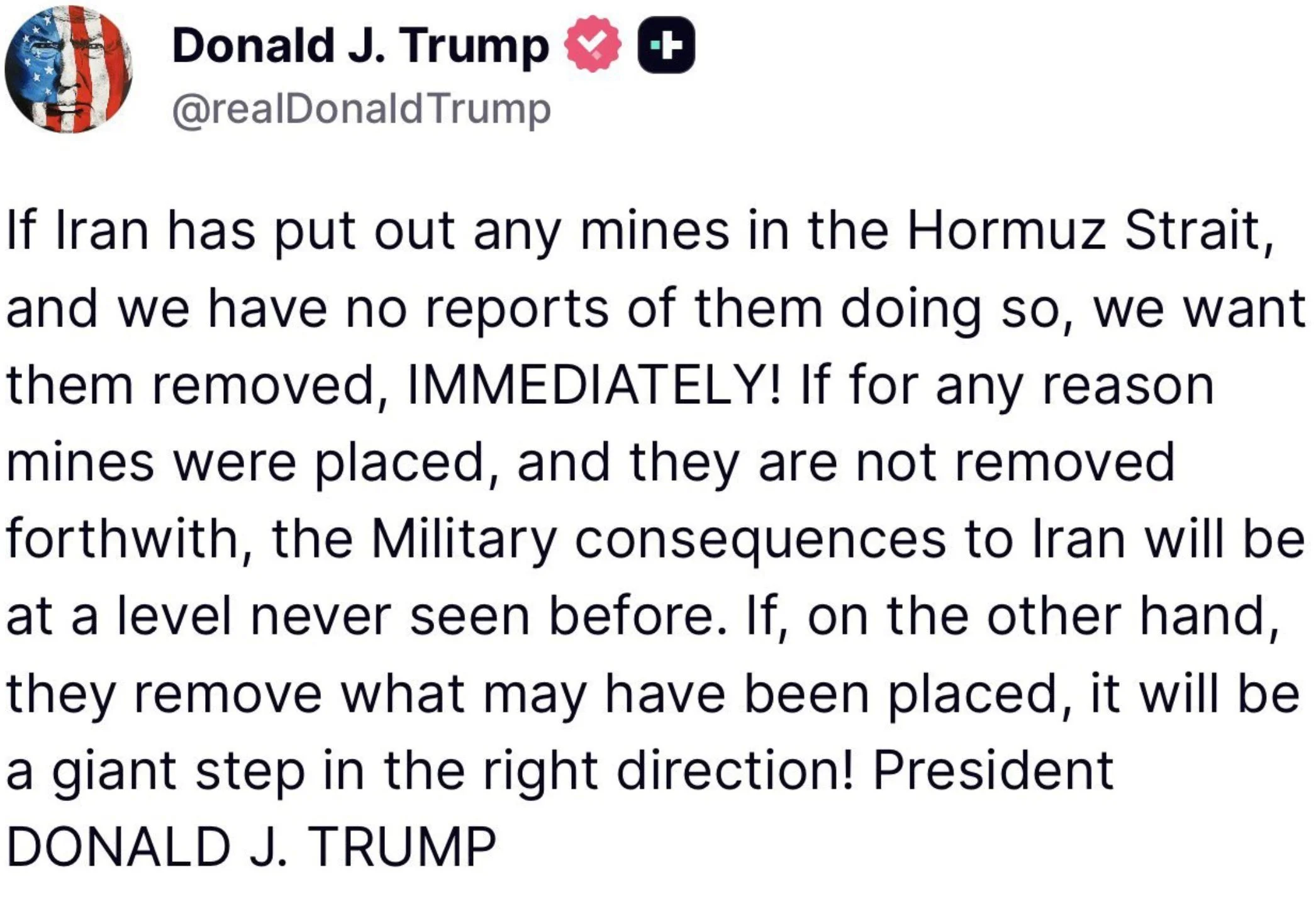
In the Truth Social post you shared, Trump said that if Iran has placed any mines in the Strait of Hormuz, “they must be removed immediately,” and warned that failure to do so would bring military consequences “the likes of which have never been seen.” The most important line in that message may be the caveat in the middle: “and we have no reports that they have.” That is not the language of a government announcing a fully documented minefield. It is the language of a government trying to deter an act it plainly thinks is close enough to plausible to justify a public ultimatum.
That is what makes the post so significant. Trump is not treating Hormuz as a background shipping story anymore. He is treating it as a tripwire. And that fits the wider reporting. Reuters reported Tuesday that the Pentagon said it was already striking Iranian mine-laying vessels and mine storage facilities, while also examining options to escort ships through the strait if ordered. That means the mine threat is already shaping U.S. military behavior, even if Washington has not publicly produced definitive proof that mines are already sitting in commercial lanes.
That is a major shift because mines are different from the other threats already hanging over Hormuz. Missiles and drones create bursts of danger. Mines create durable fear. A missile salvo can end in minutes. A suspected mine threat can freeze shipping for days or weeks, because shipowners, insurers, naval planners, and commodity traders all have to behave as if the route is contaminated until it is proven otherwise. Reuters notes that Hormuz’s traffic lanes are only two nautical miles wide in each direction and that ships must pass close to Iranian islands and a mountainous coastline that gives Iranian forces cover. In a corridor that narrow, even a relatively limited mine threat can paralyze the whole route.
And this is not some obscure trade lane. The Strait of Hormuz is one of the central arteries of the global economy. The International Energy Agency says nearly 20 million barrels per day of oil moved through the strait in 2025, about 25% of the world’s seaborne oil trade, and only 3.5 to 5.5 million barrels per day of alternative pipeline capacity exists to bypass it. The U.S. Energy Information Administration similarly says flows through Hormuz averaged 20 million barrels per day in 2024, equal to about 20% of global petroleum liquids consumption, with about one-fifth of global LNG trade also moving through the route.
That is why Trump’s warning is really about more than mines. It is about what a mine scare would do to a system that is already seizing up. Reuters reported Tuesday that traffic through Hormuz has already dropped 97% since the war began on February 28. At least 11 ships have been attacked since the conflict began, and insurance premiums have risen by as much as 300%. Even before a fully documented mine-laying campaign, most commercial traffic had already halted out of caution, cost, and fear. So when Trump threatens military consequences over mines, he is speaking into a situation where the strait is already barely functioning as a normal commercial route.
That helps explain the tone. Trump’s wording is not just saber-rattling for its own sake. It is a deterrence message aimed at a very specific nightmare scenario: the moment when a de facto blockade turns into something more physical, slower to reverse, and much harder for markets to shrug off. Reuters reported Monday that Trump had already warned Iran it would be hit “TWENTY TIMES HARDER” if it blocked the flow of oil through Hormuz, and CBS reported that he said he was considering taking over the waterway and offering escorts for tankers. The new post you shared sharpens that warning further by focusing on mines specifically, which are one of the few tools that could make reopening Hormuz vastly more difficult even if airstrikes and naval patrols continue.
The larger message to Tehran is obvious: Washington appears willing to tolerate ambiguity about threats, but not ambiguity about the channel itself. If Iran merely threatens shipping, the United States can answer with escorts, insurance guarantees, and strikes on naval assets. But if Hormuz becomes a suspected minefield, the crisis changes category. It is no longer just about deterring attacks. It becomes a question of whether the world’s most important energy chokepoint is still commercially usable at all. Reuters’ reporting underscores that the Pentagon already sees the issue that way, because it is not just talking about escorts; it is already going after the infrastructure of mine warfare.
That is also why oil traders will read Trump’s post as more than rhetoric. When a president threatens unprecedented retaliation over a hypothetical mine threat, markets tend to hear two things at once. First, the White House is trying to stop a dangerous step before it happens. Second, the White House must think the step is close enough to real that it cannot wait for perfect confirmation. In an energy market, that matters because crude is not priced only on confirmed damage. It is priced on what traders think could soon become physically impossible. The IEA warns that any prolonged disruption at Hormuz would have “huge consequences” for world oil markets and that physical shortages would develop quickly if the interruption persisted.
That is where the things get darker. The market already knows that bypass options are too limited for a full Hormuz crisis. The IEA says only 3.5 to 5.5 million barrels per day of export capacity can realistically bypass the strait, versus almost 20 million barrels per day of oil exports that normally move through it. The EIA’s estimate is similarly sobering, putting available Saudi and UAE bypass capacity at around 2.6 million barrels per day. So if mine fears deepen the disruption, this is not a story where pipelines simply save the day. The gap is far too large.
That is one reason the oil-price scenarios have become so violent. Reuters reported Tuesday that Wood Mackenzie said the war is currently cutting Gulf oil and oil-products supply to the market by around 15 million barrels per day, a shock large enough to push Brent to $150 per barrel in the coming weeks. The consultancy said $200 is “not outside the realms of possibility” in 2026 if the shutdown persists. Saudi Aramco separately warned Tuesday that continued disruption in Hormuz would have “catastrophic consequences” for world oil markets, saying this is the region’s biggest oil-and-gas crisis and that even with rerouting through the East-West pipeline, close to 350 million barrels could be disrupted.
Trump’s post therefore lands in a market that is already primed to overreact to any evidence that the crisis is hardening rather than easing. If the mine threat grows, oil no longer trades just as a war premium. It starts trading as a logistics and clearance problem. It starts pricing how long it takes to inspect routes, sweep suspected mines, assemble escorts, reassure insurers, and convince shipowners that “open” also means “safe enough to use.” Those are not the same thing. Reuters quotes shipping and defense experts saying short-term escort operations may be feasible, but sustaining safe passage through Hormuz for months would require significant naval resources.
That also helps explain why Trump chose such maximal language. A mine crisis does not just threaten energy prices. Reuters notes it could feed broader shocks in fertilizer, food security, aviation, agriculture, and automotive supply chains. Around 33% of the world’s fertilizers, including sulphur and ammonia, pass through Hormuz, according to Kpler data cited by Reuters. So the White House is not just warning about tankers and oil charts. It is warning about the kind of chokepoint event that can spread from crude prices into inflation, food costs, industrial inputs, and broader recession fears.
The paradox in Trump’s post is that it sounds conditional while also sounding urgent. He says there are “no reports” mines have been laid, yet he is already threatening extraordinary retaliation if they are not removed. That only makes sense if U.S. officials believe the mine risk has moved into the zone where waiting for airtight public confirmation would be too late. Reuters’ report that the Pentagon is already striking mine-related targets strongly supports that reading. So the real significance of Trump’s message is not that Washington has publicly proven every detail. It is that Washington is now behaving as though it cannot afford to be wrong.
And that is what makes this post more alarming than a typical social-media threat. It sounds like a warning to Iran, but it is also a signal to the market, to shippers, to insurers, and to U.S. allies: Hormuz has become the red line inside the red line. If Tehran crosses it in a way Washington views as physical mining rather than mere intimidation, the U.S. response may widen sharply and quickly. If it does not, the administration can claim deterrence worked. Either way, the message is the same. The war is no longer just about what gets bombed on land. It is about whether the sea lane that moves a fifth of the world’s oil remains usable at all.