The Japanese 7-Eleven Budget Meal Challenge: How to Eat Well Without Restaurant Prices
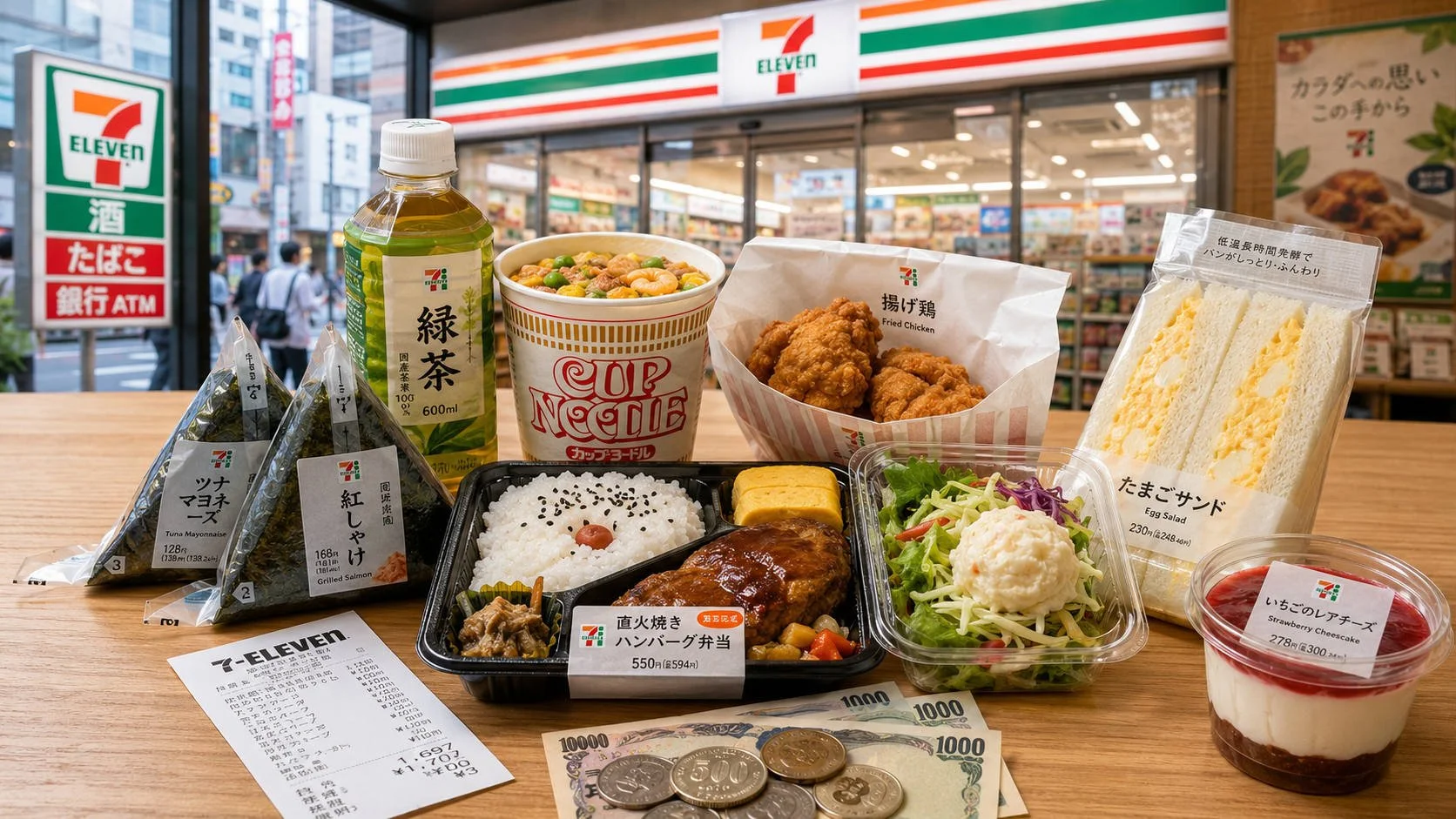
Japanese 7-Eleven is not a convenience store in the sad international sense, where “lunch” means a rotating hot dog sweating under a heat lamp like it knows too much. Japanese 7-Eleven is a functioning food system with fluorescent lights. It is a tiny 24-hour cafeteria, café, snack bunker, ATM station, and emergency emotional support facility for travelers who spent all day walking and are now one bad menu translation away from eating a decorative leaf.
The Japanese 7-Eleven budget meal challenge is simple: build a full, satisfying meal from 7-Eleven Japan for less than what you would usually spend at a restaurant. Not “survive on one sad rice ball and tap water like a haunted student.” Eat well. Eat smart. Eat like someone who understands that convenience-store food in Japan is not a punishment—it is infrastructure with seaweed.
Japan’s 7-Eleven network is massive, with official company data listing 21,743 stores in 2024, which means the odds of finding one are slightly better than finding your own willpower in a souvenir shop. The company’s English visitor page lists popular items like tuna mayonnaise onigiri, egg salad sandwiches, smoothies, and Nanachiki fried chicken, and says most stores can microwave food, provide cutlery, and sometimes offer eat-in areas.
The Rules of the Japanese 7-Eleven Budget Meal Challenge
The challenge has one goal: build meals that feel complete without paying full restaurant prices. A travel-food guide from MATCHA estimates that a convenience store meal in Japan typically costs around 700 to 1,000 yen, while convenience stores sell onigiri, sandwiches, bento, noodles, salads, hot snacks, drinks, and desserts. That is the playing field.
Here are the rules, because even cheap dinner needs a constitution:
Choose one main carbohydrate.
Choose one protein.
Add one vegetable, soup, or side.
Skip the novelty dessert unless you actually budgeted for it, not because a pudding looked at you seductively from the chilled case.
Do not buy eight tiny snacks and pretend that is “sampling culture.” That is how your 850-yen meal becomes a 2,400-yen grocery crime scene with gummies.
The best 7-Eleven meals are built like tiny Japanese set meals: rice or noodles, protein, vegetable or soup, and drink. This is not revolutionary. It is just common sense wearing a convenience-store barcode.
Why Japanese 7-Eleven Beats Random Tourist Restaurants
The worst travel food mistake is assuming every meal needs to be a restaurant experience. That is how you end up paying too much for mediocre ramen near a station while a laminated menu with English subtitles gently robs you.
Restaurants matter. Obviously. You should eat proper ramen, sushi, tempura, soba, izakaya food, curry, tonkatsu, and whatever regional specialty is available. But not three times a day unless your budget is sponsored by a mysterious uncle.
Convenience stores fill the gap beautifully. MATCHA notes that ramen commonly costs around 600 to 1,200 yen, casual teishoku meal sets around 800 to 1,000 yen, and conveyor-belt sushi around 1,500 to 2,500 yen per person. A 7-Eleven meal under 1,000 yen is not “cheap” in the bad way. It is cheap in the “I would like to still afford temple admission and train fare” way.
The trick is choosing actual meal components, not wandering the aisles like a jet-lagged raccoon who has discovered packaging.
Breakfast Challenge: Under 500 Yen Without Eating Like a Goblin
The easiest Japanese 7-Eleven breakfast is the classic combo: egg sandwich plus coffee.
7-Eleven Japan’s egg sandwich is famous for a reason. The official site lists a “Kodawari THE Tamago Sandwich” at 270 yen before tax, 291.60 yen with tax in many regions, with egg salad made from boiled egg, mayonnaise, salt, and pepper. Pair that with a regular Seven Café hot or iced coffee, both listed at 130 yen before tax, 140.40 yen with tax, and you have breakfast for roughly 432 yen.
That is not a compromise. That is a soft, creamy egg sandwich and a real coffee for less than what some hotel cafés charge for looking in the direction of a croissant.
Budget build:
Egg sandwich: 291.60 yen.
Regular coffee: 140.40 yen.
Total: 432 yen.
This is the meal for travelers who want to leave the hotel quickly without becoming financially entangled with a breakfast buffet where the scrambled eggs have the texture of damp insulation.
Breakfast Upgrade: The “I Walk 25,000 Steps and Need Fuel” Combo
For a bigger breakfast, add a drinking yogurt or smoothie. A 7 Premium plain drinking yogurt is listed at 145 yen before tax, 156.60 yen with tax, while vegetable smoothies like Green MIX are listed around 193 yen before tax, 208.44 yen with tax.
The upgraded breakfast looks like this:
Egg sandwich.
Coffee.
Drinking yogurt or smoothie.
That puts you around 589 to 640 yen, depending on the drink. Still cheaper than many café breakfasts, and considerably less tragic than buying one pastry and pretending air is protein.
Useful tip: do not confuse smoothies with vegetables magically solving your life. A smoothie is a drink, not a moral rebirth in a plastic bottle. Still, it can round out breakfast nicely when your alternative is eating two melon-pan and calling it “culture.”
Onigiri Lunch Challenge: The Classic Konbini Power Move
The most reliable budget lunch at Japanese 7-Eleven is two onigiri plus miso soup or hot chicken.
A tuna mayonnaise hand-roll onigiri is listed at 182 yen before tax, 196.56 yen with tax in many regions. Cup miso soup options can be very cheap, with a 7 Premium seaweed cup miso listed at 125 yen before tax, 135 yen with tax. Add two onigiri and soup, and you are looking at roughly 528 yen if prices match what is available in your region.
That is lunch. Not a snack. Not a “little bite.” Lunch.
Budget build:
Two tuna mayo onigiri: 393.12 yen.
Cup miso soup: 135 yen.
Total: 528.12 yen.
This meal is cheap, portable, and shockingly effective. Rice gives you energy, tuna mayo gives you fat and flavor, miso soup gives warmth and salt, and the seaweed wrapper gives you the thrilling sensation of succeeding at packaging engineering.
Useful tip: learn how to open the onigiri before you are hungry and standing in public. The packaging has numbers. Follow them. Do not fight the triangle like it insulted your family.
The Protein Lunch: Salad Chicken, Rice Ball, and Side Salad
If you want more protein without buying a full bento, build the athlete-adjacent version: salad chicken plus onigiri plus a vegetable side.
7-Eleven Japan lists several salad chicken products around 248 yen before tax, 267.84 yen with tax, including herb and plain versions with about 24 grams of protein. A tuna mayo onigiri adds another roughly 196.56 yen, and a small deli-style side like gobō salad is listed at 198 yen before tax, 213.84 yen with tax in many regions.
Budget build:
Salad chicken: 267.84 yen.
Onigiri: 196.56 yen.
Gobō salad: 213.84 yen.
Total: 678.24 yen.
This is the meal for people who want to eat like they have a plan, not like they were hypnotized by the dessert shelf. It has protein, carbs, vegetables, and enough salt to remind you that convenience food is still convenience food and not a spa retreat.
Useful tip: get chopsticks or a fork at checkout. 7-Eleven’s English FAQ says staff can provide necessary cutlery for bento, salads, frozen foods, and ready-to-eat items. Do not discover you forgot utensils while holding salad chicken in a hotel room like a caveman with Wi-Fi.
Bento Challenge: One Box, One Meal, No Spreadsheet
Sometimes the smart move is to buy a full bento and stop pretending you are a meal architect. Japanese 7-Eleven bento boxes vary by region, but current official examples include items like a hamburger-and-karaage bento at 550 yen before tax, 594 yen with tax and a karaage bento in the Kinki region at 638 yen before tax, 689.04 yen with tax.
That means the bento challenge is simple:
Buy one bento under 700 yen.
Add no drink unless you have water.
Leave.
Do not add pudding, fried chicken, and a novelty latte “for balance,” because now your bento meal has become a fiscal clown parade.
A bento is the best option when you want hot rice, meat, and sides in one box. Ask staff to heat it. Most 7-Eleven stores in Japan have microwaves and staff can heat food for you, though some items cannot be heated in-store.
Useful tip: if the cashier says something that sounds like “atatamemasu ka?” they are probably asking whether you want it heated. Say “hai” if you do. You are not being interrogated. You are being offered civilization.
Hot Snack Challenge: Nanachiki and Onigiri
Nanachiki is 7-Eleven Japan’s hot fried chicken, and it sits at the counter like a tiny golden trap. The official product page lists Nanachiki at 232 yen before tax, 250.56 yen with tax, describing it as thick, juicy fried chicken seasoned with a blend of spices.
Build the hot snack meal like this:
Nanachiki.
One onigiri.
Cup miso soup or small salad.
That puts you around 582 to 661 yen, depending on whether you choose soup or a side salad. It feels like a meal, tastes like a reward, and prevents you from buying three pieces of fried chicken and calling it “protein diversification,” which is a phrase only a guilty person would invent.
Useful tip: hot snacks are best eaten immediately. Taking Nanachiki on a 40-minute train ride and expecting crisp glory later is optimism with grease on it.
Pasta and Frozen Food Challenge: The Hotel-Room Dinner Strategy
Japanese 7-Eleven also works when you are exhausted and your hotel room is your restaurant. Ready-to-heat pasta and frozen meals can be excellent cheap dinners if your hotel has a microwave or if the store heats items for you.
A current 7 Premium Gold mushroom cream fresh pasta is listed at 428 yen before tax, 462.24 yen with tax nationwide. Frozen fried rice can be even cheaper, with a 7 Premium fried rice product listed at 138 yen before tax, 149.04 yen with tax, though that is more of a budget base than a full dinner by itself.
A realistic dinner build:
Cream pasta: 462.24 yen.
Small side salad: around 200 to 300 yen.
Miso soup if desired: 108 to 135 yen.
Total: roughly 770 to 900 yen.
This is where 7-Eleven becomes dangerous in the best way. You can be back in your hotel room, showered, pajama-adjacent, eating hot pasta while tourists outside are still queuing for a restaurant that Instagram bullied them into visiting.
The 1,000-Yen “Eat Like a Responsible Adult” Challenge
Here is the perfect 1,000-yen meal formula:
One main item: bento, pasta, rice bowl, or two onigiri.
One protein: Nanachiki, salad chicken, boiled egg, or fish/meat side.
One vegetable or soup: side salad, cup miso, cut vegetables, or deli salad.
One drink: water, tea, coffee, yogurt drink, or smoothie.
Example:
Tuna mayo onigiri: 196.56 yen.
Salad chicken: 267.84 yen.
Gobō salad: 213.84 yen.
Cup miso soup: 135 yen.
Regular coffee: 140.40 yen.
Total: 953.64 yen.
Look at that. A full meal with protein, carbs, vegetable fiber, soup, and coffee under 1,000 yen. Meanwhile, somewhere nearby, a tourist is paying 1,480 yen for a “samurai burger set” next to a station and wondering why it tastes like theme-park regret.
The 700-Yen “I’m Saving Money but Not Suffering” Challenge
This is the sweet spot.
Build:
Two onigiri.
Cup miso soup.
Coffee or tea.
Using the tuna mayo onigiri and regular coffee prices cited above, this comes out around 668.52 yen before any regional or checkout rounding differences.
This is the challenge for travelers who want to save money for one proper dinner later. It is also a good lunch when you are moving between museums, shrines, trains, and the slow realization that Japanese cities are designed to trick you into walking forever.
The 500-Yen “Emergency Meal” Challenge
For under 500 yen, keep it brutally simple:
Egg sandwich plus coffee.
Or:
Two onigiri.
Or:
Onigiri plus Nanachiki.
An egg sandwich plus coffee can come in around 432 yen, while Nanachiki plus one tuna mayo onigiri comes in around 447 yen using current official examples.
This is not the meal you eat every time. It is the meal for train days, early mornings, late arrivals, and moments when restaurant hunting sounds about as appealing as filing taxes in a thunderstorm.
How to Actually Eat Well at Japanese 7-Eleven
The secret is not buying the cheapest thing. The secret is building a meal.
Cheap but bad: candy, chips, sweet bread, sweet drink.
Cheap and good: onigiri, soup, salad chicken, side vegetable.
Cheap but chaotic: fried chicken, pudding, canned coffee, and a bag of chips. Delicious? Yes. Meal? Only in the legal sense that calories occurred.
Use this formula:
Rice or noodles for energy.
Chicken, egg, fish, tofu, or meat for protein.
Soup, salad, seaweed, root vegetables, or cut vegetables for micronutrients and texture.
Tea, coffee, water, or yogurt drink instead of defaulting to soda like a vending machine goblin.
You are not trying to become a monk. You are trying to eat well for cheap. There is a difference. One involves spiritual discipline; the other involves not letting a cream puff make all your decisions.
Watch the Regional Availability Trap
7-Eleven Japan’s product pages repeatedly note that items may not be available at every store or even in every area within a sales region, and that products can be discontinued if demand exceeds supply or ingredients run short. This is important because the internet loves declaring one specific item “the best 7-Eleven meal,” as though every store in Hokkaido, Tokyo, Kyoto, Fukuoka, and Okinawa has identical shelves arranged by a national snack deity.
They do not.
Think in categories, not exact products. If there is no tuna mayo onigiri, get salmon. If there is no gobō salad, get another cup deli. If there is no Nanachiki, get another hot snack. The challenge is about structure, not chasing one specific rice triangle like it owes you closure.
Eat-In Areas, Heating, and the Tax Goblin
Some 7-Eleven stores in Japan have eat-in areas, but not all. The official visitor FAQ says some stores offer eat-in seating, and that food bought at the reduced tax rate for takeout is subject to a 10% tax rate if consumed in the eat-in area.
This is not a huge deal, but it is worth knowing. If you want the cheapest version, take your food away. If you need a chair because your feet have become archaeological artifacts, use the eat-in area politely, follow trash rules, and do not camp there like you are writing a novel called One Man, One Bento, No Shame.
What Not to Buy During the Budget Meal Challenge
Do not buy only sweets. Japanese convenience-store desserts are excellent, which is exactly why they are dangerous. The pudding case is not your friend. It is a refrigerated casino.
Do not buy tiny drinks without checking size. Some drinks look cute and then vanish in three sips like a financial prank.
Do not buy imported snacks if you are trying to save money. You did not fly to Japan to overpay for novelty Pringles like a confused raccoon in duty-free.
Do not buy alcohol as part of the “budget meal.” Yes, 7-Eleven sells alcohol in most stores, and the English FAQ notes alcohol and cigarettes are available at the majority of stores with age verification, while drinking under 20 is prohibited in Japan. But adding beer turns a budget meal into a leisure activity with a receipt problem.
Best Japanese 7-Eleven Budget Meal Combos
Best breakfast: egg sandwich and coffee. Cheap, fast, iconic, and not a sugar bomb wearing bread.
Best lunch: two onigiri and miso soup. The classic traveler meal. Portable, filling, and less expensive than your indecision.
Best protein meal: salad chicken, onigiri, and side salad. Gym-adjacent without being gym-bro tragic.
Best hot meal: bento under 700 yen, heated at the register. One box, no drama.
Best late-night meal: Nanachiki, onigiri, and tea. Greasy enough to feel comforting, structured enough to avoid becoming a snack landslide.
Best hotel dinner: pasta or bento plus salad and soup. Eat hot food in pajamas like royalty, except royalty usually does not microwave mushroom pasta under fluorescent hotel lighting.
Japanese 7-Eleven Is the Budget Traveler’s Tiny Food Wizard
The Japanese 7-Eleven budget meal challenge works because Japanese 7-Eleven is not merely selling emergency snacks. It is selling meal components: rice, noodles, protein, soup, salads, sandwiches, hot snacks, coffee, yogurt drinks, and desserts for people who may be commuting, studying, traveling, working late, or silently recovering from walking 28,000 steps through Tokyo because Google Maps said “just 12 minutes.”
You can eat well without restaurant prices if you stop shopping like a panicked tourist and start building meals like a person with a plan. Onigiri plus soup. Egg sandwich plus coffee. Bento plus tea. Salad chicken plus rice. Pasta plus side salad. Nanachiki plus miso, if the day has been rude and you require crispy emotional support.
Japanese 7-Eleven is not a replacement for restaurants. It is how you protect your food budget between them.
Eat your ramen. Book the sushi. Try the izakaya. Get the regional specialty. Then, when breakfast is too expensive, lunch is too rushed, or dinner reservations have betrayed you, walk into 7-Eleven and assemble a meal that costs less than restaurant appetizers pretending to be “small plates.”
The real challenge is not eating cheaply.
The real challenge is leaving without buying a pudding, a seasonal ice cream, a limited-edition drink, and one mysterious snack because the packaging looked confident.