Minimums, preferred targets and local risks explain why three, seven and ten days are not interchangeable.
Three days in Britain. At least a week in Sweden. Ten days if possible in Germany. If you are trying to understand government emergency-food advice, the numbers can sound like rival answers to the same question.
They come with different qualifications. Some are minimums, some are preferred targets and some describe a useful place to start. None should be treated as a countdown to a particular disaster or a promise about when the electricity will return.
The practical answer is to read the number together with the household, the local risks and the purpose of the supplies. A reserve kept at home and a bag you can carry during an evacuation are related preparations, but they have different limits.
As of October 30, the official guidance examined here ranges from a 72-hour baseline to a ten-day aspiration. Japan combines a minimum of three days with a preference for a week. Germany says three days already helps even while encouraging ten. Those distinctions are more useful than choosing whichever headline has the largest number.
What the different recommendations actually say
The comparison below keeps the words that matter beside each target. The European Union appears as an institution setting a policy direction, rather than as another country. These are preparation recommendations, not comparable estimates of how dangerous each place is.
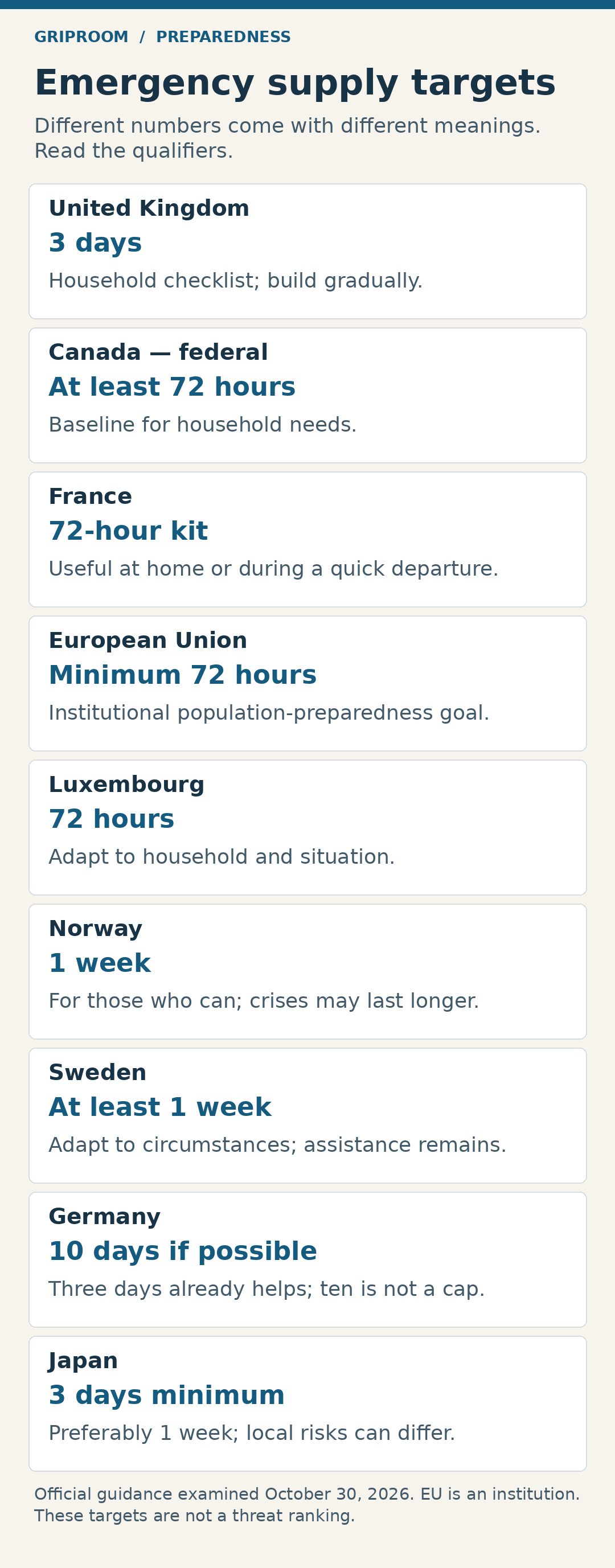
Official supply targets differ in meaning. Germany's ten-day aspiration includes a useful three-day starting point; Japan distinguishes its minimum from its preference.
The UK checklist uses three days. Canada says at least 72 hours; France describes a 72-hour emergency kit; the EU strategy specifies a minimum 72-hour goal; and Luxembourg uses 72 hours of self-sufficiency. Norway recommends one week for those who can prepare. Sweden asks for at least a week while preserving assistance for people who ordinarily need it. Germany encourages ten days if possible and says three days already helps. Japan recommends at least three days, preferably a week. The targets do not predict how long the next crisis will last.
One apparent disagreement disappears when the recommendation is stated fully. A household with a week's usable supplies can meet a three-day minimum and a one-week preference at the same time. The two statements answer different questions: the floor a government wants people to reach and the reserve it would prefer them to hold.
An international list that strips away those words creates precision without comparability. It can tell you which printed number is larger, but not which recommendation is more demanding for a particular household or why the agency chose it. That is why the qualifiers stay in this comparison rather than being relegated to a note beneath a ranking.
Three days can be a baseline, a kit or a starting point
Britain's Be Ready checklist asks households to prepare for three days. It encourages gradual purchases and food people normally eat that keeps without refrigeration or cooking. The aim is to help households manage while support reaches people in greatest need.
Canada's federal emergency-kit guidance uses at least 72 hours. That wording matters: a baseline does not imply that a fourth day is unnecessary or that every Canadian household faces identical access to help.
France's 72-hour kit is useful in more than one setting. The official page describes supplies for remaining at home while awaiting relief and for leaving quickly. A list presented around a bag therefore should not be interpreted as a completely different policy from keeping supplies at home.
Luxembourg's household guide and checklist similarly use a 72-hour self-sufficiency target and require attention to the household and situation. Its document explains both taking shelter and evacuation; the headline number does not remove that distinction.
At institutional level, the EU's March 2025 strategy seeks a minimum of 72 hours of population self-sufficiency. It is a policy goal across a union of countries, not evidence that every national guide is identical or that longer national recommendations have been replaced.
A week comes with assumptions about who can prepare
Norway raised its recommendation from three days to one week in May 2024. Its Directorate for Civil Protection explains the target in terms of a practical buffer while disruption is managed and services are restored. The agency's FAQ also acknowledges that a crisis can last longer.
That is a useful corrective to literal-minded readings. A week of supplies is a planning target; it does not make day eight safe, and it does not mean officials have forecast precisely seven days without service. The target also needs to be achievable for the people being asked to meet it.
Sweden's home-preparedness guidance asks people to plan for at least a week of access to food, water, communication and heating, adapted to their circumstances. It also says people who normally require special assistance remain entitled to help during a crisis, although service may vary and take longer.
Removing that qualification changes the message. The advice is not that everyone, regardless of disability, finances or living arrangements, must become completely independent of public support. The intended division of effort is that households able to prepare make it easier to prioritize people who cannot cope as readily on their own.
Germany's ten days and Japan's three-to-seven are not contradictions
Germany's English-language preparedness guide encourages ten days of supplies if possible. It also stresses that a three-day reserve is already useful.
Both instructions can be followed. A household can establish a smaller reserve, then build toward the larger target when space and money permit. Reporting only ten days can make the advice sound like an all-or-nothing requirement; reporting only three days can erase the longer aspiration. Nor is ten days a cap on what a household might reasonably need in its own circumstances.
Japan makes the distinction within the recommendation itself: at least three days, preferably a week. The agriculture ministry's English guidance uses that minimum/preferred structure for food reserves. Its household stockpiling material explains disrupted utilities and deliveries and the possibility of delayed relief, with local risks affecting preparation.
The distinction also predates the current news cycle. It appears in a 2014 official decision. Japan's announced November 2 appeal provides a timely reason to discuss the advice, but it does not by itself turn an established preference into a new mandatory seven-day standard.
Local risk can change the answer within one country
National comparisons can hide variation that matters more to an individual household.
The Canadian Red Cross recommends at least three days of supplies at home. It specifies a minimum of seven to ten days for remote and northern communities, and 14 days for people in regions prone to earthquakes and tsunamis.
These are the organization's recommendations, not a newly issued federal order. They illustrate why a national headline cannot answer every local question. The relevant comparison may be between the access and hazards of two communities inside one country, rather than the headline targets of two governments.
The longer regional targets also should not be read as precise predictions. They describe preparation for circumstances where assistance or replenishment may be harder to obtain. The sensible starting point is the applicable local guidance and the household's situation, rather than an international average assembled from unlike recommendations.
Home reserves and an evacuation bag solve different problems
Food that can stay on a shelf for months still has to be useful in the emergency you are preparing for. A home reserve needs to account for the conditions in which it will be used. An evacuation bag adds another constraint: the household must be able to take it along.
That makes a large stationary reserve and a portable kit different tools. It does not make them competing choices. The Canadian Red Cross's kit guidance distinguishes supplies for different situations, while the French guidance deliberately describes a kit that can help both at home and during a quick departure.
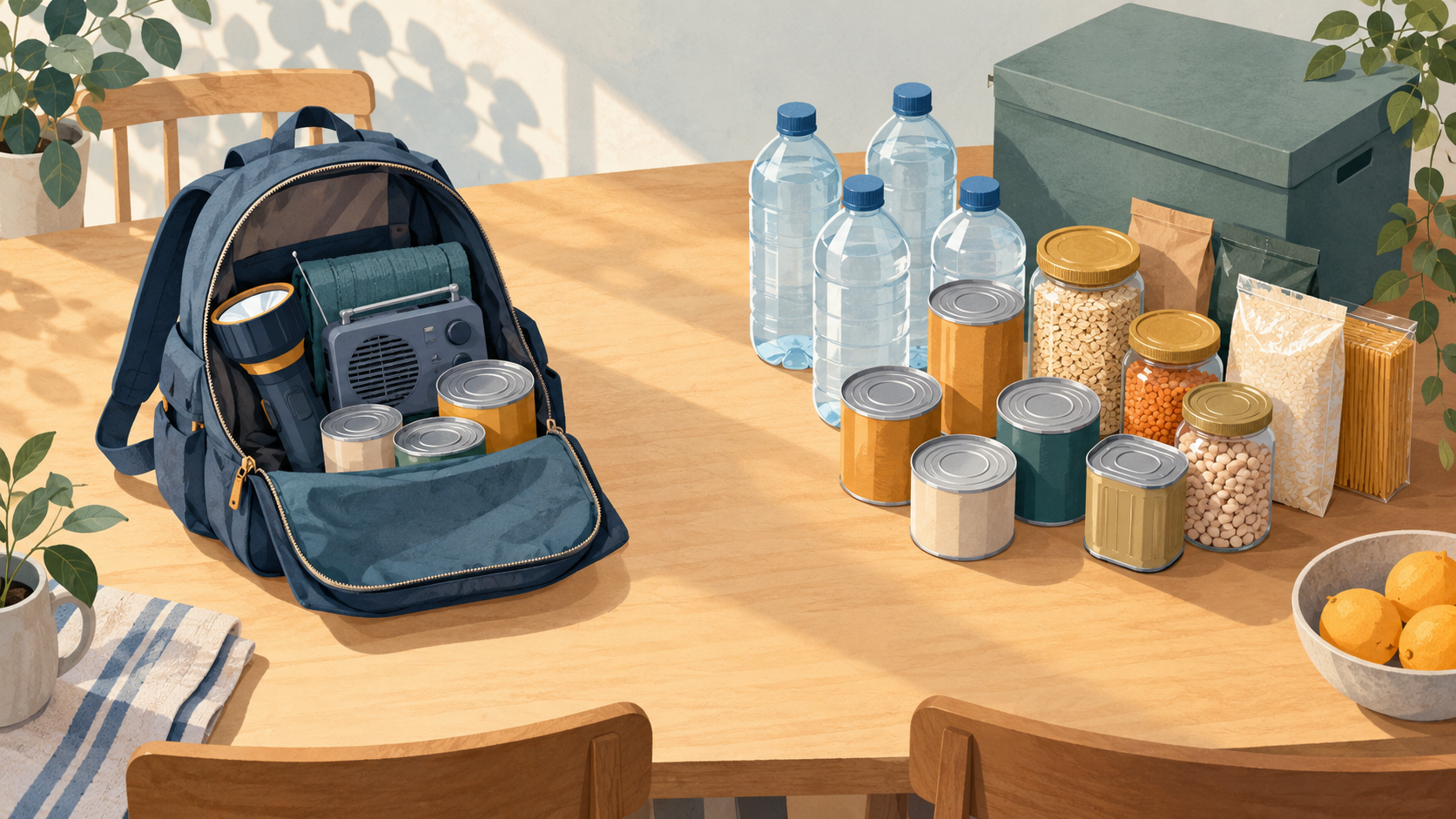
The illustration above shows that relationship, not the exact contents or quantity recommended by any government. A bag pictured with a few tins is not a three-day nutritional plan, just as a row of water bottles cannot communicate every household's water requirements.
Food is also only one part of the guidance. Water, information, light, sanitation and household-specific needs belong in the same planning exercise. Counting cans while overlooking the other functions can satisfy the most visible part of a checklist and miss its purpose.
Read the qualifying words before filling the cupboard
A useful reading of any checklist starts with four questions. Is the number a minimum, a preferred target or a starting reserve? Does the list concern supplies at home, portable supplies or both? Which household circumstances does it assume? Does local guidance recommend a different buffer?
The UK's gradual approach offers a practical way into that exercise: check what is already available, identify gaps and add suitable items during ordinary shopping when possible. Choosing things the household uses also makes it easier to maintain a reserve rather than forget an expensive box indefinitely.
That is different from rushing to buy the largest quantity mentioned anywhere. Preparation has to fit the household's resources and the conditions in which supplies will be used. The qualification attached to a target is part of the recommendation, not fine print to discard.
The next useful decision is therefore specific: what ordinary need would your household have trouble meeting during a disruption, and what does the relevant official checklist say about it? Start there. The largest number in an overseas headline can wait.