Mystery Booster Commander has restricted distribution, unusual cards and plenty of reasons for collectors to pay attention. Those features do not tell us how many boxes exist.
The defensible answer is that the official product and launch documents examined for this article do not provide a quantified total print run. They describe where the product will appear and how an early bundle sale works. That supports an analysis of availability, but not a precise global rarity claim.
There is also a reason to be cautious about treating the October bundle sale as the entire supply story. Wizards' product page advertises future Magic-event availability and lists MagicCon dates into 2027. Those are distribution plans, not a guarantee of additional manufacturing. They do show why a one-sale-only story is incomplete.
For a buyer, the useful question is what kind of scarcity an asking price is supposed to reflect: a temporarily difficult purchase, a rare card treatment, or a genuinely small number of boxes.
A purchase limit is not a production total
The Atlanta Festival in a Box announcement described a sale while supplies last, capped at two per customer. That tells buyers how the sale was restricted. It does not reveal the size of the stock allocated to it, the amount held for events or the total manufactured.
A cap can help distribute a limited allocation among more customers. It can also exist for a product that has substantial supply elsewhere. Without an announced quantity, neither interpretation supplies a box count.
The same caution applies to a storefront stockout. It can mean an allocation sold, that fulfillment is being managed, or that the particular channel has no inventory available at that moment. It cannot, by itself, establish how much unopened product remains in warehouses, with sellers or in private collections.
That is why the phrase “limited” needs an object. Limited per customer, limited to particular channels, limited in one sale and limited to a stated manufacturing quantity describe different restrictions.
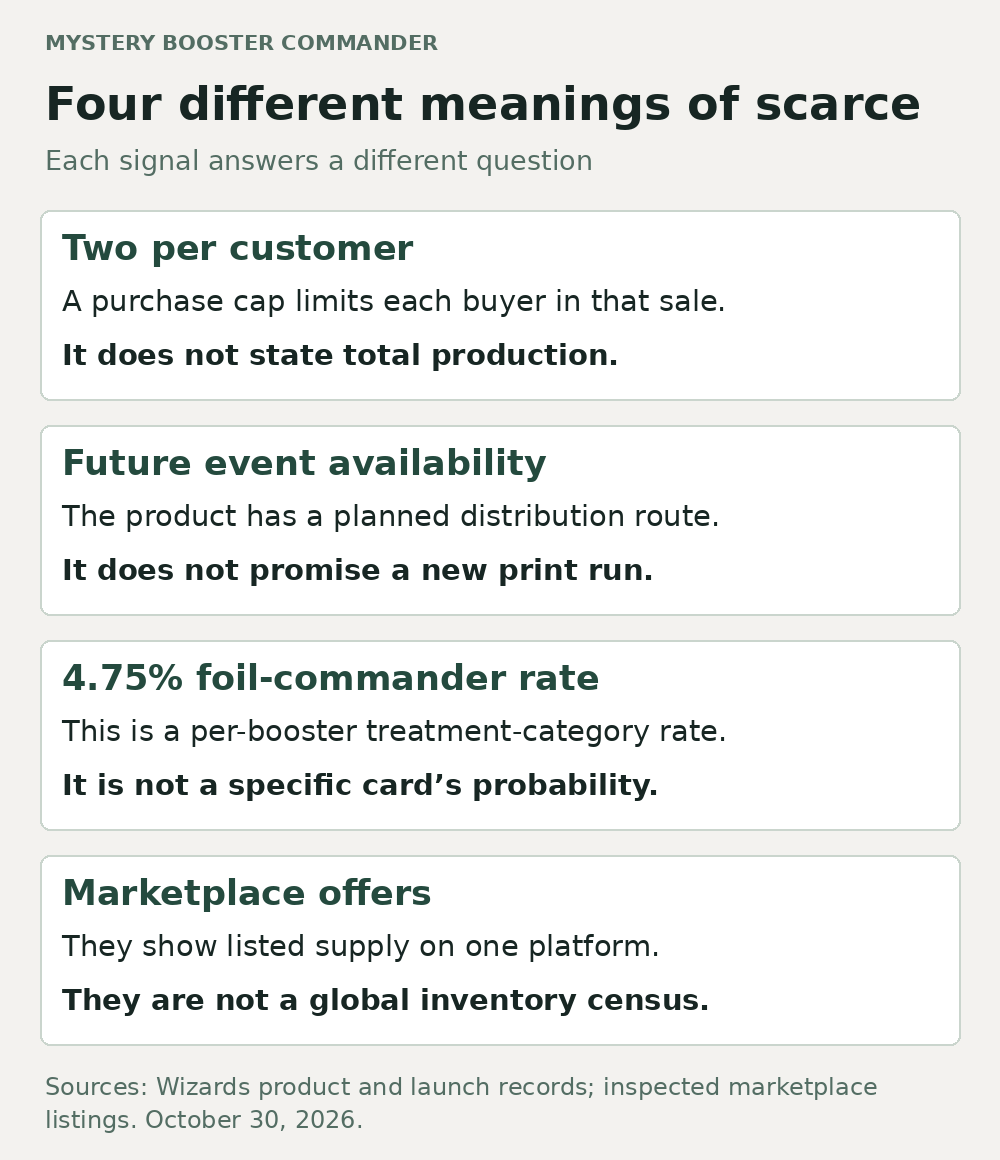
A two-per-customer cap concerns that sale, not total production. Future event plans do not guarantee a new printing. The 4.75% foil-commander rate concerns a per-booster category, not a specific card. Marketplace offers describe one platform, not global inventory.
Later event availability changes the argument
Wizards places MBC within a continuing event program. The official page lists future MagicCon appearances rather than presenting the October online bundle as the only way the product can reach players.
The narrow implication matters. A buyer should not assume that the end of one online sale ends distribution everywhere. Future events may put more packs into circulation and more opened cards onto the secondary market.
The broader implication remains uncertain. An event schedule does not disclose whether those packs come from existing inventory or a new production run. It does not specify how many boxes each event will receive, whether attendees can buy sealed displays, or whether another online allocation will appear.
Those unknowns cut both ways. Future distribution can coexist with a small overall run. A large production total can coexist with frustrating access. The documents support neither a guaranteed restock nor a conclusion that supply is permanently exhausted.
For anyone considering a premium, this is the question to keep asking: what evidence would show that the product is becoming harder to obtain across the relevant channels, rather than merely unavailable through one familiar route?
The box and its rarest treatments are different markets
A sealed display can be obtainable while a specific card treatment is difficult to find. Conversely, an unusually scarce treatment does not make every ordinary card or every unopened box equally rare.
MBC illustrates the distinction. The official breakdown gives a 4.75% per-booster rate for a traditional-foil new commander. Multiplying that rate by 24 boosters gives an average of 1.14 such foils per box. That is an expectation across a distribution, not a promise printed on each display.
It is also a category rate. It does not tell you the chance of opening one particular foil commander. Dividing by a checklist size would require evidence that all eligible cards appear at equal rates. The published category percentage alone does not establish that.
Collectors should therefore specify the thing they are calling rare. A named card, a foil version, a frame treatment and a sealed box are separate objects with different supply and demand. A striking pull can be genuinely unusual without proving a small global production run for the entire release.
Reused designs complicate the rarity story
The official product description says MBC reuses the Mystery Booster 2 selection of playtest cards and includes some Future Sight-frame cards from that release. A familiar design appearing again is a reminder to distinguish a particular printing from the underlying card or treatment concept.
This matters when paying for exclusivity. A collector may value a specific version's finish, appearance or provenance. A player may mainly want the game piece. An additional version can affect those buyers differently.
The same distinction belongs in a sealed-product thesis. Reprinting an individual card can weaken one reason to open an older product without reproducing its exact sealed box. Releasing more of an existing box can expand available sealed supply without introducing a new card version. Those are separate mechanisms, so they should not be collapsed into a single vague “reprint risk.”
No current buyer can derive a future price path simply by deciding which label sounds more exclusive. The value question still includes what collectors want and what they are willing to pay.
Marketplace listings are a window, not an inventory census
Listing counts can help describe one platform at one moment. They do not count every box in existence, and they are not always counts of units. One offer may represent several boxes; another may contain fewer packs than the product title suggests.
Our marketplace inspection found custom offers for partial displays and extras-only bundles alongside complete-product offers. That makes an unfiltered count or lowest asking price especially easy to misread.
The stock outside the platform is another limitation. Retailers, event organizers and private owners may hold product that is not listed there. Sellers can add or withdraw listings without any change in the manufacturing total.
A better availability check combines several observations: comparable complete-product offers, their delivery terms, transactions where accessible, and official distribution updates. Even that describes the market you can observe. It should not be repackaged as an exact estimate of worldwide production.
What would make a stronger scarcity case?
A stated production quantity or a clear official commitment about future manufacturing would address the print-run question directly. A reliable account of allocations could also improve the picture, provided its coverage and limitations were clear.
For practical buying decisions, repeated evidence across channels would matter more than one alarming screenshot. Are complete boxes becoming harder to find? Are the offers comparable in condition and delivery? Are buyers actually transacting at the higher prices, or are sellers simply asking more?
Timing matters as well. Newly distributed product can take time to reach sellers and buyers. A snapshot during that process may describe a temporary bottleneck rather than lasting rarity. Equally, promised or anticipated availability should not be counted as inventory that is already for sale.
These are evidence questions, not a reason to assume prices must fall. The goal is to identify which part of the scarcity story is supported before paying for it.
A sensible buying rule
Treat Mystery Booster Commander as a product with limited access routes and uncertain total production, rather than assigning it an unsupported small print-run number.
If you want to draft it or collect its distinctive cards, decide what that experience or those versions are worth at the current delivered price. If you want to hold boxes financially, ask whether the purchase still appeals without a confident assumption that no more supply will appear.
The next useful update is a concrete change in distribution or an attributable statement about manufacturing. Another screenshot of a two-box limit tells you the rule for that sale. It still does not tell you how many boxes were made.
Sources