Den Tokyo Playful Fine Dining: Why Fun Can Be Worth Paying For
Fine dining has spent decades convincing people that expensive food must arrive with the emotional temperature of a bank vault. Tiny plates. Whispered explanations. Tweezers. Foam. A server describing a scallop like it survived a divorce. Somewhere along the way, restaurants decided that if dinner costs serious money, everyone at the table should sit very still and behave like they are witnessing a museum artifact being dusted.
Then there is Den in Tokyo, a two-Michelin-starred restaurant from chef Zaiyu Hasegawa, where kaiseki tradition collides with fried chicken boxes, emoji carrots, home-cooking warmth, and the radical idea that paying a lot for dinner should maybe include enjoying yourself. Horrifying concept. Someone alert the Ministry of Tiny Serious Plates.
Den is not “fun” in the cheap sense, like a restaurant putting sparklers in dessert and calling it personality. Den is playful because the jokes are attached to craft. The surprise lands because the technique is real. The warmth feels expensive because it is rare. The whole restaurant makes a quietly devastating argument: fun can be worth paying for when it is designed with intelligence, generosity, and actual cooking skill.
Den is currently ranked No. 22 on Asia’s 50 Best Restaurants 2025 and was named No. 1 in Asia in 2022; The World’s 50 Best Restaurants 2025 extended list ranked it No. 53 globally. Michelin lists Den with Two Stars and describes its menu as playful and inventive, with a fresh perspective on Japanese cuisine.
What Is Den Tokyo?
Den is chef Zaiyu Hasegawa’s flagship restaurant in Jingumae, Shibuya. Its official website gives the address as 2-3-18 Jingumae, Shibuya-ku, Tokyo, about a 10-minute walk from Gaienmae Station. Reservations are taken only by phone, during stated hours, up to two months ahead, for parties of up to four; Den says it does not accept online reservations or third-party bookings. Because apparently getting into one of Tokyo’s most beloved restaurants still requires the ancient ritual of calling a telephone like it is 1997 and you are trying to win concert tickets.
Hasegawa opened Den in Jimbocho when he was 29, after training in traditional Japanese cooking, including at Uotoku, the ryotei where his mother worked as a geisha. Den moved to its current Jingumae location in late 2016. Asia’s 50 Best describes the restaurant as contemporary, accessible, welcoming, and rooted in kaiseki while pulling in home cooking, fast-food references, travel, and collaboration.
That combination is the whole spell. Den does not reject Japanese culinary tradition. It loosens the tie. It lets the form breathe. It says, “Yes, we understand the centuries of technique. Also, here is fried chicken in a custom box. Please unclench.”
Why Den’s Playful Fine Dining Is Not Just a Gimmick
The word “playful” has been abused by restaurants so badly it should receive hazard pay. Many places use “playful” to mean “we put dessert in a fake plant pot” or “the spoon is shaped like childhood trauma.” That is not play. That is theater-kid garnish.
Den’s play works because it begins with hospitality, not attention-seeking. On its official site, Hasegawa frames his cooking around the feeling of home food made with the wish of making others happy. That sounds simple, which is how dangerous ideas often arrive: wearing slippers, holding rice.
This is a very different luxury language from the usual fine-dining dialect of “rare ingredient, pristine technique, please admire the chef’s distance from ordinary life.” Den’s luxury is emotional. The restaurant wants the guest to feel looked after, amused, surprised, and included. Not educated against their will by a radish.
And yes, the food has to be excellent. Fun without deliciousness is children’s entertainment with a tasting menu price. Den avoids that particular culinary war crime by making the playfulness serve the meal.
DFC: Den Fried Chicken and the Genius of Expensive Comfort Food
Den’s most famous joke is DFC, or Den Fried Chicken, a playful riff on fast-food fried chicken. It is not just “lol, chicken box.” The dish is a boneless chicken wing stuffed with sticky rice, then deep-fried until crisp, served in custom takeout-style packaging. TastyTrip reported Hasegawa’s explanation that the dish grew from the kaiseki idea of oshinogi, a small rice course meant to satisfy the stomach; Den made it more approachable by stuffing rice into chicken wings.
That is why DFC works. It is funny for approximately three seconds, then your brain catches up and realizes it is also clever. It takes a formal dining structure, translates it through fast-food memory, and gives you something tactile, hot, familiar, and technically annoying to make.
This is not a chef slumming it with junk-food cosplay. This is a chef understanding that people have memories attached to fried chicken boxes, crispy skin, rice, heat, and hands-on eating. Fine dining often acts like comfort food is a suspicious peasant trying to sneak into the ballroom. Den invites comfort food in, gives it a tailored suit, and somehow it still has sauce on its fingers.
That is worth paying for because the dish does something expensive restaurants often forget: it gives you permission to feel joy immediately.
The Den Garden Salad: Emoji Carrots, Farmers, and Actual Thought
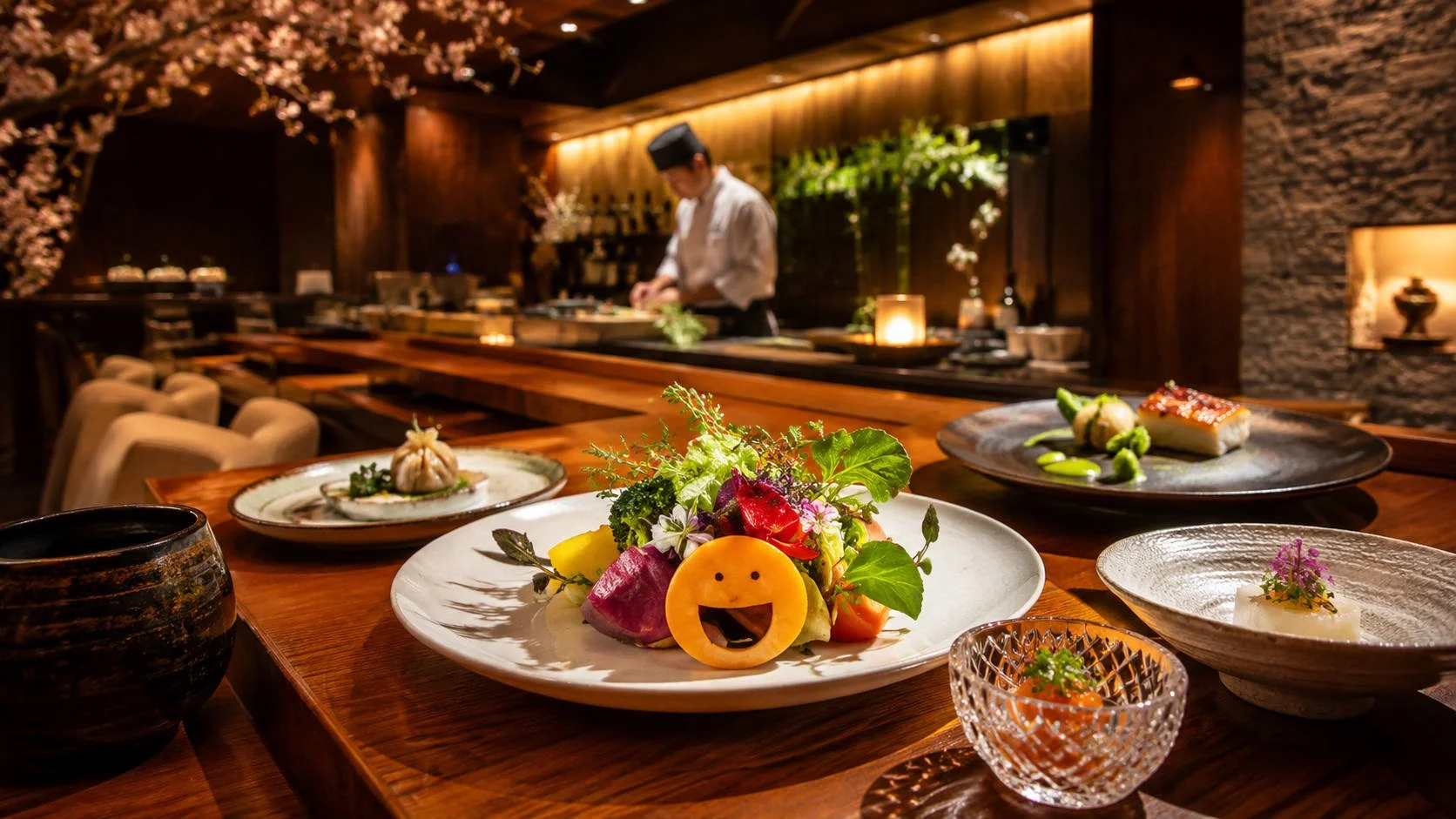
Another famous Den signature is the garden salad, often photographed because it includes a cheerful little carved carrot face. Yes, an emoji carrot. Yes, people take pictures. Yes, somewhere a very serious food person probably frowned so hard their tasting spoon bent.
But again, the joke is not the point. The point is that Den’s salad expresses connection to farmers and seasonal produce. Michelin quotes Hasegawa explaining that the vegetables are grown without pesticides or chemical fertilizers, and that the salad is a fun way for diners to see what came from the garden.
Asia’s 50 Best describes Den’s garden salad as having more than 20 ingredients, and travel reports describe vegetables prepared in multiple ways—grilled, pickled, fried, seasoned lightly, arranged with color and texture.
This is why the carrot face matters. It makes a complex vegetable course readable. It turns the plate into a wink instead of a lecture. Plenty of restaurants say they care about farmers, then serve you three leaves under a spotlight and charge you like the lettuce had a private tutor. Den makes the farmer connection visible, seasonal, and happy. Imagine that: vegetables without moral superiority. Stunning innovation.
Den Makes Kaiseki Feel Human
Kaiseki can be magnificent. It can also become intimidating if presented like a cultural exam in which the diner is expected to sit politely while silently wondering whether they are eating the garnish. Den’s brilliance is that it keeps the seasonal structure and elegance of kaiseki but removes the emotional barbed wire.
Asia’s 50 Best says Hasegawa draws on kaiseki while incorporating Japanese home cooking, fast-food favorites, travel influences, and collaborations. Highlights include foie gras monaka wafers, DFC chicken, the Den garden salad, and donabe rice topped with ingredients like wagyu, seafood, wild plants, or mushrooms.
That is a serious menu with a grin. Monaka wafers nod to Japanese sweets but become savory. Fried chicken nods to fast food but lands inside kaiseki logic. Donabe rice brings everyone back to the table’s center because rice is not a decoration in Japanese food; it is the quiet adult in the room.
Den makes fine dining feel less like a performance of wealth and more like a hosted evening. You are not just buying ingredients. You are buying pacing, warmth, relief, surprise, and the feeling that the restaurant actually wants you to have a good time, not just admire how disciplined the chef’s microgreens are.
Why Fun Is Worth Paying For
Fun is worth paying for when it changes the meal from consumption into memory.
A technically perfect dinner can still evaporate from your brain by the next morning if it feels like 12 elegant plates of competence. Lovely fish. Precise sauce. Nice ceramics. Very good. Completely gone from memory, like a dream about accounting.
Fun creates hooks. The fried chicken box. The smiling carrot. The dog mascot Puchi Jr. The warm team. The personal gestures. The feeling that the restaurant has a sense of humor without losing its standards. The World’s 50 Best 2025 extended list even notes that guests leaving Den may be greeted by the Hasegawas’ canine mascot, which is exactly the kind of detail fine dining usually avoids because it sounds dangerously close to delight.
Memory is part of value. People pretend they pay for fine dining only because of ingredients and technique. Please. If that were true, nobody would care about dining rooms, service, narrative, pacing, or the tiny emotional thunderbolt of a surprise course. A restaurant is not a spreadsheet of components. It is an experience. Sorry to everyone who thinks luxury should taste like a silent laboratory.
Den charges for food, yes. But it also charges for being remembered.
Hospitality Is Labor, Not Pixie Dust
One reason Den feels valuable is that hospitality is treated as part of the cooking. The team’s reputation for smiles, conversation, warmth, and relaxed welcome is not accidental. Michelin’s description emphasizes bright smiles and easy conversation; 50 Best repeatedly frames Den as accessible and welcoming.
That matters because high-end hospitality is work. Emotional work. Timing work. Anticipation work. Reading the table. Explaining without condescending. Joking without hijacking the meal. Making nervous guests feel comfortable. Making experienced diners feel surprised. Making everyone feel like they are inside the joke, not being used as props for it.
This is harder than solemn service. Solemn service can hide behind choreography. Fun service requires judgment. Get it wrong and the restaurant becomes a cruise ship magic show with better chopsticks. Get it right and the dining room relaxes. Den gets it right because the playfulness feels generous, not desperate.
The Anti-Stuffy Fine Dining Argument
Den’s success is a quiet rebuke to the idea that fine dining must be severe to be important.
Some restaurants treat seriousness like seasoning. Too much of it, and the whole meal tastes like a grant application. Den proves you can be serious about craft without being miserable about dinner. You can respect tradition without embalming it. You can serve elite food without making guests feel like they accidentally wandered into a ceremony where laughter is taxable.
This matters because fine dining has an insecurity problem. It often fears that if the guest has too much fun, the meal will seem less profound. Den understands the opposite: delight can deepen respect. A dish that makes you smile is not automatically shallow. Sometimes it is more difficult than the dish that merely makes you nod with expensive approval.
Anybody can plate a scallop like a moon rock and dim the lights. It takes nerve to serve fried chicken at a two-star level and trust the room to understand both the joke and the craft.
What Den Teaches About Value in Expensive Restaurants
Den’s tasting menu is listed by 50 Best Discovery from about $110, though prices can change and drinks increase the final bill. Reservations open about eight weeks or two months ahead and are taken only by phone, depending on the source and Den’s current policy wording.
That price is not cheap. It is also not in the outer-space tier of fine dining where the bill arrives and everyone at the table briefly sees their ancestors. Compared with many internationally famous tasting-menu restaurants, Den’s value proposition is not “most rare ingredients per dollar.” It is “one of the world’s most emotionally distinctive fine-dining experiences without turning dinner into a luxury hostage negotiation.”
The useful lesson: value is not the same as quantity. A cheap meal can be bad value if it is forgettable, stingy, or joyless. An expensive meal can be good value if it gives you craft, memory, hospitality, generosity, and a story you are still boring your friends with years later.
Obviously, do not spend rent money on dinner. Do not become the person who says “it was worth it” while eating instant noodles for the next 26 days in a dark apartment. But if you are choosing one serious meal in Tokyo, Den makes a powerful case that fun belongs in the value calculation.
When Playful Fine Dining Becomes Ridiculous
Let us be clear: not all playful fine dining deserves applause. Some of it should be escorted out of the building by a sober adult.
Fun is not worth paying for when the food is mediocre. It is not worth paying for when the joke exists only for Instagram. It is not worth paying for when the staff has to explain the concept for eight minutes while your soup dies of exposure. It is not worth paying for when the “interactive course” means the restaurant has outsourced labor to the guest while charging service.
Den avoids this because the playfulness is not floating on top like edible confetti. It is built into the logic of the food. DFC is funny, but it is also a rice course. The salad is cute, but it is also about farmers and seasonal vegetables. The hospitality is warm, but it does not erase technique. The jokes have bones.
A gimmick says, “Look at me.”
A great playful dish says, “Taste this, then look again.”
Who Should Book Den Tokyo?
Book Den if you want Japanese fine dining that feels warm, seasonal, polished, and funny without being clownish. Book it if you like restaurants where hospitality matters as much as plating. Book it if you are tired of tasting menus that behave like they were designed by a committee of monks with tweezers and unresolved childhood issues.
Do not book Den if you want silent, ultra-formal, rigid kaiseki. Do not book it if your idea of luxury requires everyone in the room to act faintly afraid. Do not book it if you hate surprises, humor, or the possibility of being charmed by a fried chicken box.
Also, do not book it if you cannot handle the reservation process. Den’s official site is explicit: call directly, during reservation hours, no online platforms, no third parties, up to two months ahead, parties up to four. This is annoying, yes, but scarcity has never been known for its customer-service personality.
Practical Tips for Dining at Den
Call during the official reservation hours listed on Den’s website, and do it as early as your target date allows. The restaurant notes calls can be difficult to connect during reservation hours, which is a polite way of saying half the food-obsessed planet may also be attacking the phone line.
Be upfront about allergies and dietary restrictions when requesting a booking. Den says it will do its best to accommodate requirements but cannot guarantee every request can be met. This is not the place to reveal at the table that you have a complicated personal feud with mushrooms.
Budget for drinks. Pairings and sake can change the final price quickly, because alcohol is where restaurant bills go to become dramatic.
Show up ready to participate. Den is not a museum. It is a meal with personality. Take the joke, enjoy the technique, and resist the urge to become the kind of diner who says, “But is fried chicken really kaiseki?” Congratulations, you found the point. Please eat it while hot.
Den Tokyo Proves Fun Can Be Luxury
Den Tokyo makes playful fine dining worth paying for because the fun is not a distraction from seriousness. It is the delivery system.
Chef Zaiyu Hasegawa takes kaiseki tradition, seasonal Japanese ingredients, home-cooking emotion, fast-food nostalgia, farmer connection, and elite technique, then wraps it all in warmth. The result is a restaurant that feels expensive in the best way: not because it intimidates you, but because it gives you something rare.
A meal that relaxes you.
A meal that surprises you.
A meal that remembers you are a human being and not a silent vessel for chefly ambition.
Fine dining has no shortage of solemn temples where tiny plates arrive like courtroom evidence. Den offers something better: precision with a pulse. Craft with a grin. Luxury that remembers laughter is not a defect.
That is why fun can be worth paying for.
Not fake fun. Not glittery nonsense. Not “we served soup in a shoe because disruption.”
Real fun. Cooked deeply. Served warmly. Priced seriously. Remembered easily.
In the grand parade of expensive dinners trying very hard to be important, Den does something almost rude in its simplicity: it makes people happy.
The nerve.