Strong data-center growth meets client weakness, output constraints and lower expected margins.
Intel delivered a quarter that looked encouraging for its turnaround. Revenue grew, its data-center business expanded sharply, and quarterly cash generation improved. Then its outlook made the recovery look considerably harder.
The October 30, 2026 selloff followed a warning about the next quarter: weaker client-chip sales, limits on server output, lower expected gross margin and substantial investment still ahead. Those pressures help explain why a growing business could receive such a harsh market response.
The central problem is converting demand into profitable shipments. Intel has customers who want more computing power. It also has a large PC business exposed to tightening budgets and a manufacturing operation that needs time and money to deliver more chips. A strong result in one part of that system cannot automatically repair weakness elsewhere.
The fourth-quarter outlook changed the story
Intel’s results put third-quarter revenue at about $16.5 billion, up 21% from a year earlier. Adjusted earnings were 52 cents per share.
For the fourth quarter, Intel guided to $15 billion–$16 billion in revenue and 25 cents in non-GAAP earnings per share. Reuters reported LSEG expectations of $17.07 billion and 43 cents, respectively. Against that attributed comparison, the revenue midpoint was about 9.2% lower.
That gap matters because the quarter just reported and the quarter being forecast answer different questions. The completed quarter shows what Intel accomplished. The outlook describes what management currently expects its factories, customers and spending plans to produce next.
Reported consensus snapshots can differ. The useful comparison is one clearly identified set of expectations against the corresponding company guidance. Combining estimates from different reports would create a tidier number without creating better evidence.
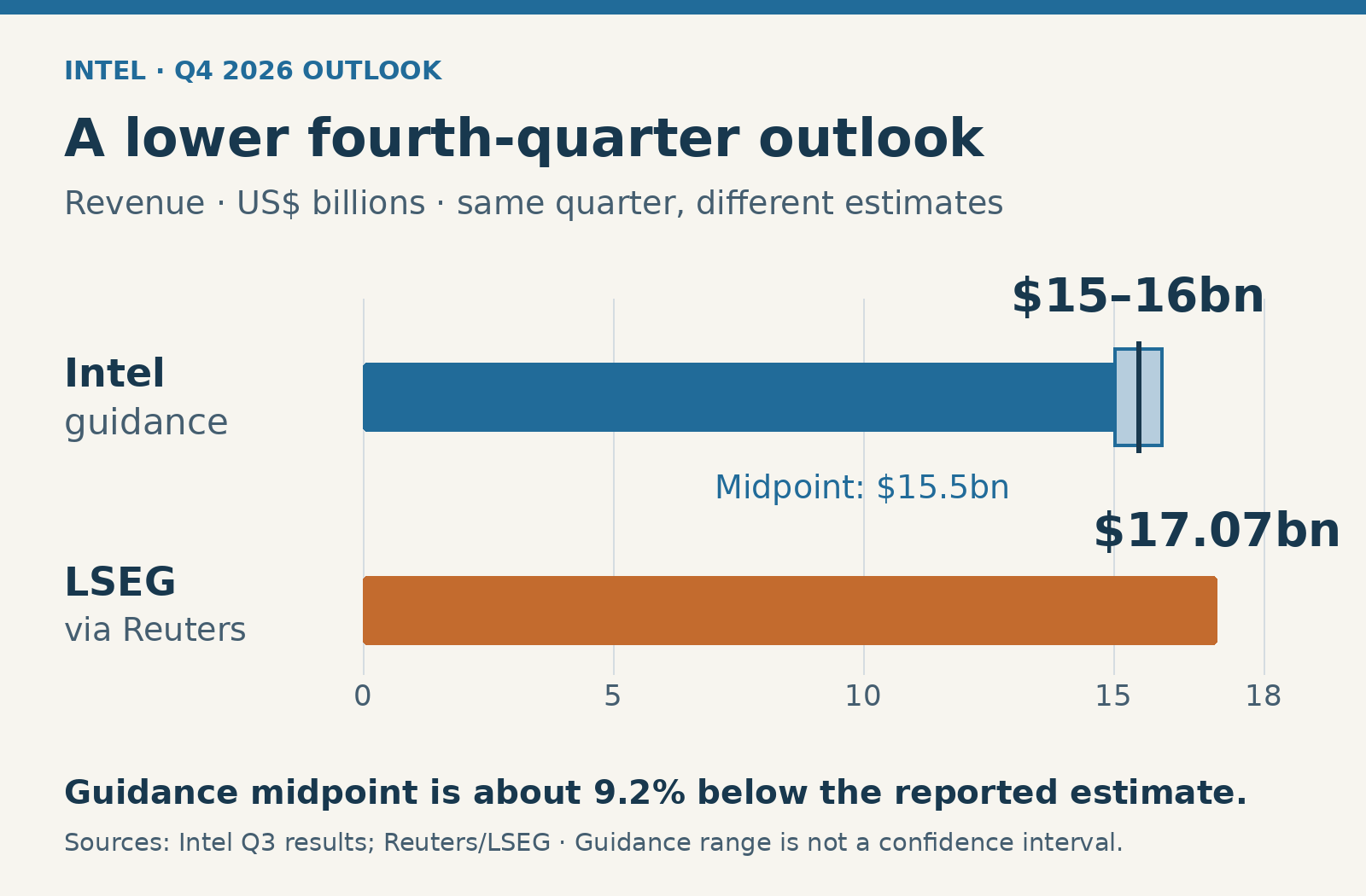
Intel’s guidance range and the Reuters-reported LSEG estimate refer to fourth-quarter revenue. The range is management guidance, not a statistical confidence interval.
Intel’s fourth-quarter revenue guidance spans $15 billion to $16 billion, with a midpoint of $15.5 billion. The Reuters-reported LSEG consensus is $17.07 billion. The midpoint is approximately 9.2% below that estimate; the comparison does not measure how much any individual factor moved the stock.
Intel faces two different business pressures
In its prepared remarks, management expected fourth-quarter data-center/AI revenue to grow by a mid-teens percentage sequentially, while it expected client revenue to decline more than 20% from the prior quarter. It cited memory costs, limited PC budgets, inventory reductions, manufacturing execution and packaging constraints.
That combination puts Intel in an awkward position. One customer group is becoming more cautious about purchases. Another wants products that Intel cannot supply as freely as it would like. The company has to manage both conditions within the same consolidated business.
An order and a shipment are different milestones. Demand can support a long-term investment case while still arriving too slowly in the income statement to satisfy near-term expectations. Factory capacity also has several moving parts: producing a usable chip is only part of getting a finished product to a customer.
The client side creates a different problem. When customers adjust inventory, their purchases can weaken more sharply than the underlying need for replacement computers. That distinction helps explain a difficult quarter, but it does not establish how quickly buying will recover.
The margin warning deserves attention
Intel reported a third-quarter non-GAAP gross margin of 44.1% and guided to 38% at its fourth-quarter revenue midpoint. That is a decline of 6.1 percentage points. Management described weaker revenue against its fixed-cost base and a changing product mix, partly offset by manufacturing yield and cost improvements.
Gross margin measures how much revenue remains after the costs assigned to producing those sales. It comes before the rest of the company’s operating expenses. A lower margin can therefore make an otherwise respectable revenue result less rewarding.
Consider the distinction between selling more products and earning more from those sales. A business can expand a fast-growing segment while its overall mix becomes less favorable. It can improve manufacturing efficiency while reduced volume elsewhere makes its existing cost base harder to absorb.
Those forces can coexist. Treating every positive production update as proof that the next quarter’s profitability must improve skips the rest of the calculation. For Intel’s turnaround, the relationship between output, mix and cost is as important as demand alone.
The factory incident is already in the numbers
Management’s preliminary estimate put the Israel factory incident’s fourth-quarter impact at roughly $300 million in revenue and two percentage points of gross margin, already included in guidance. Intel described the incident as an accident.
That accounting detail prevents a common mistake. Subtracting the estimated revenue impact from the published outlook again would count the same disruption twice. Nor does the incident establish an exact explanation for the entire gap between guidance and reported expectations.
The same care applies to margins. The incident estimate is one included effect. It does not explain the entire projected margin decline, and the disclosures do not justify assigning a precise remainder to each other pressure.
The foundry business needs a careful reading
Intel’s manufacturing ambitions are central to its turnaround, but segment revenue requires care. Its quarterly filing says foundry revenue consists substantially of business with other Intel operations. External foundry, assembly and test revenue totaled $411 million in the quarter.
Internal manufacturing has economic value. It helps Intel produce the chips sold by its product businesses. But revenue recorded between divisions does not show that an outside customer paid Intel the same amount. It also cannot simply be added to consolidated revenue.
For readers following the outside-customer foundry strategy, the useful question is how much external business is developing and what it costs to serve it. A large segment headline alone cannot answer that.
This distinction also changes the way to read a turnaround announcement. Improvements to an internal manufacturing system can matter before the outside-customer operation becomes large. Those are related developments, with different implications for the business case.
The strongest countercase is real
Intel’s data-center/AI segment generated about $7.3 billion in third-quarter revenue, up 78%. The company also reported approximately $5.1 billion in operating cash flow and $1.6 billion in adjusted free cash flow for the quarter. Those results show meaningful operating strength.
They also illustrate why a stock decline cannot be translated directly into “the business stopped working.” The reported quarter contains evidence that parts of Intel’s strategy are producing results. The market reaction reflects a more difficult question about what comes next.
Management planned $20 billion in gross capital spending for 2026, with spending rising strongly in 2027. Investment can expand future output while weighing on nearer-term cash generation. Whether the eventual return justifies the spending depends on execution, customer demand and economics that remain unfinished.
What would make the turnaround more convincing?
The next useful evidence will connect the pieces: more deliverable server output, healthier client purchasing, realized margin performance and a clear account of capital spending and cash generation.
A production improvement would be encouraging because it could turn unmet server demand into sales. A steadier client business would reduce a separate drag. Better margins would show that the additional activity is becoming more valuable, rather than simply larger.
None of those developments guarantees a particular stock price. A business result and the price investors are prepared to pay for it remain separate judgments.
Intel’s next disclosures will be most revealing where those judgments meet: whether the company can ship what customers want, retain more of the revenue and fund the capacity it is building. That is where a promising turnaround becomes a demonstrated one.