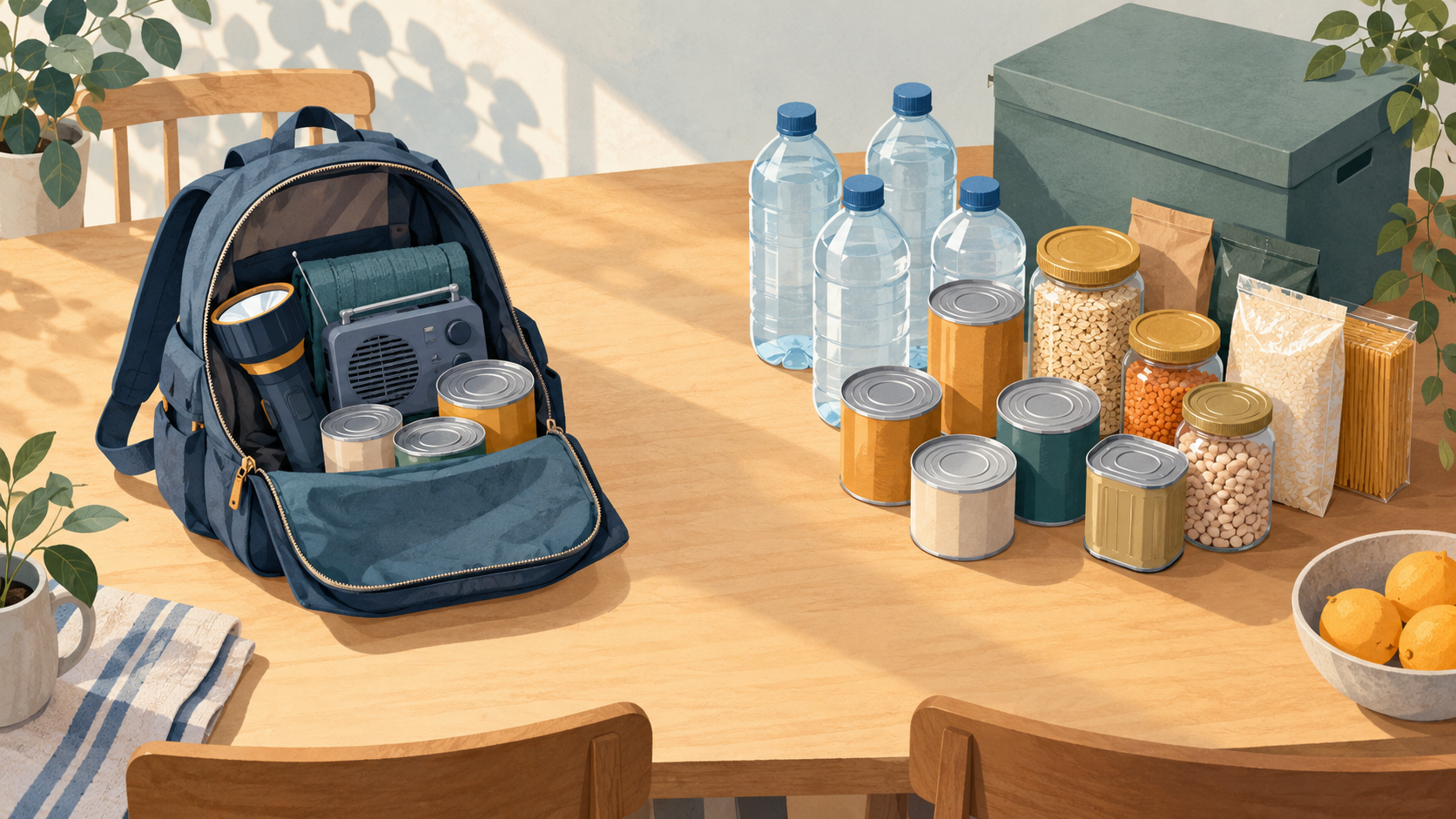
New campaigns, old advice and real security concerns are converging. The dates explain what the headlines alone cannot.
Britain wants households ready for three days of disruption. Norway recommends a week. Germany would like people to work toward ten days. Japan has announced a preparedness appeal for November 2, the day before the American midterm elections.
Read those headlines together and the kitchen cupboard starts to look like a geopolitical indicator.
The dates tell a more complicated story. There is new outreach, some genuinely stronger preparedness planning and explicit concern about war and cyberattacks. There is also advice that predates this autumn by years. Canada's federal 72-hour campaign, for example, was launched in May 2006. Japan's familiar three-day minimum and preferred week of supplies appear in an official decision from 2014.
Governments are encouraging households to keep essentials because a disruption to utilities, communications or deliveries can leave people needing supplies before normal service returns. Some governments are deliberately learning from one another. The public records examined here do not establish that the campaigns are a shared warning about a newly known event tied to the U.S. elections or renewed strikes against Iran.
That distinction leaves room to take both preparedness and the security situation seriously.
Britain's campaign is new. Much of its advice is not.
The UK's Be Ready campaign launched on October 22, encouraging households to prepare for three days of disruption. Food and water matter, but so do ways to receive information and support people who would have more difficulty coping.
The announcement contains a particularly useful detail: Britain has published household resilience advice since May 2024. The website received new branding and messaging; much of the underlying guidance stayed the same. The rollout is planned over three years, with further advertising to follow.
Nor did the campaign materialize without notice. A July government announcement had already said a household preparedness campaign was coming.
None of that makes the advice unimportant. It changes what the launch can reasonably tell us. A new campaign can mean a government wants more people to act on existing guidance, rather than that officials have just discovered a new three-day danger.
The international similarities are partly intentional. Britain's announcement describes learning from other countries, and its statement to Parliament places the campaign alongside work with international partners. Calling every national effort completely unrelated would miss something real. Cooperation on preparedness, however, is a different claim from coordination around one impending catastrophe.
The three dates that keep getting mixed together
For any emergency-supplies story, three dates help: when the recommendation already existed, when it changed, and when the government began promoting it again.
Canada is a good example of the first. Its 2006 announcement promoted household self-sufficiency for at least 72 hours while rescue workers concentrated on people in greatest need. The current federal guidance retains that baseline. Seeing it circulate today does not make it a new Canadian warning.
Norway provides a genuine change. Its Directorate for Civil Protection says the recommended period rose from three days to one week in May 2024. The preparedness campaign began in 2018 and includes an annual awareness week in calendar week 44. A recurring autumn push can therefore appear beside newer headlines without representing a newly synchronized deadline.
The European Union's Preparedness Union Strategy dates to March 2025. Even that was not the first appearance of the 72-hour idea: the 2024 Niinistö report had already recommended a minimum period of household self-sufficiency.
These records do not identify the first time anyone ever suggested keeping emergency food. They establish something narrower and useful: several recommendations being discussed together in late October have visible histories outside this election window.

Selected public records distinguish established advice, actual revisions and new campaigns. The announced November 2 Japanese appeal had not occurred as of October 30.
Some October announcements really are new
Belgium and Luxembourg have supplied fresh reasons for the subject to appear in the news.
Belgium launched its new household guide on October 1. The National Crisis Center's announcement describes the second phase of a four-year campaign and explains the timing: the first Thursday in October is the national BE-Alert test day. There is a documented reason for that particular launch date.
Luxembourg launched its 72-hour self-sufficiency guide on October 9, with household distribution beginning October 14. Its guidance belongs to an existing resilience strategy. The new booklet is a real development, but a booklet's arrival is not evidence of a newly discovered disaster date.
France's 72-hour emergency-kit guidance has a slightly different practical emphasis. It describes a kit useful while remaining at home awaiting help and during a hurried departure. That is worth preserving when comparing countries: a home reserve and something you can carry out the door are related needs, not identical shopping lists.
The EU also matters as an institution, rather than another country to add to a dramatic total. Its strategy seeks more coordinated preparedness. Shared terminology and similar targets can reflect that policy work, alongside national circumstances and older advice.
The apparent wave is therefore a mixture: new guides, recurring awareness efforts, revised documents and older recommendations receiving renewed attention.
Distribution also changes how advice is encountered. A recommendation sitting on an official website and a guide arriving at people's homes are different public experiences, even if they repeat the same basic target. Luxembourg's announcement describes a household mailing, making the advice much harder to overlook. That can generate a fresh news event without establishing a fresh underlying threat. To understand the timing, it helps to ask what the government has newly done to reach people, as well as what it has newly asked them to buy.
Japan's November 2 date has a public explanation
Japan's planned appeal has attracted particular attention because of its timing and the language of an emergency request.
The institutional sequence is visible. An official September 25 announcement set out the new disaster agency's launch date. In an October 20 ministerial briefing, the government discussed an appeal to residents, local authorities and ministries in connection with that launch.
FNN's written report published October 27, describing an October 26 appearance by disaster-prevention minister Goshi Hosono, reported the familiar recommendation: at least three days of food, drinking water and toilet provisions, preferably a week. Its stated hazards included major earthquakes.
The distinction between minimum and preferred is important. So is the history. A July 2014 Cabinet Office decision already used the three-day minimum and approximately one-week preference for food and drinking water. The upcoming appeal does not, by itself, establish a new national supply-duration standard.
Japan's agriculture ministry guidance also provides a practical explanation for household reserves: damaged utilities, interrupted distribution and delays before relief supplies reach people. Keeping enough food is partly about the journey from a warehouse to a kitchen when ordinary systems are not working.
As of October 30, November 2 remained the announced launch and appeal date. An announcement about what a government plans to request is not the same as the final appeal, and neither is a prediction that a disaster will happen that day.
That public institutional explanation deserves a place before speculation about why the date falls near an American election.
War and cyberattacks are part of the picture
It would be equally misleading to explain the entire preparedness push as a collection of weather reminders.
Sweden explicitly places household preparedness within civil-defence planning. Its crisis-or-war brochure is direct about the security dimension. The point of keeping supplies extends beyond a brief interruption during otherwise normal conditions.
Germany's civil-protection agency launched its revised guide in October 2025. The guide addresses armed conflict as well as other emergencies. Its publication belongs in the timeline, rather than being silently moved into October 2026 because it is circulating again.
EU preparedness policy covers geopolitical conflict and cyber threats alongside disasters. In Britain, Sky's reporting of ministerial comments includes hostile-state and terrorist threats, sophisticated cyberattacks and disruption to payment systems.
These are substantive security concerns. A household may experience several of them through the same immediate problems: no working payment terminal, an interrupted delivery or an unreliable water supply. Similar household advice can therefore address different causes.
The existence of those risks supports taking the guidance seriously. It does not establish the timing, location or cause of a particular future crisis.
What about Iran and the American midterms?
There is a separate reason the election connection feels plausible: reporting about the Middle East has explicitly discussed a post-election window.
On October 28, the Associated Press reported that U.S. officials had warned regional allies about possible renewed military action against Iran after the midterms and potential retaliation. Its account relied on two unnamed diplomats and emphasized that the president had not made a final decision.
On October 30, Reuters reported that Qatari mediators had returned to Tehran as efforts toward a U.S.-Iran agreement continued, citing an official briefed on the talks.
Diplomacy and preparations for possible escalation can exist at the same time. Mediation is not a completed deal; warnings are not an irrevocable decision to strike.
The additional claim—that household campaigns across different countries were launched because of that same military timetable—needs its own evidence. The inspected campaign records do not establish it. Canada's 2006 campaign cannot be explained by this month's election calendar, and Norway's May 2024 revision is not an October 2026 instruction.
Recent security concerns could still strengthen governments' interest in resilience. That is a plausible general relationship, not proof of the specific shared warning suggested by the cluster of headlines. Establishing that narrower connection would require documents, attributable statements or reporting that actually connects the decisions.
It would also matter which decisions were connected. Evidence that ministers share a general concern about hostile-state disruption would support a security explanation for preparedness policy. Evidence that they agreed on a public-education campaign would establish coordinated outreach. Neither would automatically establish advance knowledge of a particular attack. Treating those as separate propositions makes room for a serious security story without asking a food checklist to prove more than it can.
A week of supplies is not a week-long disaster forecast
The numbers can create another false impression: that each government has estimated how long its population is about to be on its own.
Germany's advice is to aim for ten days if possible while recognizing that three days is already useful. Those are complementary instructions about building a reserve, rather than two competing estimates of the next crisis.
Norway's explanation of the one-week target discusses a practical buffer and the time needed to manage disruption, while acknowledging that crises can last longer. The target is not an assurance that services will return on day eight.
Likewise, Japan's minimum and preferred amounts are not interchangeable, and Sweden's at-least-a-week guidance carries important household and assistance qualifications.
You cannot read three, seven and ten days as a ranking of which governments are most frightened. The words around the number, the people being addressed and the purpose of the kit all matter.
The common vulnerability is ordinary life stopping
A cyberattack and a severe storm do not have to resemble each other to create similar household problems. The connection is the services people use to get through the day. Britain's discussion of payment and communications disruption makes that visible: having food available is useful when the difficulty is buying it, not only when there is a national shortage.
The practical details can be less cinematic than the headlines. The UK checklist specifies food that does not require refrigeration or cooking. Japan's appeal includes toilet provisions alongside food and water. Those details point to a household temporarily losing familiar functions, rather than a single shopping instruction designed around one scenario.
This is also why the advice is broader than buying more tins. Supplies, access to information and a plan for obtaining help solve different problems. A reserve that meets one need does not automatically meet the others. The shared household consequences help explain why governments facing different hazards can arrive at overlapping checklists.
Preparedness still includes other people
There is an easily missed social purpose behind the cupboard advice. If households that can manage temporarily are better prepared, responders can concentrate on people who need help sooner.
The UK checklist asks people to build readiness gradually and speak with neighbours about support they might share. Sweden's home-preparedness guidance says people who ordinarily require assistance remain entitled to it during a crisis, although service levels and waiting times may change.

British and Swedish guidance pairs household preparation with community support and assistance for people who need it.
Households are asked to prepare within their circumstances. Neighbours can discuss practical help and contact details. Public assistance remains part of the response, with priority for those least able to cope independently; Sweden explicitly preserves entitlement to assistance for people who ordinarily need it. These are connected parts of preparedness, not a promise that every service will operate normally.
That makes an important difference to the tone of the advice. A person with limited money, space or mobility is not failing a national resilience test by being unable to assemble the largest possible stockpile. The policies themselves recognize unequal circumstances.
For now, the useful thing to watch is a concrete change: a new local warning, a changed recommendation or the actual text of an announced appeal. Another headline repeating a familiar number tells you considerably less. The date on a campaign deserves attention; the history behind the advice deserves it too.