A larger US strike on Iran could lead to sharply different outcomes: a contained regional response, a prolonged energy and shipping disruption, or wider interference with civilian services. A useful worst-case analysis separates those paths, identifies what each requires and shows what could stop it.
It also starts with the people closest to the fighting. Death, injury and damage to essential services in the region are direct stakes of an escalation. Distant fuel bills and digital disruption belong in the analysis, but they should not crowd out the civilians who would face the earliest and most immediate harm.
This is a conditional map, not a prediction that the United States has ordered a new campaign or that Iran would activate every possible response. The public evidence about near-term strike timing remains a separate question.
First establish what would be new
The conflict already includes military action and maritime danger. AP reported limited defensive US strikes on November 2. A future operation’s consequences would depend on its scale, duration and objectives, as well as the response it provoked.
Calling every subsequent incident “the start” of a wider war can obscure that baseline. Calling an existing disruption a new additional loss can overstate its economic effect. A scenario should specify the change being considered, rather than quietly assuming that every earlier disruption starts again at full size.
There is evidence for relevant mechanisms. AP’s analysis of damage at US facilities documents regional vulnerabilities demonstrated during earlier rounds. The US Maritime Administration’s commercial-shipping advisory describes maritime hazards. Neither tells readers which site would be attacked next or how extensive a future reprisal would become.
Path one: retaliation stays principally regional
The most direct path is a further exchange involving forces and interests in the region. Even a response that remains geographically limited can cause casualties and interrupt civilian life. “Contained” describes the extent of escalation, not the absence of harm.
For this path to grow, additional decisions and successful actions would be required. An announced threat is not the same thing as a delivered effect. Defensive measures, limits on the response and continued negotiation can all affect how far an exchange travels.
The prior damage record helps distinguish demonstrated mechanisms from imagined ones. It does not provide a reliable timetable or establish that past outcomes would repeat at the same scale. A different operation could provoke a different response, and public reporting cannot reveal every constraint on either side.
The reader should watch the scope of actual actions and attributable official information, rather than a map of every conceivable target. Plotting sensitive facilities with speculative arrows would create an appearance of precision without establishing intent, capability or the likely result.
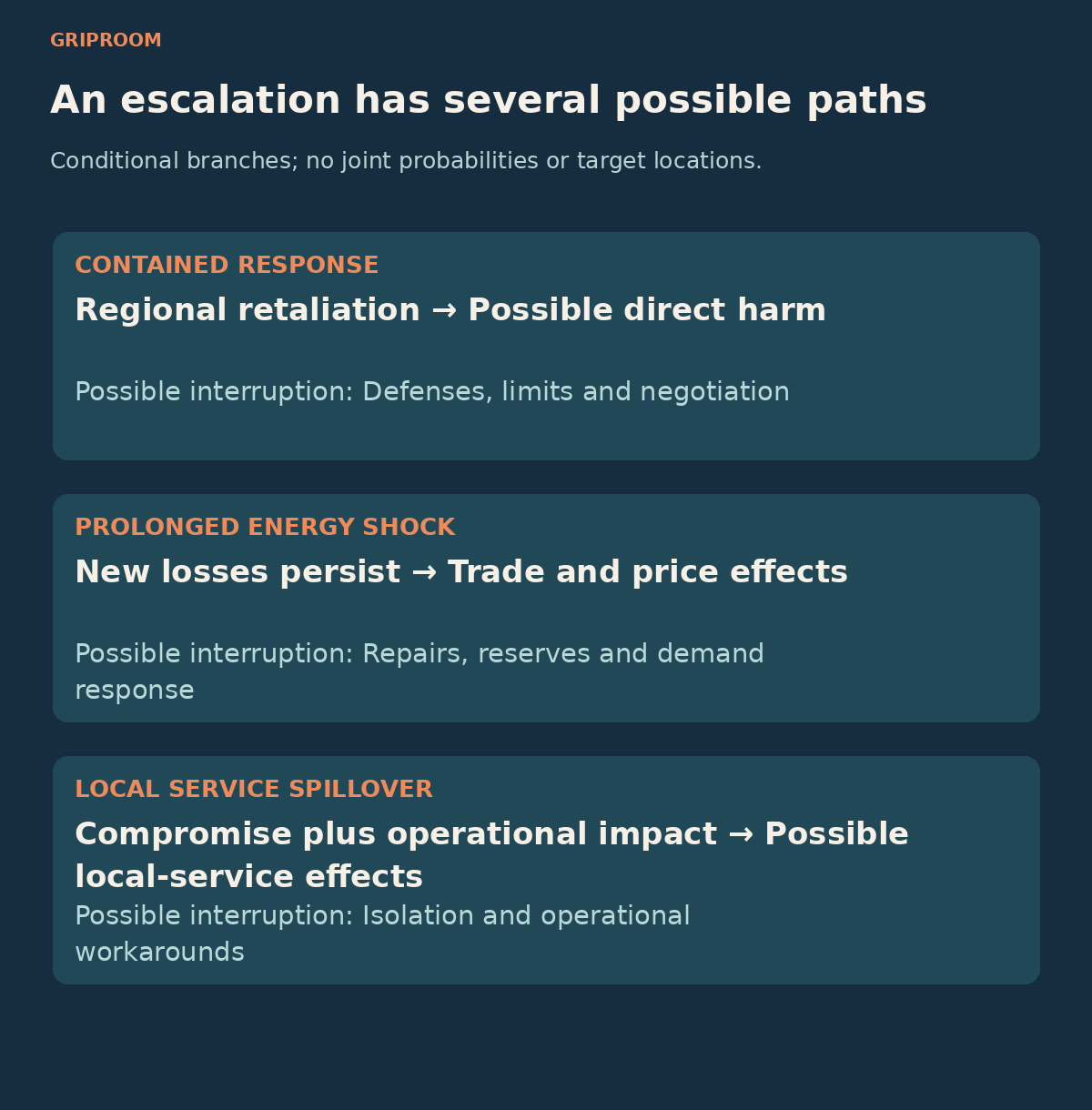
The three paths are alternatives that may interact, not events assumed to occur together. Regional retaliation depends on choices and effective delivery. A lasting energy shock requires sustained net disruption. A local cyber or service impact requires a separate successful event. Defenses, diplomacy, repair, stocks, isolation and manual operation can interrupt different paths.
Path two: energy disruption becomes harder to reverse
A sustained energy shock requires more than a threatening statement about a sea route. It requires a consequential loss of movement, production or export capacity that is not sufficiently offset by other supply and response measures.
The location of the bottleneck matters. Ships unable to move an available cargo present one problem; a damaged facility unable to produce or prepare that cargo presents another. A safe route cannot transport oil that is not available, and repaired output still needs a workable route to buyers.
EIA’s October outlook describes September pipeline disruption and partial repair. That is evidence that infrastructure and restoration matter, not a live measurement of November losses. Current shipping analysis from Braemar also distinguishes inefficient continuing movement from more persistent loss of cargo.
The worst energy path would combine sustained net losses with slow restoration and inadequate offsets. Its consequences could reach transport and other economic activity. Yet those conditions should remain visible, rather than being smuggled into a confident claim that crude must reach a chosen price.
There are interruption points. The IEA’s emergency-response framework includes stocks and demand restraint. Repair, alternative routes and a negotiated reduction in fighting can change the supply picture. These responses have limits, but their existence belongs in the scenario just as much as the damage does.
For the assumptions behind the dollar figures, see what oil at $150 or $200 would have to disrupt. A price spike, a sustained average and a household’s eventual fuel bill are different outcomes.
Path three: a local service is disrupted beyond the battlefield
Cyber activity supplies a plausible way for effects to cross distance without a missile crossing an ocean. It also supplies ample room for exaggeration.
The July 2026 joint US warning documents Iran-linked targeting of industrial-control technology and observed operational disruption. That supports a serious infrastructure-security discussion. It does not establish a forthcoming nationwide American outage, a single coordinated attack on every sector or a guarantee that drinking water would be unsafe.
A local impact requires its own successful compromise and operational consequence. The technology affected, the function it performs and the operator’s response all matter. Evidence of access is not automatically evidence of a loss of service; a loss of service is not automatically evidence of contamination.
There are demonstrated ways to interrupt the path. In a 2023 municipal incident described by CISA, the authority took the affected system offline and switched to manual operations, with no known risk to its drinking water or supply at that time. That outcome cannot be guaranteed for every utility. It does show why technical compromise and public harm should not be treated as synonyms.
The focused guide to Iran-linked water warnings examines attribution and public-health instructions in greater detail. A national headline is a poor substitute for a resident’s actual local notice.
Civilian systems can transmit harm indirectly
Some of the most serious consequences do not end at the initially damaged system. The ICRC explains the indirect effects of damage to interconnected civilian infrastructure: electricity, water, sanitation and health services depend on one another. A disruption can therefore affect people beyond the immediate impact site and beyond the first day.
This does not mean every damaged component triggers a complete cascade. Redundancy, repair, staffing and the availability of alternatives matter. It means that counting only the first broken structure can understate civilian consequences.
A sound scenario asks what service the damaged system supports and which people rely on it. It also asks what can continue operating, what can be repaired and what temporary arrangements exist. Those questions keep the account humane and specific without providing a vulnerability catalogue.
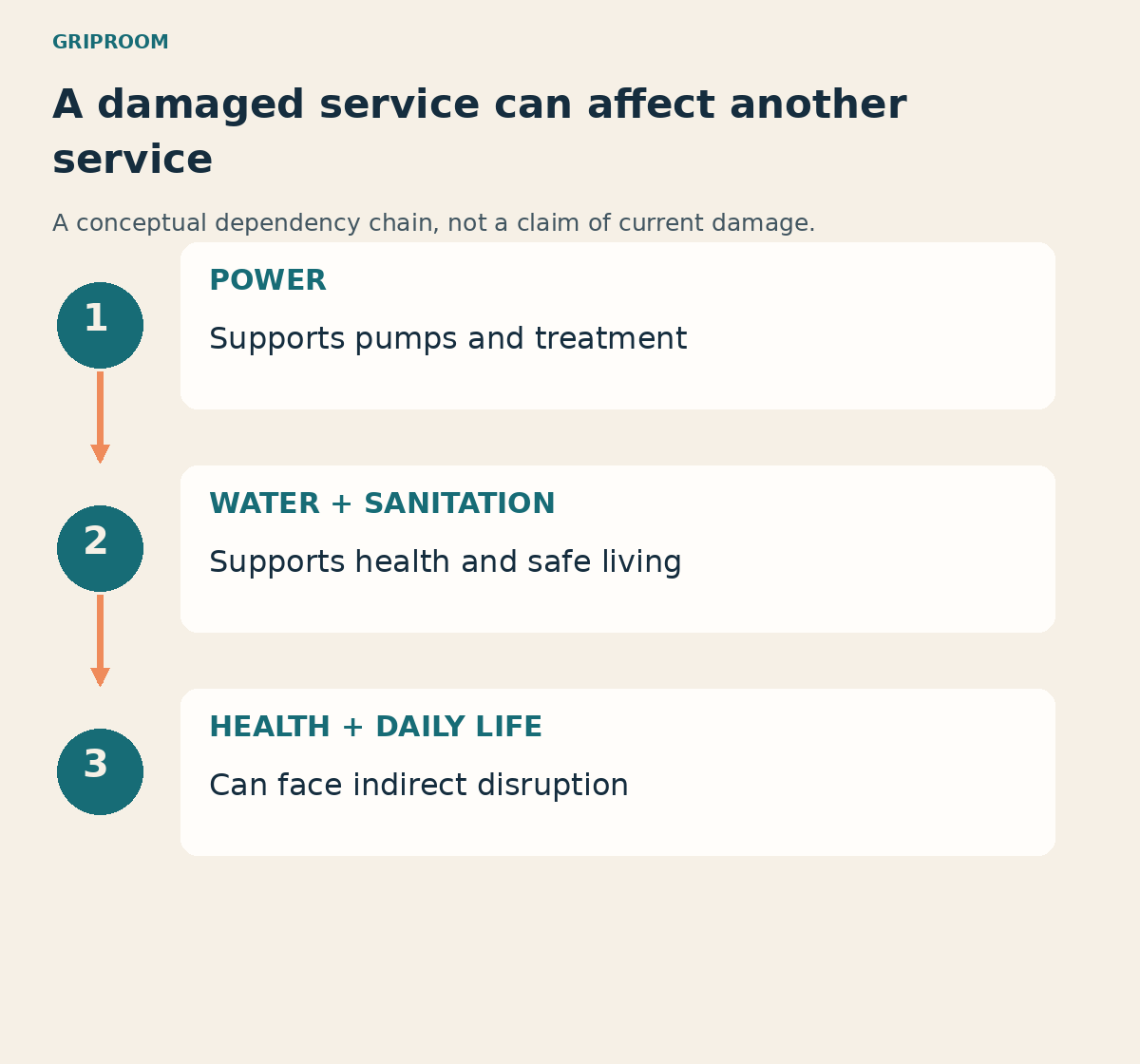
ICRC describes interconnected civilian infrastructure and the indirect effects of conflict. Power supports water and sanitation operations; these services support health and daily life. Actual outcomes depend on damage, redundancy, repair and local conditions. This is a general dependency illustration, not a map of a specific facility or a forecast of simultaneous failure.
The worst assumptions cannot simply be added together
The most alarming version of a scenario often assumes that military retaliation succeeds, energy infrastructure remains damaged, alternative supply proves inadequate, a cyber campaign succeeds elsewhere and local response measures fail. Each step may describe a possibility. Together, they form a much stronger proposition requiring much stronger support.
The paths are also connected in ways that complicate a simple sum. Several reported signals may reflect the same underlying confrontation. Several economic effects may arise from the same missing supply. Counting them as independent evidence or independent losses can inflate the story.
The opposite mistake is to select one successful mitigation and declare the wider risk solved. A contained water incident does not settle maritime safety. An oil stock release does not protect every civilian service. Different tools interrupt different paths.
What readers can usefully distinguish
The most useful updates identify a confirmed action, a specific affected service, a dated measurement or an attributable change in policy. A circulating threat or an anonymous expectation can be relevant, but its evidence level must remain attached.
For households, the difference between a broad geopolitical concern and an actual local instruction is especially important. Preparedness advice can be sensible without functioning as advance notice of a particular attack. The chronology of government food and water advice explains why some newly circulating recommendations are much older than the current confrontation.
The reason to map a worst case is to understand the dependencies: which choices, constraints and failures would have to connect before the damage spreads. Keep those conditions visible and the map becomes useful. Remove them, and it becomes a collection of frightening possibilities presented as a single future.