
November 3 has become the focal date in the Iran story because President Donald Trump has publicly ruled out another U.S. attack before the midterm elections. That puts the days afterward under intense scrutiny. The reporting leaves the decision about renewed strikes unresolved.
As of October 30, there is substantial reporting about preparations for renewed U.S.-Israeli attacks, alongside continuing mediation. The evidence supports taking the escalation risk seriously. It does not establish a launch date or turn a reported military plan into a final presidential order.
The useful distinction is between preparing an option, choosing it and carrying it out. Those steps can happen close together. They can also remain separated by negotiations, disagreements and changing conditions.

Why the midterms have become the focus
On October 22, ABC News reported that the United States and Israel had drawn up plans for renewed joint strikes, citing two Israeli sources familiar with the planning. A named White House spokesperson reaffirmed that the United States would not attack Iran before the November 3 elections.
That followed Trump's October 8 statement ruling out an attack before the vote. The immediate political significance is straightforward: a publicly stated period of restraint has an endpoint.
An endpoint is not an appointment. A commitment to refrain until election day does not identify the next target, settle the purpose of an operation or promise action the following morning.
There is another reason to define the question carefully. This is a conflict with earlier rounds of military action, rather than a choice between an untouched peace and the first shot of a new war. A September presidential notification, for example, describes U.S. strikes begun on September 1. The letter is dated September 3 and was printed September 4.
The question now is whether major attacks resume, with what objectives and consequences. The election alone cannot answer those questions.
What the preparations actually establish
The Associated Press reported on October 29 that U.S. officials had warned regional allies to prepare for possible strikes and Iranian retaliation after the elections. The diplomats cited by AP said Trump had not made a final decision. That account describes their assessment at the time; it cannot reveal subsequent private deliberations.
Planning and warnings still matter. Governments have reasons to prepare allies before a possible operation, particularly when retaliation could cross borders. The mistake is to promote a warning about a contingency into confirmation that the contingency has been chosen.
The same care applies to troop movements and embassy departures. ABC's account distinguishes some changes linked to the Houthi threat from Iran strike planning. A precaution can be serious without proving the particular theory attached to it online.
Nor should repeated headlines automatically be counted as separate confirmations. A news story may cite another outlet, repeat an official's account or describe the same underlying planning discussion. Ten versions of one report do not provide ten windows into the decision.
A report identifying a decision, an official acknowledgment and documented military action each add something different. Another account that options exist may show continued planning without establishing that Trump has chosen one.
Diplomacy remains part of the picture
Qatar's October 27 foreign ministry briefing described continuing exchanges and proposals through its mediation channel. It also called for respect for neighboring states and freedom of navigation. An active intermediary is evidence that a channel remains open; it is not evidence that either side has accepted the other's terms.
Reuters reported renewed Qatari mediation in Tehran on October 30, citing an official briefed on the talks.
Even the purpose of an outreach can be contested. In its October 29 account of Vice President JD Vance's contact with Iran, Reuters reported Trump describing it as related to medical supplies. Other reporting had characterized the outreach differently, and Reuters said it could not immediately verify those reports. Its account also recorded a senior Iranian official rejecting Qatari proposals as unacceptable ideas rather than an offer. Continuing contact therefore coexists with disagreement over what is being discussed and on what terms.
Military preparation and mediation can proceed at the same time. As an interpretation of the available evidence, that makes more sense than treating each diplomatic contact as proof that the strike option has disappeared, or each preparation as proof that negotiations have ended.
A visit, a proposal and an accepted arrangement are separate developments. An accepted arrangement would be stronger evidence of a change in course than another round of contact. Even then, its terms, implementation and acceptance by the parties would matter.
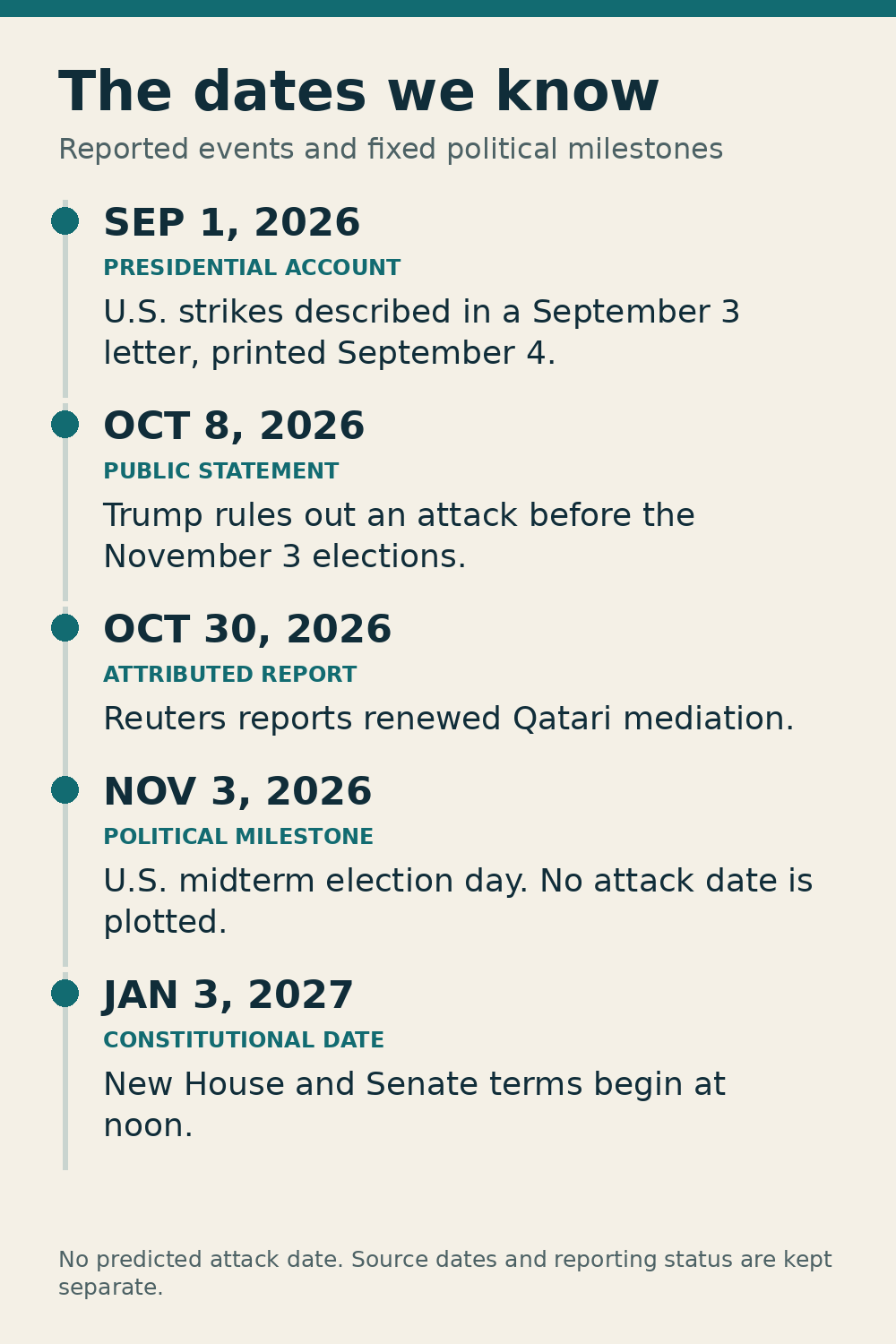
The timeline separates reported events from fixed political dates. It includes no predicted attack date.
The President's September 3 letter, printed September 4, describes September 1 strikes. Trump publicly ruled out attacks before the election on October 8; Reuters reported renewed Qatari mediation on October 30. The election is November 3, 2026; new congressional terms begin January 3, 2027, at noon. No attack date is predicted.
Three calendars are moving at different speeds
The first calendar is political: November 3 is the election date named in the public pre-election restraint. The second is military: the reporting describes preparations, but does not give the public a complete readiness assessment or a binding schedule.
The third is congressional. Under the Twentieth Amendment, new House and Senate terms begin at noon on January 3. An election result therefore does not immediately seat a new majority. The outgoing Congress retains its powers during the interval before January 3, 2027.
These calendars can be confused in ways that make a headline sound more decisive than the underlying event. “After the midterms” might refer to a political opening within days, an operational window determined later or a fight over authority and funding that continues into a new Congress.
It is also possible for military action to begin before the incoming Congress can exercise its new composition. Conversely, an incoming majority does not need to exist before the current Congress can debate, investigate or act. Election timing changes the political setting; it does not switch the entire constitutional system off and on.
What would make the next report more decisive
The Council on Foreign Relations has described escalation, negotiation and waiting as the broad options. The value of following the news is to identify movement between those options, rather than assigning every headline to an inevitable-war narrative.
A public order or an acknowledged operation would be materially different from another story about preparations. A jointly accepted diplomatic arrangement would be materially different from another visit by mediators. A new deadline would matter only alongside a clear account of who set it, what it requires and whether the other side accepted it.
The purpose of an operation would matter too. A limited objective, a wider campaign and an attempt to force political change are not interchangeable descriptions. The mere existence of a strike plan does not tell the public which objective would be authorized or whether it could be achieved.
The September presidential letter illustrates a further distinction: a government's account of what it did also contains its explanation of why it believes the action was lawful. That legal argument is the administration's position, not a court's finding about every future operation.
For now, November 3 is a useful date to watch because the White House itself made it relevant. Evidence of a decision, an operation or an accepted diplomatic change would alter what is established. The calendar identifies the period covered by a stated restraint. It cannot choose the next move.