US warnings establish that Iran-linked actors have targeted industrial-control technology and caused operational disruption. Reporting also describes links between an Iran-affiliated campaign and Minnesota water incidents. The evidence needs careful separation: a broader federal attribution, a state’s incident statement and a journalist’s account of an obtained memo are different records.
None of those records, by itself, establishes poisoned tap water or an impending nationwide outage. For a resident, three questions remain distinct: was a control system compromised, was service interrupted, and was the water unsafe? The answer to one cannot simply be copied into the next.
The incidents are serious enough without collapsing those distinctions. Losing reliable control or monitoring can require a consequential operational response even when an operator preserves delivery and water safety.
What the joint warning documents
The July 22 update distributed by CISA and federal partners describes Iran-linked targeting of internet-connected industrial controllers. It records disruption across water, energy and municipal contexts. It is evidence of observed activity, not merely a hypothetical capability.
Its date also matters. A July update is not a newly issued warning that an attack will occur this weekend. The document can establish a continuing research concern without revealing a new operational timetable.
Joint authorship should not be mistaken for several independent discoveries of the same event. A CISA, FBI and partner advisory is one shared warning with a shared evidentiary origin. Counting each agency’s name as separate confirmation would make the evidence look larger without adding a new observation.
Minnesota requires its own attribution record
Minnesota IT Services’ July 30 statement describes technology affected at more than 30 water systems. That does not mean 30 separate public water outages. The statement leaves attribution unresolved and says there were no active requests to change public water use at that date.
Reuters’ July 28 reporting includes a state spokesperson retaining attribution limits. Its July 30 follow-up reports federal descriptions of operational effects and expert assessments of likely Iranian links. Those are additional reporting, with their own sources and qualifications.
WIRED reports obtaining a WaterISAC memo connecting the Minnesota incidents to an Iran-affiliated campaign. The underlying memo was not obtained independently for this article. That makes the link a substantive reported finding, while limiting what we can authenticate directly.
These accounts should appear together. Leaving out the memo reporting would understate the public case for a connection. Treating it as a directly inspected final government attribution would overstate the reporting available here. The narrower conclusion is both more accurate and more useful: there are reported Iran links beyond mere timing, while the inspected state statement retains uncertainty.
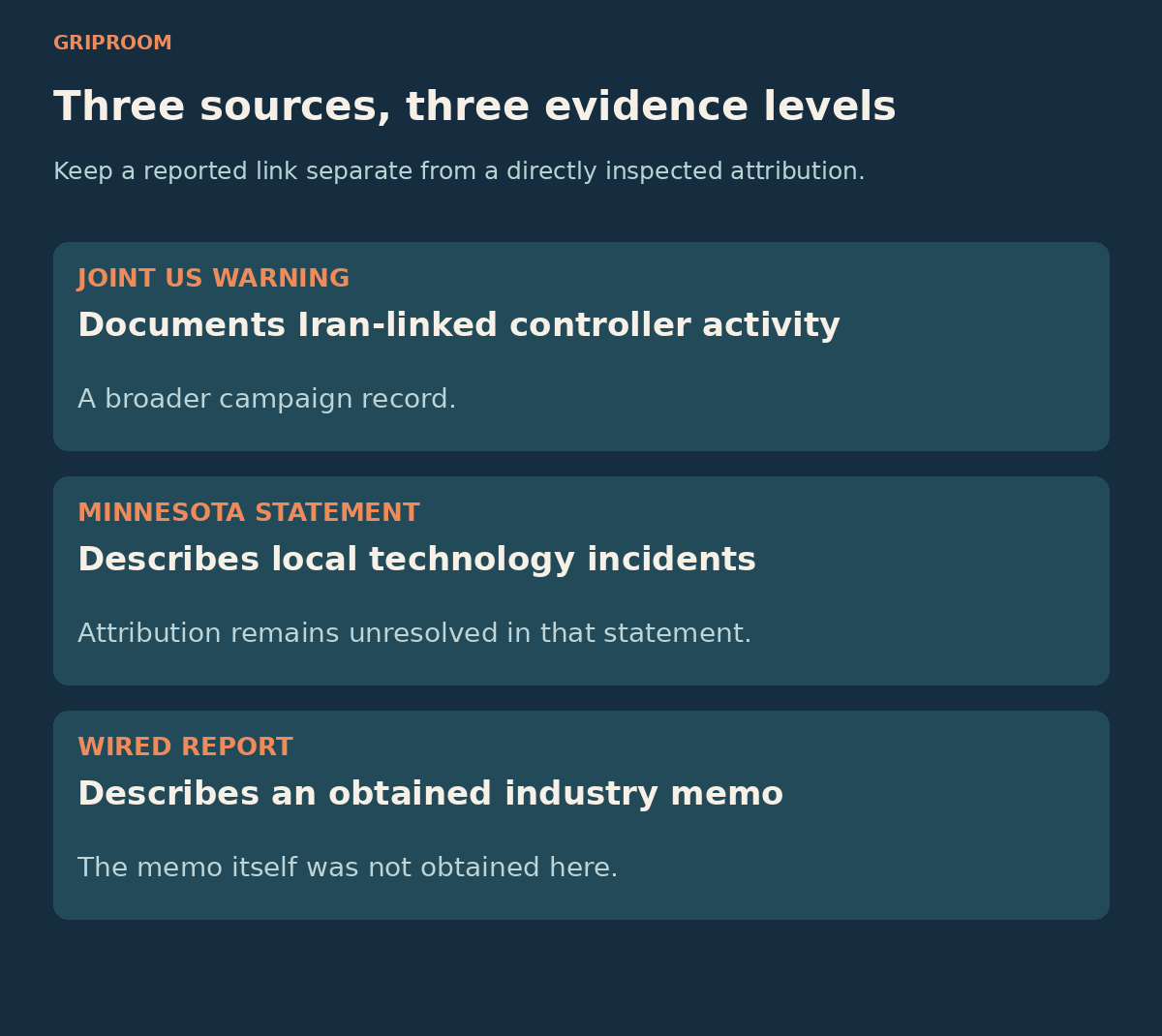
The July 22 joint warning identifies Iran-linked industrial-control activity. The inspected July 30 Minnesota statement leaves responsibility for its local incidents unresolved. WIRED reports that a memo links those incidents to an Iran-affiliated campaign; the underlying memo was not independently obtained for this article. These are related but distinct records.
Control, delivery and quality are separate outcomes
A compromised controller concerns the technology used to operate or monitor a process. A service interruption concerns what residents receive. A water-quality problem concerns whether that water is safe for a particular use.
Those categories can interact, but none is an automatic consequence of the preceding one. An operator can isolate affected equipment, change procedures or preserve service through a workaround. An interruption can also be serious without evidence of contamination.
The difference is visible in an older case. In CISA’s November 2023 municipal incident account, the authority took the affected system offline and switched to manual operations. CISA reported no known risk to drinking water or supply at that time. That is one documented outcome, not a guarantee that every operator could achieve the same result under every condition.
For news readers, the words “affected” and “disrupted” therefore need an object. Was a screen unavailable? Was remote monitoring impaired? Did the plant change procedures? Were customers without water? Was a public-health notice issued? An article that identifies the outcome answers a question that the word “hack” alone leaves open.
The actual local advisory determines what to do
The CDC distinguishes boil-water, do-not-drink and do-not-use advisories. Follow the current instructions from the local utility and public-health authority; the response depends on the hazard and the uses specified.
A boil-water notice gives treatment instructions for the situation it addresses. A do-not-drink notice is different, and boiling does not remove chemical hazards. A do-not-use notice can restrict activities beyond drinking. Use the notice’s instructions for the activities it covers, rather than assuming one response fits every hazard.
The operational distinction also matters in the other direction. A report that a utility is working manually is not an instruction for every resident to stop using water. Look for an actual local notice describing the affected area and permitted uses.
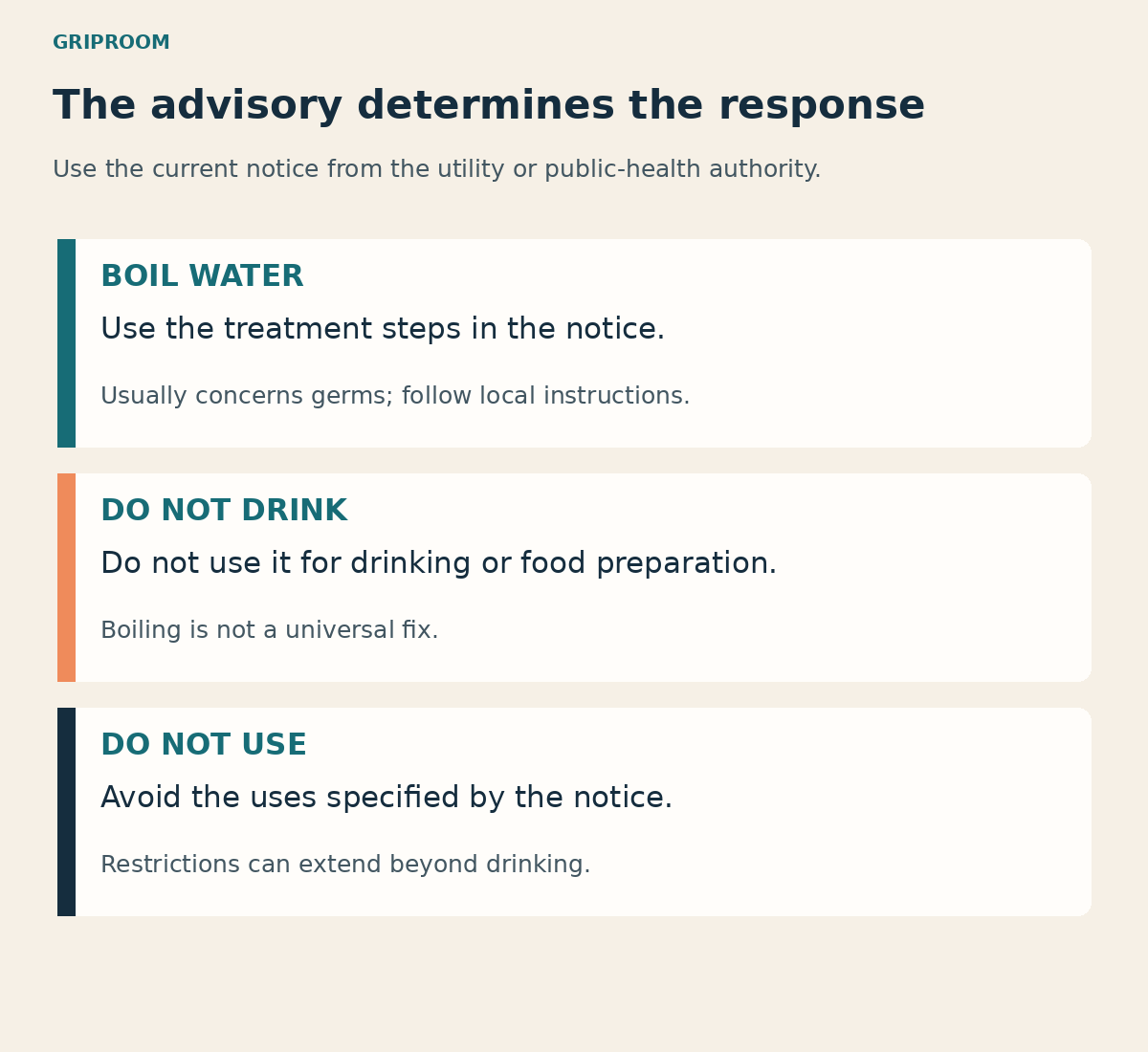
CDC distinguishes boil-water, do-not-drink and do-not-use advisories. Follow the precise current local notice. Boiling may be appropriate for a boil-water advisory, but it does not remove chemical hazards and is not a substitute for do-not-drink or do-not-use instructions. Restrictions and permitted activities depend on the notice.
Preparedness does not require a poisoning theory
People can reasonably plan for a temporary service interruption without assuming that an adversary has contaminated their local supply. Reliable access and water quality are both important, but they are different practical problems.
The same separation should guide how a household reads a developing story. Start with the location, date and service named in the official notice. Then establish the response requested. Broader geopolitical attribution may remain unresolved longer than the immediate operational instructions.
That is particularly relevant when an older incident circulates beside a new political threat. The combination can make the older account feel like a warning about an event that has not occurred. Preserve the original incident date and check whether the local authority has actually issued a new notice.
For the wider context, the Iran retaliation scenario guide treats local cyber effects as one conditional path among several. It does not assume a coordinated national shutdown. The government preparedness chronology likewise distinguishes practical advice from evidence of a specific forthcoming attack.
The strongest useful conclusion is bounded
The federal advisory supports a concrete concern about Iran-linked industrial-control activity. Minnesota’s public statement supports a concrete account of affected technology with attribution limits. The independent reporting strengthens the discussion of a possible connection and must be attributed accurately.
The next claim needs its own evidence. A definitive attribution should identify the source making it and the incidents it covers. A service-outage claim should establish the actual interruption. A water-safety claim should cite the relevant public-health finding.
Those are not technical niceties. They determine what readers believe has happened and what they decide to do. A well-sourced account can explain the threat, preserve the real uncertainty and point people toward the instructions that apply to them—without converting a compromised device into a claim that every tap is dangerous.