Some government preparedness appeals really are new. Japan issued a request on November 2, 2026, and the UK launched a household campaign in October. That does not make every recommendation inside those appeals new, or establish a shared warning about an approaching Iran attack.
The original documents show several different stories: new outreach, older stockpiling advice, revised security guidance and campaigns planned before this weekend became a subject of speculation. Reading their dates separately changes what the apparent pattern can support.
Preparedness can be sensible while the proposed connection remains unproven. A cupboard of supplies is useful for disruption; it is a poor instrument for reading a secret military calendar.
Japan’s November 2 request is genuine new outreach
Japan’s official November 2 preparedness request accompanied the launch of its new disaster-management agency. It asks people to consider home safety, supplies, hazard information and evacuation arrangements. This is an actual request, rather than a plan that had yet to happen.
There is also an advance record. At the October 27 ministerial press conference, officials discussed the coming agency launch and the planned request. That places its preparation before the launch itself. It does not reveal every private consideration behind government policy, but it prevents an announced campaign from being presented as an unexplained last-minute signal.
The food-and-water baseline is older. An earlier agriculture-ministry feature already recommends at least three days of supplies and preferably a week, referring to a household guide produced in 2014. A fresh appeal to follow an existing recommendation is a change in outreach, not automatically a change in the recommended amount.
This is also why the word “emergency” needs context. In this case, the surrounding official request concerns disaster preparation, including household and evacuation measures. Its title alone cannot establish that officials are communicating advance knowledge of a particular foreign military operation.
Britain’s new campaign has a visible history
The UK Cabinet Office’s October 22 announcement begins a three-year household preparedness campaign. It describes practical steps for disruption to everyday services and highlights severe weather. It also says the government learned from European peers and that much earlier advice remains unchanged.
A ministerial statement to Parliament traces the intention to launch the campaign to July 14. New October messaging is therefore compatible with an earlier planning process and an existing preparedness baseline.
Peer learning is an important part of the apparent international pattern. Several governments offering similar advice need not have reached that advice independently, much less received the same secret military deadline. The UK explicitly describes borrowing experience from other countries.
That does not mean the October campaign is imaginary or irrelevant. It means the specific novelty is the campaign and its delivery, while the original announcement explains a broader resilience purpose.
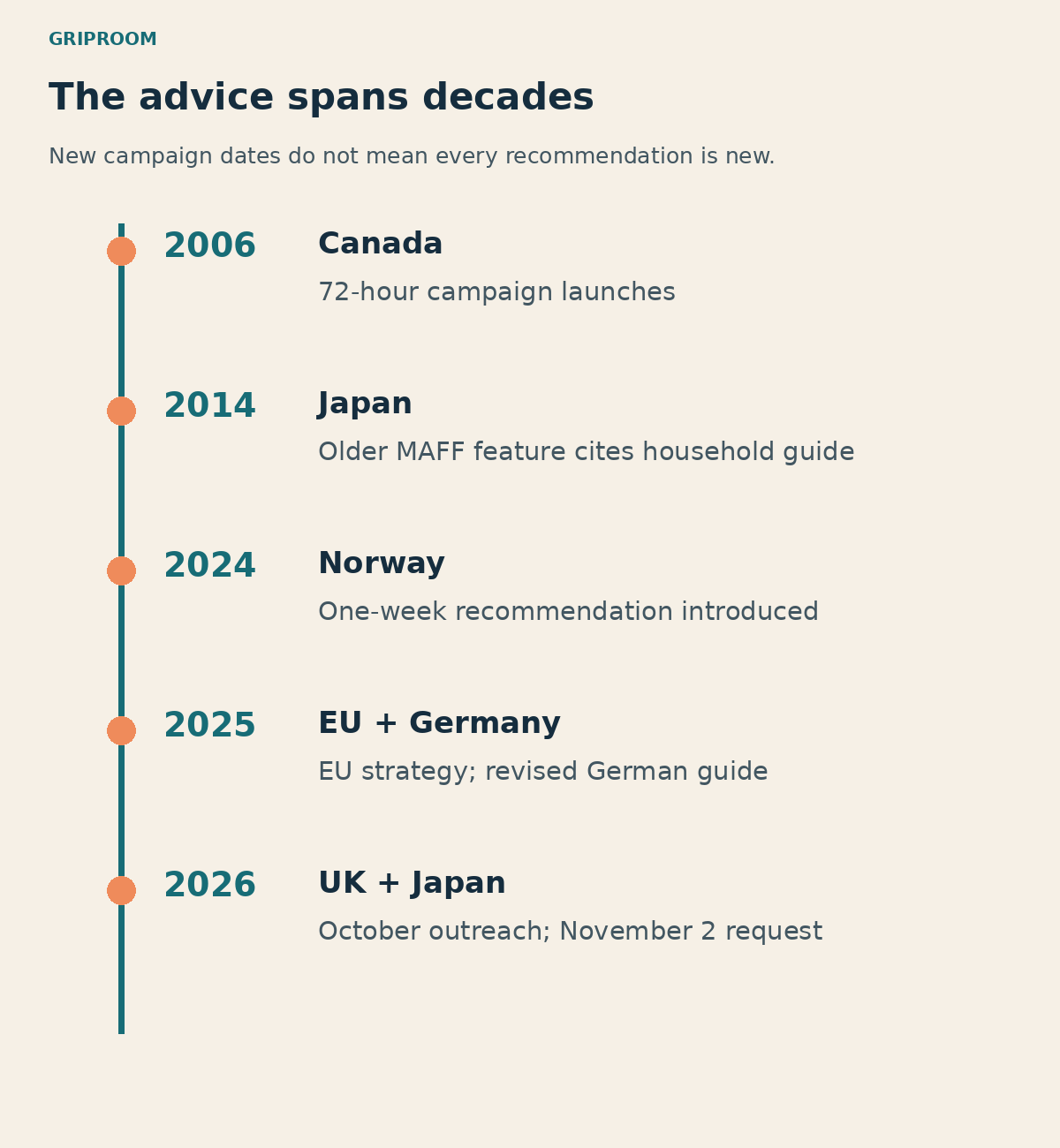
Canada launched its 72-hour campaign in 2006. An older Japanese MAFF feature references a 2014 household guide. Norway’s one-week advice dates to May 2024. The EU strategy and revised German guide launched in 2025. The UK’s October 2026 campaign and Japan’s November 2 request are recent outreach, with advance planning records. This chronology does not establish a shared Iran timetable.
Some widely shared programs are much older
Canada’s familiar 72-hour message has a long public record. Public Safety Canada announced the campaign’s launch on May 8, 2006. A later date in the archived webpage’s metadata is not the date that the recommendation began.
Norway’s civil-protection authority traces its preparedness campaign to 2018 and the move to a one-week recommendation to May 2024. That history matters when a newly shared screenshot makes the advice appear to have arrived alongside this week’s news.
The European Commission’s preparedness strategy dates to March 2025 and includes at least 72 hours of household self-sufficiency within a broader approach to hazards. It was not first issued in the days before the coming weekend.
Germany supplies a useful warning against calling every revision routine. The BBK launched a substantially revised guide in October 2025. It retained familiar emergency-preparedness material and added content addressing newer challenges, including protection around explosions and disinformation. Those are substantive additions. The same launch page links to a guide edition carrying a 2026 publication date, which is a different date from the campaign’s launch.
The comparison therefore cannot be reduced to “all new” or “all old.” Countries can have longstanding household-supply advice and still make meaningful changes in response to security concerns. The right question is what changed in the actual document.
Three dates can be hiding on one page
A circulating preparedness notice may have a campaign-launch date, a history for the underlying recommendation and a latest revision date. Each answers a different question.
The launch tells readers when a new appeal began. The recommendation history shows whether the practical instruction is longstanding. The revision date can indicate a small webpage edit, a new edition or a substantive policy change. Reading only the most recent date can erase the other two.
The reverse mistake is possible as well. Finding an old recommendation does not prove that a current update contains nothing new. Germany’s added topics illustrate why the content of a revision deserves inspection rather than dismissal.
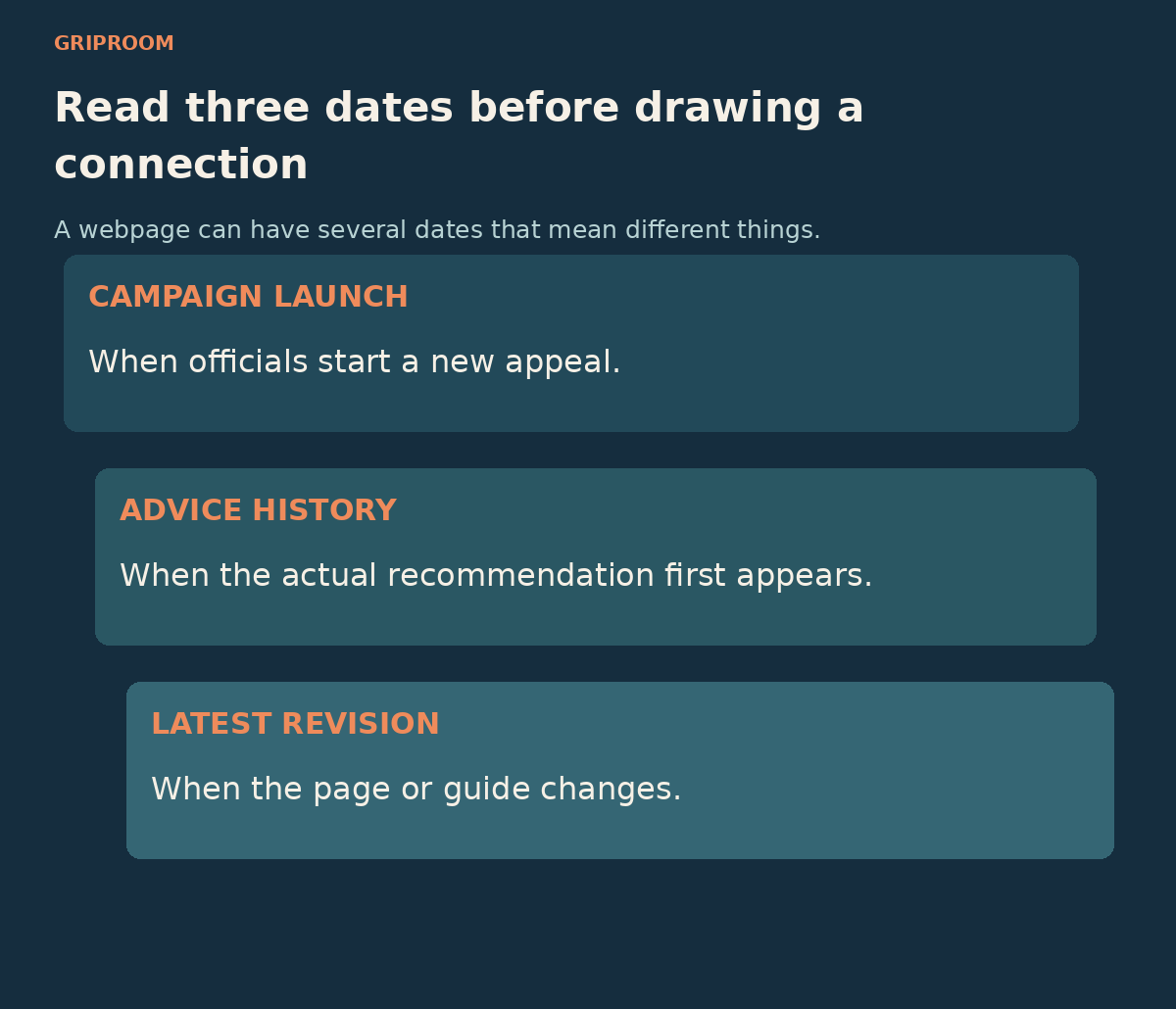
Compare the date of a campaign launch with the history of its recommendation and the current document revision. Canada’s launch differs from later page metadata; Germany’s2025 guide launch differs from a linked2026 edition. A date change alone neither proves a new threat nor proves that nothing material changed.
What would establish a specific Iran connection
The inspected notices do not identify a common Iran attack timetable. They support specific findings about their own programs and stated purposes. They cannot establish what every official privately knows.
A stronger linkage would need more than several countries recommending water and shelf-stable food. It would need specific evidence connecting the notices to the same event: an attributable statement, a document explaining that connection or credible reporting with a clearly described basis.
Timing alone is weaker when recommendations span years, campaigns were announced in advance and governments explicitly learn from peers. The repetition is worth examining. Its explanation must still fit the records.
For the separate question of possible renewed strikes, see what the current Iran signals actually show. For the consequences if a larger operation occurs, the conditional retaliation map separates regional, energy and service effects. Household guidance should not be asked to answer all three questions at once.
Useful preparation does not depend on the theory
The practical value of being ready for an interruption survives uncertainty about its cause. The notices themselves discuss supplies, planning and resilience. Following appropriate local advice does not require believing that several governments are quietly announcing the same war.
For readers sharing a warning, the most useful addition is often its original date and context. Identify the country, the actual request, the launch history and the current instructions. A newly discovered notice is not necessarily a newly issued notice.
Japan’s completed November 2 request and Britain’s October campaign deserve accurate coverage as new outreach. Canada, Norway, the EU and Germany deserve their own chronologies. Those distinctions leave readers with a clearer answer than either an invented coordinated alarm or a blanket assurance that nothing has changed.