
The public evidence available on November 5, 2026 supports a serious possibility of further escalation between the United States and Iran. It does not establish a new US attack on the weekend of November 7–8. Military activity, threatening statements and negotiations are occurring in the same confrontation. A date attached to an aviation notice cannot settle what the president has decided.
That distinction matters because the most interesting question is also the least visible one: has Washington moved from keeping military options available to ordering a particular operation? The inspected public records illuminate the surroundings of that decision. They do not include an authenticated attack order.
There is still plenty worth investigating. The useful approach is to ask what each observation actually measures before combining several observations into a countdown.
The confrontation is already active
This is not a choice between perfect peace and the first shot of a new war. AP reported limited defensive US strikes on November 2, alongside continuing diplomatic efforts. A renewed major campaign would be a different development, with different consequences, from another limited action within an existing conflict.
The distinction can disappear in a short social-media post. A report that US forces have acted becomes evidence that a much larger operation must be imminent. Yet the first fact does not automatically establish the second. Scope matters: what happened, where it happened and whether the action was described as defensive or part of a broader offensive.
Nor does continued shipping danger depend on a new American decision. Reuters reported fresh maritime incidents on November 5 and cited anonymous sources expecting further US strikes. Those accounts are substantive reasons to take escalation seriously. They remain attributed reporting, rather than an authenticated order or a confirmed date. The same report also described continuing mediation.
A NOTAM needs its actual text
An aviation notice can be genuine, consequential and still tell a reader much less than a circulating interpretation suggests. A validity period is not necessarily a continuous closure. A daily schedule, route restriction, altitude band, replacement notice or cancellation can change what the dates mean.
The reported Iraqi November 7–11 notice has not been authenticated for this article. We have not obtained its original issuing-authority record with the complete fields and revision history. That leaves its precise applicability, novelty and purpose unresolved. Repeating a notice number without its issuer and airspace context does not repair that gap.
There is a separate, verifiable aviation document: EASA’s Iraq conflict-zone bulletin. Its July issue and September revision predate the coming weekend. It supports the existence of aviation hazards in a conflict zone. It is not the alleged new Iraqi notice, and it cannot be substituted for that notice simply because both concern Iraq.
For readers, the practical test is straightforward. Before treating a notice as a military clue, establish what it actually tells aircraft operators to do. Only then ask whether the instruction is unusual and whether the suggested explanation is supported.
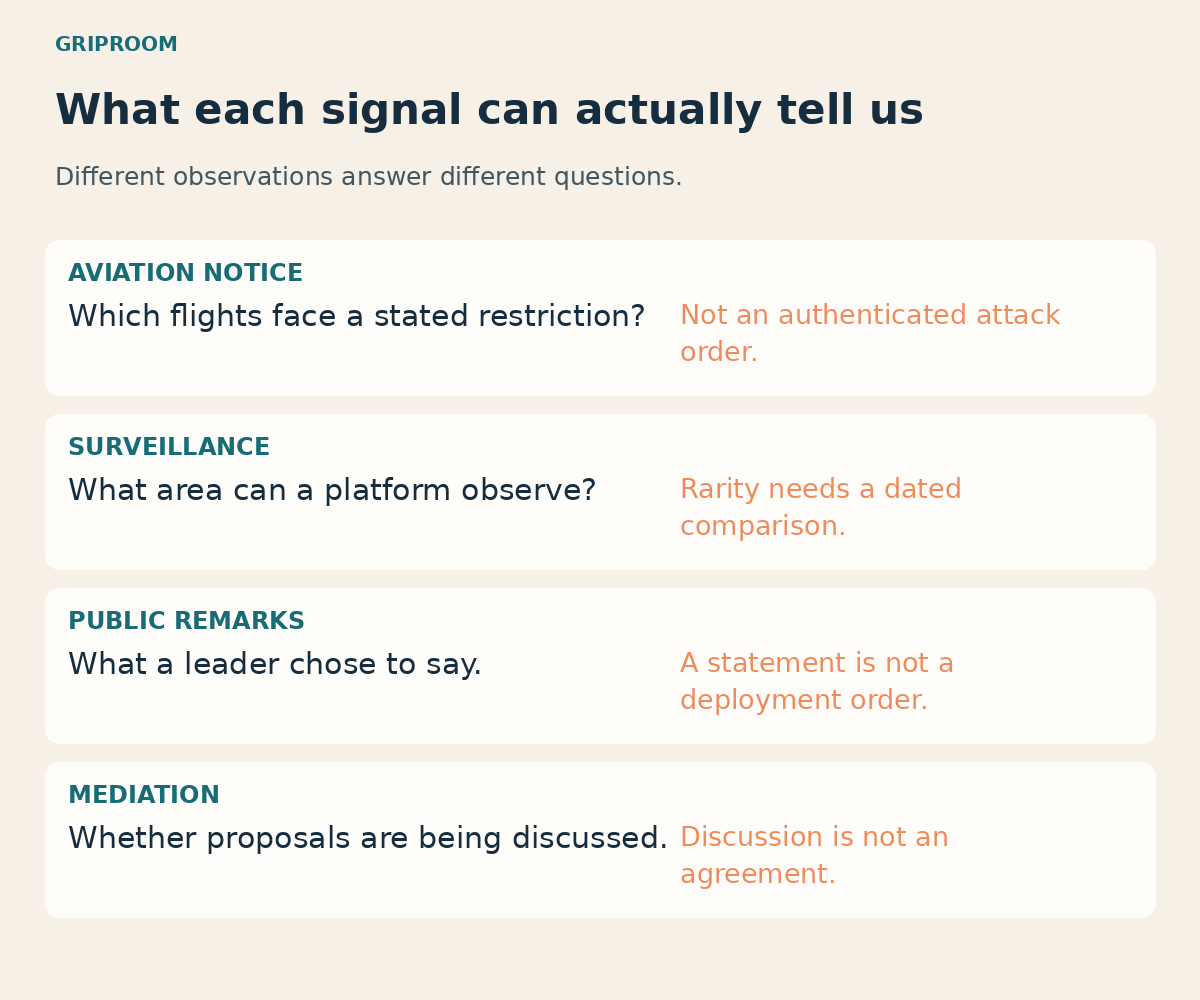
Aviation notices concern flight conditions; surveillance concerns observation; public remarks show a stated position; mediation shows discussions. None of these categories alone establishes an attack date. The specific Iraqi notice and claimed unusual drone overlap remain unverified.
Two surveillance aircraft are an observation, not yet an anomaly
The claim that two MQ-4C Tritons operated around the same time raises a reasonable research question. It does not answer that question merely by being described as rare.
NAVAIR describes the Triton as a persistent maritime intelligence, surveillance and reconnaissance platform. Its regional surveillance role did not begin with this weekend’s discussion; the service describes a CENTCOM orbit established in fall 2024. Watching an important sea route is therefore consistent with an existing mission.
To establish an unusual current pattern, a researcher needs the original flight records, reliable dates and comparable observation periods. Two aircraft appearing on one day could reflect expanded coverage, overlap between missions or another explanation. Those are hypotheses to test. The specific pair’s provenance and historical rarity have not been established here.
There is also a difference between seeing an aircraft and seeing the full mission. An incomplete public tracking record cannot by itself establish all aircraft present, every task assigned or the reason for an overlap. The strongest argument would compare like with like, rather than compare one memorable screenshot with a hazy memory of quieter days.
Diplomacy is part of the evidence
On November 3, Qatar’s foreign ministry described continued efforts to bridge differences between Washington and Tehran. On November 5, Reuters reported that a senior Iranian official said a new proposal had been transmitted through Qatar. Neither establishes a completed agreement. Together, they show why a military-only interpretation leaves out relevant public evidence.
Talks do not guarantee restraint. Governments can negotiate while preserving military options, and a proposal may fail. But the existence of talks also cannot be dismissed automatically as camouflage. That claim would need evidence of its own.
Reported November 5 remarks by Trump left a further decision open. Such statements deserve attention, but they can serve several purposes, including pressure on an opponent and reassurance to an audience. They should be read alongside actions and documents, rather than promoted into a private operational instruction.
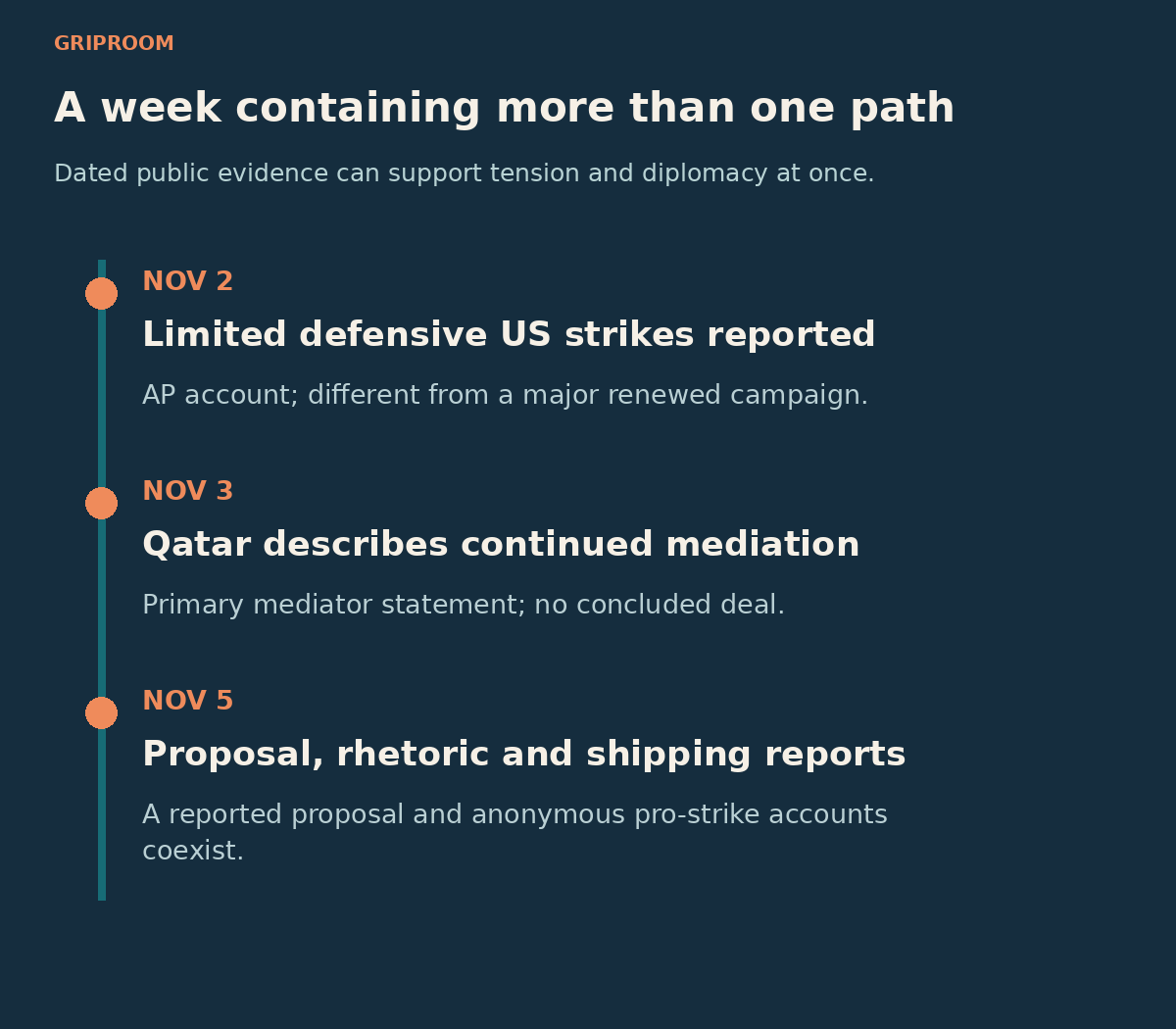
AP reported limited defensive action on November 2. Qatar described mediation on November 3. November 5 reporting included a proposal, military rhetoric, shipping incidents and anonymous expectations of more strikes. These records do not establish a new attack order or date.
Election demeanor is an especially weak military clock
A politician accepting an election result calmly can feel surprising when a reader expected confrontation. The surprise is real; the military inference is not established by it.
AFP reported Trump’s acceptance of the result alongside political blame and discussion of Iran. A later White House pool account also recorded an election-fraud allegation concerning Alaska. Public behavior is more mixed than a single calm clip suggests, and the pool account itself asks readers to verify quotations against a transcript.
More fundamentally, no validated relationship has been established here between a president’s visible mood after an election and the timing of an Iran order. Treating calmness as a coded warning invites an interpretation that can survive almost any outcome. Anger could be called a warning, too. A useful indicator needs some way to distinguish the alternatives.
What would make the evidence stronger
An authenticated original notice would resolve what the aviation restriction actually says. A dated, comparable flight history could establish whether the surveillance pattern changed. An on-record announcement, attributable reporting about an order, or an observed major action would address the military decision more directly.
Even those records would need their proper scope. A precaution can be justified by uncertainty. A deployment can support more than one mission. A reported plan can change before execution. None should be read as a promise that nothing will happen; none automatically reveals the exact weekend, either.
For the consequences of a larger operation, the more useful next question is how retaliation and wider disruption could unfold. That analysis can be conditional and concrete without pretending to know the decision inside the room. The public record can support a serious warning about uncertainty. It cannot turn missing information into proof of a hidden timetable.