A water-utility cyber incident can put a household’s most ordinary routines in doubt: drinking from the tap, cooking dinner, brushing teeth and cleaning up afterward. The useful first question is what the incident has actually changed for the water reaching that home.
Compromised equipment, interrupted water service and a warning about water quality are different situations. Some attacks may be contained before customers lose service. Others can interfere with the operation or monitoring of equipment. The household response should follow the utility’s actual instructions, with stored safe water available to cover immediate needs.
That is a more practical way to understand the risk than treating every report of a hacked device as proof that the tap water is contaminated.
What the documented incidents establish
In its July 30, 2026 update, Minnesota IT Services described malicious activity involving technology at more than 30 community water systems. It specifically cautioned that technology being affected did not mean every community had experienced a water-service disruption.
The state said there were no active requests for residents to modify drinking-water use at that time. It also left attribution unresolved. Both details belong to that dated update; neither provides current clearance for a reader’s local water supply.
A CISA bulletin from November 2023 describes another important outcome. A municipal authority took affected control equipment offline and switched to manual operation, with no known drinking-water or supply risk in that case.
These accounts show why the consequences have to be investigated separately from the intrusion. The fact that unauthorized activity reached a system is serious. It still leaves questions about which functions were affected, how operators responded and what happened to customers.
The physical system still needs trustworthy control
Water infrastructure includes physical equipment and the systems used to control or observe it. CISA describes controllers involved in functions such as pumping, chemical dosing and alarms. Interference with those functions can require operators to check equipment, change operating arrangements or interrupt a process.
Manual operation can help preserve service, as the municipal example shows. Its existence is not an assurance that every utility can continue every function indefinitely after every kind of failure. The relevant evidence is how a particular system is operating under the conditions it actually faces.
For a household, this creates two separate concerns: whether usable water is available, and whether the information about its permitted use is reliable and current. A restored computer screen or an announcement that an investigation is progressing does not answer every operational question by itself.
This is where safety checks matter. They are checks and decisions by the utility and public-health authorities about their system and the applicable restrictions. A household should not try to replace that assessment by deciding the water looks ordinary.
Match the response to the actual notice
The CDC distinguishes three types of drinking-water advisory. A boil-water advisory addresses germs and provides instructions for using bottled or properly boiled water. A do-not-drink advisory calls for an alternative for drinking and food preparation; boiling does not make harmful chemicals or toxins safe. A do-not-use advisory means not using tap water for any purpose while the restriction remains in effect.
The local notice supplies the instructions that apply. Do not choose a boiling response simply because the news report contains the word “cyberattack.”
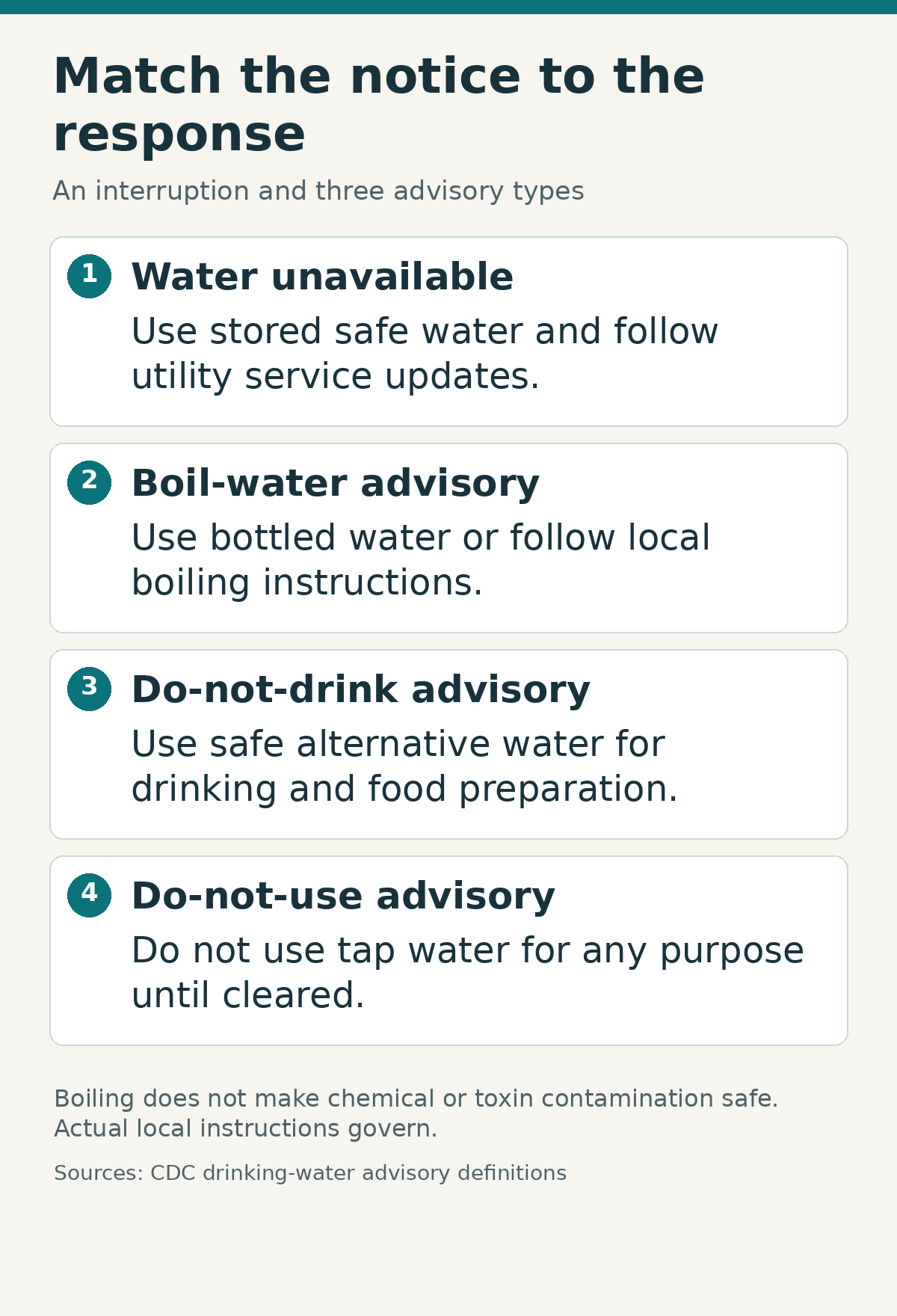
The graphic separates unavailable water from boil-water, do-not-drink and do-not-use advisories. The notice determines the restrictions; boiling is not a remedy for chemical or toxin contamination. An outage alone does not identify a contaminant.
A restriction can make familiar routines less straightforward even when water still comes out of the tap. Read the activities addressed in the notice instead of assuming that an instruction about drinking automatically settles every question about cleaning or other uses.
Keep safe water for the interruption you have to manage
The CDC’s US emergency-water guidance starts at at least one US gallon per person per day for three days, with a two-week supply if possible. It identifies additional needs, including pets, illness and hot weather. A household’s supplies should reflect the people and animals who actually depend on them.
The guidance is a storage baseline, not an estimate of the next cyberattack’s duration. Three days of preparation does not mean a utility has promised to restore service within three days, and a larger reserve does not establish that a longer interruption is expected.
Unopened commercially bottled water is the CDC’s preferred reliable emergency source. Observe its dates. If filling containers at home, use suitable food-grade containers and follow official cleaning and storage instructions; the CDC advises replacing home-filled water every six months. Containers formerly used for toxic chemicals are unsuitable.
The household planning question is how to make that supply usable. Know where it is, check what needs replacement and account for what your household may need to do while tap-water use is restricted. A collection of containers that nobody can locate or access quickly is a less useful reserve.
Space and cost are real limits. Building a reserve gradually within those limits is a more workable plan than treating the largest possible stockpile as a test every household must pass immediately.
A longer interruption would put more pressure on alternatives
The household burden depends on duration and on the options that remain available. Stored water can cover immediate needs while people obtain current instructions or arrange a safe alternative. It does not remove the need for a continuing supply during a longer disruption.
Buying more water is itself an access task. Someone has to find an operating seller, reach it and complete the purchase. A household with limited transport or difficulty carrying containers faces a different problem from one with an easily accessible alternative.
This is why water preparedness belongs with food and payment preparedness. Each reserve can reduce the urgency of a different purchase or service need. The combination can provide more flexibility, although it does not make any household independent of the surrounding community.
A severe scenario would involve a sustained service problem or use restriction together with limited practical alternatives. That is a conditional description of how hardship could grow. The Minnesota and CISA accounts do not provide a national probability for that outcome or a reason to assume it is occurring in a reader’s town.
Check the source of the instructions before changing your routine
During an incident, establish which notice applies to your address or service area, when it was issued and whether a newer instruction has replaced it. Use the utility’s established contact information or the relevant public authority’s own updates. An old screenshot may accurately describe an earlier phase while missing a later change.
Keep the operating-status update and the water-use instruction separate in your reading. A report that a digital service has returned may be useful progress without telling you that every restriction has been lifted. Conversely, a precautionary operating change does not automatically mean households have been told to stop drinking their water.
When service or permitted use changes again, read the restoration instructions rather than assuming that running water alone settles the issue. Follow any actions the utility specifies for its system and your situation. Do not improvise a universal flushing, boiling or treatment procedure from a general article.
If you cannot obtain or manage the supplies the notice requires, contact the utility or local public authority for the options and assistance information available in that incident. A preparedness plan can include knowing how to obtain help, as well as what fits in a cupboard.
The connection to government advice about household reserves is concrete. A short reserve buys time while the service problem is understood and addressed. The safest response still depends on what the responsible authorities say about the water you would actually use.
Sources