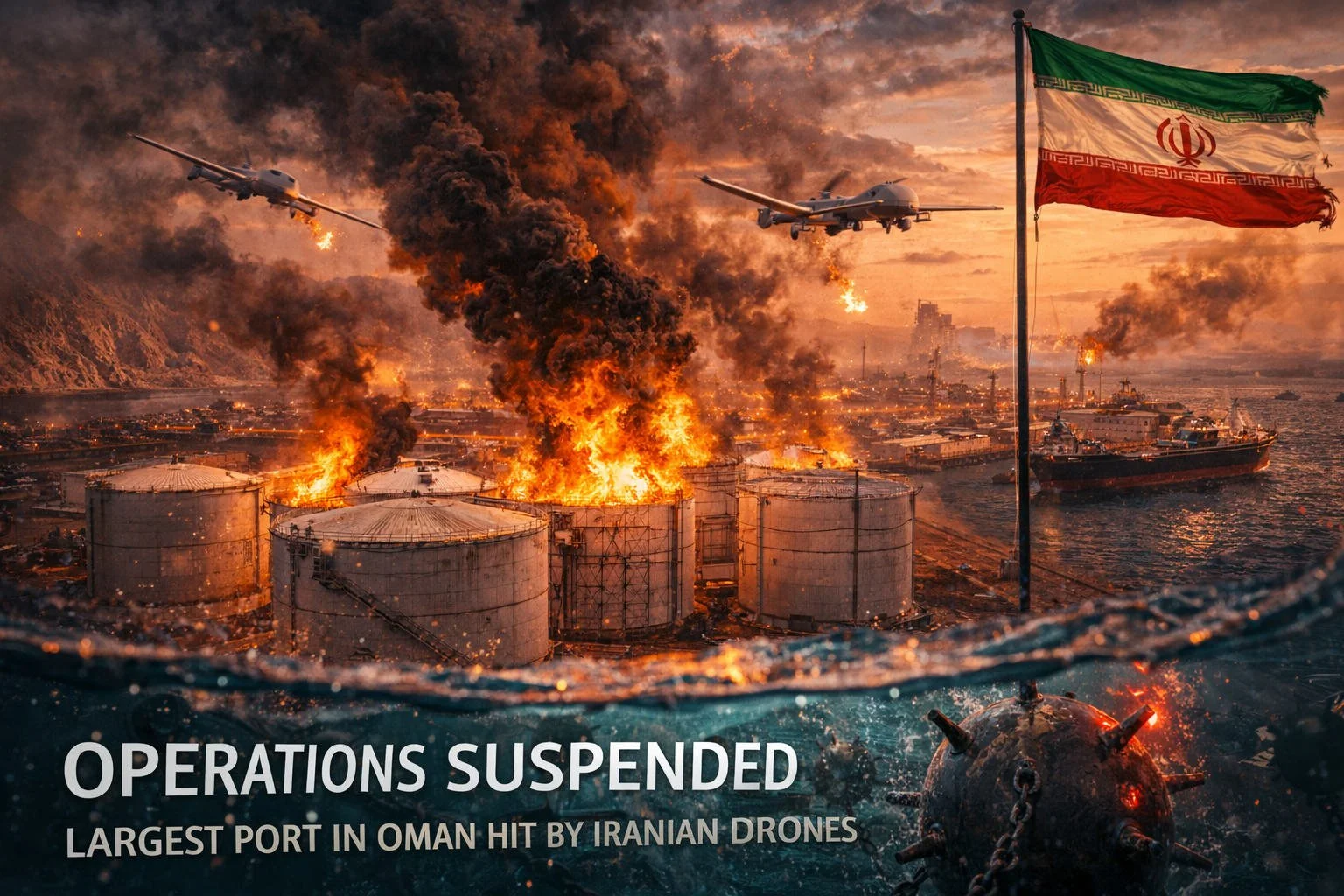
Operations at Oman’s Salalah port were disrupted on Wednesday after drones struck fuel tanks at the facility, widening the war’s pressure on Gulf energy and shipping infrastructure. Reuters reported that oil storage facilities at Salalah were hit, citing maritime security firm Ambrey and Omani state media, while Maersk said it had paused all operations at the port until further notice in response to an ongoing incident near the general cargo terminal. Bloomberg separately reported, citing Inchcape Shipping Services, that operations at the port’s container and general cargo terminals were suspended.
The strike matters because Salalah is not a marginal coastal outpost. It is one of Oman’s most important maritime hubs, sitting on the Arabian Sea outside the Strait of Hormuz and serving as a major commercial gateway for cargo and fuel movements. That makes it especially significant in a war where traders, shipowners, and governments are already scrambling for workarounds as traffic through Hormuz collapses and fuel infrastructure elsewhere in the Gulf comes under attack.
So far, the immediate damage appears to be concentrated on fuel storage rather than on ships themselves. Reuters said no damage to merchant vessels had been reported at Salalah, and Omani state media said there had been no disruption to the continuity of oil supplies or petroleum derivatives inside the country. That distinction is important: this does not yet look like a crippling blow to Oman’s domestic fuel market. But it is still a serious hit to confidence in the region’s logistics network, because ports do not need to be destroyed outright to become difficult or expensive to use.
The broader shipping picture is already strained. Reuters reported that Maersk has 10 vessels stranded in the Gulf and is redistributing fuel to keep its network running as maritime fuel storage and flows are disrupted across the Middle East. The same report said roughly 100 container ships are stuck in the Gulf, with at least some coming under attack, including a Japan-flagged vessel that suffered minor damage from a projectile near the UAE. In that environment, a hit on Salalah is not just another isolated incident. It is part of a growing pattern in which even fallback ports and support hubs are no longer being treated as safe.
That pattern has been building for days. Earlier in the war, Reuters reported that a fuel tank at Oman’s Duqm commercial port was hit by unmanned aircraft, while fires and operational disruption at Fujairah in the UAE slowed bunkering and vessel loading at one of the region’s key refueling centers. Reuters also reported that the disruption at Fujairah pushed bunker prices higher and raised expectations that demand would shift to alternative hubs such as Singapore, Colombo, India, and ports in the Mediterranean. Salalah was one of the places the market could have leaned on more heavily. A strike there makes that relief valve less reliable.
The timing makes the incident even more serious. Reuters says the current war has threatened one-fifth of the world’s oil that normally sails out of the region through the Strait of Hormuz. Even before the Salalah strike, maritime traffic through Hormuz had slowed dramatically and insurance, routing, and fuel-supply decisions were already being distorted by repeated attacks. When ports outside the strait itself begin taking hits on fuel infrastructure, the war stops looking like a narrow chokepoint crisis and starts looking like a wider campaign against the regional system that supports global shipping.
There is also a political undertone here. Oman had been acting as a mediator in U.S.-Iran nuclear talks before the current conflict exploded, according to Reuters’ earlier reporting on the Duqm strike. That gives these attacks added symbolic weight. Hitting infrastructure in Oman is not just about fuel tanks and terminals; it signals that the spillover from the war is now reaching states that had tried to stay outside the line of fire. Even if Oman’s domestic oil supply remains stable for now, repeated drone attacks on its ports would deepen regional anxiety and force shipping companies to assume that neutral geography is no longer much protection.
The practical consequence is that fuel and freight disruption could worsen even without a spectacular single-point collapse. When storage tanks are hit, terminals pause operations, and bunker availability becomes uncertain, shipping lines have to reroute fuel, delay port calls, and make more conservative decisions about where vessels can safely stop. Those costs eventually ripple outward into freight markets, energy pricing, and supply chains far beyond the Gulf. Salalah’s strike does not by itself shut down global trade. But it adds another crack to a system already buckling under war pressure, and that is exactly the kind of development that can keep markets on edge even when no single port has fully gone dark.