A cell tower does not need directions. A trading system already knows where its computers are. Yet both can depend on a technology most people associate with a blue dot moving along a road.
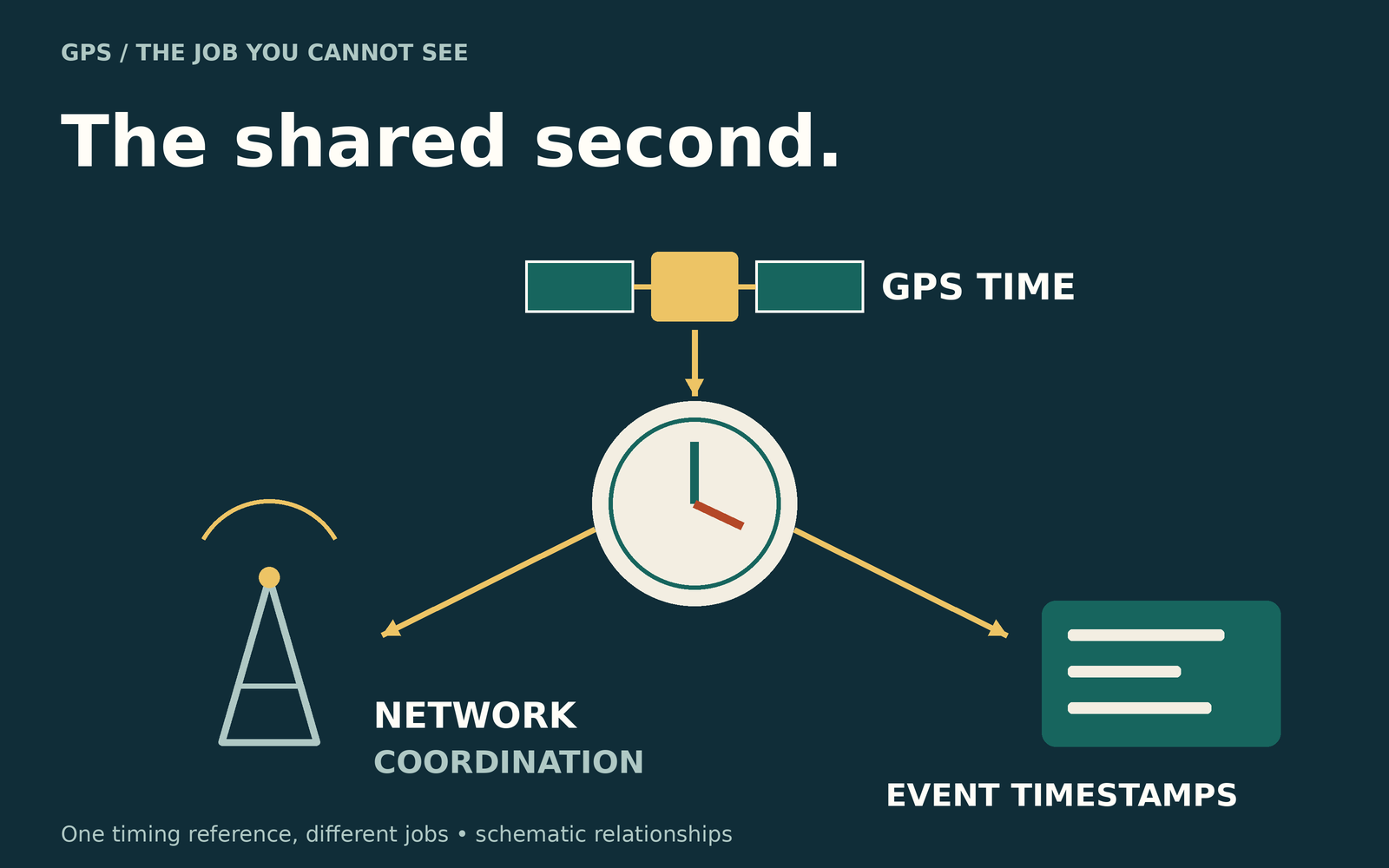
GPS provides precise time as well as position. Networks use shared timing to coordinate equipment; financial systems use trustworthy timestamps to record events. Satellites can supply a common reference to machinery that never goes anywhere.
That hidden job explains why GPS interference can concern people far beyond aviation and navigation. It also explains why “GPS fails, therefore everything stops” is an inadequate description of the risk. The consequences depend on what the affected system uses the signal for, how long it can keep time without it and what other references it can trust.
The satellites are also a clock service
In everyday conversation, GPS usually means location. In an engineering discussion, the timing part can be the entire reason to install a receiver.
NIST's 2021 study documents telecom and financial timing uses, plus local clocks and alternatives.
The useful distinction, reflected in NIST's timing definitions, is between owning an accurate clock and keeping multiple clocks aligned. Two systems can each measure the passage of time quite consistently while disagreeing about when a particular second begins. Shared operations may require them to agree closely enough to perform a task together.
GPS can supply that common reference across geographically separated locations. The receiver does not have to be navigating. It can be helping a fixed installation decide what time it is.
This makes the antenna on a roof less mysterious. Its presence does not necessarily mean the facility is tracking movement. The antenna may be serving the clock inside.
A phone network needs equipment to agree
NIST gives a concrete digital-telephone example in its 2021 report: if network clocks drift far enough apart, a frame can slip, producing a noisy or dropped call. The timing requirement belongs to the equipment carrying the call, rather than the time displayed on a phone. This is a dated technical example, not a claim that every current mobile network uses the same architecture.
The reverse inference also fails. A warning about timing dependence does not mean every tower immediately stops transmitting when a satellite signal disappears. Equipment may continue using a local oscillator, another reference or a combination of sources. The duration and quality of that continuation are engineering questions.
For an operator, the important inventory is therefore more specific than “do we use GPS?” It includes which functions rely on it and what happens when their reference becomes unavailable or unreliable.
Finance needs a trustworthy sequence of events
Financial systems have another reason to care about a shared second: records need to describe when events happened. If two machines disagree about time, comparing their logs becomes more difficult. A timestamp is useful only within the accuracy and assumptions of the clock that produced it.
There is a concrete regulatory example. FINRA Rule 6820 requires covered industry members' business clocks to stay within specified tolerances of NIST time. It also requires synchronization procedures and records of synchronization and relevant drift.
The rule specifies the required clock performance. It does not order every bank or financial computer to install a GPS receiver. Its scope concerns the defined industry members and business clocks, with different provisions for different event categories.
That is a revealing distinction. Accurate time is the operational requirement; GPS is one way of obtaining a reference. Confusing the requirement with the implementation can turn a real dependency into an exaggerated claim about an entire financial system.
An ATM, a trading venue and a firm's reporting clock should not be treated as interchangeable simply because all involve money. Each named claim needs its own equipment, rule and operational context.
Losing the reference starts another clock
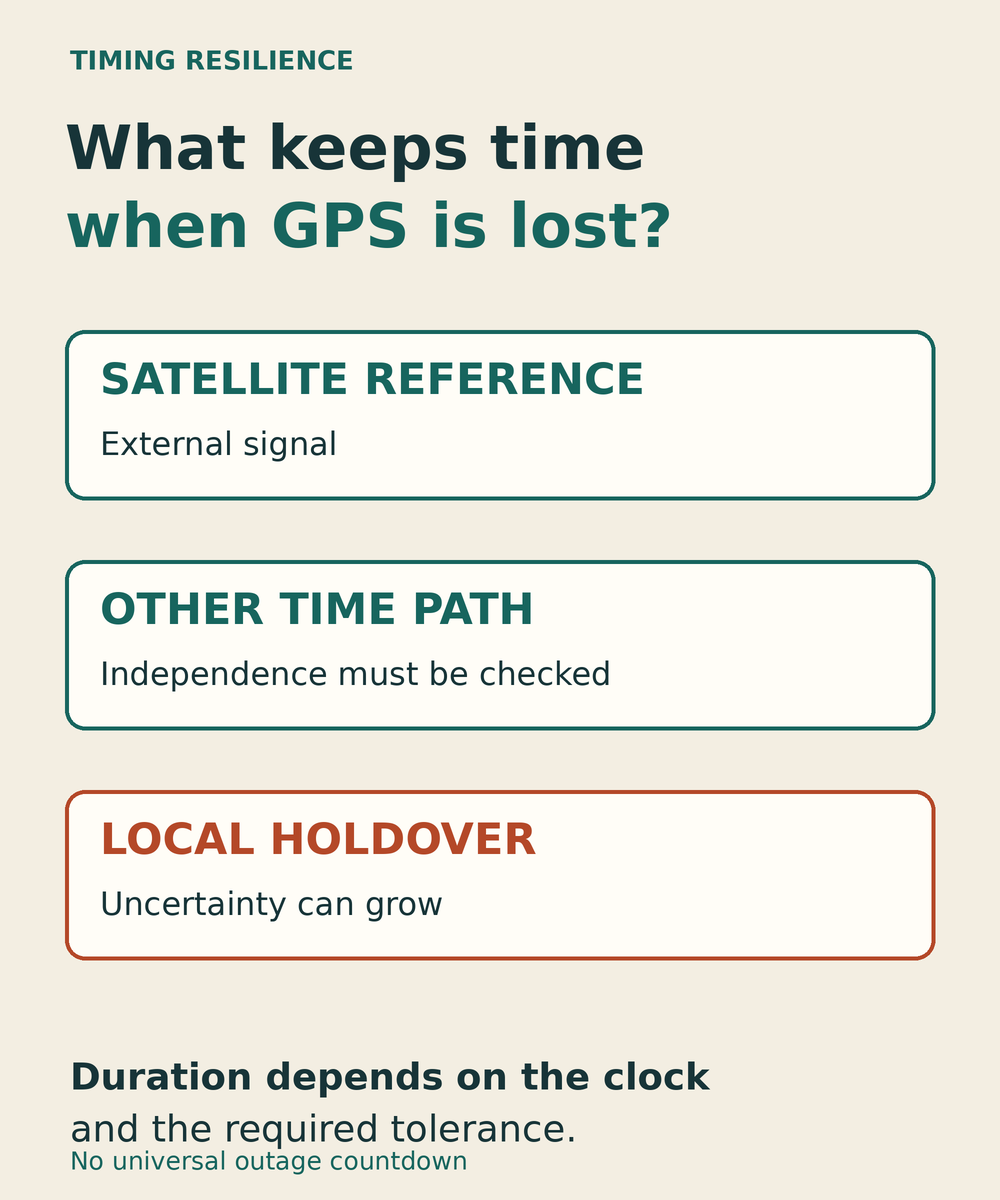
Holdover means relying on a local oscillator after the reference is lost. Error can grow at a rate that depends on the equipment, so installations need not stay within tolerance for the same length of time.
That creates a time-dependent problem rather than a single universal failure switch. A short interruption and a prolonged loss of reference need not produce the same result. Nor do two installations with different equipment and backup arrangements.
NIST's report is technical context, not a current census of every operator's readiness. It cannot support a claim that all networks have an adequate backup, or a countdown saying they will all fail after the same number of minutes.
A second source needs a different failure path
A useful backup question is where the alternative gets its own time. Adding another box is less reassuring if both boxes ultimately rely on the same disrupted source.
There are ways to deliver precise time without depending on satellite navigation. NIST's Time over Fiber service was established to offer a GNSS-independent connection to its atomic time signals. Its explanation also emphasizes the need to account for delay along the connection.
Fiber is therefore an example of an alternative delivery approach, rather than proof that every facility can obtain or already uses one. Network paths, hardware and calibration still matter.
Canada's PNT Resilience Framework similarly treats positioning, navigation and timing as dependencies to understand and manage. A framework's existence does not reveal which safeguards a particular operator has installed.
For a meaningful claim about resilience, ask about the common source, the delivery route, the local clock and the required tolerance. Those four details say more than the number of backup devices in a rack.
The separate problem of GPS reception aboard satellites involves receivers in orbit. Here, the hidden dependency is shared time inside fixed systems.
GPS is easy to notice when a map starts behaving strangely. Its quieter role is helping distant systems agree on the same second. Whether a disruption remains a maintenance problem or becomes a service problem depends on what keeps that agreement alive.