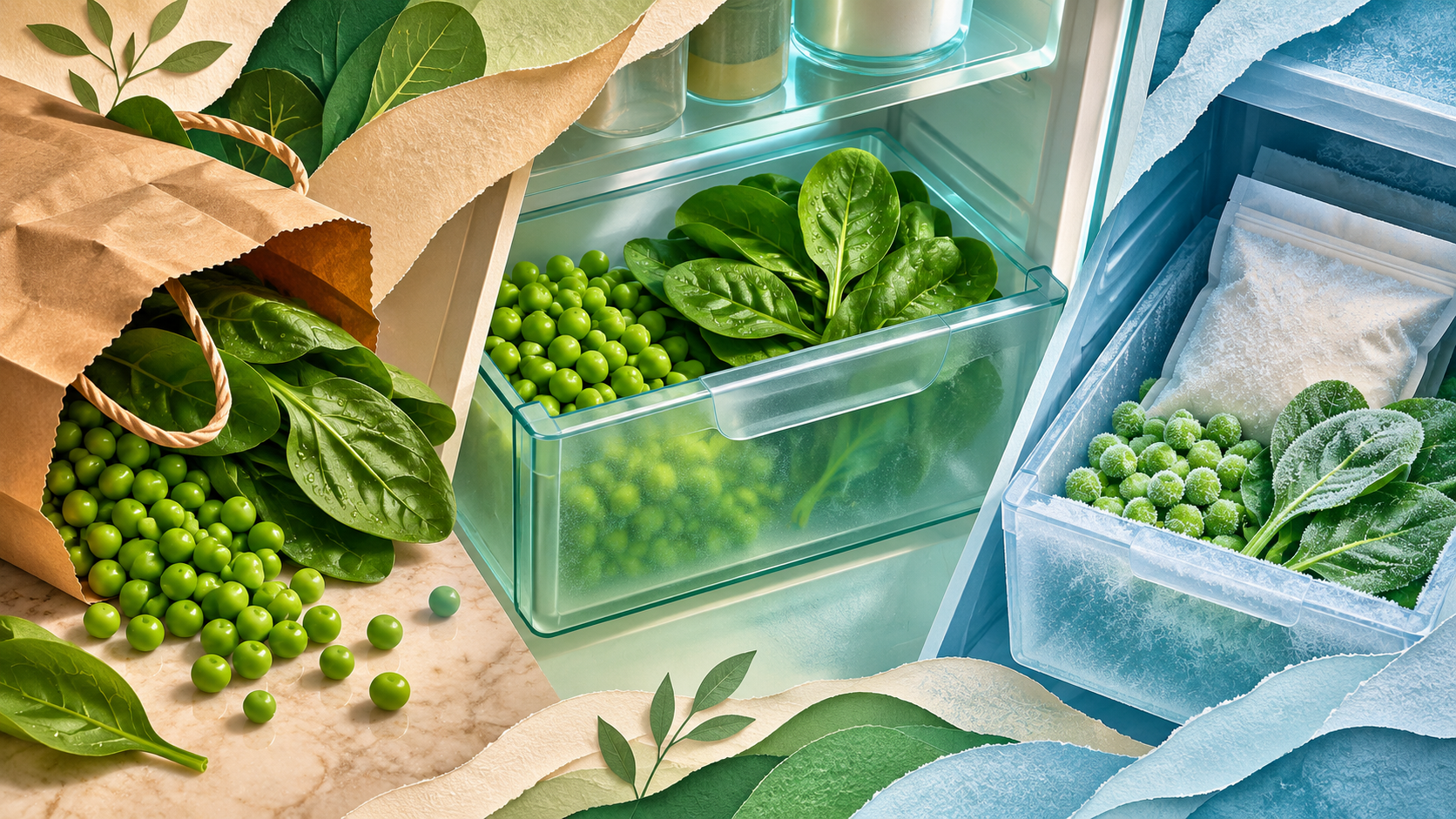
The spinach in your crisper has a head start on looking wholesome. The bag in your freezer has a head start on waiting for Thursday. Nutritionally, either can come out ahead.
Frozen vegetables can contain comparable amounts of selected nutrients to fresh vegetables, and sometimes more than fresh produce stored for several days. But the answer changes with the vegetable, nutrient, storage history and preparation. “Fresh” and “frozen” describe routes to dinner, not fixed nutritional grades.
Freshness has a clock
A fresh vegetable may spend time in transport, on display and in your refrigerator before it reaches a plate. Calling it fresh does not tell you when it was harvested or how it was handled. Cold storage slows deterioration, but it does not stop every change.
Frozen vegetables take a different route. Many are briefly heated, or blanched, before freezing. Blanching can reduce some heat-sensitive or water-soluble nutrients. It also inactivates enzymes that would otherwise contribute to deterioration. Freezing then slows further change.
That trade-off explains the apparent paradox. A processing step can cause an initial loss while helping preserve what remains during storage. The result depends on which nutrient you follow and when you measure it. The food-processing research also describes changes to plant tissue and losses associated with thawing. The freezer is useful, but “locks in every nutrient” promises too much.
A useful shopping comparison therefore includes your calendar. If you are buying vegetables for later in the week, the alternative to frozen may be fresh produce that will wait several days in the crisper. Comparing a frozen product only with a vegetable just picked from a field can miss that everyday choice.
Peas and spinach tell different stories
A 2017 supermarket study by Li and colleagues compared fresh, fresh-stored and frozen produce bought around Athens, Georgia. Its most useful distinction was simple: some fresh samples were tested at purchase, while others spent another five days refrigerated. Those five days began after purchase, not after harvest.
For green peas, measured ascorbic acid, a form of vitamin C, averaged 19.0 milligrams per 100 grams in purchase-day fresh samples, 15.4 in fresh-stored samples and 21.1 in frozen samples. Frozen and purchase-day fresh peas did not differ significantly; both exceeded the five-day samples.
Spinach reversed the story. Purchase-day fresh spinach averaged 25.2 milligrams per 100 grams, fresh-stored spinach 19.6 and frozen spinach 14.5. All three differed significantly. The same study, measuring the same compound, favored frozen over refrigerated peas and fresh over frozen spinach.
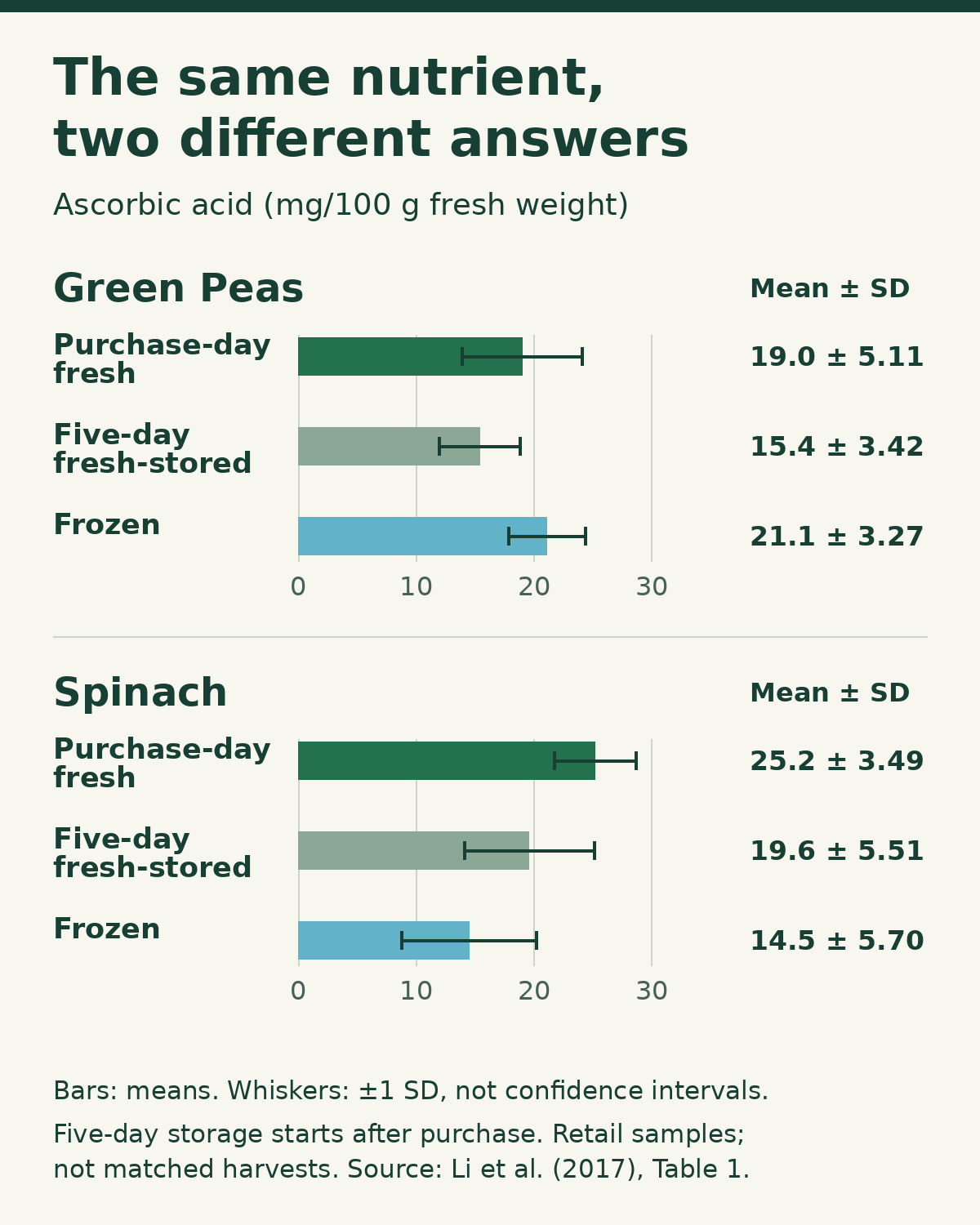
Chart details: Peas: purchase-day fresh 19.0 ± 5.11, five-day fresh-stored 15.4 ± 3.42, frozen 21.1 ± 3.27. Spinach: purchase-day fresh 25.2 ± 3.49, five-day fresh-stored 19.6 ± 5.51, frozen 14.5 ± 5.70. Values are mean ± SD in mg/100 g fresh weight. The two panels share the same zero-based scale. Fresh-stored means five days refrigerated after purchase. These were retail composites, not matched harvests. The study did not perform a formal equivalence test.
The pea result does not mean freezing added vitamins. Differences in starting produce and handling can affect the comparison, alongside losses during storage. Nor does it show that every fresh pea follows the same five-day decline. It shows what the researchers found in these sampled retail products under their study conditions.
Broccoli supplied another warning against choosing a universal winner. Its ascorbic-acid results showed no significant difference among the three categories. Yet frozen broccoli had less measured beta-carotene and folate than both fresh categories.
The comparison also has limits. Retail fresh and frozen products were not matched by harvest or cultivar. Sampling covered six seasonal periods across two years. Researchers pooled produce from six stores into combined samples, then tested each repeatedly; those laboratory repeats were not independent farms. Some preparation steps differed by nutrient assay. These were measurements of purchased products, not identically prepared dinners or a promise about your next bag.
Following the same harvest
A separate UC Davis vitamin study, published in 2015, split harvested produce into refrigerated and frozen pathways. It examined six vegetables, including peas, spinach and carrots, plus two fruits. This design helped separate storage and processing effects from differences between unrelated retail purchases.
Again, results varied. Green beans retained ascorbic acid well through the frozen pathway, while refrigerated samples lost some during storage. Carrots offered a counterexample: beta-carotene was lower after freezing and declined further during frozen storage. Fresh and frozen samples were followed over different time spans, so this was not a perfectly matched day-for-day comparison throughout.
The companion mineral, fiber and phenolic paper came from that same experiment. It found many similar results alongside crop-specific differences. Its fiber measure was acid-detergent fiber, not a complete measure of total dietary fiber. Two papers broadened the measurements; they did not create two independent experiments.
One technical detail matters when comparing the studies: the UC Davis vitamin figures used dry weight, while the supermarket figures above used fresh weight. Removing water changes the denominator. Their raw numbers cannot be lined up as though each described the same 100-gram portion on your plate.
Together, these findings support a conditional answer. Frozen vegetables can hold their own on particular nutrients. Neither storage route wins every comparison.
What the measurements cannot tell you
A test that detects no significant difference does not prove two foods nutritionally equivalent. A nutrient concentration is also different from the amount your body absorbs. These studies did not establish equal absorption, disease prevention or whole-diet health outcomes.
Funding deserves a place in the picture. Li's study acknowledged a Frozen Food Foundation grant, and its methods say the Foundation predetermined the produce investigated. The Foundation's research page identifies partnerships with both the University of Georgia and UC Davis. The principal comparisons therefore share an industry-linked sponsor connection. That does not erase the measurements, but it makes the fresh-favoring results especially important to keep in view.
It also helps to keep the question modest. An ascorbic-acid assay measures a particular compound, not every form of vitamin C and certainly not the entire nutritional value of a vegetable. A higher reading in one column is useful evidence, but it is a narrow basis for declaring one food healthier overall.
Shop for the meals you will actually make
For a fair comparison, start with plain vegetables. Frozen broccoli in cheese sauce answers a different shopping question from unseasoned fresh broccoli. Check the ingredient list and nutrition label for additions such as sodium or saturated fat.
Think about your schedule, too. If plans often change, a bag you can portion across meals may be easier to use than a large fresh purchase. Fresh vegetables may suit the dishes you expect to cook soon. Compare local unit prices rather than assuming frozen always costs less. These choices fit the practical planning behind grocery shopping on a budget.
Mixing the two formats can be a practical response: fresh produce for a near-term meal, frozen portions for a less certain night. The point is to make the purchase fit your cooking habits. There is no need to replace a fresh vegetable you enjoy simply because another crop performed well in a freezer study.
Cook safely before chasing vitamin savings
Preparation is another part of the nutrient story. Separate research on cooking fresh vegetables found that retention varied with the vegetable and cooking treatment. That is a reason to consider how you cook, not to undercook a product that needs heat for safety.
Follow the package cooking instructions. Health Canada says most frozen packaged vegetables need cooking, including before they go into cold salads or smoothies. Factory blanching does not automatically make them ready to eat. As the FDA explains, freezing does not kill many bacteria.
Choose the vegetables that fit your meals, store them properly and prepare them safely. A freezer bag can be a sound nutritional choice without winning an imaginary contest against every fresh vegetable in the shop.