The next milestone for Voyager 1 is easiest to picture as a very slow conversation. Send a radio message from Earth, allow about a day for it to reach the spacecraft, then allow another day for a reply to travel back. Even before anyone considers a complicated repair, the waiting is enormous.
NASA expects Voyager 1 to reach one light-day from Earth on November 18, 2026, after a journey of about 49 years. That is roughly 25.9 billion kilometers, or 16.1 billion miles. The agency’s current mission schedule places the milestone at about 5:16 a.m. Eastern time.
Nothing special happens to the surrounding space at that moment. Voyager will pass a memorable distance marker while continuing a scientific mission that crossed into interstellar space years ago.
A day of light, nearly half a century of travel
A light-day is a unit of distance: how far light travels through a vacuum in 24 hours. It says nothing about how quickly a spacecraft can cover the same ground. Voyager 1 has been traveling since 1977, and even this extraordinary voyage has brought it only one day into light’s travel budget.
The conversion is straightforward. Multiply the speed of light, exactly 299,792,458 meters per second, by the 86,400 seconds in a day. The result is about 25.9 billion kilometers. In astronomical units, the familiar yardstick based on the Earth–Sun distance, that is about 173 AU. These are conversions of a distance unit, not a fresh measurement of Voyager’s position.
The reference point matters. NASA’s milestone is measured from Earth, whose position changes as it orbits the Sun. Distance from the Sun is a different quantity. One Night Sky Network outreach article uses “from the Sun” for the November 18 marker, but the mission-specific pages and NASA’s newer announcement consistently say Earth. The Earth-based description is the one to use here.
Nor is this a light-year. The light-day explanation celebrates an immense human achievement on a scale that remains small beside the distances between stars.
The two-day wait is only the travel time
Radio waves are electromagnetic radiation, just like visible light. At this distance, NASA puts their travel time at roughly 24 hours each way. A command followed by a response therefore involves about 48 hours of signal propagation.
That is the travel portion of the exchange, not a promise that every command produces an answer exactly two days later. The spacecraft still has to perform the requested operation, and mission teams have to arrange communications and process the results. The operational clock can be longer than the light-travel clock.
There is a second way to feel that distance: a measurement arriving on Earth describes conditions at the spacecraft about a day earlier. If engineers use it to decide on a new command, that instruction needs another day to arrive. Troubleshooting means working with a past view of a very remote machine.
The delay also grows gradually. Crossing the light-day marker does not suddenly make Voyager unavailable for two days. NASA’s October 29 mission update explicitly says the milestone will bring no environmental or onboard change. The spacecraft has no reason to notice the round number that people back home are celebrating.
Interstellar space has more than one boundary story
Voyager 1 crossed the heliopause on August 25, 2012. This is the boundary between the Sun’s solar-wind bubble, called the heliosphere, and the surrounding interstellar medium. Scientists announced the conclusion in September 2013, after combining particle measurements with evidence from plasma waves. The crossing and the announcement happened in different years.
The evidence mattered more than the mileage. Plasma is gas containing electrically charged particles. Waves in that material helped scientists infer that Voyager was surrounded by the denser plasma of interstellar space. The probe did not need to reach a predetermined distance for the measurements to reveal a new environment.
That was a change in the environment the spacecraft was measuring. The coming light-day marker is a change in how neatly humans can describe its distance.
“Has Voyager left the solar system?” needs a definition before it can have a useful answer. In everyday conversation, the solar system often means the planetary neighborhood. In a broader astronomical sense, it includes the distant Oort Cloud, a vast inferred population of icy bodies orbiting the Sun. Voyager can be outside the heliosphere while still being far short of those outer regions.
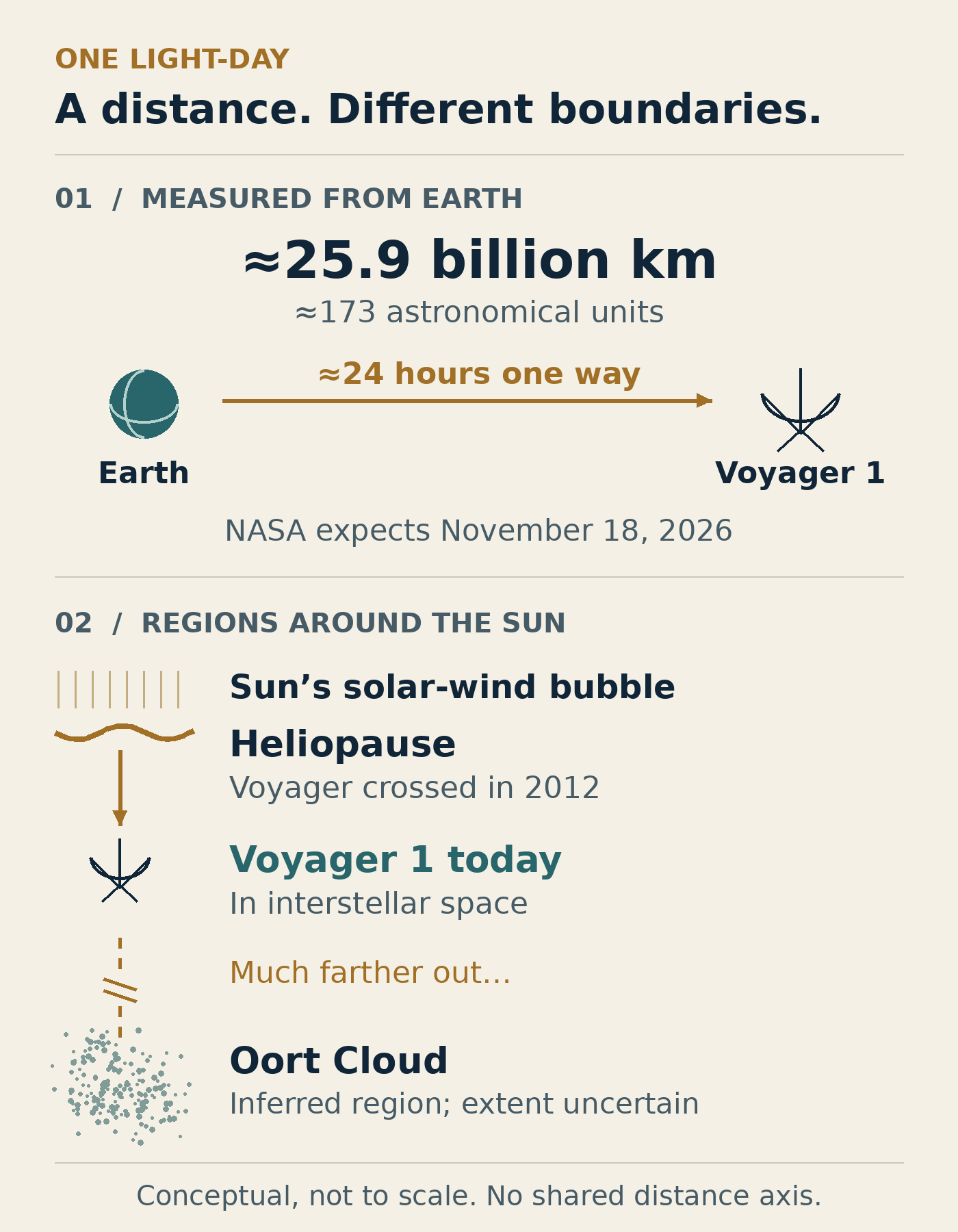
The Oort Cloud has not been mapped like a planetary orbit. NASA describes its extent with broad estimates, and its familiar Voyager travel times are rough guides: centuries before reaching the inner region and tens of thousands of years to pass beyond the broader cloud. Turning those into an exact arrival year would give a fuzzy destination a false timetable.
There is another trap in the boundary language. Voyager is on an escape trajectory; being within the broader solar system’s extent does not mean it remains gravitationally bound to the Sun. Gravity does not switch off at a border. And, as JPL’s account of the interstellar crossing explains, solar influence can persist beyond the heliopause. Interstellar space is not a perfectly isolated room.
Two instruments still make the journey useful
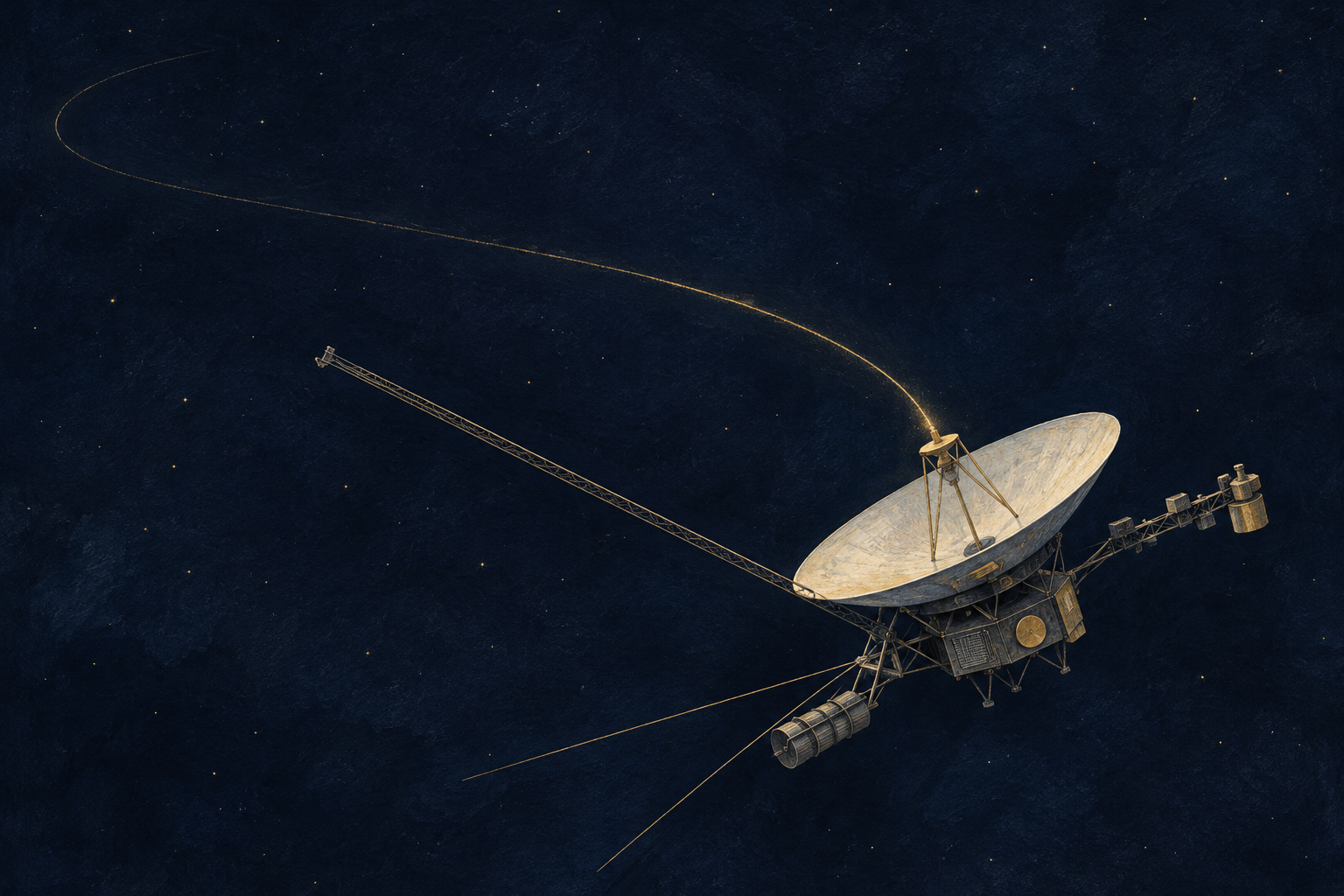
As of November 11, NASA lists two active Voyager 1 science instruments: the magnetometer and the Plasma Wave Subsystem. They keep this milestone attached to an observing mission rather than merely a distant piece of hardware. The cameras have been off since 1990, so pictures of Voyager at its present location are illustrations, not new photographs from the probe.
Power is the practical constraint. The cosmic-ray instrument was switched off in 2025, followed by the Low-Energy Charged Particles experiment in April 2026. Engineers completed another power-saving equipment swap in September. These measures buy operating margin, not a guaranteed retirement date.
NASA also reported that a brief loss of contact ended on October 20. Its October 29 update said the cause remained under investigation. That real interruption is separate from the ordinary, predictable delay caused by distance.
For a closer look at the mission’s next chapter, NASA has announced a public discussion for November 19. The most interesting question goes beyond the odometer: what can the team keep learning from two instruments so far away that even a reply needs a day to come home?