An antenna can receive a television signal perfectly and still leave its owner staring at a screen that cannot show the program. For an encrypted broadcast, good reception and permission to decrypt are separate requirements. That becomes a rather less academic distinction when the program contains an emergency warning.
Yes: an alert carried inside an encrypted ATSC 3.0 television service can be inaccessible to equipment that cannot decrypt that service. That is a compatibility problem for a particular viewing path. It does not establish that every television will miss an alert, or that an upcoming nationwide test will fail.
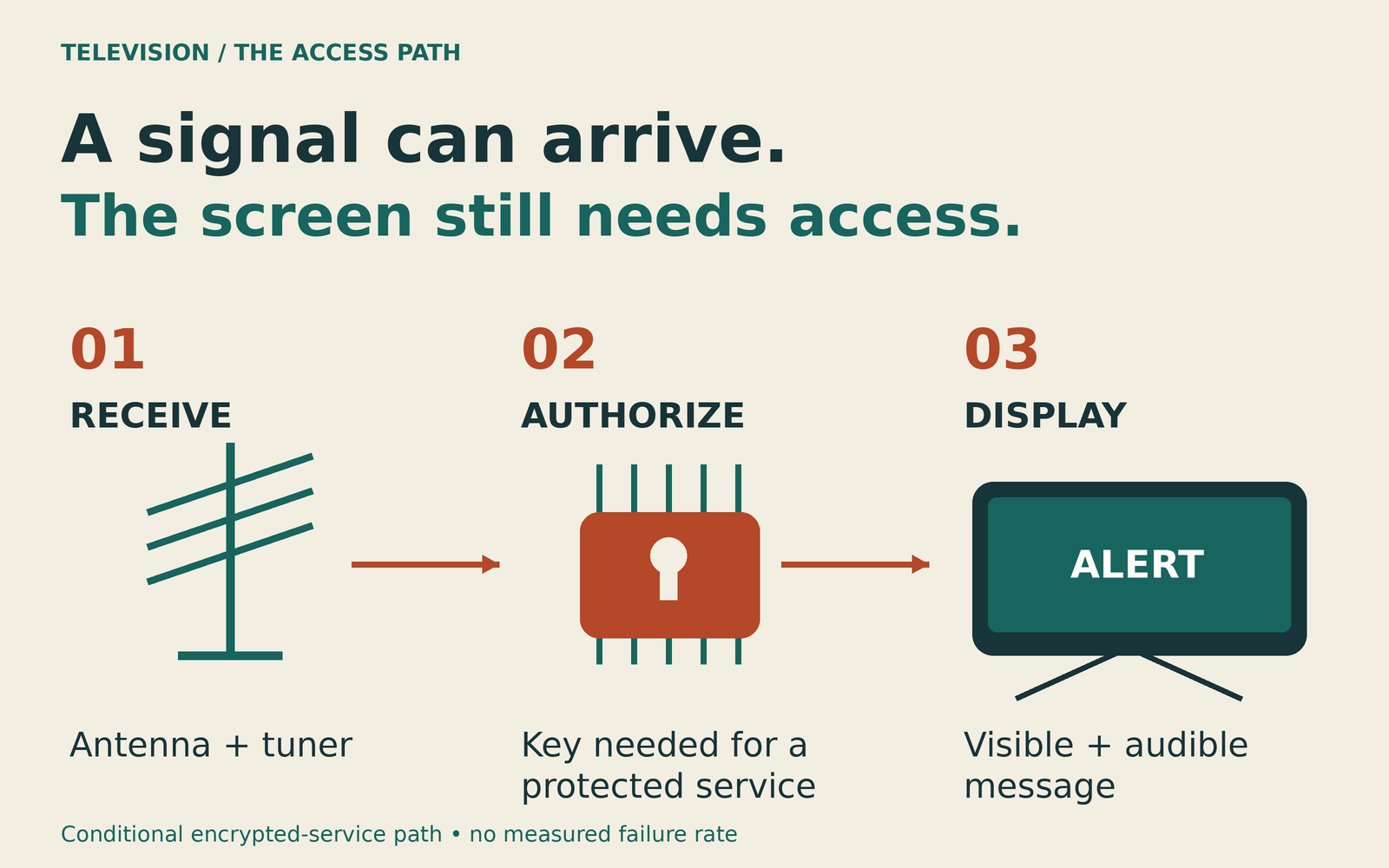
The useful question is where the message has to travel after the antenna receives it. A warning that reaches the broadcaster has another journey to finish before somebody in a living room can see or hear it.
The lock is inside the broadcast
ATSC 3.0, often marketed as NEXTGEN TV, is a newer over-the-air television standard. Encryption can be part of its delivery system even when watching a station does not require a subscription. Free programming and unrestricted equipment compatibility are different promises.
The ATSC 3.0 Security Authority's explanation separates two protections. Authenticity signatures let a receiver check where signaling came from and whether it was altered. Content encryption controls access to the media itself, using keys available through licensed equipment. The organization describes the former protection as mandatory and content protection as voluntary.
Authenticating a message does not by itself make its encrypted contents accessible.
Think of a properly addressed envelope delivered to a locked mailbox. Delivery and access can both be working as designed while the person at the end still lacks the key. The analogy explains the access question; it does not decide a broadcaster's legal obligations.
Why a tuner manufacturer raised the alarm
In an October 5, 2026 filing, tuner manufacturer SiliconDust argued that the audio and visual Emergency Alert System message inside a DRM-protected television service is encrypted along with that service. It asked the FCC to address access barriers around the national test.
SiliconDust has a commercial interest in receiver compatibility, so its filing is an argument from an interested manufacturer. It is also a specific, inspectable argument about a delivery mechanism. Those two facts can coexist.
The filing was written before the test. It describes a concern to investigate, rather than an observed nationwide result. Its legal interpretation is not an FCC ruling.
There is a competing industry position. TV Technology reported an AWARN response opposing a request to turn off content protection. That response addressed a later October 26 SiliconDust letter, so the exchange should not be flattened into one document and one rebuttal. The underlying original counterfiling was unavailable for this article; the reported legal positions remain attributed reporting.
For viewers, the strongest countercase is more straightforward: a compatible receiver with working authorization can display protected programming. The existence of encryption alone is not evidence that such a receiver will miss its warning.
Does this mean antenna TV needs the internet?
There is no sound universal answer covering every receiver and every credential arrangement.
A3SA's 2023 encoding rules explicitly contemplate less-secure devices that use an internet connection to decrypt covered simulcasts. Those rules also address recording and playback permissions. They do not establish that every ATSC 3.0 television needs a continuous internet connection.
Its credential-proxy explanation describes an internet-based route used by receivers employing the specified Widevine arrangement. A device requests credentials through the proxy, which necessarily receives an IP address and device identifier. That documents a real authorization dependency for that route, without supplying a complete catalogue of offline behavior across products.
This is why “the internet went out” is an incomplete test description. Which receiver? Which firmware? Which channel? Were credentials already available? Was the service encrypted? A result with one combination cannot answer for every device sold under the same broad television standard.
Viewers comparing equipment need its actual compatibility documentation. A label announcing the new broadcast standard does not explain every condition under which a particular tuner can display every protected service.
What the November test can establish
The FCC's September notice schedules the nationwide EAS test for November 17, 2026, at 2:20 p.m. Eastern, with December 3 as the backup date. The clock time matters here because it identifies the announced test, rather than a rumor about an emergency.
A useful receiving report would identify the station, service, equipment, software and connection conditions, then describe whether the message actually appeared and sounded. It would distinguish a reception failure from a decryption problem and from a failure farther upstream.
Those details can make an inconvenient result informative. Without them, a black screen is simply a black screen with several possible explanations.
Conventional ATSC 1.0 reception, unencrypted ATSC 3.0 reception and protected ATSC 3.0 reception are different paths. A problem on one does not demonstrate that all three fail. Equally, success on an older simulcast does not settle the access question on a newer protected service.
The question viewers should keep asking
The public-interest concern is easy to understand: emergency information is most useful when the people who need it can actually receive and understand it. Adding an equipment-authorization requirement deserves scrutiny precisely because the underlying broadcast may be freely available over the air.
The evidence supports investigating that requirement. It does not supply a national failure rate, an exact count of affected households, a verdict of unlawful conduct or advance knowledge of the test result.
For the viewer, the decisive question is practical: can this receiver display this station's warning under the conditions in which I expect to use it? A clear answer requires following the message all the way to the screen.