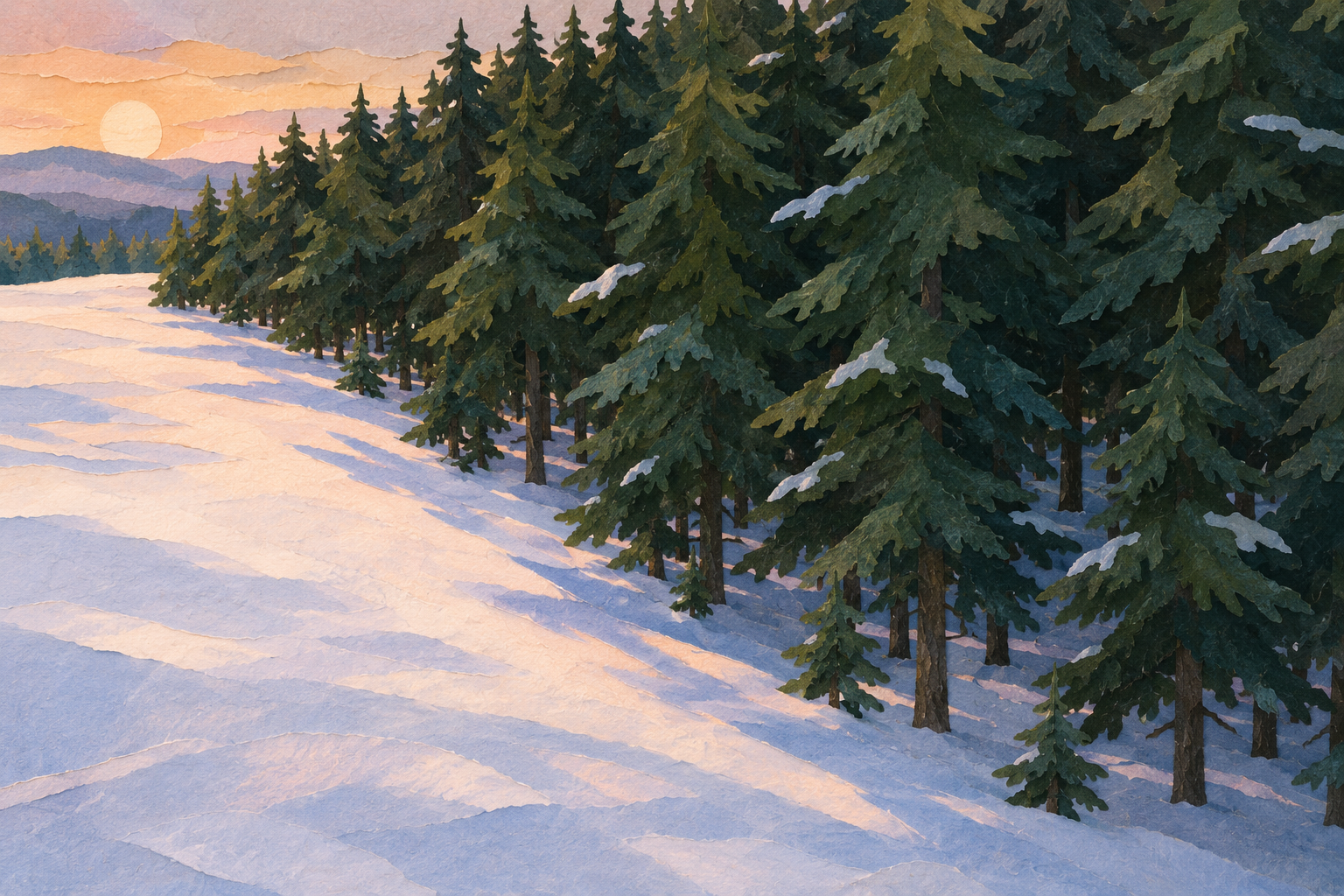
A new forest can make a snowy landscape absorb more sunlight. Bright snow reflects much of the light that hits it; dark branches and evergreen crowns can intercept that light instead. As trees spread over an open white surface, they can add a warming influence even while taking carbon dioxide out of the air.
That is one part of the climate calculation. Maps comparing stored carbon with changes in reflectivity have identified places where the warming could outweigh the carbon benefit in that limited accounting. They do not include every climate effect. A newer, broader modeling study found net global cooling in all three reforestation scenarios it tested.
The surprise is real, but the lesson is more useful than “trees are bad.” Where a forest grows, what it replaces, how it changes water and clouds, and how long it lasts all matter. Counting seedlings cannot answer those questions.
The snow is still there. Less sunlight reaches it.
The relevant property is albedo, the fraction of incoming sunlight a surface reflects. Fresh snow has a high albedo. A dark forest canopy generally reflects less. Covering bright ground with trees can therefore increase the solar energy absorbed by the landscape.
The snow does not have to disappear for this to happen. From above, a patch of snowy forest can present a dark surface because the crowns obscure the ground. Evergreen trees make the mechanism especially easy to picture: their needles remain in place during the snowy season.
Timing matters. Snow cover and daylight must overlap for snow masking to change the solar energy budget. A long winter night provides no sunlight to absorb. Spring conditions, the duration of snow cover, tree species and canopy density can all change the balance. Latitude is a clue to these conditions, not a verdict.
Snow is also only the most vivid example. Planting over other bright surfaces can lower reflectivity, including in some dry landscapes. Meanwhile, the carbon benefit depends on how much additional carbon the vegetation stores. A place with a large reflectivity change and modest carbon gains can look very different from a productive forest returning to a formerly forested site.
This is why a tree-planting promise needs a description of the land underneath it. “More trees” leaves out the comparison that determines the result.
What the warming maps actually show
A widely discussed 2024 study in Nature Communications brought that comparison into sharper focus. Natalia Hasler and colleagues mapped potential changes in albedo and biomass carbon when tree cover replaces open land. Funding came from the Bezos Earth Fund through The Nature Conservancy, with a subgrant to Clark University. The Bernina Initiative and Restor Foundation supported Restor’s data collection. The authors declared no competing interests.
Their central finding was that ignoring albedo can overstate the climate benefit of adding trees. In some locations, the estimated warming from reduced reflectivity exceeded the estimated cooling from carbon storage. The size of the adjustment varied enormously across different maps of potential restoration land. There was no single discount that could sensibly be applied to every forest.
Just as important, the study did not conclude that restoration was generally a losing proposition. In its sample of locations associated with restoration projects, 84% of mapped pixels remained climate-positive under the study’s carbon-plus-albedo calculation. The sample contained 815,654 pixels drawn from records of past, current and planned restoration. Those were map pixels, not 815,654 independently monitored projects, and the result described modeled potential rather than verified outcomes on the ground.
The researchers compared maximum potential biomass storage with maximum albedo change. They translated the sunlight effect into a carbon-equivalent measure using a convention that accounts for how a carbon dioxide pulse changes over 100 years. That does not mean every forest was observed for a century or would reach the mapped result exactly 100 years after planting.
The choice of accounting period matters, too: sunlight and carbon effects unfold differently over time. Changing the period can change how an intermediate case is judged. A carbon-equivalent number is a comparison tool, not a guarantee about future temperature.
The maps are useful for asking where reflectivity deserves attention. A complete project assessment still needs other carbon stores, growth and disturbance risks, water effects and atmospheric responses. The paper’s neat-looking map cannot make those complications disappear.
Trees also move water, heat and clouds
A forest is more than a dark object containing carbon. It exchanges water and energy with the air. Water evaporating from surfaces and passing through leaves uses energy, which can cool the surface. The roughness of a canopy also changes how heat is transferred to the atmosphere.
These processes help explain why a dark tropical forest can have a cooler surface than nearby open land. Its albedo is not the only thing that has changed. The water cycle can be powerful enough to reverse the local temperature result suggested by reflectivity alone.
Clouds add another layer. Changes in vegetation can alter cloud cover, which affects sunlight before it reaches the ground. A 2024 cloud study found that reduced cloud cover partly offset the reflective cooling associated with deforestation. That result cannot simply be reversed to produce a universal tree-planting benefit, but it shows why judging the ground while ignoring the sky can mislead.
Forest emissions of volatile organic compounds also interact with atmospheric chemistry, affecting particles, clouds and greenhouse gases. Their importance depends on the wider emissions environment and on how a model represents those processes. These are reasons to examine the whole system, rather than add percentages from unrelated studies as if they were items on a receipt.
The IPCC’s assessment expressed low confidence in the net direction of afforestation feedback on global mean temperature, with strong regional dependence. The underlying processes are well established; combining them into one answer for every possible new forest is the difficult part.
A cooler surface is not the same as a cooler planet
Three different temperature questions often get bundled into one sentence about trees.
First, how warm is the surface? Satellites can measure the temperature of the land and canopy they see. Second, how warm is the nearby air? That matters to people, crops and wildlife, but it need not change by the same amount as the surface. Third, what happens to the global climate after carbon, sunlight and atmospheric feedbacks are considered?
A 2025 study separating surface and air temperatures found substantially smaller local air-temperature responses than surface responses in its analysis of potential tree restoration. A striking satellite image of cooler tree cover should therefore not be read as an equally large reduction in the temperature someone breathes.
The distinction also works in the other direction. A warmer forest surface in a snowy season does not establish that the forest causes net global warming. Carbon removal operates beyond the forest boundary, while local changes can involve redistributing heat and moisture.
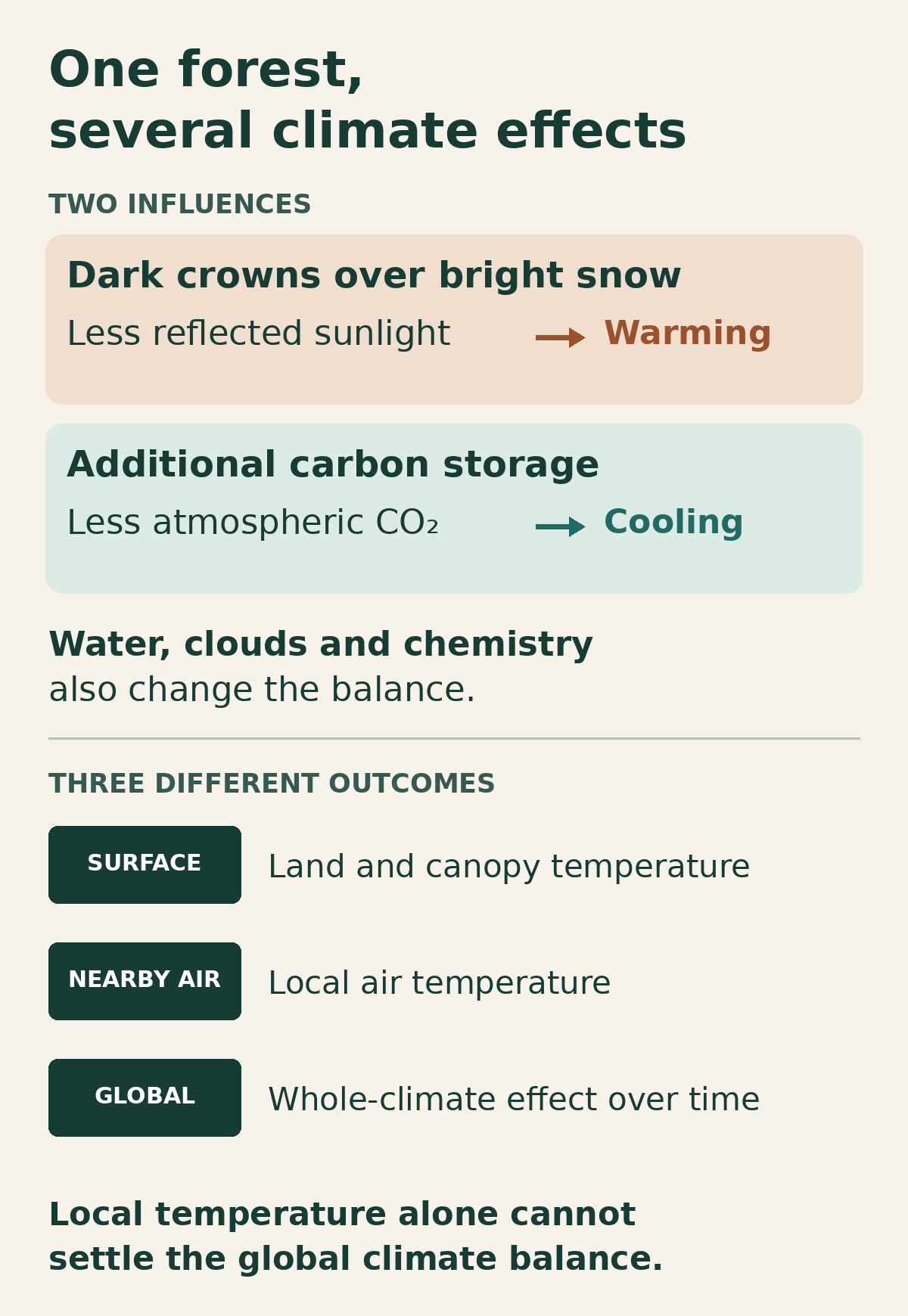
Reading the diagram: Dark crowns over bright snow can reduce reflected sunlight, adding a warming influence. Additional carbon storage can add a cooling influence. Water, clouds and atmospheric chemistry also affect the outcome. None of these arrows supplies a universal temperature value, and a local temperature measurement cannot settle the global balance.
Season matters here as well. Earlier global satellite research found that boreal forests could show surface warming in winter and cooling in summer. An annual average can hide that reversal. Those observations compared forested and open land; they were not controlled experiments following identical sites before and after planting.
Recent observations reinforce the caution about simple geographical rules. A 2026 study of Canadian boreal-tundra regions found surface-cooling tendencies in many areas where taller vegetation expanded, with results varying by vegetation type. That is evidence about surface energy and temperature, not a complete greenhouse-gas balance. It nevertheless makes “northern trees always warm things” a poor shortcut.
The newer global result still favored cooling
The most useful challenge to an anti-tree reading comes from a 2026 reforestation modeling study. Researchers tested three different global reforestation patterns in a climate model, with forest expansion phased in between 2015 and 2070. The reference case held land cover fixed at its 2015 state; the reforestation scenarios expanded forests. Support included an ETH Zurich research grant and Swiss National Science Foundation funding, alongside Belgian and EU research programs and Swiss SERI. The authors declared no competing interests.
All three scenarios produced estimated net global cooling by late century after the carbon contribution was included. Patterns with more northern forest expansion still produced warming through their physical effects on the climate system. Those warming effects reduced the benefit without overturning the global result in these scenarios.
Location also mattered enough that a smaller forest expansion could deliver about as much estimated global cooling as a larger one. More area was not automatically a better climate intervention.
These were conditional simulations, not promises about a real planting program. The study used one climate-model system and approximated the cooling from additional carbon storage rather than directly simulating the resulting decline in atmospheric carbon dioxide. Some atmospheric chemistry effects were omitted. Its conclusions should not be stretched into a guarantee that any reforestation plan will cool the planet.
Taken together, the studies support a more demanding question: which forests, on which land, over which period, with which effects included? They do not support trading one universal slogan for another.
Protect forests, and recognize land that should stay open
Protecting an existing forest is a different decision from covering an open ecosystem with new trees. Existing forests already hold carbon and support living communities. Clearing them can release carbon and destroy habitat. An albedo calculation for adding tree cover does not make the reverse action harmless.
Restoring a degraded forest, including through natural regeneration where appropriate, is another distinct task. It starts with the ecological history and condition of a place, rather than assuming that every empty-looking patch needs saplings.
Some apparently “empty” land is an ancient grassland or savanna. These ecosystems can support species adapted to open conditions and store substantial carbon below ground. Research on tree expansion in grassy ecosystems warns that dense tree cover can damage biodiversity and alter water availability. A forest is not an ecological upgrade everywhere. Water deserves particular attention in dry places, where increasing tree cover can mean a tradeoff between vegetation growth and water available elsewhere in the ecosystem. Climate accounting should sit alongside those local ecological questions, rather than erase them.
Urban trees answer a further question. Shade can make a street or courtyard more tolerable in hot weather, while vegetation can contribute to local cooling. Those adaptation benefits remain valuable even though a neighborhood heat measurement cannot tell us the project’s full global climate effect. A street tree does not need to solve planetary warming by itself to be useful.
Ask what grows, what changes and what lasts
A credible tree-climate claim should say what ecosystem is being restored or replaced, what would happen without the project, and which effects the calculation includes. It should distinguish potential carbon storage from carbon actually accumulated and retained. It should also explain why planting is the appropriate route: land that can recover through natural regeneration presents a different choice from a site where that recovery needs active help. The relevant comparison is the likely future of that particular place.
It should also explain time. Canopy reflectivity changes as trees grow; carbon accumulation has its own trajectory. Fire, drought, pests and later land-use decisions can change what remains. There is no universal year when every new forest “pays back” its albedo effect.
Trees can be part of climate mitigation, ecosystem recovery and protection from heat. They cannot substitute for cutting fossil-fuel emissions. The snow-covered forest adds a useful correction to the familiar picture: carbon is essential, but sunlight, water and the original ecosystem belong in the calculation too.