
Turning off a privacy setting should produce a result you can understand. On a smart TV, the first complication is that “tracking” can describe several different activities, while the switch in front of you may control only one.
Opting out can stop a particular viewing-recognition data flow. It does not necessarily stop every kind of collection, advertising use or communication with a server. Research has found controls that worked in tested devices, alongside traffic patterns that warrant further investigation. Neither finding supports a verdict on every television.
The most useful starting point is the wording of the choice. Are you refusing viewing recognition, changing advertising preferences or opting out of sale and sharing? Those can be separate instructions with separate effects.
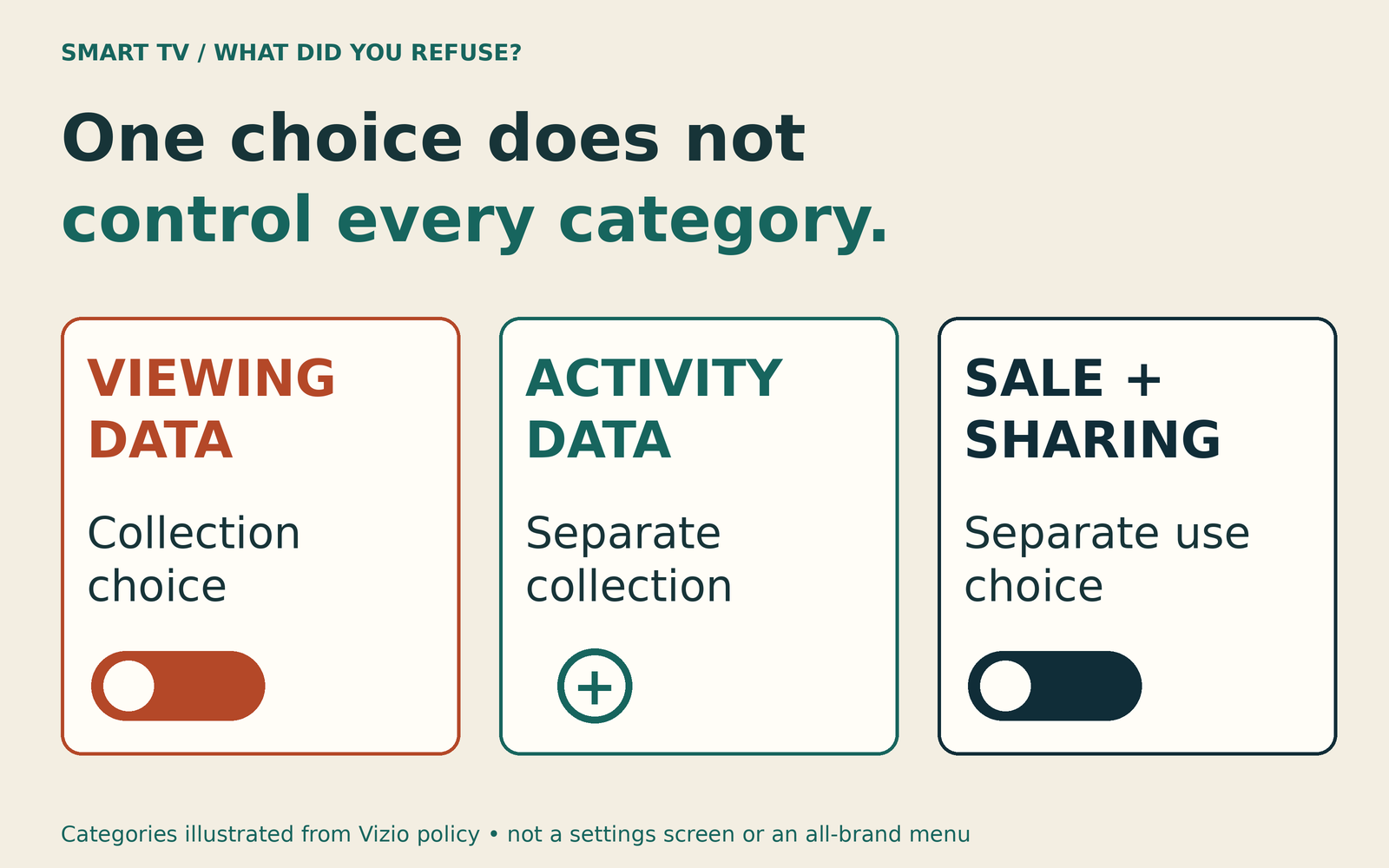
The setting can work within a narrower promise
Vizio makes the distinction unusually explicit. Its Viewing Data supplement says disabling Viewing Data does not limit Activity Data collection. It also says a qualifying Walmart-account sale/sharing opt-out does not itself stop Viewing Data collection; the television's collection setting must be switched off for that purpose.
The account-related choice has conditions, including device linkage and supported firmware. It should not be treated as a universal instruction for every Vizio model. The broader point is simpler: refusing a later use of data can differ from refusing its initial collection.
For an owner, this creates a more specific question than “did I opt out?” The question is what did this choice tell the television to stop doing? The answer can be in the policy's definitions, even when the settings screen makes the choice sound broader.
ACR is about recognizing what is on the screen
Automatic Content Recognition, or ACR, identifies displayed content by comparing information derived from audio or video with reference material. It is a different mechanism from a streaming app knowing which program you selected inside that app.
The 2024 study Watching TV with the Second-Party investigated Samsung and LG televisions through their network traffic. Its tested opt-outs stopped communication with the identified ACR domains. That is useful evidence that a privacy control can produce a measurable effect.
Its sample also showed that using HDMI did not automatically take viewing outside the television's recognition system. A device can act as an external display while its own operating system remains connected and active.
Those findings have boundaries: the tested hardware, software, scenarios and countries. They do not certify the behavior of every later model. Still, a claim that all smart-TV privacy controls are meaningless has to account for observed cases in which they worked.
Why a newer study raises harder questions
A public preprint, Watching the Watchers, examines a broader set of smart-TV operating systems and viewing scenarios. The available document still has placeholder publication fields, so it should be read as a preprint rather than described as an already published journal article.
The researchers report effective opt-outs in some tested systems and residual traffic consistent with ACR activity in others. The important qualification is theirs: for encrypted implementations, traffic behavior generally provided evidence to interpret, rather than direct access to the complete payload or proof of what a server retained.
That supports scrutiny. It does not establish that every residual connection contains viewing history, that every affected setting violates the law or that a particular backend processed data in a way the researchers could not inspect.
The distinction is substantive. Suspicious behavior is a reason for a better test or more information. Calling it proven collection can silently fill in the very thing the measurement could not reveal.
A server connection is a clue with several meanings
Independent hardware testers at RTINGS describe a similar measurement challenge. In tests updated in August 2026, identifiable ACR-related flows on some named televisions stopped or changed after consent was withdrawn. On others, the testers could not cleanly separate potential recognition traffic from background services.
Their tests also found differences in the ease and consequences of changing privacy choices. Those observations should stay attached to the particular tested device and data category. A difficult Activity Data choice cannot automatically be reported as a broken Viewing Data switch.
Imagine seeing the same delivery van arrive at an office before and after you cancel a subscription. Its arrival raises a question, but it does not reveal the contents of every package. Network evidence can be much more informative than that analogy, especially in controlled experiments, yet encrypted payloads still impose a real limit.
The studies and lab tests have not been established here as matched-model, matched-firmware repetitions. A difference between their results therefore cannot be assigned confidently to a software change, a company response or a single methodological cause.
What owners can check without a laboratory
Start with the television's own documentation for the exact model and region. Look for the definition of the setting, then check whether other data categories have separate controls. Viewing recognition, advertising personalization and sale or sharing should each be understood on their own terms.
Read the consequence before accepting it. A control that changes recommendations is a different bargain from one that removes connected features. Write down the choice you made so that a later update or reset is easier to assess. This is a practical record, not a guarantee about what software will do afterward.
An external streaming box also deserves its own privacy review. It may move the app activity to another platform without turning an internet-connected television into an inert monitor. Disconnecting the TV's network connection changes that path, but the separate streamer and its apps can still have their own collection practices.
For technically inclined owners, network logs can help identify destinations and changes. They should be interpreted with the same care the researchers apply: a continuing connection and a decoded viewing-history record are different levels of evidence. Selective blocking may also affect unrelated functions when services share infrastructure.
The meaningful outcome is a specific claim you can evaluate: a named choice, a defined category of data and an observable or documented effect. “Privacy on” is comforting, but a television usually needs a more detailed instruction than that.