The number worth finding before your next flight is the small Wh rating on your power bank. From January 1, 2027, IATA’s Dangerous Goods Regulations prohibit passengers and crew from carrying lithium-ion power banks above 100 watt-hours. The important change is the loss of an airline-approval route for larger banks, rather than a ban on every portable charger. IATA’s published 2027 changes spell out that boundary.
A bank marked exactly 100 Wh does not exceed it. A smaller bank still has to satisfy the airline’s other conditions. And January 1 is the date of IATA’s new edition, not proof that every country introduces identical enforcement that morning.
What changes in 2027
The relevant comparison is between an ordinary bank below the threshold and a larger one that previously needed permission.
Under ICAO’s March 2026 amendment, a bank above 100 Wh but no more than 160 Wh can still fit an operator-approval exception. IATA’s 2027 edition removes that exception for lithium-ion power banks. Asking permission therefore stops being a solution for that category under the new IATA rules.
For someone already traveling with one small bank, the capacity change may make no difference. It matters more to travelers carrying larger laptop-charging models and anyone relying on an old approval for a trip spanning the new year.
For a December departure with a January return, check both dates before packing. A larger bank accepted on the outward journey may not qualify for the return under the new IATA provision. If an airline previously approved your bank, ask whether that approval covers the later flight rather than assuming it travels indefinitely with the device.
Keep the category straight. A laptop’s installed battery, an ordinary spare battery, mobility equipment and a consumer power bank can have different provisions. The change does not establish one 100 Wh rule for every battery aboard an aircraft.
Two restrictions arrived in 2026 already
The timeline has two steps:
March 27, 2026: ICAO’s amendment introduces a maximum of two power banks per person and prohibits recharging a power bank aboard the aircraft. Cabin-only carriage and protection against short circuits were already required.
January 1, 2027: IATA’s 68th edition removes the larger-bank approval route above 100 Wh. It also separates the two-bank allowance from the ordinary spare-battery allowance.
That second point matters when an older page seems to permit a small electronics shop in your backpack. The 2027 summary allows 18 ordinary spare batteries, with possible operator permission for more, but no more than two power banks. An allowance for spares cannot be repurposed into permission for 18 chargers.
Read watt-hours, not the biggest number on the box
Watts and watt-hours answer different questions. A USB output rating in watts describes power delivery; the Wh figure describes stored-energy capacity. A prominent “100 W” claim is not a 100 Wh battery label.
Start with the manufacturer’s marked Wh rating. If you need to understand a capacity printed in milliamp-hours, the calculation is:
Wh = mAh ÷ 1,000 × nominal voltage.
Use the voltage associated with that capacity rating, not an unrelated USB output voltage. IATA’s passenger guidance explains the calculation and warns that an unverifiable rating can prevent carriage.
For illustration, 20,000 mAh at 3.7 V equals 74 Wh; 30,000 mAh at 3.7 V equals 111 Wh. A 27,000 mAh rating at 3.7 V gives 99.9 Wh, but the same mAh number at 3.85 V gives 103.95 Wh. That is why “anything below 27,000 mAh is fine” is a poor packing rule.
The retail headline is especially unhelpful when it mixes capacity and fast-charging claims. A charger can advertise a high wattage without having a large energy capacity, while a slower model can still exceed the Wh threshold. Look for the battery specification, not just the port specifications. If the case marking and documentation disagree, resolve that with the manufacturer and airline before travel.
These calculations explain labels; they do not certify a product or guarantee acceptance. Nor does draining a 148 Wh bank change its rated capacity to something below 100 Wh. The charge indicator and the capacity label measure different things.
Why two smaller banks can differ from one larger bank
Consider two separate banks marked 74 Wh each, compared with one marked 148 Wh. Both arrangements total 148 Wh of nominal stored energy. Under IATA’s 2027 capacity and count tests, the pair fits: neither bank exceeds 100 Wh and there are only two. The single larger bank fails the capacity test.
That result is conditional. An airline allowing only one bank would reject the pair on quantity. Other carriage conditions still apply, and the arithmetic says nothing about equal phone charges or comparative fire risk. It is a packing-rule illustration, not an invitation to modify a battery.
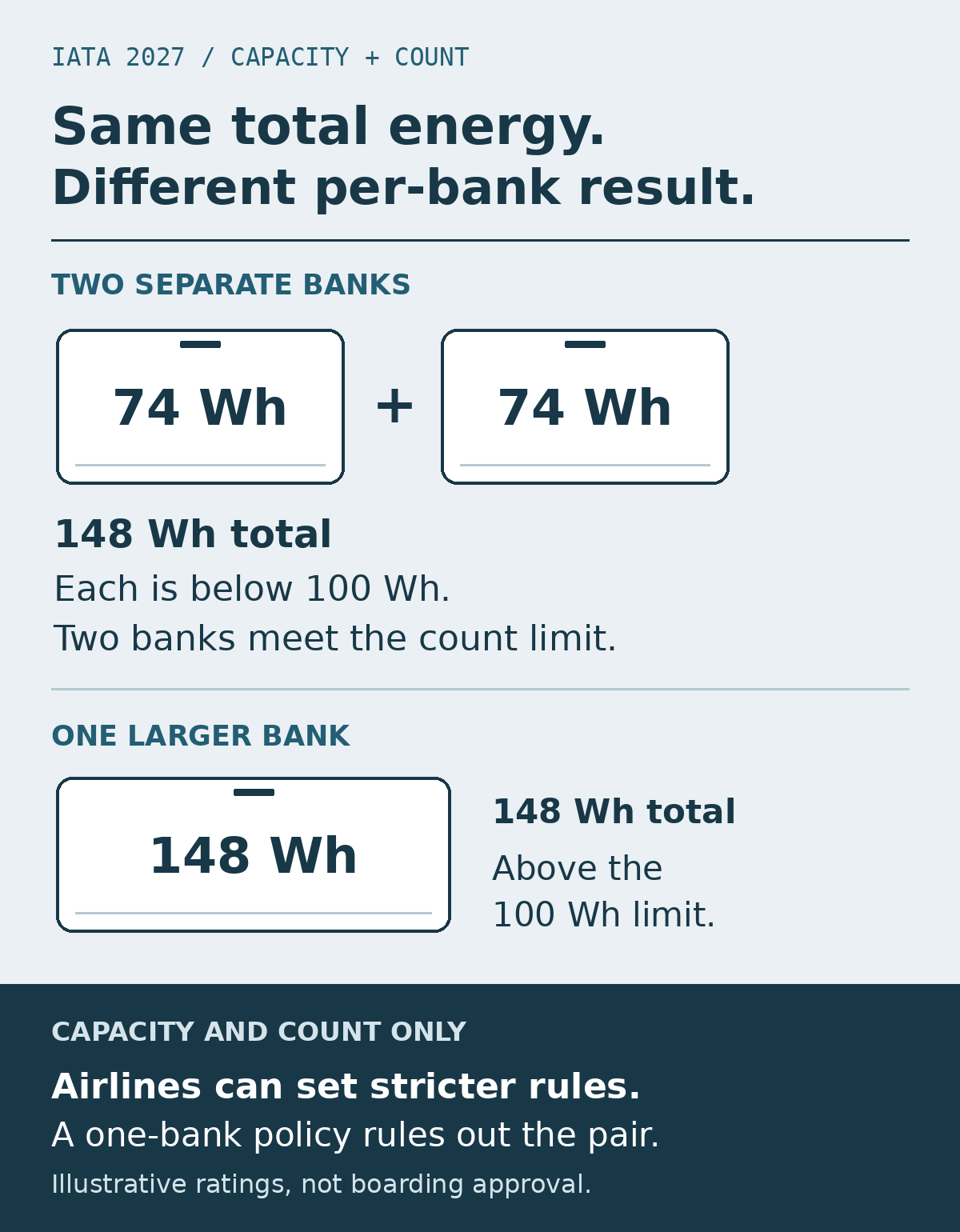
Both arrangements total 148 Wh. The test applies to each power bank separately, alongside the limit on how many a person carries. A stricter one-bank airline policy would rule out the two-bank arrangement even though each unit is below 100 Wh.
Why official pages can give different answers
International standards, national implementation and airline conditions do not always move together. IATA’s operator guidance explicitly says enforceability depends on each state’s adoption process. Some changes apply immediately; others require administrative or legislative steps.
The United States offers a concrete example. PHMSA’s October 27, 2026 harmonization proposal proposes the two-bank cap and prohibition on recharging. It is a proposed rule, with comments due December 28, not a final U.S. rule. That distinction still holds in the records checked for this article on November 11, 2026.
Airlines can also be stricter. Emirates’ August 2025 announcement specified one bank from October 1, 2025. Lufthansa’s battery page, checked for this article, specifies two, bans onboard use and recharging apart from approved medical-device use, and prohibits overhead-locker storage. These examples show variation; neither a dated announcement nor this article replaces the current terms for your flight.
If two official pages conflict, check their dates, which battery category they describe, and whether the wording is mandatory or advisory. An older general table about spare batteries may not answer a newer, power-bank-specific question. When the distinction affects the bank you intend to bring, seek clarification from the operating airline before departure.
The 2027 claim here rests on IATA’s public change summary. The full licensed 2027–2028 ICAO manual was not reviewed, so it would be misleading to call this a separately verified, universal ICAO ban.
“Charging” has two directions
Plugging a bank into the aircraft to refill it is different from plugging your phone into the bank. ICAO prohibits the first and recommends against the second. The UK Civil Aviation Authority’s explanation preserves that distinction.
An airline can prohibit both, as Lufthansa does for ordinary passenger use. Permission to carry a bank therefore does not automatically include permission to use it. Check storage, too: “carry-on only” does not necessarily mean “leave it in the overhead bin.”
A short check before you pack
Read the label and check the condition. Find the Wh rating and manufacturer documentation. Check for recalls; do not travel with a damaged or recalled bank.
Check each operating airline. Look at capacity, count, storage and use separately, including connections and the return flight. An outbound acceptance does not settle a later flight’s requirements.
Keep the bank in the cabin. If your carry-on is gate-checked, remove the power bank first. Protect it against damage and short circuits, using suitable individual protection. These precautions are emphasized in FAA PackSafe guidance.
Alert the crew promptly if something is wrong. If a bank becomes unusually hot, swells or smokes, tell the crew and follow their instructions.
The useful packing question is specific: does this labeled bank meet the rules for every flight on this trip? Answer that before reaching the gate, especially if your charger is above 100 Wh or your journey crosses into 2027.