The EU is not promising the return of the phone battery you could swap between the train station and the office. Its rules do not require every smartphone to have a tool-free, pop-off back. Covered smartphones already face battery-replacement requirements that began on June 20, 2025, with two permitted routes: ordinary-user replacement, or replacement requiring basic repair knowledge if stricter durability conditions are met.
The much-discussed February 18, 2027 date belongs to the broader Batteries Regulation. Understanding how those two laws fit together is more useful than waiting for a particular phone design that neither one promises. The European Commission’s current guidance explains the distinction.
Two dates, and a phone-specific rule
Article 11 of the EU Batteries Regulation introduces the general requirement for portable batteries incorporated into products to be readily removable and replaceable by end users, subject to exceptions. It applies from February 18, 2027, not January 1.
Even that general rule allows tools. Commercially available tools are permitted; necessary specialized tools must be supplied free with the product. Proprietary tools, heat and solvents are excluded from the general disassembly standard. “Readily removable” was never a universal promise that your fingernails would be the complete toolkit.
Smartphones have their own ecodesign regulation. In guidance published on October 22, 2026, the Commission explicitly says its removal and replacement provisions prevail for covered products. That is the Commission’s stated interpretation, although the guidance is nonbinding and final interpretation of EU law belongs to the Court of Justice.
This precedence is about removal and replacement. It does not erase the applicable spare-battery and software requirements from the broader law.
Scope matters, too. This explanation concerns ordinary smartphones covered by the ecodesign regulation, rather than every device that fits in a pocket. A folding screen does not, by itself, put a phone outside the rules. The legislation does exclude specified categories, including roll-up main displays, high-security communication phones and certain devices for potentially explosive environments.
The two smartphone replacement routes
The rules distinguish between a person with no specific repair experience, called a “layman,” and a “generalist,” someone familiar with basic repair techniques and safety precautions. Neither definition means a technician employed by the phone manufacturer.
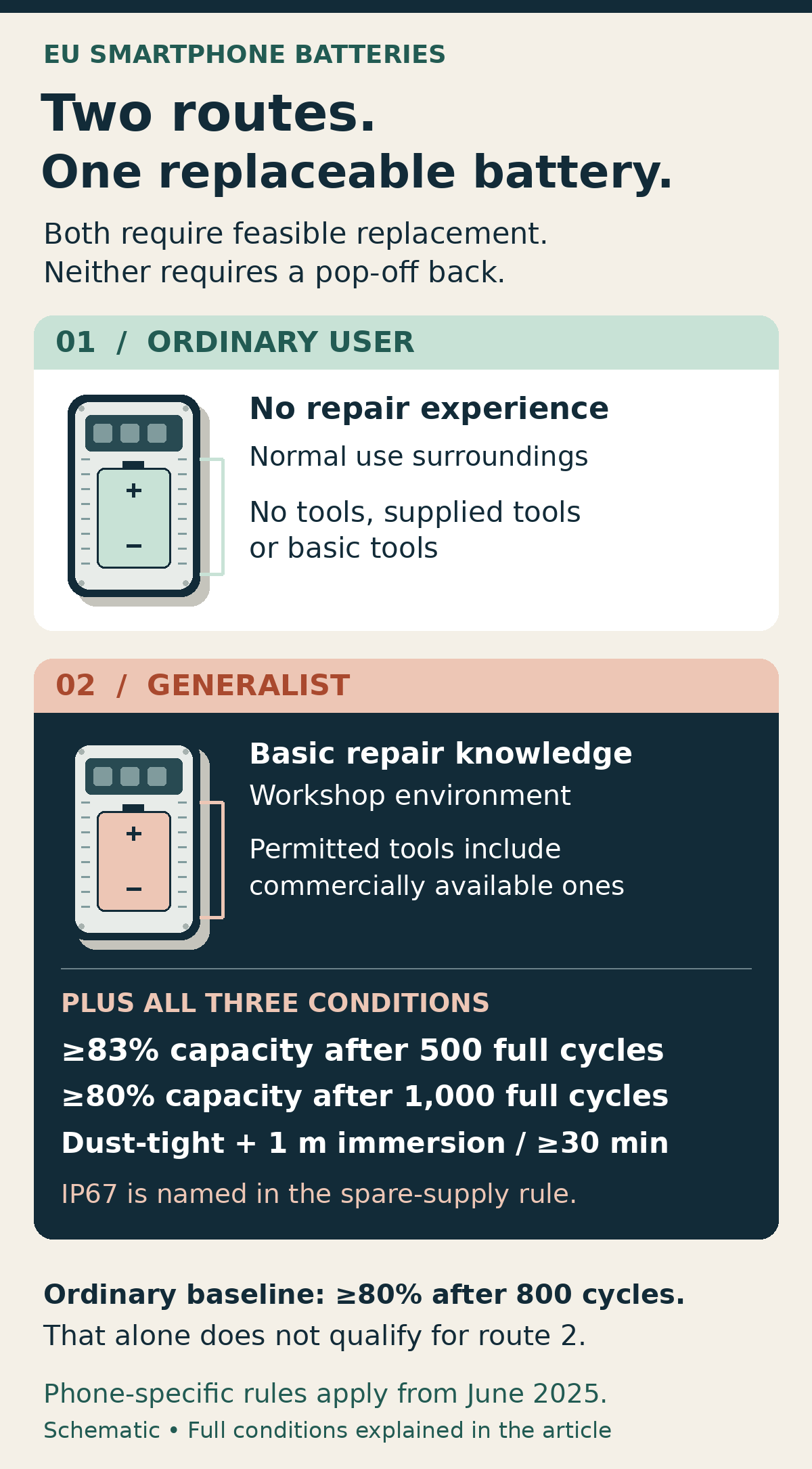
Diagram explained: The first route permits ordinary-user replacement in normal use surroundings, with no tools, supplied tools or basic tools. The alternative permits a generalist and workshop, including commercially available tools, but also requires at least 83% rated battery capacity after 500 full cycles, at least 80% after 1,000, and dust-tightness with protection during immersion to one metre for at least 30 minutes. IP67 is named in the matching spare-supply provision. The ordinary 800-cycle baseline alone does not qualify a phone for this alternative.
Route one: replacement by an ordinary user
Under the first route, battery replacement must be possible without specific repair experience and in the phone’s normal use environment. It may require no tools, tools supplied with the phone or replacement part, or basic tools. Fasteners must be reusable or supplied again.
The regulation’s basic-tool list includes familiar screwdrivers, a spudger and a pick. A phone can therefore satisfy this route without a battery door that opens by hand. The test is whether the specified person can perform the replacement under the specified conditions, not whether the phone resembles a favorite handset from 2008.
Route two: repair skills, plus greater durability
The alternative allows replacement by a generalist in a workshop, using the permitted tools, including commercially available ones. Feasible replacement and the relevant fastener requirements still apply.
Then come three cumulative conditions:
The battery must retain at least 83% of its rated capacity after 500 full charge cycles.
It must achieve at least 1,000 full charge cycles, retaining at least 80% of rated capacity at that point.
The device must be dust-tight and protected against immersion to one metre for at least 30 minutes.
The associated spare-battery provision expressly names IP67. A water-resistance badge alone is insufficient, and a manufacturer’s 1,000-cycle claim addresses only part of what would need checking.
The percentages concern the battery’s remaining capacity relative to its rated capacity after the specified cycling. They are not a promise that a phone will run for 83% of a day, or that every owner will reach the threshold after the same number of years. Keep those capacity measurements separate from how long a particular phone lasts between charges.
The ordinary smartphone minimum is 800 cycles at 80% remaining capacity. That baseline should not be confused with the tougher alternative. These thresholds and both routes appear in Annex II, Part B of the ecodesign regulation.
The obligations that survive the headline
Replacement needs more than an accessible battery compartment. Someone must supply the battery, and the phone must accept a compatible replacement.
Under ecodesign, spare batteries must remain available through at least seven years after the last unit of the model is placed on the market. That clock is tied to the model’s final market placement, not your purchase date. It is neither a seven-year warranty nor a promise of free batteries.
The ecodesign text allows manufacturers to restrict battery supply to professional repairers when its specified endurance and IP67 conditions are met. But Article 11 also establishes a five-year minimum spare-battery period after the last model unit’s market placement, with reasonable, nondiscriminatory prices for independent professionals and end users. The updated guidance’s spare-parts section says both sets of applicable requirements operate together. It would be misleading to turn the ecodesign exception into a settled answer to every direct-sale question after 2027.
Software is another part of the repair. Article 11 prohibits software from obstructing compatible battery replacement. Ecodesign requires nondiscriminatory access to the relevant tools for serialized replacement parts. The Commission again says the applicable obligations from both laws apply. A battery that physically fits but is blocked by software is not the outcome these provisions allow.
Water resistance is not a universal escape hatch
The smartphone alternative combines durability, water-and-dust protection and feasible repair. It should not be confused with the Batteries Regulation’s separate exception for certain wet-use appliances.
That exception concerns appliances designed primarily for regularly wet conditions and intended to be washable or rinseable, with a safety justification. The Commission’s guidance says an IP rating alone does not establish eligibility.
A supplementary act published in October 2026, entering into force on November 11, adds conditional categories including certain wearables and specialized devices. It does not create a blanket ordinary-smartphone exemption.
Nor should the general law’s heat-and-solvent restriction simply be pasted onto every phone repair claim while ignoring the prevailing phone-specific provisions. Whether a particular design satisfies all the relevant conditions requires checking that design. A broad headline cannot do the assessment.
What to check before buying your next phone
Start with the specific model’s repair documentation and battery-ordering options. Look for who can replace the battery, what tools and software are required, and how a compatible replacement can be obtained. The EU energy label and EPREL information also help compare repairability, battery endurance and protection against water and dust.
For a useful comparison, ask what the entire replacement involves, rather than checking only whether a spare battery appears in a parts catalog. A user-repair route and a workshop route can lead to very different experiences for the owner, even though both are permitted.
These are market-placement rules, not an instruction to retrofit the phone in your drawer. As the EU’s product-rules guide explains, placement concerns each individual unit’s first supply on the market, not simply the model’s launch or every later shop sale.
The rules also do not promise identical US or worldwide designs. Even “the UK” needs care: official UK guidance distinguishes the EU battery regime applying in Northern Ireland under the Windsor Framework from the separate regime in Great Britain.
A model’s repair manual will tell you more about your eventual battery replacement than a mock-up of an unreleased phone. Look for a workable replacement process and a dependable supply of parts. A pop-off back would be one way to make replacement convenient, but it is not the design these EU rules universally require.