A grocery outage can leave two things untouched: the food on the shelves and the money in your account. The failure sits between them, in the systems that complete the sale.
Having some cash can help when a card-payment channel fails. It depends on a shop that can still operate and accept the cash. If the checkout is unusable or the branch has closed, offering banknotes does not restore its ability to sell.
That makes cash a useful part of household preparedness, with a narrower job than people sometimes give it: paying for essentials through a functioning alternative route. You do not need to predict a national food shortage for that option to matter.
The purchase has more than one moving part
A failed card transaction does not establish that the store has run out of food, that your bank has lost your money or that a cyberattack is responsible. The problem could involve the payment service, the merchant’s connection or another part of the checkout. The current store notice is more informative than guessing from one error message.
A documented example came in Canada on July 8, 2022. Interac says the Rogers network outage made its services unavailable. It later reported added carrier diversity and backup connectivity. This is a dated network-outage example, not a cyberattack case or proof that the original weakness remains unchanged.
The lesson is about dependencies. A second app or card may still share a failed provider, connection or device. Counting the options in a wallet is not the same as checking which ones work during the particular disruption.
Why a little cash can be useful
Michigan’s official preparedness guidance recommends keeping a small amount of cash safely at home, with small bills, because ATMs and credit cards may be unavailable when people need essentials.
Cash already on hand avoids relying on a successful withdrawal during the problem. Small denominations can also make a modest purchase easier if the merchant has limited change. Neither advantage guarantees acceptance at every shop.
Before filling a basket during an outage, establish whether the branch is selling and which payment methods it can currently accept. That is a practical question about the store’s operation. A general preparedness checklist cannot answer it for every retailer.
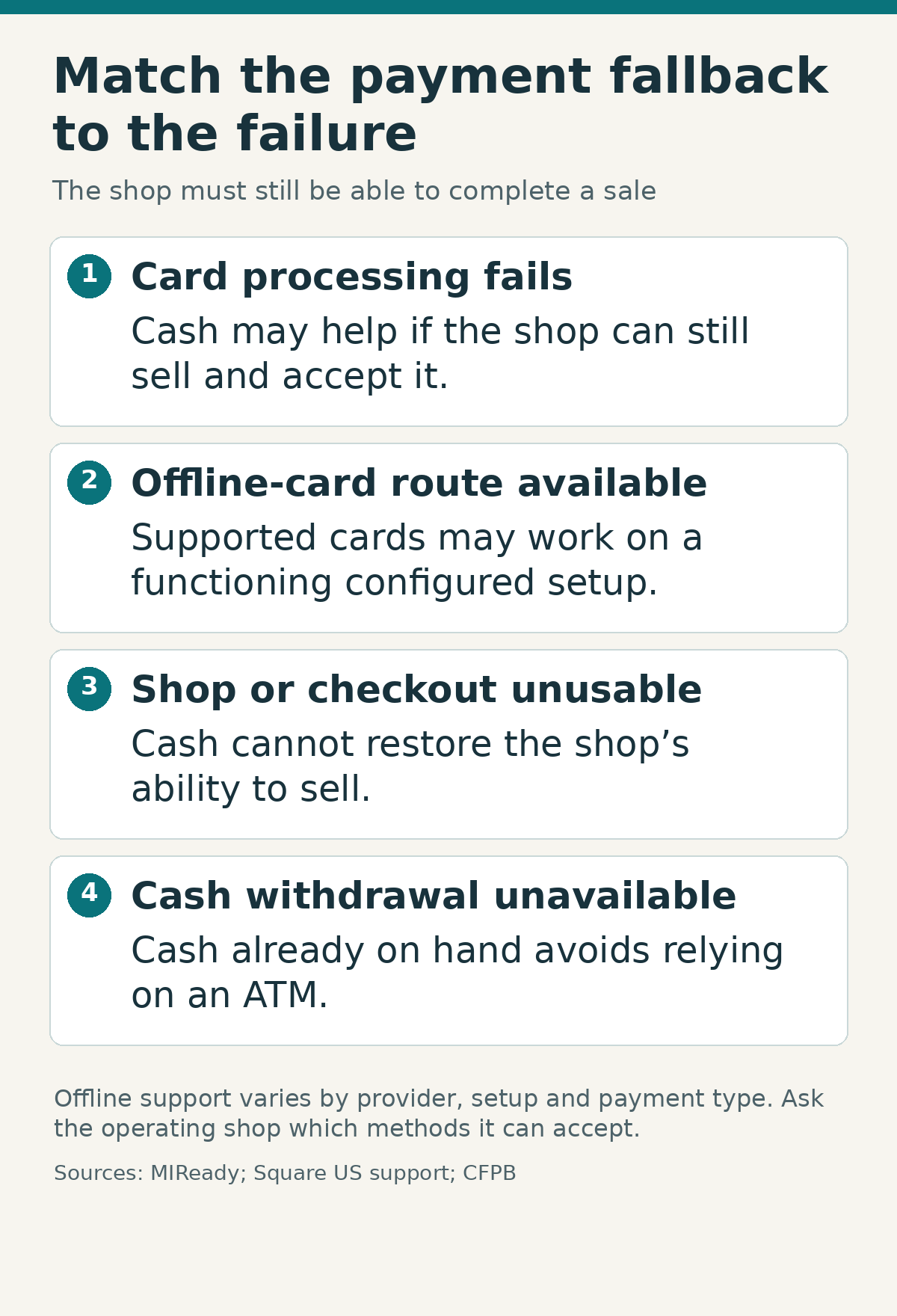
The graphic distinguishes a card-processing problem, a supported offline-card arrangement, a disabled checkout or closed shop, and an inability to withdraw cash. The useful fallback changes with the failure; no single method guarantees a completed purchase.
Plan around what you would still need to buy
A useful cash target starts with the household’s remaining purchase needs. It does not start with a universal dollar amount or a percentage of the money in your savings account.
First, check what you already have. If there is suitable food and safe water at home, those supplies reduce the purchases you would need to make immediately. Avoid treating a full replacement grocery order as the default emergency shopping list.
Second, identify the essentials still missing over the period you are choosing to prepare for. Keep the list specific to your household. Include an essential trip cost if reaching another operating shop would require one, rather than treating all the cash as grocery money.
Third, use your own recent spending or receipts to estimate those purchases. The result is a planning input, not a prediction of outage prices or a promise that the listed products will be available.
Finally, choose an amount you can reasonably keep available, in usable denominations, while meeting current obligations. A plan that creates another financial problem is not automatically better because its cash envelope is larger.
This is a short purchase-access exercise. The broader task of starting an emergency fund with limited money is different. A reserve held in a bank account and physical banknotes are not interchangeable during every kind of outage.
Some cards can work offline, with specific limits
It would also be wrong to assume that every card payment stops the moment a connection fails. Square’s US support documentation, for example, describes cash and selected offline-card options on supported merchant setups.
The restrictions matter. The page excludes EBT/SNAP, Cash App Pay and Square’s merchant Tap to Pay feature on iPhone and Android from offline support, among other limits. That merchant feature is not a blanket description of every consumer phone wallet. Hardware, apps, settings and payment type affect the options.
Square is one concrete provider example. Its documentation does not establish the contingency procedure of your supermarket. If staff say a payment method is unsupported during an incident, the useful next step is to identify an accepted method or another operating shop, rather than assuming that an offline feature must be available everywhere.
Keep the cash reserve proportionate
Physical cash has its own disadvantages. The Consumer Financial Protection Bureau notes that money kept on hand can be stolen, lost or destroyed. Its emergency-fund guidance also recognizes that the appropriate reserve depends on the household’s situation.
Keep any cash fallback secure and accessible to the people who may need to use it. Avoid turning a limited purchasing backup into a reason to withdraw long-term savings or keep large sums at home. If spare cash is difficult to find, start with the options already available and the purchases that are actually essential.
Food on hand and a usable payment method solve related problems. Supplies can reduce the urgency of the next purchase. Cash can widen the ways to pay for what is still needed. An operating shop and available stock remain part of the equation.
That is why preparedness advice extends beyond the contents of a cupboard. A temporary failure in the path from bank balance to shopping bag can matter well before supplies run out.
Sources