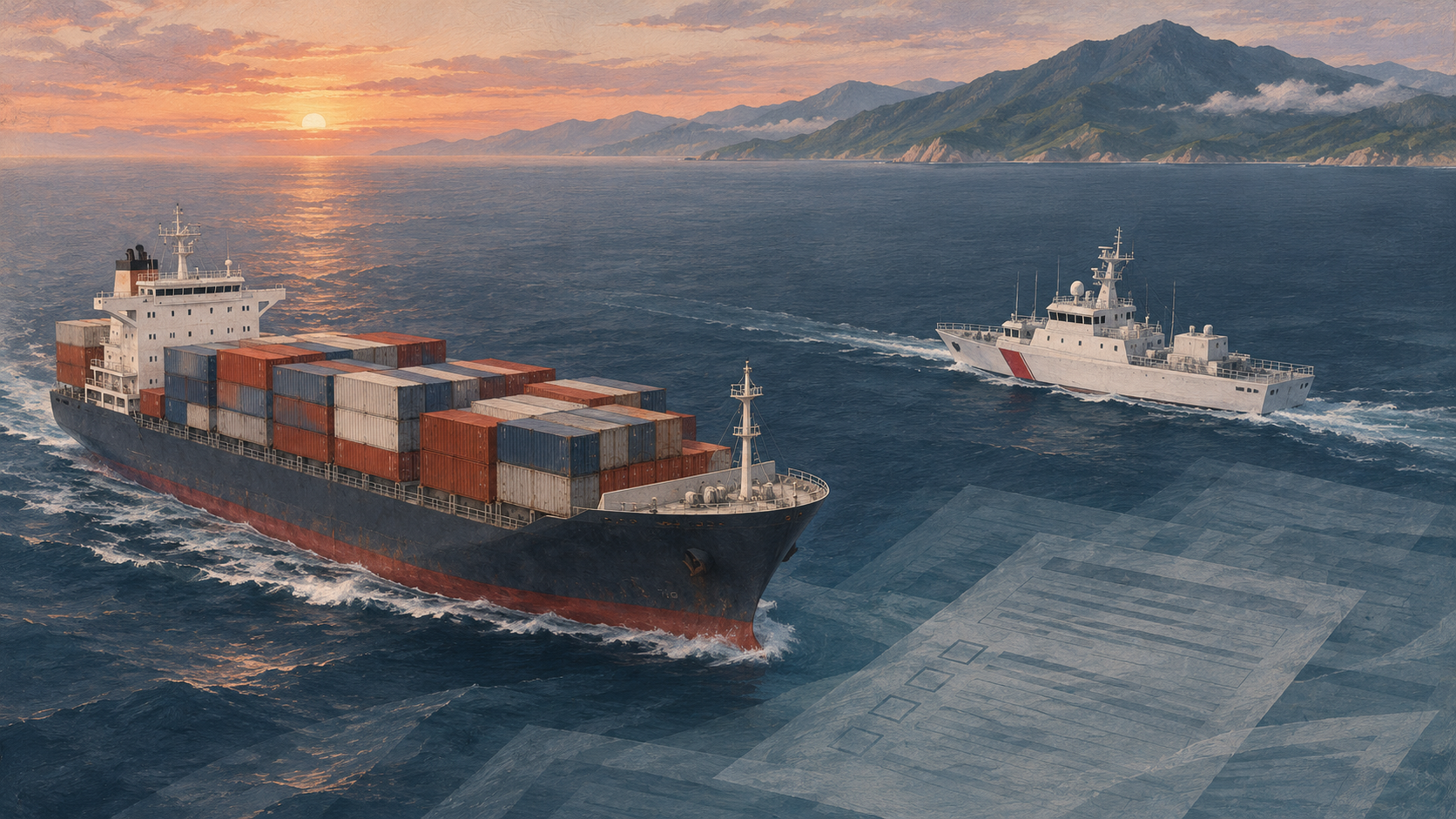
A demand to complete a customs declaration sounds like a dull beginning to an international crisis. For Taiwan, it could carry an extraordinary question: whose permission does a ship need to reach the island?
That question sat at the center of a Taiwanese government exercise in June. The scenario imagined China requiring ships entering or leaving Taiwan’s ports to submit declarations through a Chinese system, followed by inspections, boardings and possible detention. It explored how administrative demands could interfere with the movement of supplies before an invasion had begun.
The scenario offers a useful way to understand the coast guard activity attracting attention around Taiwan. China could try to pressure the island by making commercial shipping obey its rules. That would create a contest over practical control, even while Beijing described its actions as ordinary law enforcement.
The recent patrol dispute does not establish that such a system is operating. It does show why the difference between a ship passing nearby and a ship claiming authority deserves close attention.
The contest begins with a claim of jurisdiction
On October 31, a China Coast Guard statement republished by Xinhua described a Hushi-led formation conducting regular law-enforcement patrols east of Taiwan. It said the formation had strengthened control over the relevant waters during October.
Taiwan rejected that description. In CNA’s account of the response, Taiwan’s Coast Guard Administration said it was monitoring two Chinese coast guard ships and accused Beijing of using radio communications and patrol announcements to manufacture an impression of jurisdiction.
Those are competing claims about authority. A patrol announcement tells us what China wants an operation to be called. Taiwan’s response tells us that the claim is being challenged. Neither announcement, by itself, demonstrates that commercial carriers have accepted a new inspection regime.
That distinction matters when reading a map crowded with ship icons. Position is one part of the story. The consequential development would be a change in what ships are required to do—and what happens when they refuse.
Commercial compliance can become the pressure point
An invasion would involve an attempt to take territory through military force. A maritime coercion campaign could pursue a more limited immediate objective: making companies behave as though Beijing controls access to Taiwan.
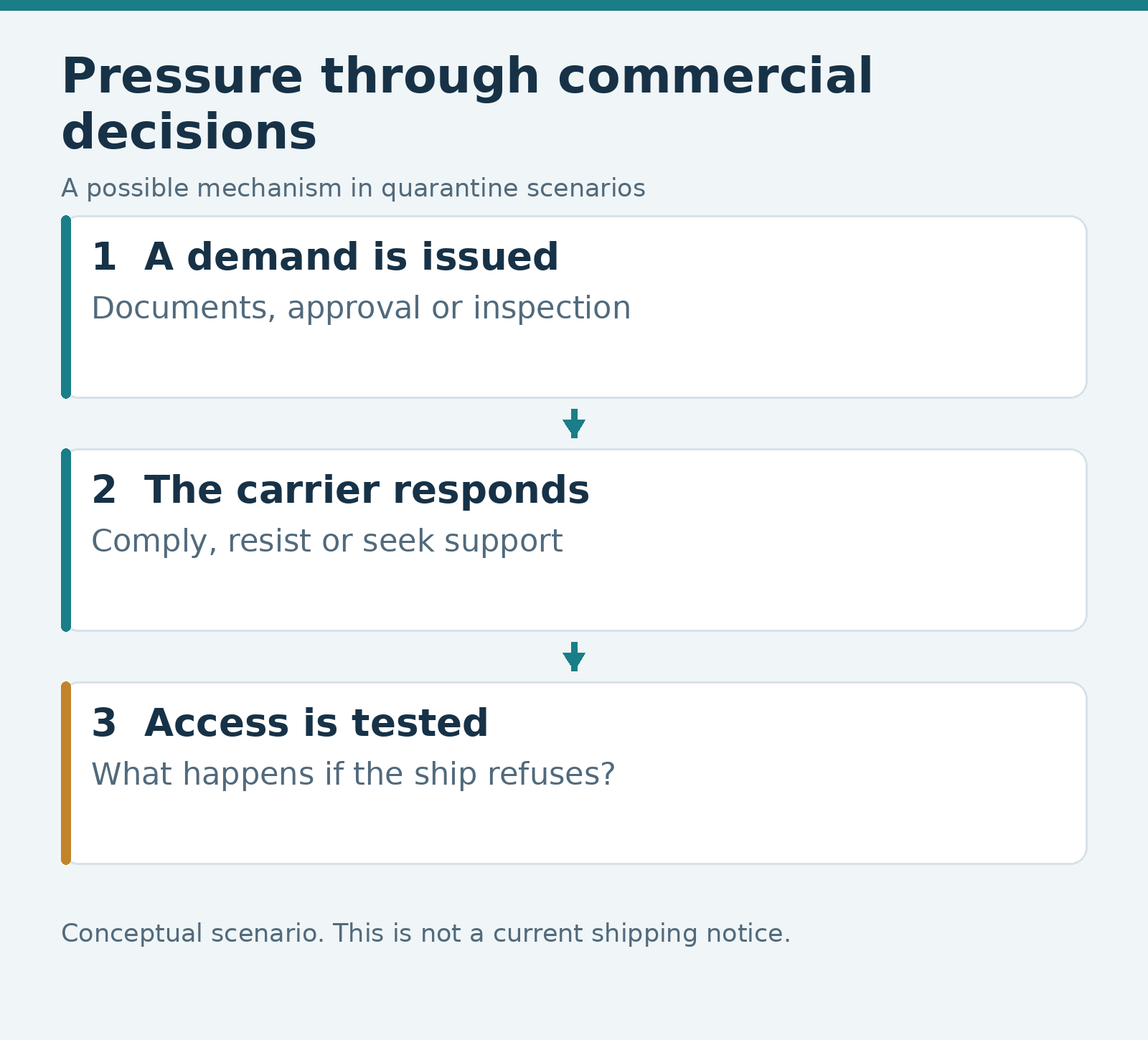
Imagine a shipping company receiving an inspection demand while its vessel is approaching the island. The company would face several decisions. Should it provide documents? Should its captain stop? Would compliance reduce immediate danger while helping establish a precedent? Could refusal leave the ship waiting, diverted or exposed to confrontation?
These are illustrative choices, not a report of a new order. Their significance is that a government can seek political results through decisions made by private firms. Captains, fleet operators and cargo owners would have to manage immediate operational uncertainty while governments argued over the larger principle.
CSIS’s quarantine research examines that mechanism. Its scenarios use law-enforcement-led controls to seek compliance from shipping companies and other actors. The objective is to demonstrate influence over access without necessarily stopping every delivery.
A demand can therefore matter before many ships have been boarded. If enough companies follow it, the authority issuing the demand gains practical influence. If they refuse and continue sailing, the authority must decide whether to enforce its claim, tolerate defiance or change course.
Taiwan has already rehearsed the paperwork problem
The June 25 exercise presentation published by Taiwan’s Presidential Office makes the administrative element unusually concrete. Its imagined sequence began with declaration and approval demands and developed into interference with maritime transport.
The exercise involved eleven government departments. It examined contact with merchant shipping, the protection of energy and essential supplies, and coordination across agencies. The presentation describes a discussion exercise in which participants played Taiwan’s side; it was not a competitive simulation demonstrating what China would successfully achieve.
That limitation is useful. An exercise establishes that officials are preparing for a problem. It does not show that the problem will occur, or that the preparations would work exactly as intended.
The meeting minutes also record concerns about coordination and information flow. Those are central to this kind of crisis. A captain would need reliable guidance. A ministry would need to know whether a demand was isolated or part of a wider campaign. Public messages would need to distinguish an assertion of control from a restriction that was actually being enforced.
The paperwork problem is therefore also an information problem: who issues instructions, who verifies them, and who can help a vessel facing pressure?
Patrol, inspection, quarantine and blockade describe different things
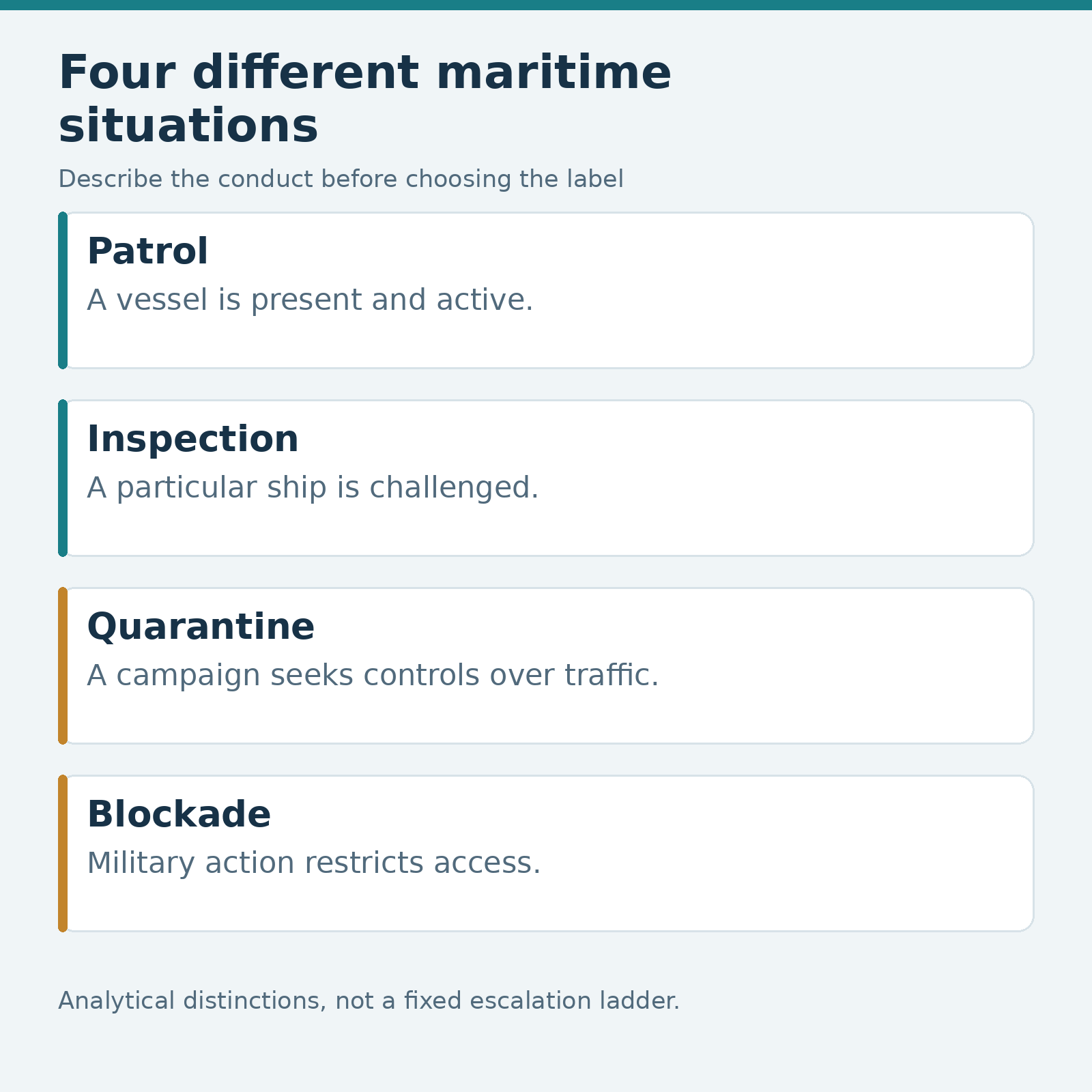
These terms can become interchangeable in fast-moving coverage. Keeping them separate makes the evidence easier to assess.
A patrol is a presence and activity. It may communicate a claim, monitor traffic or support another operation. Its existence does not automatically show that trade is being controlled.
An inspection is an action or demand directed at a vessel. It raises questions about the claimed authority, the ship affected, whether anyone boarded, and whether the voyage continued.
In the CSIS framework, a quarantine is a campaign led by law-enforcement forces to impose controls over traffic. A blockade is principally a military operation to restrict flows. These are analytical distinctions, rather than assurances that an action described as a quarantine would be lawful, peaceful or easy to contain.
RAND’s earlier quarantine analysis likewise treats access to Taiwan as a source of political and economic leverage. Its value here is the examination of choices and escalation problems. Its research was completed in 2022, so it should not be read as a current operational assessment.
The label would matter less to a delayed ship than the conduct behind it. A narrowly framed inspection demand could become more serious if accompanied by repeated diversions, detention or force.
Limited pressure could still produce wider consequences
An operation would not have to stop all trade to create difficult choices. Selective interference could leave some ships moving while others faced uncertainty. That could complicate the simple public question of whether Taiwan was “open” or “closed.”
The more useful questions would concern particular services and routes. Which vessels were affected? Were demands applied consistently? Did ships continue to call at the intended ports? Were essential supplies reaching their destinations?
The effects would depend on commercial behavior as well as government action. A company might comply with a demand to protect its crew and cargo. Another might seek support before proceeding. Those responses could change the pressure campaign’s effectiveness without a dramatic clash appearing in a video clip.
This also explains why warnings about inspections should not be converted into instant claims of shortages. There are several steps between an announced demand, an enforced restriction and a measurable interruption in supplies. Each requires evidence.
Taiwan’s exercise linked shipping communications with supply management because those functions would have to work together. Knowing that a vessel has been challenged is different from knowing which cargo will arrive late and what alternatives remain available.
The strategy would face resistance and escalation risks
Calling an operation law enforcement would not make other governments or shipping companies accept it. Taiwan could challenge demands, maintain contact with vessels and deploy its own coast guard. Other governments would face choices about diplomatic pressure and support for navigation.
China would also have to manage the gap between an assertion and sustained enforcement. The CSIS scenarios emphasize the coordination and logistics required for a large quarantine. Maintaining pressure across changing traffic, companies and foreign responses would be much more demanding than publishing a patrol statement.
The possibility of escalation runs through all of these choices. A company’s refusal might expose a weakly enforced claim. An attempt to compel compliance might produce a confrontation. A crisis that began with documents could become dangerous because documents were never the only thing at stake.
Watch what ships are made to do
The clearest evidence of a change would be specific and observable: an actual notice setting requirements, a documented boarding, a vessel diverted, a company explaining its response, or a sustained pattern of interference with port access.
Those developments would carry more weight than another broad claim that control had been strengthened. Reports should also distinguish operations around Taiwan’s outlying islands from activity affecting the main island’s commercial routes.
A ship can be present without controlling a route. A government can issue a demand without securing compliance. The practical test is whether ships reaching Taiwan must change their behavior because someone else has acquired the ability to make them do so.
Sources