

A hospital does not have to be flattened for its patients to lose essential care. Electricity can fail, medical refrigeration can be interrupted and water can become harder to supply safely. A building may remain standing while the services that make it useful become unreliable.
That is the civilian question behind reports that the United States has considered using the MOAB in Iran. The weapon’s nickname, the mother of all bombs, draws attention to the explosion. The consequences of damaging infrastructure can continue through the systems connected to it.
As of November 2, the reporting describes a military option rather than a publicly confirmed order to use it. The distinction matters. So does another: MOAB is a conventional weapon. Assessing its humanitarian consequences does not require confusing it with a nuclear bomb or assuming every reported energy target is a power plant.
The reports describe options, with important differences
CNN reported in October that U.S. planning included possible MOAB use against Iranian energy infrastructure and nuclear-related sites, citing officials familiar with the discussions. Its account also described doubts about whether deploying the weapon would deliver Trump’s strategic objectives.
A separate planning account on ABC News’ Iran live page named petrochemical and nuclear-related targets while carrying a source’s statement that power plants were excluded from the plans described.
Those accounts should not be folded into a single, confirmed plan to attack Iran’s electricity network. They may concern different options, versions of planning or meanings of infrastructure. A live page’s latest update also does not establish when every embedded account was first reported.
For readers, the useful questions are specific: which category of facility is being discussed, what purpose would an attack serve and has any option actually been chosen? The existence of a large bomb does not answer them.
A large air blast is a different tool from a penetrator
The U.S. Air Force handbook distinguishes the GBU-43/B Massive Ordnance Air Blast, or MOAB, from the GBU-57 Massive Ordnance Penetrator, or MOP. The names sound related, but the weapon categories have different purposes. MOP is associated with hardened underground targets.
That distinction is especially important when discussion moves between above-ground infrastructure and a complex buried beneath a mountain. A claim about destructive effects in one setting cannot simply be transferred to another.
The official record of MOAB’s April 2017 use in Afghanistan documents a strike against an ISIS-K cave-and-tunnel complex. That episode is historical evidence of use. It does not establish a guaranteed result at an Iranian facility, or resolve the separate question of whether a strike would help end a war.
The word conventional also deserves care. It identifies the weapon category; it is not a synonym for limited civilian consequences. The relevant questions still include what is nearby, which services depend on the damaged infrastructure and what can keep operating afterward.
Iran already has records of service disruption
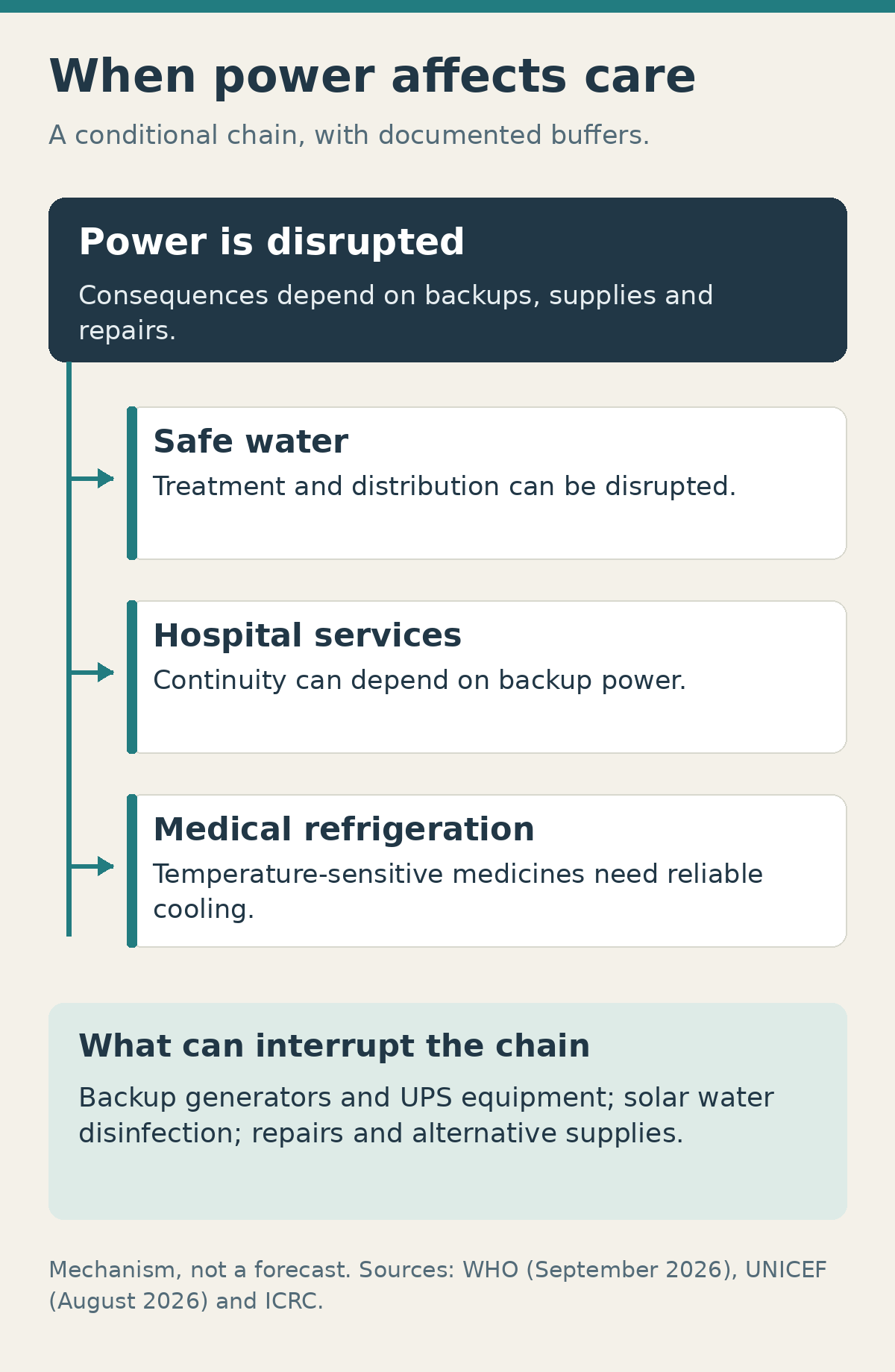
The civilian-service mechanism has a documented Iranian basis. In its September 15 situation report, WHO included Iranian health-authority accounts of electricity damage disrupting hospital power and the refrigeration of vaccines and medicines. The report also described pressures on safe-water services.
These are dated observations from the existing conflict. They are not evidence of damage caused by a future MOAB strike, and they should not be presented as a current November tally.
Their value is more practical. They show that the connection between infrastructure and care is already part of Iran’s humanitarian response. A discussion of future risks can start with those documented dependencies rather than inventing a national collapse scenario.
The report also highlights why physical damage is an incomplete measure of the problem. A damaged service can affect people who are far from the damaged structure, including patients relying on medicines or treatment that must remain available every day.
Backup equipment changes the picture
The same WHO report says the organization delivered generators and uninterruptible power supplies to six hospitals. That is an important part of the story. The response is not simply a list of vulnerabilities; it also includes measures intended to preserve care.
UNICEF’s August account of emergency water and sanitation support in Iran documents solar-powered disinfection equipment, water-quality monitoring tools and wastewater pumps supplied to affected areas. Some of that equipment is specifically intended to keep water safe during power disruptions.
Those records support a more useful explanation than either reassurance by assumption or catastrophe by assumption. Backup systems can reduce the consequences of an interruption. Evidence that equipment has reached some facilities does not establish the coverage or endurance of every facility’s protection.
The unanswered questions are about resilience: how much service can be maintained, for how long, through what alternatives and with what repair capacity? The available humanitarian records do not provide a nationwide answer. They do show why mitigation must be included in any honest account of the risk.
Harm can continue through connected services
The ICRC’s explanation of essential infrastructure describes interdependent services and consequences extending beyond an immediate impact area. Electricity, water, sanitation, health care and refrigeration do not operate as isolated systems.
If a disruption defeats the relevant backups, the people affected may include those whose homes or hospitals were never directly struck. If alternative supplies hold or repairs restore service quickly, the consequences can be smaller and shorter. Both paths belong in the analysis.
WHO’s regional emergency overview identifies difficulties accessing treatment and medical supplies across the affected region. Its regional scope should remain intact; it is not a catalogue of effects caused by one weapon in one country.
For an individual patient, the distinction between direct and indirect harm may be less important than whether care remains available. For a reader assessing a proposed operation, the distinction helps explain why counting damaged buildings alone misses part of the humanitarian question.
Civilian infrastructure has legal protection
Civilian infrastructure is more than a casual description of something people use. Civilian objects have protection under the laws of armed conflict. Some infrastructure with civilian functions may also serve military purposes, but dual use does not itself settle whether an attack would be lawful.
The ICRC explains that a military-objective assessment is required, alongside consideration of foreseeable civilian harm, proportionality and precautions. It rejects broad economic coercion as a sufficient justification for attacking energy infrastructure.
The U.S. Department of Defense’s law-of-war manual takes a broader view of economic objects supporting an adversary’s war-sustaining capacity. That difference in interpretation deserves explanation rather than a blanket claim that every energy installation is either always protected from attack or always a lawful target.
For any particular proposed strike, essential facts remain missing from the public account: the object’s relevant function, the anticipated military advantage and the foreseeable civilian consequences. The name of the weapon cannot substitute for that assessment.
A spectacular explosion does not settle the political problem
The doubts described in CNN’s reporting reach beyond the blast. Destruction of infrastructure and achievement of a political objective are separate results. A weapon could cause severe damage without producing concessions, ending nuclear uncertainty or bringing a conflict to a durable conclusion.
That separation is the central strategic test. What would the operation change afterward, and how would that change advance an achievable objective? A dramatic image of an explosion would demonstrate that an explosion occurred. It would not, by itself, answer either question.
GripRoom’s guide to possible Iran strikes after the midterms addresses the separate political timing and negotiation questions. The election calendar does not determine the munition, the target or the consequences.
The most informative future reporting would identify an actual decision and its stated objective. The civilian assessment would then need to follow the affected services, their alternatives and their restoration. The consequences would be measured in the care, water and other services people could still obtain after the immediate damage, and in how quickly reliable access returned.