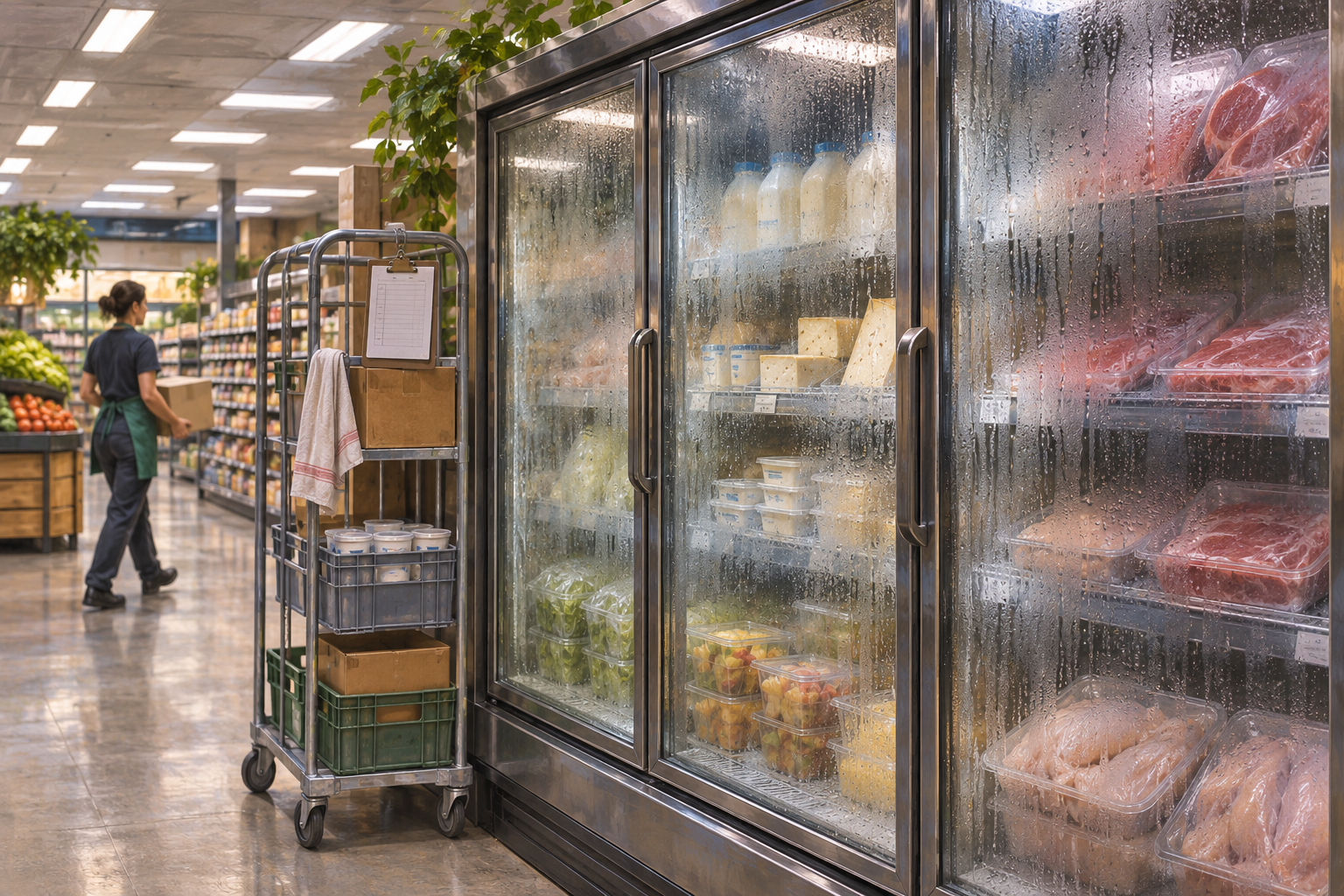
A supermarket can have electricity and still lose the food in its refrigerators. The vulnerable part can be the controls that tell the equipment what to do. A functioning power supply does not guarantee that the machinery is receiving the right instructions.
That is the disturbing household lesson from Europe’s refrigeration incidents. A cyberattack does not have to close every business or cause a dramatic blackout to interfere with dinner. It can make a particular category of food unavailable at the store people normally use.
The practical question is how far that problem spreads: which products are affected, how long the disruption lasts, what alternatives shoppers have and how quickly the retailer can replace withdrawn stock. Those questions are more useful than treating every damaged freezer as evidence of an approaching national shortage.
The European incidents reached the food itself
France’s CERT-FR published an alert about compromised remote refrigeration controllers on October 12, 2026, and updated it on October 16. Its recommendations include checking equipment configuration, specifically defrost schedules. The alert concerns control of physical equipment, rather than simply a retailer’s website being unavailable.
On November 2, fresh reports described refrigeration problems at supermarkets in several European countries. Musgrave, the group behind SuperValu, said an incident involving a particular refrigeration model had affected 13 stores. It removed chilled and frozen products as a precaution while keeping other products available, according to its statement carried by ESM Magazine.
The recovery update matters as much as the initial alarm. Later that day, Musgrave told Agriland that the incident had been resolved while replenishment continued. Restoring normal equipment operation and replacing the affected range were different parts of recovery.
Other retailers described limits to the disruption. Delhaize said its distribution centres and store deliveries were operating normally, in reporting by the Associated Press. That is material evidence about the supply chain, even when individual shops have lost access to some fresh and frozen goods.
The incidents justify concern about food access. They also show why the latest operating statement deserves a place beside the first report of losses.
A cooling failure can hide inside an ordinary-looking shop
Electricity, equipment control and safe stock are separate conditions. A building can have power while a cooling system is behaving incorrectly. A refrigeration unit can later be restored while some products remain unavailable. A shop can be open while a section of its usual range has been withdrawn.
These distinctions explain the headline’s “lights stay on” scenario. It describes what a control failure can do. The available reporting does not establish the electrical condition of every affected European store, or mean that each refrigerator continued receiving power throughout its incident.
The distinction also changes what a household can infer from appearances. A bright aisle or a running checkout is reassuring about those particular functions. It does not provide the time-and-temperature history of the food behind the cabinet glass.
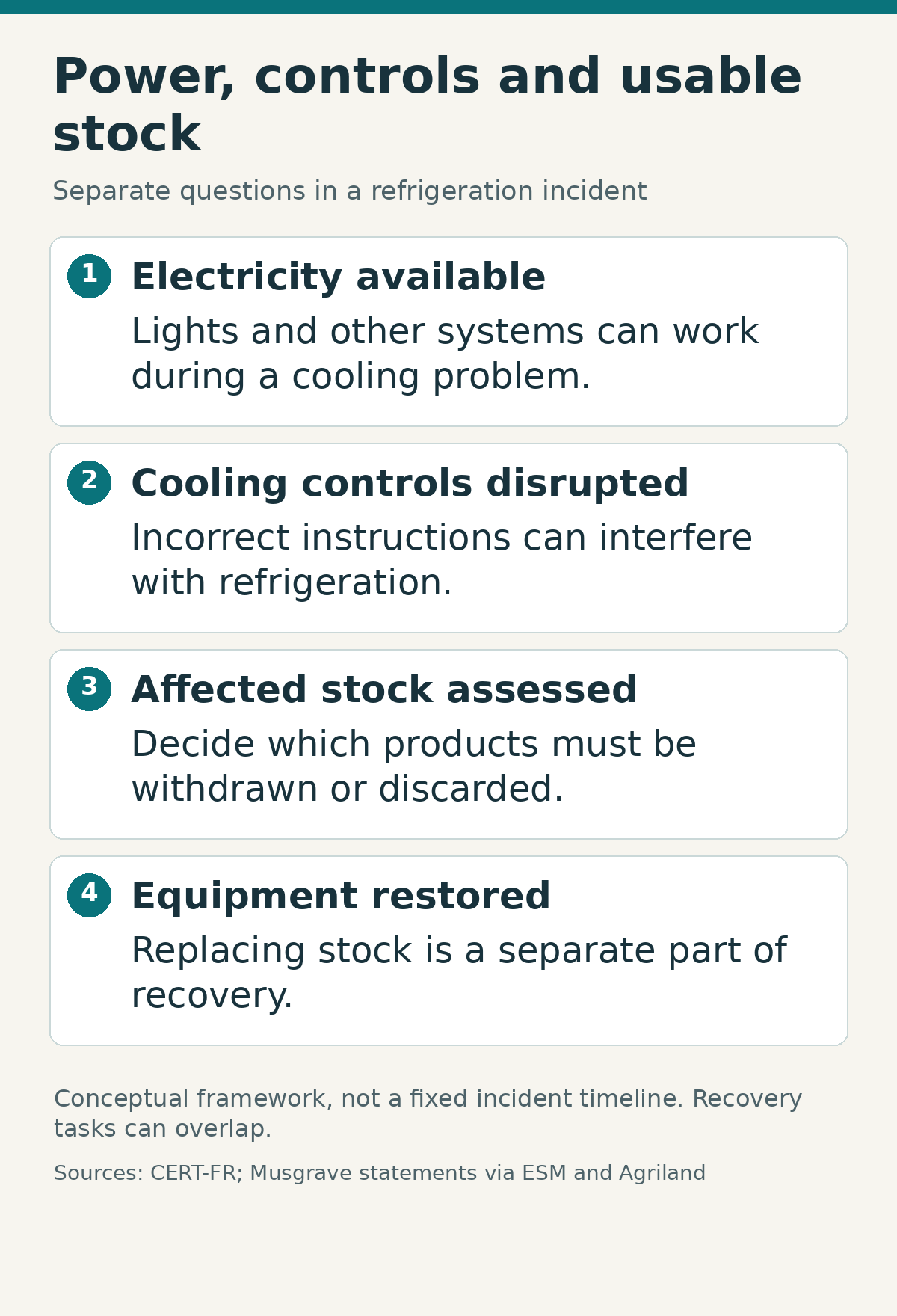
The graphic separates available electricity, disrupted cooling controls, a decision about affected stock and replenishment after equipment recovery. No single one establishes that all the others are functioning normally.
A temperature setting is not the temperature of the food
Refrigeration stories can contain several different measurements. A controller’s target setting, the air temperature inside a cabinet and the temperature reached by a product are not interchangeable. A reported high setting should not quietly become a claim that every item of food reached that temperature.
Time matters too. A brief intervention and a prolonged cooling failure can lead to different outcomes. Without product-temperature records, it would be misleading to calculate a precise food-safety window from a dramatic number in a headline.
Precautionary withdrawal is another separate observation. A retailer can remove products because it cannot establish that the necessary conditions were maintained. That decision protects customers; it does not prove that every removed item was spoiled. Equally, a product’s appearance is not a substitute for the missing safety information.
For shoppers, the useful action is to follow the retailer’s instructions about affected products and any official food-safety notice. The news that a chain has experienced an incident does not, by itself, establish that every purchase from every branch is affected.
The harder question is access, not just the number of stores
A count of affected shops provides only part of the picture. A small disruption can be a substantial problem for someone whose nearest alternative is difficult to reach. The same number of affected stores can have a different effect where customers have several practical substitutes.
Duration changes the burden. A temporarily restricted chilled aisle may be manageable during an ordinary shopping trip. Repeated unsuccessful trips, delayed replacement stock or a longer interruption can consume more money and time. These are conditional consequences, not established outcomes for every November 2 customer.
The shopping capacity that remains available matters as well. A store keeping dry goods on sale is offering a different level of service from a closed branch. A functioning distribution centre is valuable, but it does not tell a particular customer exactly when the product they need will return to their local shelf.
The evidence needed for a wider food-access story therefore includes the affected range, duration, customer alternatives and replenishment or distribution constraints. Reports of local losses alone cannot supply all of those answers. The inspected accounts do not establish a nationwide food shortage.
This is also where the worst case becomes more demanding than the initial attack. A broader, longer disruption would require evidence that the impact extends through meaningful shopping capacity or persists beyond available workarounds. Repetition and recovery difficulties could matter even without a single spectacular incident.
That possibility deserves investigation when new evidence appears. It should not be presented as something that has already happened simply because refrigeration equipment has a network connection.
Repairing the controller does not replace the groceries
The SuperValu update illustrates a recovery problem that is easy to miss. A retailer can say its equipment is operating normally while the replacement range is still being replenished. The statement can be accurate without promising that every usual product is immediately back in its usual place.
For a customer, the relevant question is often very specific: can this branch supply what I need today? A general recovery announcement may not answer that at product level. Checking the current branch information can be more useful than circulating an earlier report that the system was down.
For interpreting the news, keep separate accounts of the technical incident and its consequences. Equipment restoration, a decision about existing stock and replenishment each answer a different question. Combining them into one vague claim that the supermarket is “back” can conceal both real progress and remaining inconvenience.
The same discipline prevents the opposite error: treating a resolved equipment incident as continuing proof that the whole chain cannot function.
A modest cupboard reserve addresses the immediate problem
The household response does not require an elaborate prediction of which company will be attacked next. It starts with an ordinary purchase-access question: what could you eat if the food you expected to buy nearby was temporarily unavailable?
A small reserve of familiar, shelf-stable food gives more flexibility than relying on one shop’s chilled range for every meal. Michigan’s official emergency-kit checklist includes nonperishable food and says supplies should fit the household’s needs. Choose things your household will actually use, account for dietary needs, and include options that fit the cooking facilities you expect to have. Building that reserve gradually also avoids making one expensive emergency shopping trip the entry requirement for preparedness.
Its purpose is breathing room while you check the situation, find an alternative or wait for the local range to recover. It does not make a household independent of retailers indefinitely, or establish a duration for the next disruption.
That is the connection to the government stockpiling guidance. A reserve can be useful when the immediate difficulty is accessing food through ordinary services, even while food continues to exist elsewhere in the system.
Food already in the home needs its own safety decisions. The CDC recommends appliance thermometers, a refrigerator at or below 40°F and a freezer at or below 0°F. It also warns against tasting suspect food to determine whether it is safe.
Be careful with familiar power-outage rules. The CDC’s closed-door timing guidance concerns a loss of power. It does not establish a safe waiting period when equipment is actively behaving incorrectly or its temperature history is unknown.
The sensible takeaway is specific: a supermarket’s electricity supply, cooling controls and usable inventory can fail in different ways. A few ordinary meals already at home can reduce the need to solve all three problems at the checkout on the same day.
Sources