TikTok Mango Sticky Rice Hype: When Thai Dessert Is Worth Waiting in Line For
TikTok did not invent mango sticky rice. Let’s start there before some 19-year-old with a ring light and a tiny spoon claims rice achieved consciousness in 2024 because she filmed it from above.
Thai mango sticky rice, or khao niao mamuang, was already famous. It was already beloved. It was already sitting in Thai markets, restaurants, fruit stalls, and dessert shops being perfect without needing a trending audio clip or a caption like “RUN don’t walk.” The dessert did not need TikTok. TikTok needed the dessert, because the algorithm is always hungry and occasionally stumbles onto something that actually deserves the attention instead of another melted chocolate cup behaving like a plumbing emergency.
Mango sticky rice is simple: ripe mango, glutinous sticky rice, coconut milk, sugar, salt, and often roasted mung beans or sesame for crunch. The trick is that every part has to be right. The mango must be sweet and fragrant. The rice must be chewy but not gluey. The coconut sauce must be rich, salty-sweet, and warm enough to feel like it was made by someone with a soul instead of a squeeze bottle. Condé Nast Traveler notes that in Thailand the dish is especially common during mango season and often uses mango varieties like nam dawk mai and ok rong, with sticky rice that has absorbed coconut milk and a sweet-salty coconut topping.
That is why the hype works. Not because TikTok discovered Thailand like a colonial dessert goblin. Because mango sticky rice is engineered by tradition to destroy skepticism.
Why TikTok Loves Mango Sticky Rice
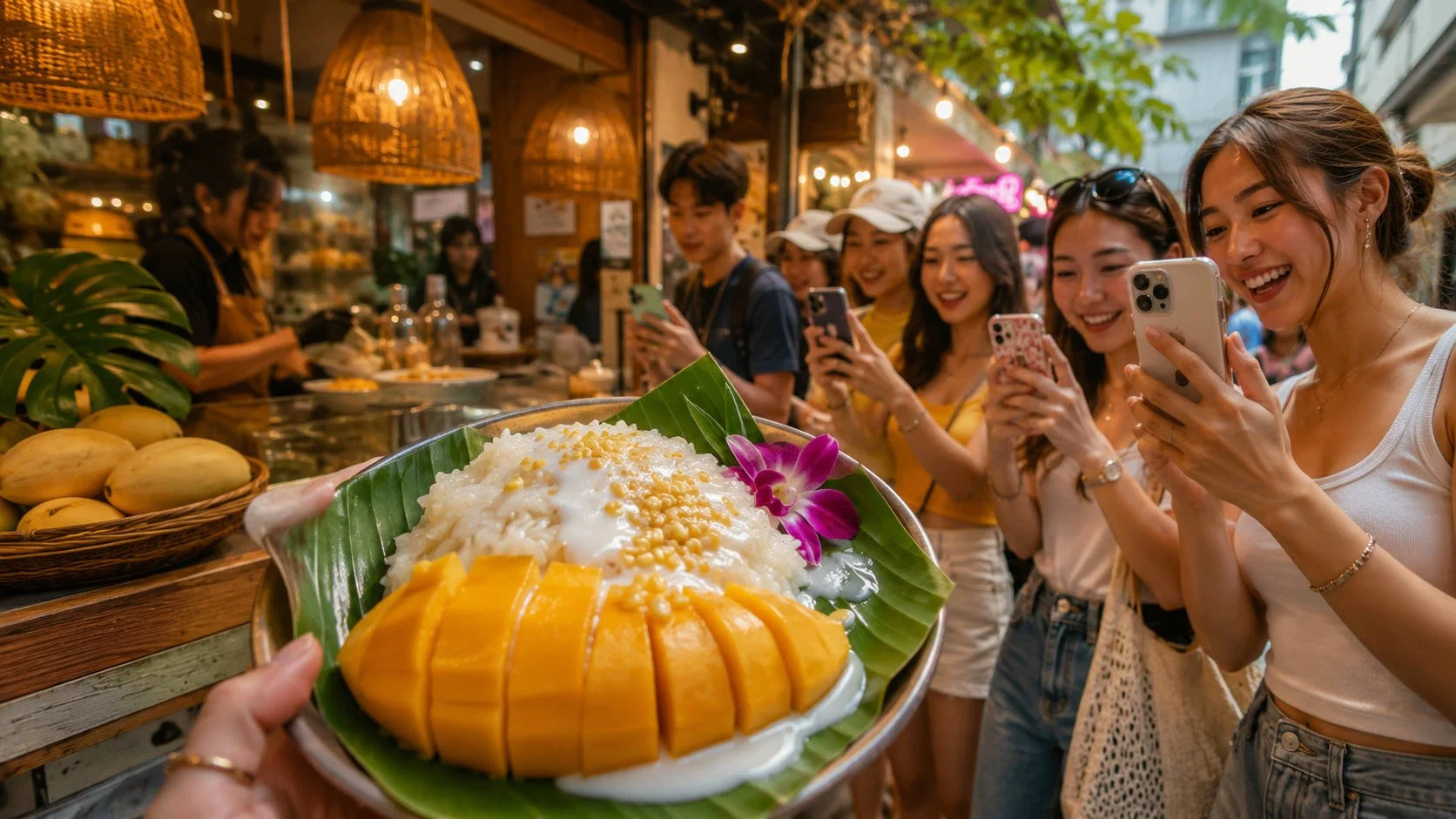
TikTok loves foods that are visually obvious and emotionally easy to understand. Mango sticky rice is basically built for that: bright yellow mango, glossy white rice, coconut drizzle, crunchy topping, sometimes a little banana leaf underneath because presentation matters and plates need moral support.
It looks good in two seconds. It needs no explanation. You see it and immediately understand the thesis: fruit, coconut, rice, sweetness, comfort, yes please.
TikTok’s recommendation system is also very good at turning one food video into your entire personality for 48 hours. Research on TikTok personalization found that follow behavior, likes, view rate, language, and location all influence what users are recommended, with follows strongest, then likes and view rate. Translation: pause too long on one mango sticky rice video and the app may begin behaving like a dessert-obsessed auntie, shoving coconut rice at your digital face until you surrender.
This is how a humble Thai dessert becomes “a thing.” One creator posts it. Another creator says it is life-changing. Someone else films a queue. A fourth person says “worth the wait?” while holding a plastic fork with the gravitas of a Supreme Court justice. Suddenly everyone wants mango sticky rice because the algorithm has declared that fruit and rice are now an event.
Annoying? Yes. Effective? Obviously.
The Coachella Moment That Turned Mango Sticky Rice Into Soft Power With Coconut Milk
The modern global hype got a major boost in 2022 when Thai rapper MILLI ate mango sticky rice onstage at Coachella. Reuters reported that sales in Thailand jumped after she brought a bowl of the dessert on stage while performing “Mango Sticky Rice,” and that vendors saw major increases in demand afterward.
This was not just a snack break. It was culinary diplomacy with a spoon.
MILLI did what governments spend millions trying to do through “soft power” campaigns: she made a national food look cool, desirable, funny, and deeply specific in front of an international audience. No committee. No glossy tourism slogan. Just a rapper eating mango sticky rice like a person who understands that dessert can carry a flag better than most speeches.
The Guardian also reported that her Coachella appearance triggered a sales surge and that she became the first Thai solo artist to perform at the festival. So yes, mango sticky rice had a viral moment before TikTok turned every food line into a small pilgrimage of people filming their hands.
And unlike many viral foods, this one had the nerve to be actually good.
What Makes Mango Sticky Rice Worth Waiting For?
A line is not automatically proof of greatness. A line can mean quality, but it can also mean social media has bullied 70 people into standing outside for a dessert that tastes like sweet glue and regret.
Mango sticky rice is worth waiting for only when the shop does the hard simple things correctly.
The rice should be warm or room temperature, glossy, tender, and distinct enough that it still feels like rice, not coconut cement. The Guardian’s 2026 recipe notes that sticky rice should be soaked for at least six hours, steamed, folded with warm coconut milk, sugar, and salt, then rested so it absorbs the mixture; it also emphasizes that salt is essential to balance the richness.
The mango should be ripe, fragrant, and smooth. Not crunchy. Not sour in a way that makes your jaw file a complaint. Not so fibrous it feels like eating fruit through dental floss. Epicurious notes that the best mangoes for this dish are sweet, creamy varieties with golden skins and should be tender enough to press gently.
The coconut sauce should not be timid. It needs salt. It needs richness. It needs to wake up the rice and mango like a tiny tropical orchestra conductor. Without the salt, the dish becomes sweet-on-sweet mush, which is fine if your palate was raised by cereal commercials, but not ideal.
The crunchy topping matters too. Roasted mung beans or sesame seeds give the whole thing texture. Without crunch, mango sticky rice can become a soft-food retirement village. Still delicious, but slightly too obedient.
The Rice Is the Part Tourists Underestimate
Tourists often obsess over the mango because it is yellow and photogenic and looks like it has its own agent. But the rice is where the real skill lives.
Good sticky rice has structure. It is chewy, fragrant, coconut-rich, and lightly salty. It should hold together without becoming a brick. Bad sticky rice is either dry and sulky or wet and collapsing, like it just got bad news.
This is why famous mango sticky rice shops matter. They are not just slicing fruit. They are managing timing, texture, coconut absorption, sweetness, salt, and batch consistency. Simple food is brutal that way. There is nowhere to hide. A bad tasting menu can bury mistakes under foam and French nouns. Mango sticky rice stands there naked in three components, daring you to notice.
Michelin describes Bangkok’s K. Panich as an iconic family-run eatery serving mango sticky rice from a recipe handed down for generations, with steamed sweetened sticky rice enhanced by rich coconut milk. That is the kind of place where the rice is not a supporting actor. It is the entire reason the mango got invited.
K. Panich: When the Line Has a Point
K. Panich, also written Kor Panich, is one of Bangkok’s best-known mango sticky rice destinations. Michelin calls it family-run and highlights its multi-generational recipe. The Michelin Guide also published a feature on the shop’s long history and closely guarded sticky rice recipe, noting the hand-mixing of coconut cream into the rice before machine finishing.
That is exactly the sort of place where waiting can make sense. Not because a video told you to. Not because everyone in line is filming like the dessert is about to issue a press statement. Because the shop has built a reputation through consistency, craft, and a product that depends on timing.
Will it change your life? Calm down. It is mango sticky rice, not a personality transplant. But it can absolutely reset your standards. The rice is the point. The mango is the obvious beauty queen. The coconut sauce is the rich aunt who paid for the venue. But the rice is the infrastructure.
Mae Varee: The Grab-and-Go Fruit Shop Fantasy
Mae Varee in Bangkok is another famous stop, especially convenient because it sits near Thong Lo BTS and sells take-away mango sticky rice sets. Current travel and review listings describe it as a fruit shop known for ripe mango and tri-color sticky rice, with small and large sets often priced around the 100–160 baht range depending on size and version.
This is a different kind of hype. K. Panich feels more old-school, heritage-dessert energy. Mae Varee is the glossy fruit-shop version: mangoes piled up like yellow trophies, sticky rice colors, takeaway containers, tourists trying to find somewhere to eat under the SkyTrain like highly motivated dessert pigeons.
Is it worth a line? Maybe. If you are nearby, yes. If you are crossing the city only because an influencer said “best in Bangkok” with the confidence of a person who has eaten exactly three versions, proceed with adult caution.
A good rule: if the line is short, join. If the line is long but moving, consider it. If the line is full of people filming the sign and no one is actually eating, you may have wandered into content traffic, not food demand.
The TikTok Line Problem
TikTok has created a special modern food phenomenon: the line that exists partly because everyone wants proof they waited in the line. A snake eating its own tail, except the snake has a phone gimbal and says “guys, I’m obsessed.”
This does not mean the food is bad. It means the line is no longer just about hunger. It is about participation. A viral dessert becomes a badge. You ate the thing. You stood where the internet told you to stand. You performed the pilgrimage. Congratulations, your reward is coconut rice and maybe sunburn.
Mango sticky rice survives this better than most desserts because it is quick to serve and usually not wildly expensive. If you wait 20 minutes and pay a few dollars for a great serving, fine. That is not a tragedy. That is tourism with snacks. But if you wait 90 minutes for something pre-packed, warm in the wrong way, and mostly famous because an algorithm keeps throwing it at foreigners, you have not found culture. You have joined a queue-themed marketing experiment.
TikTok can lead you to good food. It can also lead you to a crowd of people staring at mango like it just announced quarterly earnings.
When Mango Sticky Rice Is Actually Worth Waiting in Line For
Wait when the mangoes are clearly ripe and moving quickly. A busy shop with high turnover is good. Old mango sitting around looking sweaty and defeated is not.
Wait when the rice is being made or replenished fresh. Warm coconut sticky rice matters. If the rice looks dry, clumped, or abandoned, the line is a scam with fruit.
Wait when locals are buying it too. Not because locals are magical food compasses—people everywhere buy mediocre snacks—but because a shop surviving on repeat local traffic usually has more substance than a place surviving entirely on tourists filming the sign.
Wait when the shop specializes in Thai sweets or fruit. Specialization matters. A dessert stand that does one thing well often beats a generic restaurant serving mango sticky rice because the menu felt obligated.
Wait during mango season if you can. Mango sticky rice is especially associated with Thailand’s hot-season mango abundance, and Condé Nast Traveler notes it becomes widely available during mango season with varieties like nam dawk mai and ok rong.
Do not wait when you are full, overheated, and only chasing a video. That is not dessert. That is algorithmic obedience with coconut milk.
How to Judge Mango Sticky Rice Like You Know What You’re Doing
Start with smell. The mango should smell like mango before it reaches your mouth. If it smells like nothing, the dessert is already limping.
Look at the rice. Glossy is good. Dry is bad. Puddled coconut sauce is fine if intentional, but rice drowning in thin liquid is a warning sign.
Taste the rice alone first. Yes, alone. Do not let the mango do all the work like a group-project martyr. The rice should be sweet, salty, coconut-rich, and chewy.
Taste the coconut sauce. It should have salt. This is non-negotiable. Salt is what keeps the dessert from becoming a nursery rhyme in food form.
Then combine everything: rice, mango, coconut sauce, crunch. That is the bite. That is the reason people stand in line instead of making responsible choices with their afternoon.
The Dessert Works Because It Balances Opposites
Mango sticky rice is popular because it is not just sweet. It is sweet, salty, rich, fresh, chewy, creamy, and crunchy. It has temperature contrast when served properly. It has seasonal fruit and pantry comfort. It is both street food and restaurant dessert. It is luxurious without being precious, which is more than can be said for half the desserts currently trapped under glass domes in restaurants that use tweezers as emotional support tools.
The Thai Embassy in Copenhagen noted in 2024 that khao niao mamuang ranked second on TasteAtlas’s list of best rice puddings, which is not a scientific law handed down by the dessert gods, but it does show how internationally recognized the dish has become.
And honestly, good. Not every viral dessert deserves respect. Some viral desserts are just sugar wearing construction equipment. Mango sticky rice deserves its moment because the dish was already built on a smart flavor architecture before the internet arrived with captions and shaky zooms.
The Tourist Mistake: Eating It Too Late
Here is a very specific mango sticky rice crime: buying it, walking around for an hour, taking 37 photos, letting the rice cool into a dense coconut puck, then complaining it was overhyped.
Eat it soon.
Many versions are best when the rice and coconut topping are warm or at least not refrigerator-cold. Condé Nast Traveler specifically notes that, despite being a summer treat, standout versions depend on warm coconut milk topping and rice.
This is not a dessert designed to sit through your temple visit, your mall trip, your train transfer, and your sudden need to photograph a cat. Eat the thing. It is food, not a souvenir.
Should You Make Mango Sticky Rice at Home?
Yes, if you are patient enough to soak rice and mature enough not to confuse regular jasmine rice with glutinous sticky rice.
The Guardian’s recipe explains the basic method: soak glutinous rice for at least six hours, steam it, fold in warm coconut milk with sugar and salt, let it absorb, then serve with ripe mango and toasted sesame seeds. Epicurious also notes that glutinous rice is called sticky or sweet rice, becomes chewy when cooked, and does not contain gluten despite the name “glutinous.”
Making it at home teaches you why good shops are impressive. The dish is simple until you actually make it, at which point the rice reveals itself to be a tiny diva with hydration demands. Too dry, bad. Too wet, bad. Not enough salt, boring. Bad mango, doomed. Coconut milk too thin, sadness.
This is why paying for a great version can be rational. Sometimes the line is not just for dessert. It is for someone else having already solved the rice problem.
The Best Way to Enjoy Mango Sticky Rice in Thailand
Do one famous shop if you want the experience. K. Panich is a strong heritage choice, and Michelin highlights its generations-old recipe. Mae Varee is convenient if you are near Thong Lo and want the fruit-shop version.
Then eat a few ordinary versions. Market versions. Street-stall versions. Restaurant versions. Mall versions. Hotel versions if you must, though hotel mango sticky rice sometimes tastes like it has been politely arranged by someone afraid of flavor.
The point is comparison. The first one may wow you. The third one teaches you what matters. The fifth one reveals whether the famous place was actually great or whether you were simply sweaty and suggestible.
This is food education, not gluttony. Well, fine, it is also gluttony. But gluttony with notes.
What TikTok Gets Right
TikTok gets one thing very right: mango sticky rice is worth attention.
A lot of traditional desserts get flattened into “exotic sweet thing” content by people who speak about food like they are discovering an island. Mango sticky rice deserves better than that. It is elegant. It is seasonal. It is technically simple but hard to perfect. It is accessible without being shallow.
TikTok also makes people curious. That matters. A viral video can send someone to a Thai restaurant, a Thai market, a recipe, or a food memory they would not have otherwise explored. That is good. The algorithm occasionally does charity by accident.
The problem is when curiosity becomes stampede behavior. People stop tasting and start collecting. They do not ask, “Is this good?” They ask, “Is this the one from TikTok?” A devastating sentence. The kind of sentence that makes a mango question civilization.
What TikTok Gets Wrong
TikTok often treats food like novelty, and mango sticky rice is not novelty. It is not a stunt. It is not a secret menu hack. It is not a dessert that became real when someone filmed it with a beauty filter.
It is also not automatically “worth the hype” at every place that sells it. A famous dessert can be made badly. A viral shop can get overwhelmed. A line can wreck quality if the kitchen cannot keep up. A beautiful mango can hide weak rice. A cute container can hide a mediocre product. The internet has never met packaging it could not overrate.
TikTok also encourages the worst possible eating behavior: filming before tasting. Mango sticky rice should be eaten while the rice is fresh and the coconut is right. Not after five minutes of rotating the plate for “content.” The dessert is not asking for a screen test. It is asking to be eaten.
Yes, Mango Sticky Rice Can Be Worth the Line
The TikTok mango sticky rice hype is annoying in the way all viral food hype is annoying: too many superlatives, too many queues, too many people saying “life-changing” about dessert while holding a plastic spoon like a holy relic.
But beneath the content fog, mango sticky rice is the rare viral dessert that can actually justify the attention.
It is simple enough for everyone to understand and complex enough to reward expertise. It is cheap enough to try casually and good enough to become a memory. It carries Thai seasonality, street-food culture, fruit-shop craft, coconut-rice technique, and the kind of flavor balance that makes you briefly forgive the entire internet for existing.
Wait in line if the place has real turnover, ripe mangoes, warm coconut sticky rice, and a reputation beyond “some influencer pointed at it.” Skip the line if it looks like a content trap filled with people filming unopened takeaway boxes.
Because mango sticky rice is worth waiting for when the dessert is the event.
It is not worth waiting for when the line is the event.
And if you finally get the good version—sweet mango, chewy warm rice, salty coconut cream, crunchy mung beans—you will understand why TikTok did not make mango sticky rice famous.
It just arrived late, screamed into a ring light, and took credit like an obnoxious little algorithm with a fork.