
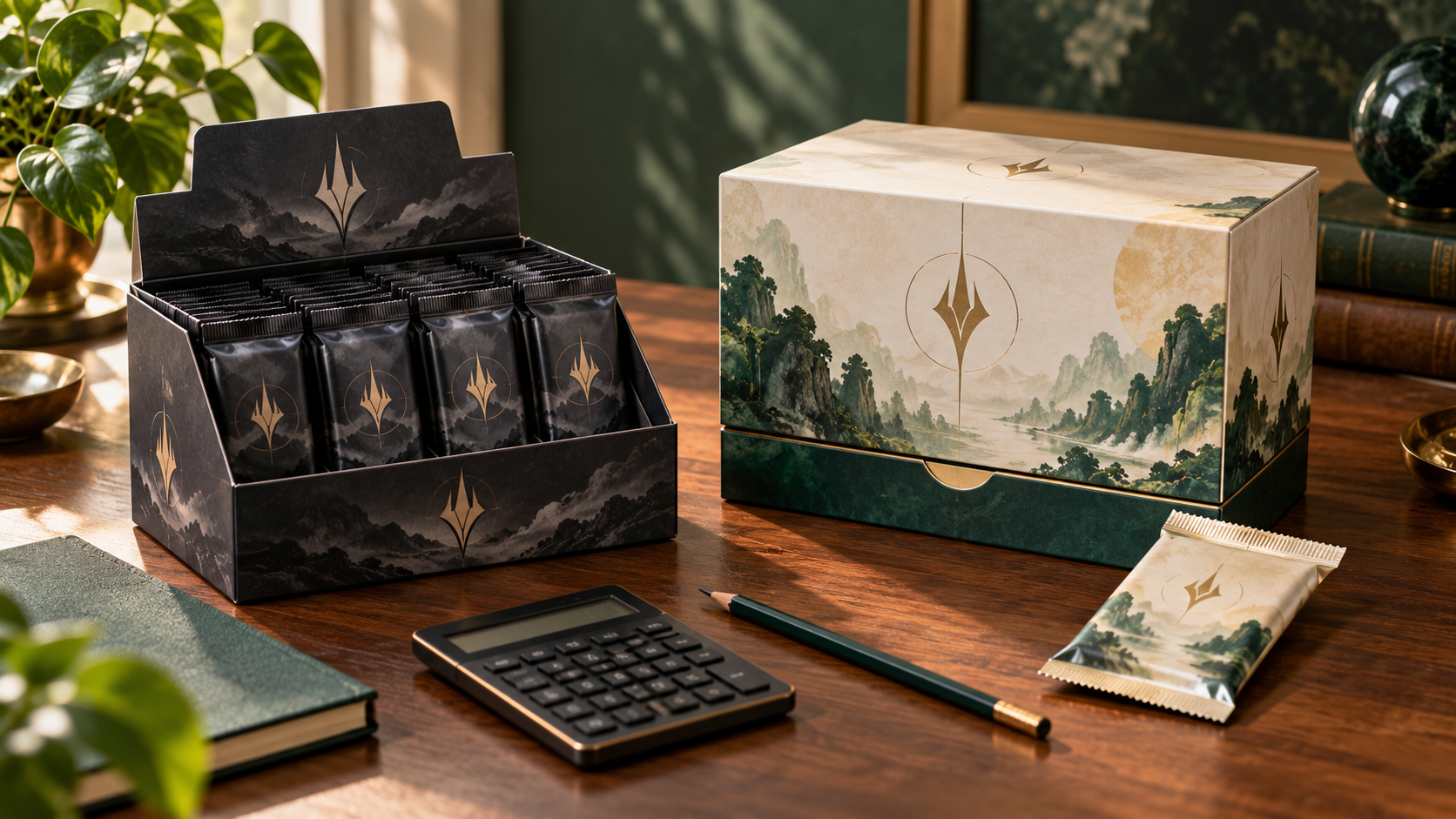
A Mystery Booster Commander box can look cheaper than the complete Festival in a Box bundle and still be the weaker purchase. The useful number is the extra amount you pay for the bundle—and what you actually receive for it.
In our October 30 US price check, sampled standard offers put the 24-pack booster box at US$368.00 and the complete Atlanta bundle at US$384.00, including listed shipping and before tax. The difference was US$16.00. These were asking prices, not guaranteed checkout totals.
At that gap, the complete bundle deserves the first comparison. It adds a foil Secret Lair drop and four promos to the same booster box. A buyer who wants those extras, or can sell them efficiently, has a stronger relative-value case than someone paying almost as much for the box alone. A buyer expecting easy profit faces a much harder test.
Start with the product, then the price
Wizards announced Festival in a Box: Atlanta 2026 at US$249.99. That package includes the booster box, Secret Gallery: Atlanta Foil Edition, and the Dance of the Dead, Tana, Tymna and Auspicious Aquarium promos.
The original US$249.99 was a bundle price. It was also an announced sale price, not proof that you can still order at that price today. Treating it as a current bare-box quotation mixes up both the item and the date.
That distinction changes the buying question. Someone who secured the original bundle has a different cost basis from someone considering a secondary-market box now. The earlier buyer's enthusiasm cannot tell the later buyer whether the current offer is attractive.
Compare complete products with the same currency, listed shipping, condition and delivery terms. Then add the taxes or other charges that apply to your actual order. A low sticker price can lose its advantage when the final total arrives.
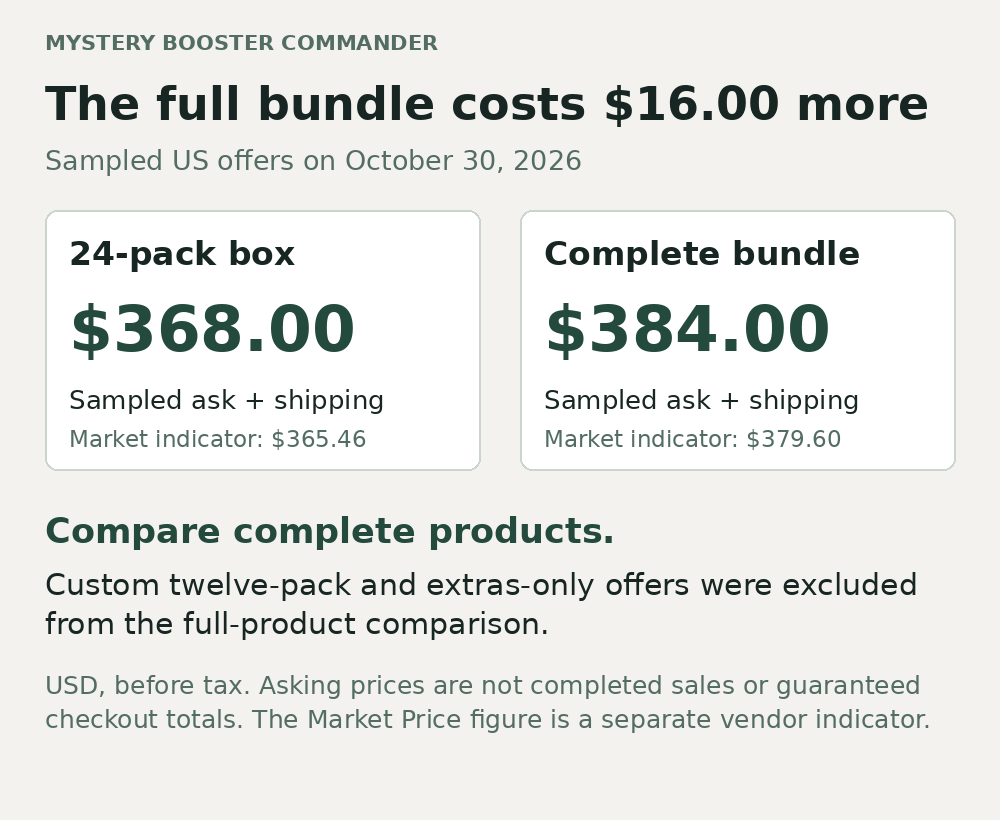
The captured full-box ask was US$368.00 and the complete-bundle ask was US$384.00, including listed shipping before tax: a US$16.00 premium. Separate Market Price indicators were US$365.46 and US$379.60. These are dated October 30 quotations, not guaranteed checkout prices.
How much do the extras really help?
The five extra products had a combined US$82.90 Market Price benchmark in the October 30 collection. That counts the sealed four-card Gallery drop once, alongside the four promos. It does not also add the individual Gallery cards, which would count the same contents twice.
The exact printing matters. A textless MagicFest foil Tymna is a separate product from an older Commander printing, a foil-etched copy or another version with the same game function. Using whichever price looks most impressive creates a flattering total rather than a useful comparison.
TCGplayer describes Market Price as a recent-sales-based indicator. It is useful context, but it is not a buyer promising to take your cards at that price. Current competing asks, condition, shipping charges and the time needed to find buyers all affect what you collect.
The captured listings showed why this matters. The sealed Gallery drop had a sampled US$20 item ask against a US$28.43 market indicator. Auspicious Aquarium had sampled item asks around US$0.19 against a US$3.12 indicator. Shipping complicates comparisons further, but the central point is clear: subtracting the full benchmark from your purchase cost can be optimistic.
For someone keeping the extras, use a different measure: what would you willingly pay for them? A card with a nominal resale price has little personal value if it will sit in a drawer and you never intend to sell it. Conversely, a promo you already planned to buy can make the bundle attractive without any resale project.
Gross card value is not recovered cash
Suppose you buy the bundle intending to sell the extras and reduce the effective cost of the box. The subtraction should use net proceeds—the money left after selling costs—not the sum of price-guide entries.
The displayed TCGplayer fee schedule for a standard domestic Level 1–4 Marketplace seller combines a 10.75% commission, a 2.5% transaction charge and US$0.30 per order. The fee bases differ, and other account types and international transactions have different terms.
As a simplified illustration, if all five extra products sold at their captured benchmarks in five orders, those variable and fixed fees would leave about US$70.42 before postage and other omitted costs. That assumes the sales happen at the benchmark prices. It is a sensitivity example, not a cash forecast.
Actual proceeds can be lower. Packaging and postage cost money. Buyers may choose cheaper offers. Several small transactions create more fixed costs and more work than one sale of a complete product. Taxes included in processing-fee bases, currency conversion and your own time can also matter.
This does not erase the bundle's relative advantage. At the sampled offers, the extra purchase cost was only US$16.00. It means the right comparison is that premium against the extras' conservative personal value or plausible net proceeds, with room for things to go worse than planned.
Check the supposedly cheap listings
A product-page title does not guarantee that every offer underneath it contains the whole product.
The unfiltered box results included a custom listing for twelve packs. The complete-bundle results included offers containing only the promos and Secret Lair, plus other twelve-pack lots. Those items can be perfectly legitimate when accurately described. They are still different purchases from a sealed 24-pack display or complete Festival bundle.
Our comparison excluded custom partial offers and used standard whole-product listings. Even then, a buyer should read the actual seller's description, condition and delivery terms. A category-wide price indicator cannot repair a mismatch between what you thought you bought and what the listing promised.
This is especially important when comparing a box with loose packs. The lower total may reflect fewer packs, different packaging or a different product altogether. Match the contents before calculating a discount.
A good draft purchase can be a poor resale project
The official product breakdown specifies 24 boosters per box. At the sampled box ask, that is about US$15.33 per booster before tax. For an eight-person draft using three boosters each, the box cost works out to roughly US$46.00 per player before other expenses.
That gives a group a concrete entertainment decision. Is this the draft experience everyone wants at that cost? Would the group prefer a different product or an event entry? The answer can be yes even when selling the opened cards would not recover the purchase price.
A buyer seeking one or two particular commanders faces a different choice. Compare the desired singles directly with the box price. Opening a display pays for a randomized selection of cards and the experience of opening or drafting them; it does not guarantee the few cards you wanted.
A resale buyer needs a third calculation: realistic card-level proceeds after fees, shipping, slow-moving stock and effort. A useful list of expensive possible pulls does not supply an average opening value. That requires supported frequencies across the relevant card pools as well as credible selling prices.
When paying more for the bundle makes sense
The bundle is the stronger relative choice when its delivered premium is comfortably below what the extras are worth to you, and the products have comparable condition and delivery terms. At the offers captured here, that was a comparison worth making before ordering a bare box.
The bare box can still win. Its price may fall, the bundle premium may widen, or the particular bundle seller's terms may be less appealing. A group that wants only the draft and has no interest in managing extra cards should value that simplicity honestly.
Be equally careful with a scarcity argument. Wizards advertises future event availability; an early sale or customer cap does not establish a tiny global print run. Paying a premium because you fear this is your final chance requires more evidence than a limited-sale label.
Before ordering, put the full box total beside the full bundle total. Give unwanted extras a cautious value, account for the cost of selling them, and ask whether you want the cards, the draft or a financial return. Those are different reasons to spend the money—and the best purchase is the one that still makes sense after you name yours.